




Abstract
This explorative empirical study examined patterns of repeated severe prison violence within a cohort of 350 detainees admitted to the Dutch high-security “Violence Facility” for uncontrollably violent detainees, aiming to identify detainee characteristics predicting severe prison violence recidivism. Data were derived from judicial reports, imprisonment registrations, and criminal records. Proportional hazards regressions were used to assess prison violence recidivism risk up to 7.5 years post-discharge by examining detainee factors related to crime history, psychopathological diagnoses, and historical and clinical violence-related risk factors. Almost 30% of detainees were re-admitted to the Violence Facility, indicating recurrent severe prison violence. A pattern of rebelliousness and non-compliance emerged as a pre-existing and persistent trait. Additionally significant were recent social functioning, treatment motivation, and daytime activity engagement in predicting prison violence recidivism. Findings enhance understanding of the persistence and predictors of prison violence, yielding implications for risk management and violence prevention in correctional settings.
Plain Language Summary
Understanding why some detainees repeatedly engage in serious violence during imprisonment can help improve prison safety. This study examined a group of 350 male detainees who had been placed in a high-security prison unit in the Netherlands, designed for detainees with extremely violent behavior. Detainees were followed for up to 7.5 years after they were discharged from this facility. Nearly 30% of the detainees returned to the high-security facility due to new incidents of severe prison violence, showing that this kind of behavior often reoccurs. This study identified detainee factors that increase this risk and showed that repeated prison violence is partly predictable based on certain detainee characteristics. In particular, patterns of rebelliousness and non-compliance were often present before detention. Poor recent social functioning, low treatment motivation, and lack of daytime activities were also important risk factors. By identifying these key factors, the study provides valuable insights into which detainees are at higher risk of reoffending violently in prison. These findings can inform prison policy and prevention efforts to improve risk assessment and to reduce violence in correctional settings.
Introduction
Background
Prison violence is a pervasive global concern (Abbiati et al., 2019; Caravaca-Sánchez et al., 2023). Besides severe consequences on institutional safety and order, it is a significant occupational threat for correctional staff (Evers et al., 2020; Jaegers et al., 2022; Linning et al., 2022). Regarding detainees, exposure to prison violence is associated with mental health problems, poor post-release adjustment, and negative criminal justice outcomes (Boxer et al., 2009; Conde et al., 2021; Daquin et al., 2016; Steiner & Meade, 2016). Furthermore, prison violence may have negative consequences for perpetrators themselves, such as further restrictions and longer detention (Medrano et al., 2017; Mooney & Daffern, 2015). Given the extensive consequences, it is essential for institutional safety and detainee rehabilitation to understand the factors associated with prison violence and to identify detainees who are at increased risk of showing prison violence.
Two theoretical frameworks are commonly used to guide research on the causes of prison violence. The deprivation model (Sykes, 1970) posits that prison violence arises from the “pains of imprisonment,” including restricted autonomy, repression, limited social interaction, and lack of meaningful activity. Such deprivations can produce strain and oppositional behavior (e.g., Auty & Liebling, 2020; Quick et al., 2023). In contrast, the importation model (Irwin & Cressey, 1962) attributes prison violence to pre-existing detainee traits, such as criminal history, lifestyle, and personal experiences (e.g., Cihan & Sorensen, 2019; Quick et al., 2023). Recent research, also within Western contexts, increasingly integrates both perspectives, demonstrating that prison violence results from the interplay between detainees’ imported characteristics (i.e., prior aggression, trauma) and the deprivations of confinement, and that these factors jointly heighten violence risk (e.g., Blevins et al., 2010; Bosma et al., 2020; Van Ginneken & Wooldredge, 2024). Consequently, a theoretical model that situates individual-level risks within the context of institutional stressors offers the most nuanced understanding of prison violence. While the relevance of both perspectives is recognized, in the present study the strongest focus lies on the importation model, by focusing exclusively on detainee-level characteristics.
Several detainee characteristics have been related to prison violence, including demographics such as a younger age, lower educational level, and ethnic minority (e.g., Cihan et al., 2017; McGuire, 2018; Schenk & Fremouw, 2012; Steiner et al., 2014). Furthermore, several studies indicated that detainees with mental health problems and low intelligence have an increased risk to exhibit prison violence (e.g., Schenk & Fremouw, 2012; Silver & Nedelec, 2018; Steiner et al., 2014; Van Der Vorst et al., 2023). Several judicial characteristics have also been associated with prison violence. These include a prior incarceration, a younger age at first arrest, prior (violent) crimes, and a violent index crime (i.e., the crime that resulted in the current imprisonment; e.g., Bosma et al., 2020; M. Butler et al., 2022; Cihan et al., 2017; Logan et al., 2023; Schenk & Fremouw, 2012; Steiner et al., 2014; Van Der Vorst et al., 2024). Moreover, some contextual circumstances have been related to prison violence, such as antisocial peers, gang membership, history of adverse experiences, neighborhood disadvantage, and low frequency of visits while detained (Cihan et al., 2020; Clark & Duwe, 2025; Henry, 2020; Sorensen et al., 2025; Steiner et al., 2014).
A small group of detainees continually engages in high levels of prison violence (Cihan & Sorensen, 2019; Reidy et al., 2018), therefore threaten prison safety, staff, and other detainees in particular. With respect to factors related to recidivism in prison violence, prior prison violence is identified as an important predictor (M. Butler et al., 2022; Cunningham & Sorensen, 2007; McGuire, 2018). Furthermore, a younger age, prior arrests, gang involvement, violent index crimes, mental health problems, interpersonal dysregulation, a low ability to cope with frustration and hostility, adverse family factors, and a low educational level have been associated with higher rates of prison violence (Baias, 2022; Cihan et al., 2020; Cihan & Sorensen, 2019; Reidy et al., 2018).
Although the specific prison conditions and terminology (e.g., seclusion, segregation, solitary confinement, supermax, and extended high-security placement) may vary, most Western correctional systems use some form of restrictive practice to manage detainees who pose severe risks to institutional order and safety, generally characterized by increased control over detainees, restricted physical space, limited social interaction, and reduced environmental input such as therapeutic programs (e.g., Gallagher et al., 2024; Mears et al., 2019, 2021). Theoretical and empirical studies highlight conceptual ambiguities of these restrictive prison facilities as well as ambiguities surrounding their aims and outcomes, questioning deterrence- and incapacitation-based rationales and emphasizing potential harms to detainees’ psychological well-being, future prison misconduct, and post-release outcomes (e.g., Aranda-Hughes & Mears, 2025; Gendreau & Goggin, 2019; Reisig, 1998; Reiter et al., 2025; Scharff Smith, 2006; Zgoba et al., 2020). Furthermore, as Mears and Labrecque (2025) argue, ambiguities regarding the goals and mechanisms of restrictive housing complicate both theoretical coherence and policy reform.
In the Netherlands, the specialized prison facility for Uncontrollably Violent Detainees, 1 from now on referred to as “Violence Facility,” constitutes a distinctive form of restrictive housing. The Violence Facility is a highly restrictive high-security unit for detainees with high aggression-control risk who have displayed severe aggressive or disruptive in-prison behavior that frequently led to serious physical harm to staff or fellow detainees. Transference to the Violence Facility aims to temporarily relieve referring prisons of detainees who display extreme behavioral control risks, thereby restoring institutional order and ensuring the safety of both staff and fellow detainees, rather than to systematically intervene in the causes of the violent behavior. In this highly structured setting, the focus is on behavioral stabilization through a clearly defined daily routine. This approach aims to restore peace, assess whether, when, and where a detainee can be safely transferred, and prepare them for relocation to an appropriate subsequent facility (Dutch Custodial Institutions Agency [DCIA], 2025). Reintegration efforts primarily involve identifying the most suitable subsequent prison setting, taking into account the detainee’s behavioral management needs and risk profile. Although the reason for admission (i.e., aggressive in-prison behavior) and the perceived negative consequences for detainees (placement in a restrictive environment) may resemble punitive or disciplinary segregation, the primary purpose of the Violence Facility is not to punish or to deter aggression, neither to prevent future recidivism outside of prison. Rather, it is designed to ensure the safe execution of custodial sentences while creating a controlled and secure climate conducive to stabilization. The Violence Facility therefore most closely resembles “administrative segregation,” that is, isolation as a means of managing certain types of detainees (Shalev, 2009, as cited in Mears, 2013) or “management restrictive housing,” that is, as a means to improve systemwide safety and order and to control detainees who the prison system has found difficult to safely manage in any other way (Mears & Labrecque, 2025).
To date, studies into the characteristics of detainees residing in high-security prison units remain relatively limited and are largely confined to the North American “supermax facilities” or “intensive management units” (Gallagher et al., 2024; Pizarro & Narag, 2008; Ross & Tewksbury, 2018). Since detainees are transferred to “supermaxes” for a variety of reasons, not necessarily prison violence (Anderson, 2024; Mears et al., 2019; Mears & Labrecque, 2025; Pizarro & Narag, 2008; Ross & Tewksbury, 2018), the existing research is of limited comparability to the specific group of detainees that are primarily transferred to restrictive prison facilities as a consequence of prison violence. Moreover, there is a scarcity of research on the characteristics of detainees who are repeatedly transferred to highly restrictive prison unit as a result of prison violence, despite the major consequences for prison safety, staff, other detainees, and perpetrators themselves. Additionally, to the best of our knowledge, no prior research has focused on detainee characteristics that predict prison violent recidivism.
Objectives
Using a dataset in which 350 Violence Facility detainees are followed up to a maximum of 7.5 years after discharge, the aims of this empirical and explorative study are twofold. Firstly, this study aims to analyze recidivism in severe prison violence, measured as a return to the Violence Facility. Secondly, this study aims to identify detainee characteristics that predict repeated prison violence by looking at their background characteristics, criminal history, incarceration history, and historical and clinical violence-related risk factors.
Since a small group of detainees is responsible for a substantial part of prison violence (Morgan et al., 2025), examining detainees who are repeatedly violent may contribute to a more thorough understanding of the characteristics and the life-course of violent detainees and to the underlying causes of prison violence. Additionally, this knowledge may contribute to a more profound comprehension of the factors associated with recurrent violence within the correctional system. In turn, these insights may add to the development of an evidence-based and targeted practice for prison violence risk management, prevention, and interventions. Such a practice would be in the interest of prison safety and, ultimately, of subsequent services and of society as well. By focusing exclusively on detainee-level characteristics, this study seeks to identify factors associated with repeated prison violence while explicitly acknowledging– but not analyzing– the potential influence of the restrictive institutional context or deterrence-, desistance-, and incapacitation-based mechanisms.
Method
Study Design
In this retrospective non-interventional cohort study, a group of Violent Facility detainees was monitored over a span of 7.5 years maximum after discharge from the Violence Facility. This study was reported in accordance with the STROBE (Strengthening the Reporting of Observational Studies in Epidemiology) guidelines for cohort studies (Von Elm et al., 2014). These guidelines provide a structured framework to ensure transparent and comprehensive reporting of observational research.
Setting
The national Dutch facility for uncontrollably violent detainees (i.e., the Violence Facility) is located in Penitentiary Institution (PI) Vught and has a maximum capacity of 48 detainees. Detainees might be admitted to the Violence Facility if their in-prison behavior is deemed to be too aggressive or disruptive for other prison facilities, and if a psychologist or psychiatrist of the referring facility determines that acute psychopathology or a treatment indication are absent (DCIA, 2025). Transference to the Violent Facility provides temporary relief to the referring prison facility, thereby facilitating the restoration of order and safety. The primary objective of transfer to the Violence Facility is the prevention of recurrent violence. To this end, opportunities for the expression of violence are limited through a series of security measures. These include compartmented areas, the utilization of handcuffs, individual programs, and the supervision of individual detainees by a minimum of two correctional officers when they are not locked in their cells. The Violence Facility provides only a limited range and amount of support and services pertaining to reintegration, interventions, and diagnostics (DCIA, 2025). Day-to-day experiences of detainees residing in the Violence Facility are limited; detainees are permitted to leave their cells for up to 18.5 hr per week with, for example, 1 hr of daily outdoor exercise, limited laundry, cleaning and shower opportunities, and only 2 hr free time on the ward during a week. Furthermore, contacts with attorneys or relations are limited.
Data Sources
The data regarding detainees at the Violence Facility were derived from a comprehensive, pre-existing database of individuals transferred to this facility in PI Vught. This “Violence Facility database” was established in 2016 for the purpose of informing policy decisions. The database contains a range of demographic, diagnostic, and judicial information, including reports to judicial authorities, previous imprisonments, and the criminal record. The systematic input of detainee-related data into the database is conducted by trained criminologists and psychologists. The data set used for this study was provided in the form of an anonymized file from the Violence Facility database, comprising information on all male detainees (18 years of age or older) who were admitted to PI Vught’s Violence Facility between January 2016 and January 2022. The data set was provided on July 1, 2023, and includes all admissions and readmissions up to that date. Consequently, the follow-up period ranges from 1.5 years (for detainees admitted in January 2022) to 7.5 years (for those admitted in January 2016). In case of multiple admissions during the inclusion period, information at the time of the first admission since 2016 – the “index admission” – was used as the reference.
Participants and Study Size
The Violence Facility dataset initially included data on 383 unique male detainees. This cohort was refined through a series of inclusion and exclusion criteria. First, three individuals were excluded because they spent less than 24 hours in the Violence Facility during their first admission since 2016. Subsequently, data from 30 detainees who were unlikely to return to the Violence Facility for practical reasons were excluded. This included 15 individuals who were, by court order, directly transferred to a high security forensic psychiatric treatment facility after their stay. Additionally, data from 13 individuals who had emigrated were excluded. Finally, two individuals were excluded because they were discharged after the observation period ended in July 2023. The final sample for this study consisted of 350 Violence Facility male detainees. Descriptive statistics on the sample, including detainees’ age, education level, country of birth, and psychiatric diagnostic classifications, are presented in Table 1.
Descriptive Statistics of Violence Facility Detainees (N = 350), Survival Time and Log-Rank Test Statistics.
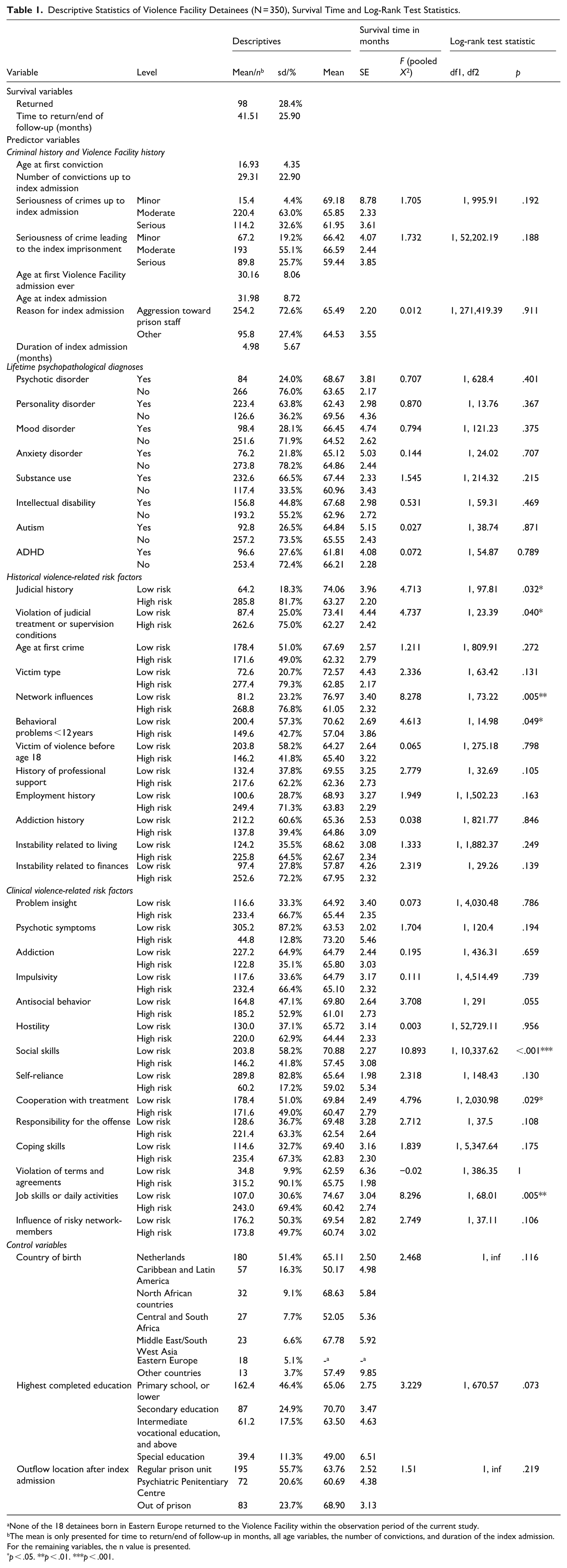
None of the 18 detainees born in Eastern Europe returned to the Violence Facility within the observation period of the current study.
The mean is only presented for time to return/end of follow-up in months, all age variables, the number of convictions, and duration of the index admission. For the remaining variables, the n value is presented.
p < .05. **p < .01. ***p < .001.
Variables and Measurement
The full list of variables included to examine and predict a return to the Violence Facility and their corresponding categorization is presented in Table 1. The outcome of interest in this study – the dependent variable – is a duration variable indicating the time-to-return to the Violence Facility in months. For each detainee, information was available on the date of their first admission since January 2016, the discharge date from that admission, and the date of their first re-entrance, or, if no re-entry occurred, up to July 2023. In some cases, individuals were released directly into the community after their stay at the Violence Facility, as their prison sentence had been fully served. In other cases, individuals remained in detention and were later reassigned to the Violence Facility. Thus, prison violence recidivism in the context of this study refers specifically to a return to the Violence Facility, which may occur either through a continued detention or after a period of release. The time to censoring was calculated as the number of months between the discharge date of the index admission and the date of the subsequent admission for returnees, or to July 2023 for non-returnees.
A first set of predictor variables relate to the severity of the criminal history: age at first conviction, number of convictions up to index admission, seriousness of prior offenses, and seriousness of the crime leading to the index imprisonment. Crimes not (yet) resulting in conviction and those resulting in acquittal were excluded. Offense seriousness was recategorized from Brand’s (2005) 12 categories into three levels – “minor” (e.g., theft and vandalism), “moderate” (e.g., threat and assault), and “serious” (e.g., manslaughter, murder, and arson) – each comprising four offense types. In case of multiple offenses, the most serious was used. Additional variables related to detainees’ Violence Facility history included: age at first Violence Facility admission, age at index admission, reason for index admission, and duration of index admission (in months).
The second set of variables concerns detainees’ psychopathological diagnoses, based on lifetime classifications from the Diagnostic and Statistical Manual of Mental Disorders (DSM), editions 4 and 5 (DSM-IV-TR and DSM-5; American Psychiatric Association, 2000, 2013). Since assessments are rarely conducted at the Violence Facility, classifications were derived from independent psychiatric or psychological assessments commissioned by the court. The professionals responsible for these assessments were not affiliated with the Violence Facility. As such examinations are not routinely requested by the court, this diagnostic information was not available for all detainees. It should be noted that these assessments are only requested by the court in case it is suspected that psychopathology is related to the charges. As a consequence, it can be expected that the data give an underestimation of the prevalence of the psychopathology within this population. For each of the eight most common overarching psychiatric categories in forensic psychiatric populations (Van Buitenen et al., 2020), any lifetime diagnosis – regardless of whether it was the primary diagnosis – was coded as “yes” or “no.”
The third and fourth set of variables are based on the 12 historical and 14 clinical items from the Historical Clinical Future Revised (HKT-R) instrument (Bogaerts et al., 2018; Spreen et al., 2014), a structured tool for assessing the risk of violent recidivism. Combining historical and clinical risk factors – such as criminogenic cognitions – offers a more comprehensive risk profile and allows for monitoring changes over time (Iqbal et al., 2024; Janković et al., 2024; Slootmaker et al., 2025). Interrater reliability for these items can be considered as reasonable to very good (Bogaerts et al., 2018; Frowijn et al., 2023). Each item is originally rated on a five-point Likert scale (0–4), with higher scores indicating greater risk of violent recidivism. These were recoded into two categories: “low risk” (scores 0, 1, and 2) and “high risk” (scores 3 and 4). Historical items were based on information available up to the index admission; clinical items reflected behavior and functioning during the 12 months prior to discharge from the Violence Facility.
Finally, some control variables potentially related to time-to-return (in months) were included: country of birth, highest completed education, and outflow location after index admission (regular prison unit, Psychiatric Penitentiary Centre, or outside prison).
Statistical Methods
The analytical procedure consisted of three subsequent steps. (1) Multiple imputation was performed to address missing data, (2) survival analyses examined time to return to the Violence Facility for subgroups, (3) Cox proportional hazards models assessed the strength of association between predictors and return risk.
Most variables in the dataset contained missing data (0%–56%), with fewer than 25% missing for most. Little’s MCAR test indicated that the missing data were missing completely at random (χ²(11) = 8.695, p = .65). Nonetheless, in line with older (Brame et al., 2010) and more recent (Blasco, 2021; Stockton et al., 2024) calls to accurately treat incomplete criminological data to reduce bias on an outcome of interest, multiple imputation was conducted using the fully conditional specification method (DeLang et al., 2022). This procedure applies tailored regression models based on variable type to estimate multiple plausible values for each missing observation. Importantly, the robustness of this approach is not strictly dependent on the proportion of missing data. As long as the assumption of missing at random is met, multiple imputation can yield valid estimates even in the presence of substantial missingness (Enders, 2010). Imputations were constrained to the possible values in the original dataset (e.g., age at first conviction constrained within a specific range, categorical variables limited to their possible values), generating five imputed datasets. Subsequent analyses were run separately on each dataset and results were pooled using Rubin’s rules (Rubin, 1987), accounting for both within-imputation and between-imputation variability.
Secondly, descriptive statistics and Kaplan-Meier estimators were computed for the full sample to examine statistics regarding time-to-return to the Violence Facility. The survival analysis methodology inherently corrects for discrepancies between detainees in terms of exposure time, defined as the period between discharge following the index admission and either the return to the Violence Facility or, in the absence of a return within the observation period, to the end of the observation period. Subsequently, log-rank tests were performed for the categorical variables to explore any differences between the categories with respect to the time-to-return to the Violence Facility.
Finally, Cox proportional hazards models were estimated using significant categorical predictors and all ratio variables. These models account for right-censored data due to varying follow-up, death or migration (Allison, 2014), and help interpret how predictors influence return risk.
No correction for multiple testing was applied, as the study is exploratory and hypothesis-generating. As such, any findings will need to be cross-validated in future research by using an independent sample. The bivariate tests were used primarily as a filter for inclusion in the Cox models.
Results
Descriptive characteristics of Violence Facility detainees and statistics regarding their return to the Violence Facility are presented in Table 1. Additionally, for the categorical variables, Table 1 shows whether there are differences between the categories with respect to the time-to-return to the Violence Facility. In total, 98 out of 350 detainees returned to the Violence Facility within the observation period of 7.5 years maximum. The majority of returns (22.0% of the total of 28.4%) occurred within 20 months after the initial outplacement of the Violence Facility, with an average return occurring approximately three and a half years after initial outplacement of the Violence Facility (M = 41.51 months, SD = 25.90; Table 1). The Kaplan-Meier curve (Figure 1) illustrates the probability of return to the Violence Facility, showing that the probability of return is highest within the first 20 months after discharge, then stabilizes for approximately 1.5 years, after which the probability of return levels off at around 30%.
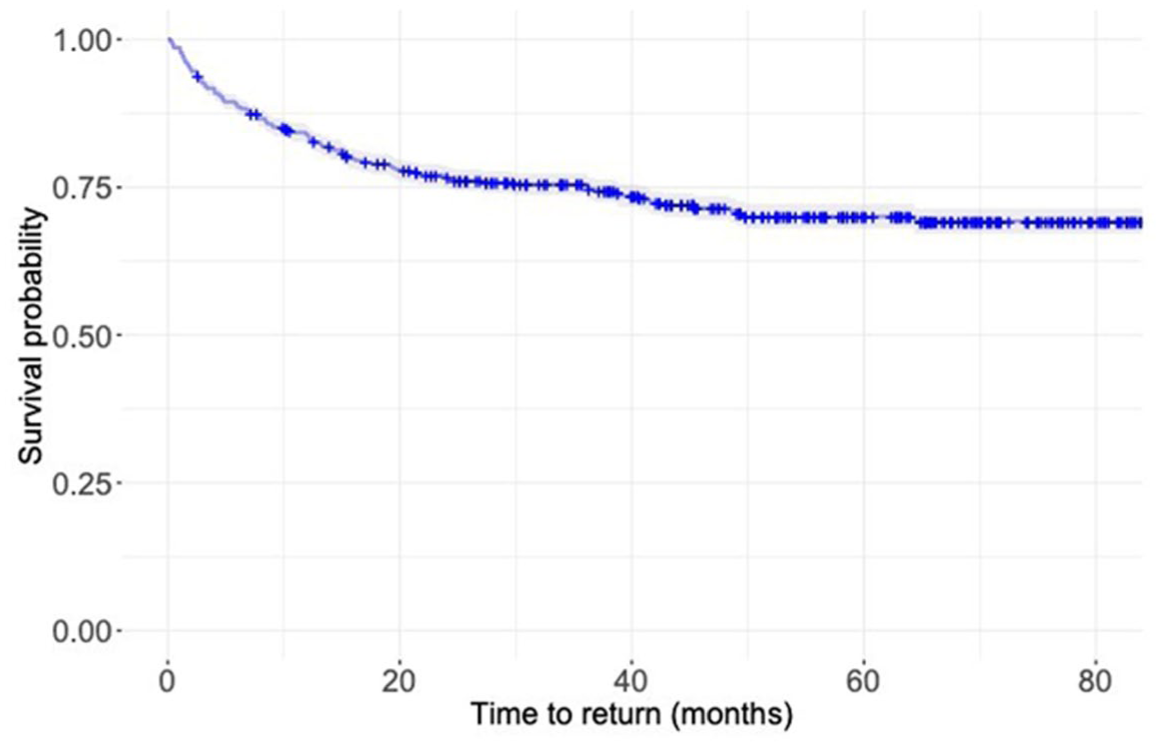
Survival function and 95% confidence interval for return to the violence facility.
As shown in Table 1, neither the criminal history, nor the Violence Facility history, nor any of the psychopathological classification categories were associated with an increased hazard of return to the Violence Facility. In contrast, several violence-related risk factors did show an association with a higher hazard of return. Specifically, detainees with high risk scores (i.e., 3 or 4) on judicial history, violation of judicial treatment or supervision conditions, negative social network influences, and behavioral problems < 12 years had shorter times-to-return in months compared to those detainees with low risk scores (i.e., 0, 1, or 2) on these risk factors. These findings suggest that a broader variety of criminal offenses and a greater diversity in violations are associated with more rapid return to the Violence Facility. Moreover, a shorter time-to-return was linked to higher levels of externalizing problem behavior prior to the age of 12, as well as to stronger affiliations with criminal or antisocial network members who exerted a negatively influence on detainees’ behavior.
With regard to the clinical risk factors, the results indicate that detainees who experienced substantial problems with their environment due to a lack of social skills (i.e., score 3 or 4, indicating high risk) returned to the Violence Facility sooner than those who did not have these problems or to a lesser extent (i.e., score 0, 1, or 2, associated with a low risk). Similarly, detainees who frequently encountered problems with job skills or daily activities as a result of their behavior, as well as those who demonstrated minimal to no cooperation with treatment (i.e., score 3 or 4 on these variables), also returned faster.
The time to return in months for each of the seven categorical variables associated with the likelihood of returning to the Violence Facility is presented in Figure 2. The green lines represent a low score on the risk factor (i.e., 0, 1, or 2), the red line represents a high score on the risk factor (i.e., score 3 or 4). In the presented survival curves, some unusual patterns are observed, such as fluctuations in survival probability and even increases instead of the expected decline. The observed fluctuations and occasional increases in survival probability in the pooled survival curves can be attributed to several factors. Variability across multiple imputed datasets and small sample sizes in certain time intervals can cause non-monotonic patterns. Additionally, the aggregation of survival curves from different imputations may introduce fluctuations. These patterns are often due to the inherent variability in the data and the methods used to combine and analyze it. Figure 2A to G all show that the survival curves diverge significantly, with those with a high score on the risk factor showing a shorter time-to-return in months than those with a low score on the risk factor. Of those with a high score on network influences (Figure 2C), for example, over 25% return to the Violence Facility within 2 years after discharge, compared to about 10% of those with a low score.
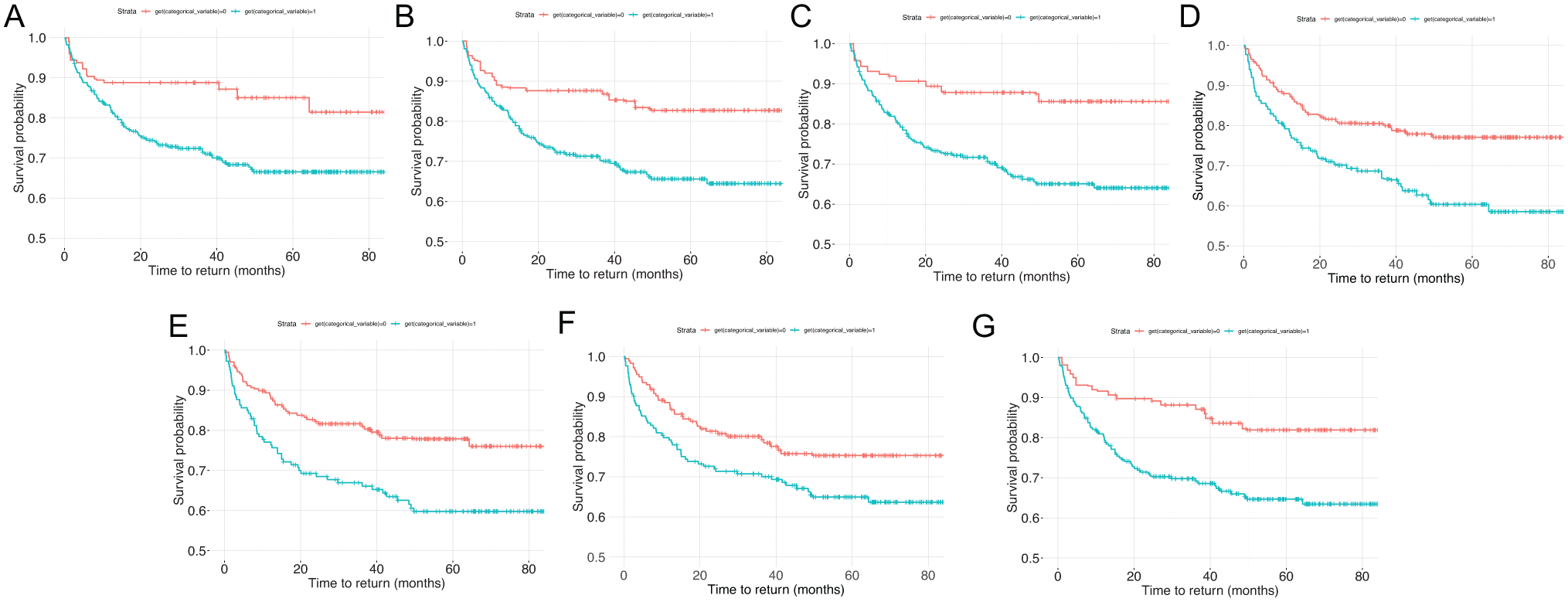
Survival functions for the seven violence-related risk factors significantly associated with time to re-entry (red [dark gray] lines represent high scores and green [light gray] lines indicate low scores). (A) Judicial history (H01); (B). Violation of judicial treatment or supervision conditions (H02); (C) Network influences (H05); (D) Behavioral problems <12 years (H06); (E) Social skills (K07); (F). Cooperation with treatment (K09); (G). Labor skills (K13).
Ultimately, the categorical predictor variables that were significantly associated with time-to-return, together with the ratio predictor variables, were incorporated into Cox proportional hazards models (Table 2). In the analyses, it was decided to exclude age at index admission from the Cox regression model due to its strong correlation with age at first Violence Facility admission ever (r = .887). Proportional hazards and linearity assumptions for the Cox regression models were assessed. Schoenfeld residuals indicated no significant time-dependent variation for any covariates (all p > .05), and adding quadratic terms did not improve model fit, with no significant quadratic effects, confirming that both assumptions were satisfied.
Cox Regression Models with Potential Predictors of the Time-to-return to the Violence Facility.
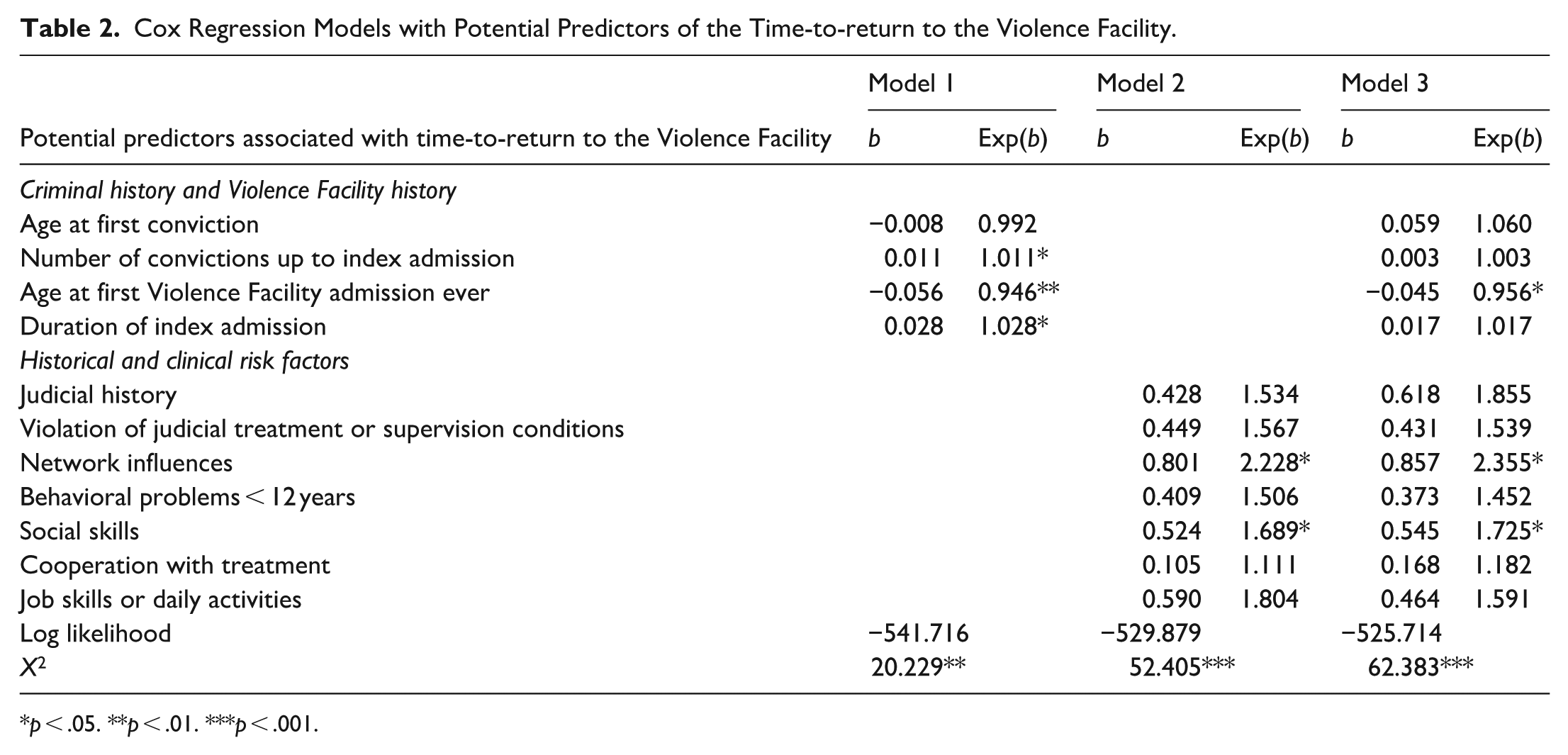
p < .05. **p < .01. ***p < .001.
Model 1 includes the criminal and Violence Facility history variables and shows that the number of convictions up to the index admission and duration of the index admission are positively related to time-to-return (p < .05), indicating that more previous convictions and a longer index admission increase the hazard of returning to the Violence Facility. Age at the first Violence Facility admission ever is negatively related to the hazard of returning (p < .01), indicating that individuals who were younger at the time of their first Violence Facility admission are more likely to be readmitted to the Violence Facility sooner compared to individuals who were older at the time of their first Violence Facility admission. Model 2 includes all historical and clinical violence-related risk factors that turned out significant in the univariate log-rank tests and shows that in the multivariate Cox regression only network influences and social skills remained associated with the hazard of return. Those with a high score on network influences have a 122.8% higher risk of returning to the Violence Facility than those with a low score on network influences. Individuals with a high score on social skills have a 68.9% higher risk of returning to the Violence Facility. When all variables from the first two models were included in a single model (Model 3), the number of convictions until the index admission and the duration of the index admission were no longer identified as predictors of time-to-return to the Violence Facility. Conversely, the age of the first Violence Facility admission ever, as well as the clinical risk factors network influences and social skills, were identified as separate significant predictors of time-to-return to the Violence Facility. Consequently, certain criminal history factors and clinical violence-related risk factors exhibited an association with the time-to-return to the Violence Facility, while others did not.
Discussion
This explorative study examined detainees repeatedly transferred to the Dutch Violence Facility, indicating recidivism in severe prison violence, and provided more insight into the chronology of prison violence. Over a 7.5-year period, the risk of return declined and stabilized around 4 years post-discharge. Over 70% of detainees did not return to the Violence Facility. While it cannot be discounted that some of this group may have been involved in further incidents while incarcerated, their behavior after being discharged from the Violence Facility has apparently not been sufficiently violent to warrant readmission. In contrast, nearly 30% returned to the Violence Facility within the observation period, mostly within 20 months. This demonstrates the durability and persistence of behavioral patterns within a substantial part of Violence Facility detainees, since a return to this facility is indicative of recurrent severe aggressive in-prison behavior. These 30% might be similar to the subgroup of detainees persistently engaging in prison violence and continuing their criminal careers throughout incarceration that has been described by previous studies (e.g., H. D. Butler et al., 2021; Cihan & Sorensen, 2019; Morgan et al., 2025; Reidy et al., 2018; Silver & Nedelec, 2018). Although prior studies found psychopathology (e.g., McGuire, 2018) and a lower educational level (e.g., Baias, 2022) associated with (higher rates of) prison violence, this study identified no differences in time to return with respect to these detainee characteristics. Previous research has yielded mixed findings regarding the association between crime severity and prison violence (e.g., H. D. Butler et al., 2021). The present study identified that the severity of committed crimes and the severity of the index crime were not associated with a more rapid return to the Violence Facility. Furthermore, time-to-return was not associated with country of birth, the location to which the detainee was sent after discharge, and aggression toward staff as reason for admission. Conversely, a wide crime variety and violation diversity were linked with a more rapid return to the Violence Facility, just as severe externalizing problem behavior before the age of 12 years. A pattern of serious rebellious behavior, in the broadest sense, and of violating various agreements or conditions thus appear to be pre-existing and persistent traits among detainees who recurrently exhibit prison violence. The relevance of the pre-prison social network is underscored by the observation that significant negative influences within a social network were associated with recurrent prison violence. With respect to the more recent functioning of Violence Facility detainees, those experiencing substantial problems with their environment due to a lack of social skills, returned significantly faster to the Violence Facility than those who did not have these problems or to a lesser extent. Furthermore, detainees who frequently had problems with job skills or daily activities as a result of their behavior, and those with less cooperation with treatment, returned significantly faster too. Accordingly, recent social functioning, recent ability to sustain a meaningful daytime activity, and recent degree of treatment or change motivation appeared to be significant detainee factors in the recurrence of prison violence.
Finally, this study illuminated several detainee characteristics that predict recidivism in severe prison violence. Identifying a younger age at first Violence Facility admission as a significant predictor of time-to-return to the Violence Facility, is consistent with prior research indicating that an earlier onset of a criminal career is a significant predictor of a prolonged and severe criminal trajectory (Piquero et al., 2007; Van Der Vorst et al., 2024; Van Hazebroek et al., 2019). The seriousness of the criminal history, psychiatric classifications, and scores on historical violence-related risk factors were not related to time-to return. However, some clinical violence-related risk factors predicted time-to-return. A main focus on negatively influencing criminal or antisocial network members in the past predicted time-to-return as well, and highlights the importance of prior contextual circumstances and the social network with respect to prison violence trajectories, as documented in previous studies (Cihan et al., 2020; Henry, 2020; Sorensen et al., 2025; Steiner et al., 2014). The finding that a lack of social skills was identified as a significant predictor of time-to-return to the Violence Facility is perhaps not so surprising since this risk factor can explicitly and directly give rise to interpersonal issues and these problems were still prevalent to a significant extent among those who returned to the Violence Facility in the year preceding their initial discharge within the observation period.
Limitations
Despite the implementation of multiple imputation for data missing completely at random, and the fact that both within-imputation and between-imputation variability were accounted for, missing data remain a noteworthy limitation of this study. Furthermore, variability across multiple imputed datasets, small sample sizes in certain time intervals, and the aggregation of survival curves from different imputations may have contributed to fluctuations and occasional increases in survival probability in the combined survival curves. Moreover, the examination of several potential predictors individually – followed by a multivariate analysis that incorporates, in addition to ratio predictors, only those categorical predictors found to be significant in the preliminary analysis – constitutes a limitation and would have benefited from cross-validation by using an independent sample. Furthermore, possible deaths of detainees and voluntary emigrations between discharge of the index admission and a potential re-admission, of which no data were available, might have influenced the probability of return. However, in contrast to research into recidivism in delinquency in society, the risk of undervaluation of re-admission to the Violence Facility within the observation period is eliminated since each re-admission was known. It is unclear whether individuals who did not return during the retrospective observation period subsequently returned or will return in the future. Although this cohort was observed for a relatively long period of 7.5 years, following the detainees for a longer time may contribute to more accurate predictors of recidivism in prison violence.
Implications, Generalizability, and Future Directions
This exploratory study sheds light on the persistence and patterns of serious prison violence among detainees in the Dutch “Violence Facility.” Transfer to this high-security and high-restricted prison facility did not result in a complete cessation of prison violence among the study cohort and within the 7.5-year observation period. Approximately 30% of individuals continued to engage in such behavior. This finding aligns with prior research describing that prior prison misconduct is associated with recurrent prison violence (e.g., M. Butler et al., 2022; Cunningham & Sorensen, 2007; McGuire, 2018). It should be noted that the absence of readmission does not necessarily indicate a complete cessation of aggressive behavior, both within and outside prison. Conversely, detainees with a history of Violence Facility placement may face a lower threshold for readmission. Nonetheless, for this group of almost 30% of the study cohort, the Violence Facility admission and merely restricting and stabilizing the detainees may have provided only a temporary relief for the prison system, rather than an environment conducive to lasting desistance from prison violence, at least within a 7.5-year timeframe. Although length of stay did not predict the likelihood of returning to the Violence Facility, the finding that nearly 30% of the cohort ultimately returned raises the question of whether an average duration of approximately months may, in itself, offer limited potential to facilitate meaningful behavioral change. Since nearly 30% of the cohort eventually returned to the facility, this period may have been either too short to foster meaningful desistance or, conversely, too long to maintain motivation for positive behavioral adjustment in the absence of structured interventions. This underscores the need for targeted, individualized interventions that extend beyond temporary containment. It might, for example, be beneficial to implement interventions addressing modifiable risk factors, that is, to enhance structured daytime activities, the (social) skills, the degree of treatment or change motivation, and to invest in a protective social network, both at the Violence Facility and afterward. Strengthening these protective dimensions could help reduce future incidents of institutional violence and its adverse consequences for detainees, staff, and correctional safety. Furthermore, incorporating both dynamic and static risk factors, including social functioning and the age at first Violence Facility admission, into individualized risk management plans may enhance decision-making regarding readiness for safe transfer to less restrictive environments. In addition, systematic assessments aimed at elucidating the underlying causes of the conducted prison violence could be valuable. This may include comprehensive diagnostic evaluations, identifying individual needs and vulnerabilities, and, where possible, performing incident-based analyses of violent episodes within prison. Such efforts could provide critical insights into the mechanisms driving in-prison aggression and inform more tailored and preventive interventions.
Although the study did not evaluate the Violence Facility’s efficacy, its findings can be interpreted within the broader theoretical frameworks of deterrence, desistance, and incapacitation of highly restrictive prison facilities, explicitly acknowledging the limited body of systematic research and the conceptual ambiguity surrounding restrictive housing (e.g., Mears & Labrecque, 2025). From a deterrence perspective, transfer to a high-security and highly restrictive facility – where autonomy and privileges are substantially limited – could be expected to discourage future violent misconduct through the anticipation of similar consequences. However, the current findings suggest that such a deterrent effect, if it exists, may be short-lived or confined to the immediate institutional context. The persistence of serious violent behavior among a considerable proportion of the cohort implies that deterrence alone may be insufficient to promote sustained behavioral change, particularly in the absence of rehabilitative or therapeutic elements that address underlying causes of aggression. For almost 30% of the study cohort who subsequently returned to the Violence Facility, the initial admission to the Violence Facility appeared to serve as a temporary “time-out” mechanism for referring institutions, providing short-term stability and relief from violent detainees. Prior studies have documented that the transfer of disruptive detainees to restrictive prison facilities can function as a paradoxical reward system that sustains its own use and reinforces institutional reliance on a potentially harmful yet expedient management tool. For the sending institution, such transfers relieve immediate management pressures and restore a sense of order, thereby probably reducing incentives to develop internal solutions for problematic behavior (Mears et al., 2021). For some detainees, restrictive environments may also carry perceived benefits – such as a protective environment (e.g., Labrecque & Smith, 2019) – further normalizing the practice. However, empirical research has echoed critiques of restrictive housing, suggesting that such environments may reduce immediate institutional risk but rarely foster long-term behavioral change and desistance (e.g., Briggs et al., 2003; Mears et al., 2024; Mears & Bales, 2009). Research further indicates that harsh confinement can exacerbate adverse psychological and criminogenic outcomes (e.g., Aranda-Hughes & Mears, 2025; Zgoba et al., 2020). Consequently, while the Violence Facility may reduce short-term institutional risks, any long-term preventive efficacy likely depends on systematically addressing the underlying causes of detainees’ aggression rather than merely managing its manifestations.
Future longitudinal studies should explore the long-term trajectories of both returning and non-returning detainees. What distinguishes those who desist from those who persist? What institutional factors – such as access to therapeutic programs or rehabilitative opportunities – shape these outcomes? Future research should therefore also examine how the length of stay within the Violence Facility interacts with individual risk factors and institutional characteristics to influence subsequent misconduct and desistance trajectories. Future studies work might also assess how detention climate characteristics within the Violence Facility, compared to less restrictive regimes, may influence aggression among individuals currently or formerly placed in the Violence Facility. Such knowledge might improve the understanding of contextual influences such as the security level on aggression and could build on earlier work (e.g., Reisig, 1998; Steiner et al., 2014), which questioned the effectiveness of control-based management strategies and emphasized the importance of organizational flexibility and managerial approaches in maintaining institutional order. Additionally, prior research (e.g., Baker et al., 2024; Reisig & Mesko, 2009; Van Hall et al., 2024) has linked the perceived legitimacy, procedural justice, and fairness of authority during detention to the likelihood of detainees’ prison violence. Future research could investigate whether the procedural justice experienced by Violence Facility detainees is related to the likelihood of readmission and thus repeated serious detention violence. These insights might also deepen the understanding of how the deprivation and importation models jointly shape the risk of prison violence (e.g., Van Ginneken & Wooldredge, 2024), and the importance of balancing high security with opportunities for meaningful social and occupational engagement to mitigate the “pains of imprisonment” while managing aggressive behavior.
Given the exploratory and data-driven nature of this study, its exclusive focus on detainees within a single Dutch facility, the absence of a cross-validation group, and the dearth of literature for comparison of the results, it is imperative that conclusions and generalizations be approached with caution. The replication of the study across diverse samples appears to be a prerequisite for substantiating the study’s findings. However, although differences in cultural context (M. Butler et al., 2022) and prison context (Anderson, 2024; Camlibel et al., 2021; Wilson & Kilgour, 2019) are of importance regarding risk factors of prison violence, results of the current study might generally contribute to a more thorough understanding of the characteristics and the life-course of violent detainees, and to potential underlying causes of (recurrent) prison violence. These results may inform the identification of potentially (repeatedly) violent detainees, can be incorporated into deliberations concerning a potential discharge to an alternate prison unit, and can guide the monitoring of potentially repeatedly violent detainees as they move on to other detention facilities. Furthermore, results can add to the implementation of targeted interventions for potentially repeatedly violent detainees to reduce the risk of violent recidivism while incarcerated. Therefore, this explorative study might eventually add to the prevention of prison violence and to its negative consequences.
Footnotes
Acknowledgements
The authors would like to express their gratitude to the Dutch Ministry of Justice and Security for providing the data and to all those criminologists and psychologists who were involved in the processing of the files. Expressed views are those of the authors and not necessarily those of the Dutch Ministry of Justice and Security.

Ethical Considerations
The Dutch Ministry of Justice and Security approved the current study. Furthermore, this study received a favorable recommendation from the Ethics Committee for Legal and Criminological Research, Faculty of Law, Vrije Universiteit Amsterdam (reference number 2023012-Z).
Consent to Participate
The Ethics Committee for Legal and Criminological Research, Faculty of Law, Vrije Universiteit Amsterdam, waived the need for participant and publication consent for the analysis and publication of the retrospectively obtained and anonymized data for this non-interventional study. Detainees were not actively recruited, informed or rewarded for this study. The data file used in this study was based on an already existing database, containing previously collected information intended for policy purposes. From this database, a select file was provided, only containing the data of detainees who were placed in the facility for uncontrollably violent detainees between 2016 and 2022. The data file was obtained completely anonymously and cannot be linked in any way to persons or criminal cases. This procedure complies with Dutch privacy legislation and was approved by the Dutch Ministry of Justice and Security and the Ethics Committee for Legal and Criminological Research, Faculty of Law, Vrije Universiteit Amsterdam (reference number 2023012-Z).
Funding
The authors received no financial support for the research, authorship, and/or publication of this article.
Declaration of Conflicting Interests
The authors declared no potential conflicts of interest with respect to the research, authorship, and/or publication of this article.
Data Availability Statement
All relevant data are within the paper. Data are available on reasonable request from the corresponding author.
Supplemental Material
Supplemental material for this article is available online.