




Abstract
This study examined the relationship between the psychosocial characteristics of juvenile detainees in three different juvenile detention centers in Türkiye and their environmental conditions. Conducted from the perspective of ecological systems theory, the research aimed to evaluate the effects of reciprocal interaction between a juvenile’s internal state and their external environment on rehabilitation. Analyses conducted using methods such as one-way ANOVA and multivariate path analysis revealed a strong relationship between psychological well-being and perceived safety and fundamental environmental factors such as structure, freedom, and support. Path analysis showed that a strong perception of structure defined as the clear rules, routines, and predictability of the prison environment is a fundamental factor that influences other perceptions such as privacy, support, and social relationships. The findings also indicate that there is no direct relationship between activity level and well-being, but rather that the quality of rehabilitation activities may be more critical. In conclusion, the study supports the need for a holistic rehabilitation approach in prisons. This approach should carefully balance freedom of movement and structured programs with the individual privacy and social space needs of juvenile detainees.
Plain language summary
Childhood and adolescence are important periods for the formation of a person’s identity and personality. However, some young people are forced to go through this process behind the closed and restrictive walls of a prison. So, how does this closed environment affect the already fragile psychology of these young people? How do the rules, relationships, and general atmosphere of this environment shape their well-being and their hopes for the future? In this study, we investigated how young people in juvenile detention centers in Türkiye cope with this challenging environment and how different aspects of the prison affect their psychological state. By listening directly to the feelings and experiences of the young people, we aimed to understand how a prison environment could be best organized. Our research found that the prison environment has a much greater impact on young people than we might have thought. Specifically, we discovered that having clear rules and a regular routine within the prison helps young people feel safer and even better able to meet basic needs like privacy. This shows that prisons are not just physical structures, but also dynamic, living ecosystems that shape the psychology of the young people within them. Our findings reveal that focusing solely on individual problems is not enough to help these young people. It is also necessary to improve the environment they are in. This approach can help our juvenile justice system move away from punishment-focused models and create more suitable and supportive environments for the development and social reintegration of youth.
Keywords
Introduction
The complexity of the prison environment is deeply related to its effects on the rehabilitation processes and psychosocial development of young prisoners. Internationally, it is widely accepted that rehabilitation is more effective than punishment in reducing recidivism rates (Pappas & Dent, 2023). However, rehabilitation in closed institutions presents a paradoxical situation, as incarceration is inherently undesirable (Sommer, 1974). Prison environments are dynamic social systems that include structural elements (security protocols, institutional rules, daily routines), relational dynamics (staff-prisoner interactions, peer relationships), and cultural factors (informal norms, subcultural codes) (Sykes, 2007; Toch, 1977). These multidimensional interactions are important in shaping the daily experiences, identity development, and future expectations of juvenile detainees.
Current studies reveal significant variability in individual responses to incarceration (Berardi et al., 2024; Lussier et al., 2025; Toch, 1977). Such findings suggest rehabilitation outcomes depend on complex interactions between environmental conditions and personal factors (Johnsen et al., 2018; Wener, 2012), thereby underscoring the need for environmentally sensitive approaches in juvenile justice systems (Knoblach et al., 2019; Jiang et al., 2020). Consequently, guided by Bronfenbrenner’s Ecological Systems Model (Bronfenbrenner & Ceci, 1994), this study explores the effects of the juvenile detention environment on the psychosocial status of juvenile detainees and examines how interventions focusing on environmental factors can meet their psychosocial needs and improve their rehabilitation.
Bronfenbrenner’s Ecological Systems Theory
Ecological systems theory (Bronfenbrenner, 1979) offers a holistic model that examines individual development within the context of environmental factors and explains this interaction through the dimensions of microsystem, mesosystem, exosystem, macrosystem, and chronosystem. The psychosocial experiences of juvenile detainees are shaped at the intersection of these systems: Microsystem (the prison environment, family relationships, peer interactions), Mesosystem (relationships between the prison, staff, and family), Exosystem (the functioning of the legal system, social services), Macrosystem (cultural norms, child rights policies), Chronosystem (changes in the detention process over time). While the theory traditionally focuses on how the environment impacts an individual, this study adopts a novel perspective by focusing on reciprocal interaction. We propose that a juvenile’s psychological state such as depression or trauma can, in turn, influence their perception of the environment, making it seem less supportive or more restrictive. By exploring this link, our research provides a more nuanced understanding of the relationship between psychological well-being and a person’s perceived environment.
The prison environment is a multidimensional environmental system that affects the psychosocial experiences of detained children. This environment, which has layers ranging from physical conditions (Birckhead, 2015; MacArthur Foundation, 2015) to psychological atmosphere (Marti, 2025; Meijers et al., 2023), contains various environmental pressures and stress factors. The quality and intensity of these factors directly influence the juveniles’ adaptation processes to the prison environment. This study examines the interaction of detainees in juvenile prisons with the environment within the framework of seven basic environmental impact factors developed by Toch (1977) and Wright (1985) and measured by the “Prison Environment Inventory.” These factors are defined as the environmental dynamics that structure the adaptation process according to the needs and perceptions of the detainees, as follows: (1) Structure (Clarity of rules, discipline, and daily routines in prison) (2) Emotional Feedback (Warm and supportive relationships with staff, visitors, and peers) (3) Activity (Opportunities for creative development, a sense of achievement, and avoiding monotony) (4) Social Stimulation (Opportunities to socialize and develop communication skills with other detainees) (5) Support (Accessibility of psychological, educational, and vocational guidance services) (6) Privacy (Need for personal space, silence, and a non-overcrowded environment) (7) Freedom (Autonomy, age-appropriate treatment, and absence of authority abuse).
Literature Review
Juvenile Detainees in the Context of Prisons and Psychosocial Rehabilitation
Juvenile detainees, defined as individuals under 18 held for an alleged crime but not yet convicted, are considered innocent until proven guilty (Child Protection Law Art. 3/1-a; Turkish Penal Code Art. 6/1-b; European Union, 2017). Globally, millions of children are detained for various reasons, including involvement in the justice system, migration, and armed conflicts (Nowak, 2019). The duration of this detention varies significantly by country and is often determined by the crime, though it can last for months or even years (Condry, 2007; Gialuz & Spagnolo, 2013). This prolonged and uncertain separation from families negatively impacts a child’s psychosocial development (Defence for Children International, 2010).
Research consistently shows that incarcerated children experience significantly higher rates of mental health issues than their peers without this experience (Murray et al., 2012). Between 60% and 70% of detained youth have a diagnosable mental health condition, with high rates of depression, suicidal ideation, PTSD, and both internalizing and externalizing problems observed in this population (Dierkhising et al., 2013; Powell, 2021). The emergence and persistence of these issues are a significant concern from both psychological and criminological perspectives. It is argued that the effects cannot be attributed solely to individual factors and prior experiences. There is a growing need for holistic approaches that also consider the impact of the detention environment itself (Arakelyan & Ager, 2021). Detention center environments, characterized by strict supervision, confinement, and a lack of engaging activities, can lead to feelings of injustice and mistrust in authorities (Jesuit Refugee Service, 2010; UNICEF, 2015). Research also highlights how restricted family visits, a lack of mental stimulation and physical activity, and social isolation can contribute to psychosis, paranoia, and self-harm (Curtin & Garnett, 2023; Favril, 2021). Moreover, conditions such as overcrowding, limited access to adequate food, medical and mental health services, education, and basic hygiene are common in detention facilities. These conditions, often stemming from insufficient funding, deepen trauma and undermine rehabilitation goals, ultimately increasing recidivism and social costs (Alves da Costa et al, 2022; Garland, 2001). The psychological effects of detention often continue long after a child’s release (Priestley et al., 2025).
The intersection of mental health issues with factors like socioeconomic status, race, and gender creates systemic inequalities. For instance, racial and ethnic minority youth are more likely to be incarcerated than referred to community-based treatment compared to white children (Hoffmann et al., 2022), they also experience more frequent mental health disorders and are less likely to receive adequate treatment while in detention. Additionally, studies show that young people from low-income, single-parent households are disproportionately incarcerated at a young age (Kroese et al., 2020; Pettit & Gutierrez, 2018) and often present with elevated instances of undiagnosed or untreated mental health conditions and co-occurring substance use disorders. These examples of justice system inequality, therefore, serve as clear indicators of underlying mental health disparities.
The context of these challenges points to a need for approaches that move away from punitive models toward child-centered, rehabilitative ones. Mears and Aron (2003) emphasize that risk and protective factors such as family, school, and community are situational and can be addressed through targeted programs. However, studies on juvenile rehabilitation outside of Western contexts are limited. This highlights a clear need for research on how these environmental factors operate within different cultural and legal frameworks, such as in Türkiye.
Ecological Models and Vulnerable Populations
Ecological models provide a robust framework for examining the complex factors influencing vulnerable groups, including those displaced by conflict and those within the justice system (Miller & Rasmussen, 2017). This approach considers multiple layers of influence, from individual to systemic factors. For example, Crosby et al. (2017) applied an ecological framework to study developmentally disabled youth in the U.S. justice system, analyzing micro- (family), meso- (support systems), exo- (policies), and macro-level (culture) factors. However, the study’s focus on individual trauma histories and family relationships overlooked the specific impact of the closed institutional environment itself on a person’s well-being. This suggests that existing ecological models have not yet fully encompassed the unique dimensions of the prison context.
Similarly, research on other vulnerable populations, such as refugees, has demonstrated the utility of ecological models. Studies show that factors like strong ethnic identity can serve as a protective factor against psychological distress, while discrimination within the host community can exacerbate it (Aitcheson et al., 2017; Beiser et al., 2016). A comprehensive review by Arakelyan and Ager (2021) further emphasizes the need to focus on the reciprocal interactions of factors within Bronfenbrenner’s bioecological model. These factors, ranging from individual interactions to broader cultural and political symbols, provide a clear framework for examining how a prison environment either supports or undermines a child’s psychological well-being. Research on Syrian refugees in Lebanon and Türkiye also highlights how ecological models can be applied from a transnational perspective, revealing that social exclusion and discrimination are common stressors across different contexts (Ruhnke et al., 2024).
While the majority of research in this field focuses on how the environment affects psychological outcomes, a growing body of work examines the reciprocal interaction of psychological factors on the perception of the environment. For example, studies on adolescents in residential care show that individuals with high levels of anxiety and depression perceive the same environment as more restrictive (Sekol, 2016). Similarly, youth with high emotional resilience have been found to evaluate their environments more positively (Mestre et al., 2017). These empirical findings suggest that an individual’s internal psychological state can act as a “lens” through which they interpret their external environment.
This field study, focusing on juvenile offenders in the context of Türkiye, examines the effect of environmental factors on psychosocial experiences from a non-Western perspective. Supported by quantitative data (such as path analysis), the study reveals how the structural features of the prison environment shape perceptions of privacy, support, and social relationships. These findings allow for a comparative evaluation of data from Türkiye with international literature within the framework of ecological systems theory. Although there is extensive information in the literature on the effects of ethnic identity and adaptation strategies on the mental health of vulnerable groups, empirical evidence specifically examining the psychological well-being of detained youth in closed institutions and its influence on their perception of the institutional environment is limited. This study aims to fill that gap by empirically demonstrating how detained youth’s psychological well-being shapes their perception of the environmental factors within the correctional setting.
Study Design
Building on this perspective, our study’s primary aim is to empirically demonstrate the relationship between a juvenile’s psychological well-being and their perception of the prison environment, as measured by the “Prison Environment Inventory.” Contrary to conventional ecological studies that use environmental factors as predictors of mental health, we investigate how psychological outcomes may influence a detainee’s perception of their surroundings.
This study employed a cross-sectional, correlational design to investigate the psychosocial experiences of 120 juvenile detainees across three distinct closed juvenile detention facilities in Türkiye. The primary objective was to examine the relationships between the detention environment and specific aspects of the detainees’ experiences and well-being. The study aimed to answer the following research questions:
(1) How do the psychosocial experiences of 120 juvenile detainees in Türkiye’s detention facilities relate to their perception of the detention environment?
(2) How do specific psychological outcomes (e.g., well-being, life outlook) affect the detainees’ perceptions of the seven sub-dimensions of the detention environment?
An evidence-based investigation was undertaken to examine how the experience of being in a detention environment relates to detainees’ overall well-being, their outlook on life, their social interactions and status within the facility, and the time spent by them in communal areas outside their individual rooms. These outcomes were hypothesized to be related to the environmental factors detailed in the Prison Environment Inventory, thereby allowing for an empirical understanding of their interconnections.
Methods
This research integrates (1) self-report measures on juveniles’ personal experiences, and (2) environmental factor assessments (e.g., using the Prison Environment Inventory) to evaluate how the experience of being in a juvenile detention environment affects their psychosocial well-being. The findings derived from this methodology offer significant advantages in informing prison design by facilitating data-driven culture and decision-making (Yates & de Oliveira, 2016), enhancing the understanding of human-environment interaction (Wener, 2012), and contributing to the development of rehabilitation-focused solutions (Ulrich, 2017). By understanding the direct links between detainees’ well-being and environmental factors, the research contributes to the development of more effective, rehabilitation-focused solutions to inform prison design. This approach supports decision-making aimed at creating detention environments that better serve the psychological needs of juvenile detainees.
Sample Group and Settings
The study was conducted with 120 voluntary participants aged 12 to 18, who had been detained for a minimum of one month in the juvenile closed prisons of Diyarbakır, Kayseri, and Tarsus. Our non-probability convenience sampling was dictated by the sensitive research environment and restricted access to juvenile facilities. A random selection was not feasible due to ethical and institutional regulations. We predetermined a target sample of 120 participants, recruiting 40 from each of the three selected prisons. We collaborated with correctional staff to identify eligible juveniles (ages 12–18, detained for at least one month, and not in severe psychological distress). From this pool, we included all who provided both guardian consent and their personal assent until we reached our target sample size. This approach, aligned with Roger Hart’s Ladder of Children’s Participation, ensured genuine voluntary participation and protected the juveniles’ autonomy.
As of July 2025, there were 3,034 children aged 12 to 18 in juvenile closed prisons in Türkiye, including 2,932 males and 102 females (TÜİK, 2025). Although the sample of 120 represents only a portion of this population, it is considered sufficient for a study of this nature, given the restricted access and ethical constraints associated with closed institutional settings. Moreover, the sample size exceeds the minimum requirements for statistical techniques such as ANOVA and path analysis (Field, 2013). The selected group was also balanced with respect to key demographic variables such as major crime categories and dormitory floor to enhance representativeness within the institution. In addition, the group is homogeneous in terms of age group and type of facility. This sampling approach aligns with those adopted in similar studies conducted in correctional settings (Ferguson & Wormith, 2013).
The juvenile detainees are housed in wards designed for eight individuals but placed in single rooms. These wards have no direct connection to the outside. The facility consists of three floors, with detainee wards located on the first and second floors. It is worth noting that the staff-to-child ratio in three distinct juvenile prisons in Türkiye is not standardized, as it varies depending on the institutional dynamics and personnel structure of each facility.
To ensure ethical compliance, comprehensive informed consent was obtained from each juvenile’s legal guardian, and their assent was secured after the study’s objectives, procedures, and right to withdraw were clearly explained by the research team. Juveniles experiencing severe acute psychological distress or those detained for less than one month were excluded from the study.
Procedure
This study was conducted between September 2022 and September 2023 in Diyarbakır, Kayseri, and Tarsus Juvenile Closed Prisons. Ten field visits (December 2022–August 2023) included 3-day institutional assessments per site. Data on prison management systems, daily routines, and information about juvenile detainees were collected through on-site observations, self-report measures, and an environment assessment survey (Prison Environment Inventory’s 7 sub-dimensions).
Data Collection and Measurement Tools
Data were collected using two primary instruments: a self-report form on juveniles’ personal experiences and the Prison Environment Inventory (PEI).
Independent Variables
Juveniles’ personal experiences were assessed through a self-report form. This form was developed based on principles from studies utilizing the Developing Prison Environment Scale (Toch, 1977; Wright, 1985). It included six distinct questions, each serving as a single-item observed indicator of a specific psychosocial experience. They were designed as direct, self-reported indicators of a juvenile’s immediate, subjective psychosocial state, such as their feelings of safety, social belonging, and life perspective: (1) How do you feel today? (2) How would you classify your own perspective on life? (3) Do you feel safe in prison? (4) How would you classify yourself socially? (5) How much time do you spend outside your room when you are allowed to go out? (6) How do you rate this institution compared to other prisons you have been in? These questions were rated on a 7-point Likert scale (1 = not at all to 7 = very much) and constitute the independent variables in our path model. The psychosocial experiences of juveniles, as captured by these questions, were subsequently analyzed via frequency and percentage distributions.
Dependent Variables
Complementing this, the correctional climate, as perceived by juveniles, was evaluated using the Prison Environment Inventory (PEI). This tool, with 7 subscales, was originally developed by Toch (1977) and Wright (1985). As detailed in the “Adaptation and Validation of Instruments” section, the adapted PEI consists of 28 items distributed across seven distinct factors/subscales: Structure, Privacy, Activity, Emotional Feedback, Freedom, Support, and Social Stimulation. We utilized a 4-point Likert scale for its items, ranging from 0 (never) to 3 (always). These seven subscales of the PEI serve as the dependent variables in our path model.
Adaptation and Validation of Instruments for the Turkish Context
To ensure the validity and reliability of the measurement tools within the specific context of Türkiye, a multi-step adaptation process was implemented. First, both the self-report measures and the Prison Environment Inventory (PEI) were translated from English into Turkish. In addition to the translation, the terminology was ethically adapted to reflect a child-centered approach. The term “prisoner” (mahkum) was replaced with “detained child” (tutuklu çocuk) to align with Turkish legal and ethical guidelines for juvenile justice.
Since the PEI had not been previously used in Türkiye, a comprehensive validation process was undertaken. To ensure clarity and appropriateness for the target population, a pilot study was conducted with 12 juvenile detainees at the Tarsus Juvenile Prison. From the original total 48-item PEI scale, 42 items (e.g., “Prison programs teach juveniles new skills”) were selected to evaluate the correctional climate. The remaining six items were excluded before the exploratory factor analysis (EFA) as the “security” subscale was not included in the scope of our research, per the requirements of the General Directorate of Prisons and Detention Houses. These items were subjected to Exploratory Factor Analysis (EFA) using Principal Axis Factoring with Varimax rotation to examine the underlying factor structure within the context of juvenile detention in Türkiye. Following the EFA, 14 items with factor loadings below 0.35 were excluded. The final scale thus consisted of 28 items, which were distributed across seven distinct factors/subscales, including Structure, Privacy, Activity, Emotional Feedback, Freedom, Support, and Social Stimulation. This factor structure was further confirmed using Confirmatory Factor Analysis (CFA) in AMOS 24. The CFA model tested whether each of the 28 items loaded onto a single, predefined factor. The model did not allow for cross-loadings, ensuring that the relationships were based on clean factor structures. The final measurement model, including standardized factor loadings, is presented in Supplementary Material. The final factor structure demonstrated adequate sampling adequacy (Kaiser-Meyer-Olkin, KMO = 0.690) and was statistically significant (Bartlett’s Test of Sphericity, χ² = 1081.856, p < .001). Internal consistency was measured by Cronbach’s Alpha. While several subscales showed acceptable reliability (e.g., Structure, α = .88), it’s important to acknowledge that some had low values, such as Social Stimulation (α = .437) and Support (α = .572). We have retained these subscales in our analysis to represent the original scale fully, but we recognize their low reliability as a significant methodological limitation of our study. The final measurement model for the Prison Environment Inventory, including standardized factor loadings, is presented in Table 1.
Item Factor Loadings, Item-Total Correlation, Reliability, and Variance Results for the Prison Environment Inventory (PEI).
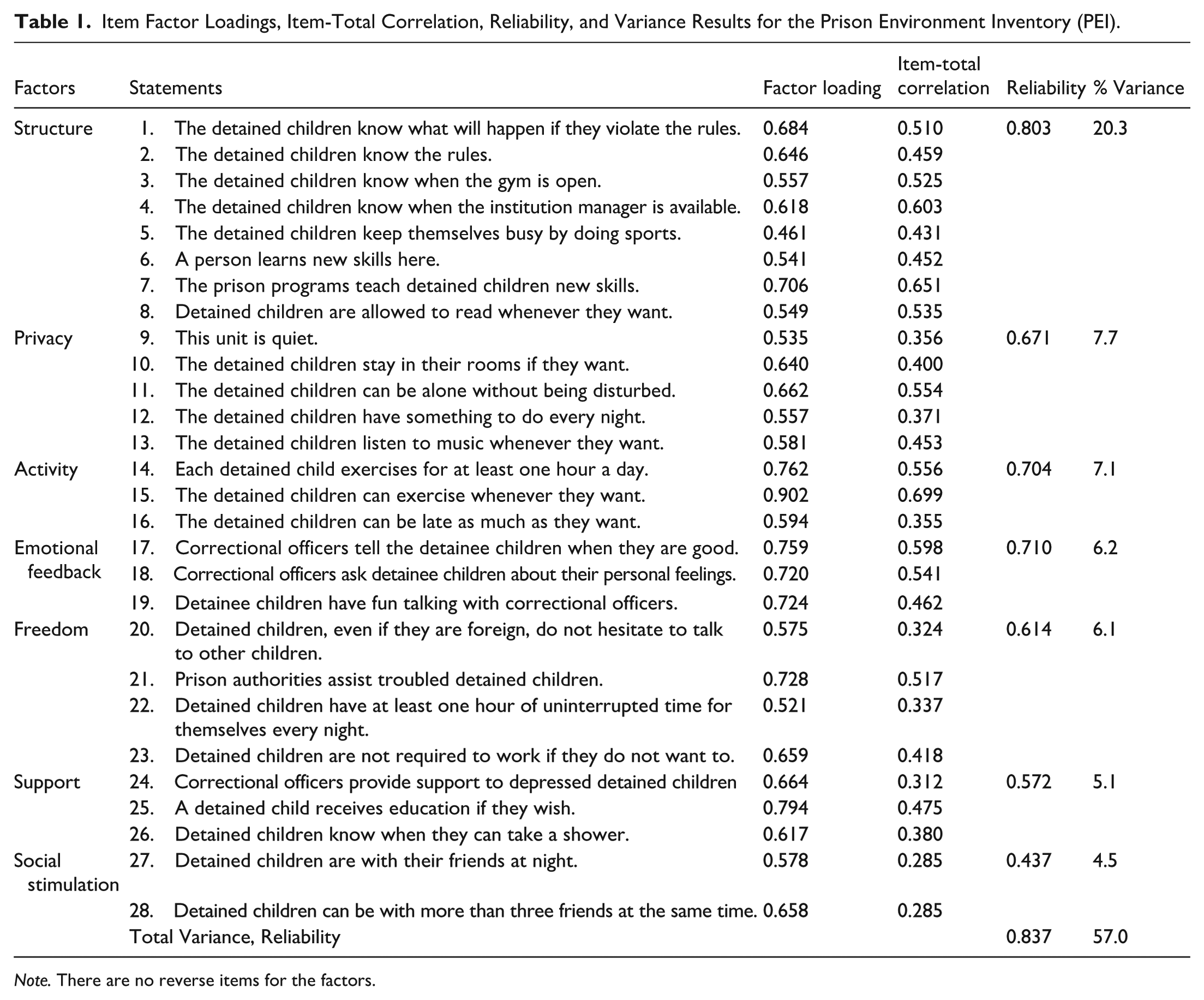
Note. There are no reverse items for the factors.
Furthermore, to ensure the full and authentic participation of all juveniles, particularly those with literacy difficulties, adaptations were made to the data collection process. While the instruments were originally designed for individual administration, they were adapted into 30-min group sessions. Surveys were administered to groups of four participants in a classroom setting, under the supervision of the research team with institutional staff, including wardens. This approach, which aligned with Roger Hart’s participatory levels 5 to 6 (1992, 2008), allowed research officers to provide one-on-one assistance as needed, facilitating comprehension and enabling children to express their experiences effectively. Research officers ensured a full dataset by systematically checking each questionnaire for completeness immediately after it was filled. Participants were asked to complete any missing responses on the spot, a rigorous follow-up that was feasible and crucial in this sensitive environment. Consequently, no missing data points or statistical methods for handling them were required.
Ethical Approval and Informed Consent Statements
Ethical approval for this study was obtained from the relevant Ethics Committee (03.06.2022). Permission to conduct the research and publish its findings was also secured from the appropriate official authorities (08.07.2024). Prior to data collection, informed consent was obtained through verbal explanations and signed forms from both participating juveniles and their legal guardians.
Data Analysis
Analyses were conducted using SPSS 26.0 and AMOS 24. Descriptive statistics were used to present socio-demographics as frequencies/percentages and scale scores as mean ± SD. Comparative analyses employed (1) One-Way ANOVA with Tukey HSD Post Hoc tests for multi-group comparisons, (2) Pearson correlation, and (3) Path analysis to examine the psychosocial-environmental relationships. Path analysis was used to examine the relationships between latent factors. This method provides more accurate estimates by correcting for attenuation caused by measurement error. Our model employed a parsimonious approach based on theoretical considerations, disallowing correlated error terms between items. Although observations were nested within three distinct centers, our analysis focused on individual-level relationships. All tests considered p < .05 and p < .01 significance levels. The analytical framework enabled examination of both linear associations (Pearson) and complex causal pathways (Path Analysis) between environmental factors and juvenile self-reporting. (For Pearson correlation interpretation, refer to Büyüköztürk, 2018). A formal a priori power analysis wasn’t conducted due to the constraints of the research setting. Instead, the sample size was determined by the number of accessible participants within the juvenile detention centers.
Results
The results of this study are presented in accordance with the outlined research questions. Initially, descriptive statistics of the participants are detailed, followed by an examination of how the detention environment influences juveniles’ psychosocial experiences relate to their perceptions of the detention environment.
Descriptive Statistics of the Sample Group
The sample group’s socio-demographic characteristics were closely documented. The juvenile detainees were equally distributed across the three centers, with 33.3% (n = 40) from Tarsus, 33.3% (n = 40) from Diyarbakır, and 33.3% (n = 40) from Kayseri prisons. All participants were male. The age distribution was as follows: 22.5% (n = 27) were between 14 and 15 years old, 37.5% (n = 45) were 16 years old, and 40% (n = 48) were between 17 and 18 years old. In terms of education level, 9.2% (n = 11) had completed elementary school or lower, 82.5% (n = 99) had completed middle school, and 8.3% (n = 10) were high school graduates.
The findings show that 54.2% (n = 65) of the juveniles reported their psychological state as good, while 25% (n = 30) reported it as bad. Their perspectives on life were 56.7% (n = 68) optimistic and 26.7% (n = 32) pessimistic. Regarding their perception of security in prison, 65.8% (n = 79) felt safe, while 20.8% (n = 25) felt unsafe. In terms of social status, 65% (n = 78) described themselves as social, while 16.7% (n = 20) described themselves as lonely. As for the frequency of spending time outside their rooms, 65.8% (n = 79) reported always spending time outside, while 20.8% (n = 25) reported never/rarely doing so. When evaluating the prison conditions (e.g., note that the following question was only answered by n = 44 juveniles who had previous incarceration experience) 72.7% (n = 32) rated the institution as good, while 15.9% (n = 7) rated it as bad.
The mean scores of Prison Environment Inventory (PEI) sub-dimensions, as reported by juvenile detainees, regarding their perceptions of the environment across different groups/sites, are shown in Figure 1.
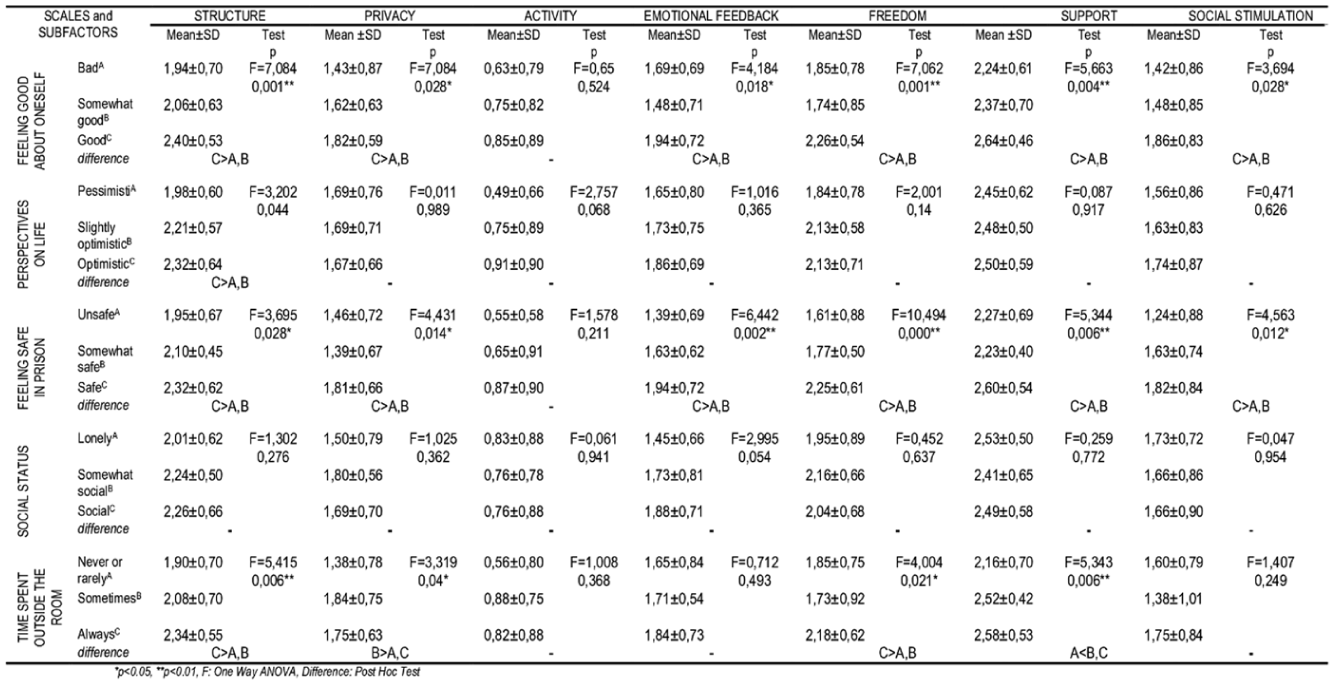
The comparison of the scores of Prison Environment Inventory (PEI) sub-dimensions, as reported by juvenile detainees.
How Self-Reported Well-being Relates to Perceptions of the Environment
Participants were divided into three groups based on their self-reported well-being: Bad (A, n = 30), Somewhat Good (B, n = 25), and Good (C, n = 65). According to ANOVA analysis: Structure: C (2.40) > B (2.06) > A (1.94), p = .001**, Privacy: C (1.82) > B (1.62) > A (1.43), p = .028*, Activity: No significant difference between groups (p = .524), Emotional Feedback: C (1.94) > A (1.69) > B (1.48), p = .018*, Freedom: C (2.26) > A (1.85) > B (1.74), p = .001**, Support: C (2.64) > B (2.37) > A (2.24), p = .004**, Social Interaction: C (1.86) > B (1.48) > A (1.42), p = .028*. Those who felt good scored significantly higher on all scales (except Activity). Perceptions of Freedom, Support, and Structure showed the most pronounced differences.
Relationship Between Life Perspective and Environmental Conditions
Participants in the study were divided into three groups based on their outlook on life: Pessimistic (A, n = 32), Somewhat Optimistic (B, n = 20), and Optimistic (C, n = 68). According to the analysis: Structure: C (2.32) > B (2.21) > A (1.98)—p = .044*, Activity: C (0.91) > A (0.49)—p = .068 (borderline significant), Freedom: C/B (2.13) > A (1.84)—p > .05, Other Factors: No significant difference between groups in Privacy, Emotional Feedback, Support, and Social Interaction (p > .05). It was determined that optimists had a distinctly stronger perception of structure, a borderline significant relationship existed between Activity level and optimism, and other factors appeared to develop independently of their perspectives on life.
How Safety Perception Relates to Environmental Factors
Participants were divided into three groups based on their self-reported feeling of safety in prison: Unsafe (A, n = 25), Somewhat Safe (B, n = 16), and Safe (C, n = 79). According to One-Way ANOVA analysis: Structure: C highest score (2.32), A lowest score (1.95), Significant difference (p = .028): C > A,B. Privacy: C (1.81) significantly higher than other groups, Significant difference (p = .014): C > A,B. Emotional Feedback: C (1.94) highest score, Highly significant difference (p = .002): C > A,B. Freedom: C (2.25) significantly higher, Highly significant difference (p = .000): C > A,B. Support: C (2.60) higher than other groups, Significant difference (p = .006): C > A,B. Social Interaction: C (1.82) and A (1.24) > B (1.63), Significant difference (p = .012): C,A > B. Activity Level: No statistically significant difference between groups (p = .211). Increasing the sense of safety in the prison environment can positively affect juveniles’ perceptions of structure, freedom, and support. The lower score of the “somewhat safe” group in social interaction suggests this group may need special support. The lack of a significant difference in activity levels suggests that all inmates have similar activity opportunities.
How Social Integration Relates to Perceptions of the Environment
Participants were divided into three groups based on their social integration: Social (A, n = 78), somewhat social (B, n = 22), and lonely (C, n = 20). According to ANOVA analysis, none of these differences were statistically significant (p > .05). In emotional feedback, there is a borderline significance (p = .054): A (1.88), B (1.73), C (1.45).
The Relationship Between Time Spent Outside Rooms and Environmental Factors
Participants were divided into three groups based on their time spent outside rooms: Never or rarely (A, n = 25), Sometimes (B, n = 16), Always (C, n = 79). According to ANOVA analysis: Structure (p = 006**): (C:2.34) > (B:2.08) > (A:1.90). Most significant difference: Group C significantly higher than others. Privacy (p = .04*): Interestingly, (B:1.84) scored highest. (C:1.75) > (A:1.38). Freedom (p = .021*): (C:2.18) significantly higher. (A:1.85) and (B:1.73) similar scores. Support Perception (p = .006**): (A:2.16) lowest score, (B:2.52) and (C:2.58) high and similar scores. As time spent outside rooms increases, perceptions of structure and freedom significantly increase, and perception of support also significantly increases. Unexpectedly in privacy perception; those who sometimes go out scored highest, those who always go out are in the middle, and those who rarely go out scored lowest. Activity, emotional feedback, and social interaction appear to be independent of time spent outside rooms.
Multivariate Path Analysis: Examining the Psychosocial-Environmental Relationship
A 12-variable structural equation modeling (SEM) (Figure 2) was developed to examine the relationships between juvenile detainees’ psychosocial experiences (e.g. feeling good about oneself, perspectives on life, feeling safe in prison, social status and time spent outside the room) and environmental factors (e.g. structure, privacy, activity, emotional feedback, freedom, support, and social stimulation).
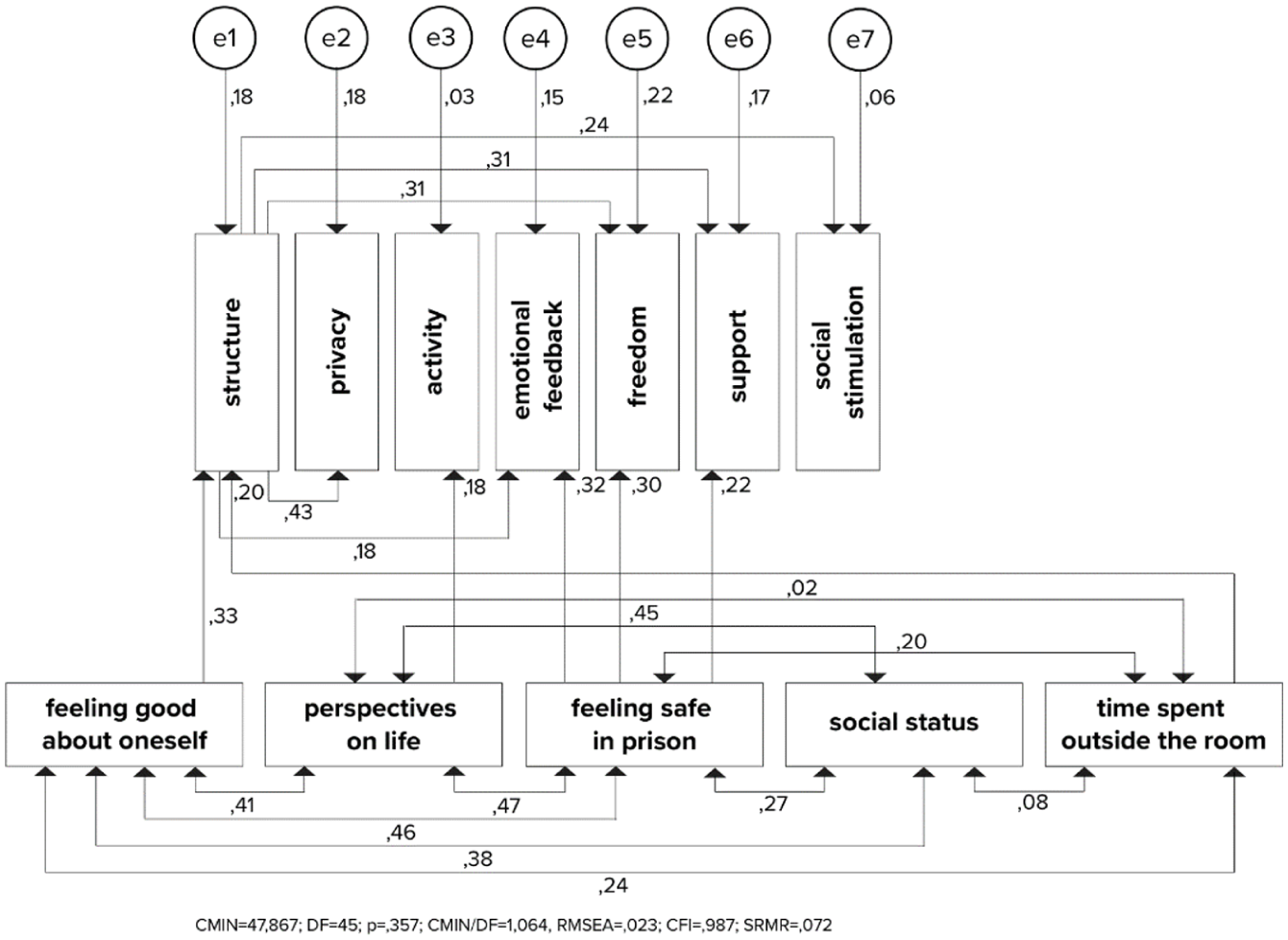
Modified model with standardized path coefficients.
Initial path analysis revealed that the relationships between some variables were not statistically significant (p > .05). Based on this finding, an iterative model development process was applied, where insignificant path coefficients were removed from the model one by one, and modification indices were taken into account. The goodness of fit values for the first modified model (χ²/df = 2.671; RMSEA = 0.118; CFI = 0.844; SRMR = 0.072) were generally found to be unacceptable (Suhr, 2006). Figure 2 presents the standardized path diagram of the final, modified model, refined through an iterative process of removing non-significant paths and considering modification indices.
The final model (Table 2) tests the relationships between factors such as detainees’ self-reported well-being, perception of safety, time spent outside the room, and perspective on life, with the environmental/contextual dimensions of prison life. In the analysis, direct effects were found. Feeling good about oneself has a significant positive effect on the perception of general structure of prison life (β = .33, p < .001). Time spent outside the room also shows a weak but statistically significant effect on perception of structure (β = .20, p = .018). Feeling safe in prison creates strong positive effects on detainees’ perception of freedom (β = .30, p < .001), emotional feedback (β = .32, p < .001), and support (β = .22, p = .010). Perspective on life has a borderline significant effect only on participation in activities (β = .18, p = .047).
Results of the Final SEM Path Analysis.
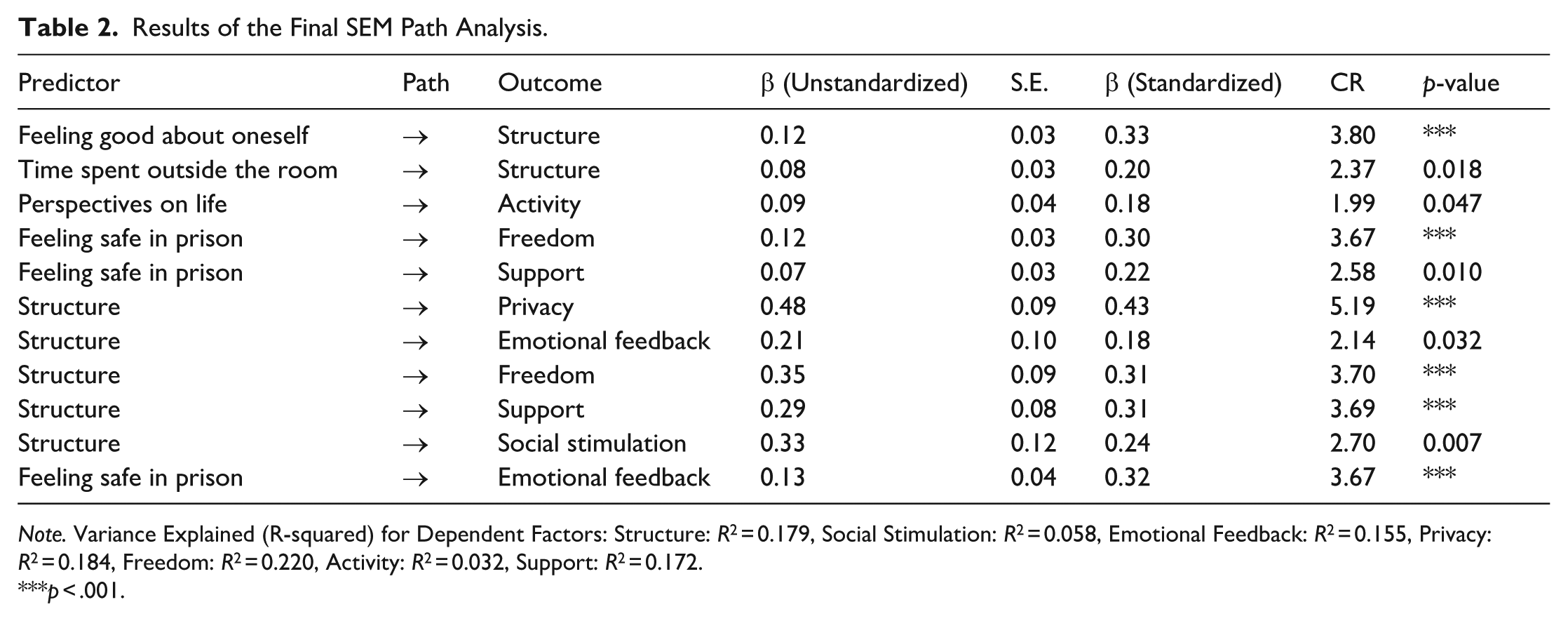
Note. Variance Explained (R-squared) for Dependent Factors: Structure: R2 = 0.179, Social Stimulation: R2 = 0.058, Emotional Feedback: R2 = 0.155, Privacy: R2 = 0.184, Freedom: R2 = 0.220, Activity: R2 = 0.032, Support: R2 = 0.172.
p < .001.
Discussion
This study reveals that perceptions of the prison environment among juvenile detainees are strongly influenced by their psychosocial well-being, particularly their feelings of security, self-worth, and overall outlook on life. These findings introduce a novel perspective to ecological systems theory, showing how an individual’s internal state significantly shapes their perception of external environmental factors.
Our results align with prior research that emphasizes the therapeutic role of structure and safety in correctional environments (Day et al., 2011; Marti, 2025). The observed link between perceived structure and privacy (β = .43) echoes Crosby et al.’s (2017) finding that a stable institutional framework is a prerequisite for psychosocial functioning.
However, our findings also introduce a valuable cultural nuance. The relationship between partial perceptions of safety and lower social interaction suggests that what might lead to gradual adaptation in Western contexts (Van der Helm et al., 2018) could trigger social withdrawal in the Turkish context. Similarly, the correlation between freedom of movement and privacy perception aligns with research on refugee youth, suggesting a universal need for a balance between openness and personal boundaries in rehabilitation environments, a finding supported by Ruhnke et al. (2024).
The lack of a significant relationship between social stimulation and environmental factors was an unexpected finding. This can be attributed to the limitations of the questions used to measure social stimulation, which focused on the quantity of interaction (e.g., number of friends, physical proximity). However, the psychological well-being of juveniles is more closely related to the quality of social bonds and the presence of emotional support. This finding suggests that it’s not the quantity but the perceived quality and supportive nature of social interactions in the detention environment that is important.
In contrast to studies focusing on individual pathology, our research highlights systemic environmental design as an equally important determinant of well-being, an approach emphasized by Arakelyan and Ager (2021). This focus allows our results to fill a significant gap in comparative criminology by examining a non-Western juvenile population and highlighting the interplay of institutional practices, spatial design, and psychosocial health within a holistic ecological model.
Conclusion and Implications
In conclusion, this study demonstrates that environmental and institutional factors such as perceived structure, support, safety, freedom of movement, and privacy have a direct effect on the psychosocial well-being of juvenile detainees in Türkiye. These findings support the use of Bronfenbrenner’s ecological systems theory as a comprehensive framework for understanding and improving correctional environments. From a comparative criminology perspective, our study offers insights into how localized environmental interventions can align with global rehabilitation principles while remaining culturally sensitive. Unlike many studies from Western contexts, our findings underscore the particular salience of predictability, communal space usage, and staff support in non-Western detention settings.
Policy and design recommendations include: (1) Designing correctional spaces that balance structure and autonomy (e.g., semi-open kitchens, courtyards), (2) Training staff to enhance supportive interpersonal climates, (3) Tailoring activities to individual motivations and promoting psychological ownership.
The study’s findings have limited generalizability as they were collected from a non-random, small sample across only three facilities in Türkiye. Our cross-sectional design prevents us from establishing causal relationships. The nested data structure, with participants from three distinct centers, also poses a risk of biased statistical results in standard analyses. Future research should incorporate multilevel modeling to better capture these complex interactions. Further studies should apply the same ecological framework in other cultural contexts to determine whether our findings are universal or culture-specific. Ultimately, this study highlights the need for juvenile justice reform efforts to move beyond punitive models and embrace an environment-centered rehabilitation approach rooted in psychosocial theory and architectural psychology.
Limitations of the Study and Future Research
This study has several key limitations. First, its findings lack generalizability as they are based on a small, non-random sample from only three facilities in Türkiye. The cross-sectional design also prevents us from establishing causal relationships. Additionally, reliance on self-reported data and selection bias due to officer-assisted recruitment may affect the results.
Future research should address these issues with longitudinal designs to examine how experiences evolve over time. Qualitative methods like in-depth interviews can offer richer insights into specific findings. Randomized controlled trials would be crucial for evaluating the effectiveness of interventions. Finally, cross-cultural studies are needed to determine which findings are universal and which are specific to the Turkish context.
Despite these limitations, this study is a foundational effort in Türkiye, offering an important ecological perspective on juvenile detainees’ psychosocial experiences and providing a basis for future research and policy.
Supplemental Material
sj-docx-1-ijo-10.1177_0306624X251395224 – Supplemental material for Psychosocial Experiences of Juvenile Detainees in Türkiye: An analysis of Environmental Factors from an Ecological Systems Perspective
Supplemental material, sj-docx-1-ijo-10.1177_0306624X251395224 for Psychosocial Experiences of Juvenile Detainees in Türkiye: An analysis of Environmental Factors from an Ecological Systems Perspective by Çiğsem Yağmur Yüksel and Mustafa Yeğin in International Journal of Offender Therapy and Comparative Criminology
Footnotes
Acknowledgements
The authors express their gratitude to the General Directorate of Prisons and Detention Houses for granting permission for the study and to the institutional staff for their support. They are also sincerely grateful to the juvenile detainees who enriched the analysis by sharing their experiences of detention and their perceptions of the environment. The authors also thank the anonymous reviewers for their valuable feedback, which greatly improved this manuscript. This study was produced as part of a doctoral thesis conducted at the Institute of Science, Çukurova University.

Ethical Considerations
This study received formal ethical approval from the University’s Non-Interventional Clinical Research Ethics Committee (03.06.2022/ No. 57) for its execution.
Consent to Participate
Permission to publish findings was later granted by the Ministry of Justice’s General Directorate of Prisons and Detention Houses (08.07.2024/ No. E.12934). Before data collection, informed consent was obtained through verbal explanations and signed forms from both participating juveniles and their legal guardians.
Funding
The authors received no financial support for the research, authorship, and/or publication of this article.
Declaration of Conflicting Interests
The authors declared no potential conflicts of interest with respect to the research, authorship, and/or publication of this article.
Data Availability Statement
The data that support the findings of this study are not publicly available due to the sensitive nature of the research concerning juvenile detainees and privacy considerations. However, the data can be obtained from the corresponding author upon reasonable request.
Supplemental Material
Supplemental material for this article is available online.
References
Supplementary Material
Please find the following supplemental material available below.
For Open Access articles published under a Creative Commons License, all supplemental material carries the same license as the article it is associated with.
For non-Open Access articles published, all supplemental material carries a non-exclusive license, and permission requests for re-use of supplemental material or any part of supplemental material shall be sent directly to the copyright owner as specified in the copyright notice associated with the article.
