




Abstract
Challenging antisocial behaviour is central to probation practice. Non-confrontational challenge has been identified as the most effective approach. Using conversation analysis to examine 25 probation sessions, we detail four common interactional resources practitioners use to challenge people subject to probation in a non-confrontational way: formulations, questions, assessments and advice-giving. We consider how these resources function and how they impact the ongoing interaction, specifically in terms of engagement and shifting clients’ perspectives. The findings here deepen the practical and theoretical understanding of this cornerstone of effective probation practice.
Plain Language Summary
Probation supervision is a key way people who have offended (hereafter clients) are supported to stop offending, usually through 1-to-1 meetings with a probation officer. In these meetings probation officers need to challenge clients’ problematic or antisocial behaviours, such as, for example, drug use or violence, to help clients stop offending. Previous research has shown when probation officers challenge clients in non-confrontational ways the outcomes (e.g., reduced reoffending) are better. However, what non-confrontational challenge looks like in probation meetings has not been examined in detail before, leaving us with a limited understanding of the ways probation officers do this and how they keep clients engaged in probation supervision whilst working to shift their perspective. In this study we use the method conversation analysis to examine how probation officers challenge clients’ problematic behaviours in non-confrontational ways during their meetings. Conversation analysis is a detailed approach to studying social interaction. We applied this method to analyse 25 video-recorded probation meetings between clients and probation officers. 9 probation officers and 18 clients participated in the study. We identified four common strategies probation officers used to challenge clients in non-confrontational ways: reframing what the client said (formulation), asking questions, giving an evaluation (assessment), and giving advice. Although all non-confrontational, these strategies had different outcomes in terms of keeping clients engaged in the discussions and shifting clients’ perspectives towards the problematic behaviour. Formulation, questioning and giving an evaluation appeared to be more effective, whereas advice giving resulted in clients being disengaged. This study deepens our understanding of what approaches probation officers can use to more effectively challenge clients’ problematic behaviours.
Literature Review
An important skill in probation practice is being able to challenge the antisocial comments or behaviours of people being supervised (clients). It is a central element in Trotter’s (2022, p. 123) prosocial modelling approach, where practitioners are tasked with ‘identifying client pro-social comments and actions; rewarding those comments and actions; presenting oneself as a pro-social model; and challenging antisocial or pro-criminal comments and actions’. A prosocial modelling approach with people who have offended can enable positive outcomes (Dowden & Andrews, 2004; Raynor et al., 2014; Trotter, 1996; Trotter & Evans, 2012). Continuing our examination of how prosocial modelling practice operates in situ in the interactions between practitioners and clients (Mullins et al., 2024), in this article we examine how probation officers challenge clients’ antisocial comments or behaviours during probation sessions.
Challenging Antisocial Behaviour in Probation Sessions
There is limited research specifically on the skill of challenging in work with people who have offended. Most research has looked at a range of practice skills, including challenging, linking these with outcomes, that is, reoffending rates, changes in clients’ skills, and engagement. Overall, practitioners’ ability to challenge, alongside other skills such as problem solving, has been linked with better outcomes (Dowden & Andrews, 2004; Marshall, 2005; Raynor et al., 2014; Trotter, 2022). In previous research, ‘challenge’ has been broadly considered under two categories: confrontational and non-confrontational. The latter has been identified as more effective (Dowden & Andrews, 2004; Marshall, 2005; Raynor et al., 2014; Trotter, 2022), although what that looks like in practice is not always clearly explained.
Dowden and Andrews (2004, p. 208) describe the skill of challenging as effective disapproval, that is, practitioners identify client’s antisocial behaviours or comments, explain their disapproval, and encourage the client to consider the short- and long-terms consequences. Then through effective use of authority, described as a firm-but-fair approach, by focussing on the behaviour and not the person, practitioners ‘guide the offender towards compliance’. When present together, effective disapproval and use of authority were linked to lower rates of recidivism. In a groupwork programme addressing sexual offending, Marshall and colleagues (Marshall, 2005; Marshall et al., 2003) identified therapists having a non-confrontational style, along with being warm, empathic and directive, corresponded with positive client outcomes, whereas having a confrontational style had a negative impact on client outcomes. They define confrontation as a ‘harsh approach to challenging clients . . . likely to be perceived by the clients as denigrating’ and a non-confrontative approach as ‘firm but supportive challenges’ (Marshall, 2005, p. 112), echoing Dowden and Andrews (2004). Raynor et al. (2014) included challenging under the skill cluster of prosocial modelling, recording when a practitioner ‘challenges antisocial behaviour or thinking in a positive way (e.g. emphasizes strengths) not confrontational or over critical’ (Vanstone & Raynor, 2012, p. 38) This skill cluster positively correlated with non-reconviction 12 months after the client had completed the probation order (r = .195, p < .05; Raynor et al., 2014, p. 248). Trotter’s (1996, 2004, 2012) studies on probation and child protection highlighted positive links between non-confrontational challenging and both client engagement and outcomes.
To our knowledge, the only study looking specifically at the skill of challenging in probation is by Trotter et al. (2017). Examining 116 audiotaped sessions between youth justice workers and clients, they found when challenge was non-confrontational, clients responded well in the moment and were more engaged in the session. However, both Dowden and Andrews (2004) and Trotter et al. (2017) identified practitioners infrequently used the skills of non-confrontational challenge (3% and 5%; 19% respectively). Trotter et al. (2017) further observed their findings did not indicate causation, recognising a practitioner may be more likely to use non-confrontational challenging with clients who are engaged.
Being able to challenge antisocial talk effectively is an important skill for practitioners. As highlighted, it has been linked to reduced reoffending and better client engagement, which in turn is linked to better outcomes (Polaschek, 2012; Sturgess et al., 2015). Despite this, previous studies note skilful challenge is not frequently well used in probation. Furthermore, beyond the simple confrontational/non-confrontational binary, examinations of how challenge is done in probation interactions is limited. Through detailed examination of the interactions between probation officers and clients, this study aims to outline how non-confrontational challenge operates in probation by detailing how practitioners do such challenges in their talk and how clients respond. Detailing the discursive features of non-confrontational challenge enables us to see why some approaches are effective in prompting a shift in client’s antisocial expressions and engaging clients in the moment, and why some are not, moving beyond the confrontational/non-confrontational binary and hopefully aiding better practice in probation.
Challenge as an Interactional Phenomenon
Previous correctional research has focused primarily on the practitioners’ actions with little, if any, consideration of the clients’ side. Understanding the interactional basis of challenge is important, as it gives insight into how practitioners’ challenges can be designed in situ to shift clients’ perspectives and maintain engagement. Although there is limited research in the field of corrections, there is a body of interactional research looking at how professionals challenge and advise clients in other settings, such as counselling and psychotherapy (Peräkylä et al., 2008), education (Benwell & Stokoe, 2002), health care (Heritage & Sefi, 1992), child welfare social work (Butler et al., 2016; Hepburn & Potter, 2011).
Common to this research is the understanding that people generally work to maintain co-operation and progressivity in their interactions with one another, even in settings where a more challenging approach may be expected or allowed (Benwell & Stokoe, 2002). This co-operation is achieved through alignment and affiliation, concepts used in conversation analysis to denote how we display co-operation in our talk with others. Alignment is considered at the structural level, in that it allows the activity of the talk continue, accepts the terms of this and matches the formal design preference (e.g. a matched response to the type of talk; accepting an invite, matching a greeting to a greeting). Stivers (2008) noted for example that saying ‘mmh’, or similar utterances, when listening to a person’s story, aligns with the activity of storytelling by letting them continue. Affiliation on the other hand is considered at the affective level, where ‘affiliative responses are maximally pro-social when they match the prior speaker’s evaluative stance, display empathy and/or cooperate with the preference of the prior action’ (Stivers et al., 2011). In the case of storytelling, for example, affiliation would be if the listener displays their agreement with the person’s stance or emotional expression (Stivers, 2008). When responses are disaligned or disaffiliating they can threaten the co-operation and ongoing talk (cf. Steensig, 2019; Stivers, 2008; Stivers et al., 2011).
Challenging someone’s talk is inherently uncooperative in interaction, as it expresses some disagreement which the interlocutors need to manage. Skilful challenge therefore needs to balance maintaining some co-operation in the talk, and promoting progressivity, while simultaneously threatening it. In considering psychotherapeutic sessions, Antaki (2008) describes some interactional resources practitioners use to challenge client’s views (e.g. lexical substitution, formulation, use of interrogatives) along a continuum of confrontational to co-operative. Confrontation is when practitioners explicitly contradict the client, where the practitioner ‘claims to reveal a truer state of affairs’ (Antaki, 2008, p. 27), whereas co-operation is more closely connected to and reflective of the client’s talk. Being closely connected to the client’s talk is likely more persuasive and acceptable to the client, as it seems the practitioner’s proposal is based on ‘something that has already and essentially been there in the [client’s] talk’ (Vehviläinen, 2003, p. 580). Relatedly, in studies about advice giving, giving advice cold created disalignment, as the speaker is moved from the role of storyteller/ informer/ complainer to the role of advisee. As such, practitioners needed to lay groundwork for advice to be accepted, for the person to be positioned interactionally as receptive to the advice (Butler et al., 2016; Hepburn & Potter, 2011; Heritage & Sefi, 1992).
Drawing on this previous body of research, here we examine some interactional resources practitioners use in probation to achieve this delicate balance, outlining the features which make them non-confrontational.
Methods and Data
We examined 25 video-recorded probation interviews using conversation analysis. The recordings were collected between 2007 and 2010 as part of the Jersey Supervision Skills Study (JS3; see Raynor et al., 2014 for fuller details). In the JS3, 95 video recorded probation sessions were examined to identify effective practice skills using a checklist, derived from international literature on effective correctional skills (Vanstone & Raynor, 2012). The study identified which skills were strongly associated with desistance over 1 and 2 years, including prosocial modelling. The researchers found when practitioners were observed using more of the skills, more frequently, their clients were less likely to be reconvicted than when practitioners did not demonstrate the skills. The skill of prosocial modelling, including non-confrontational challenge (Vanstone & Raynor, 2012), in particular correlated with client desistance (i.e. lower likelihood of reconviction) 1 year post order completion (r = .195, p < .05; Raynor et al., 2014). JS3 evidenced what skills work, but how they work remained in the ‘black box’. Through detailed interactional analysis, this study develops our understanding of the how. Specifically, our analysis was guided by the question: ‘How do practitioners challenge clients’ antisocial behaviour or comments, and how do clients respond?’
We received ethical approval for secondary analysis from the University of Edinburgh and the Jersey Probation and Aftercare Service. The third author selected 30 videos from the JS3 data set. Ten were randomly chosen from the 20% of interviews which scored highest on the practitioner’s use of skills, and 10 from the lower end of the distribution. The other 10 were from sequences (i.e. a number of interviews with the same client). Five were unsuitable due to recording quality or irrelevant content, leaving 25 for analysis in this part of the study, constituting 14 hours and 31 min of video recordings to be analysed. There were 9 practitioners (3 female; 6 male) and 18 clients (4 female; 14 male) in the recordings. All participants were white; 3 clients identified in the recordings as Madeirans. This seems to be reasonably representative of the population of Jersey (Jersey Government, 2024). The clients ranged in age from teenagers still attending school to adults who owned their own businesses. The specific offences leading to compulsory supervision are not known. However, there were a wide range of offences discussed in the recordings, including possession and supply of substances, drunk and disorderly behaviour, assault, resisting arrest, vandalism and intimate partner violence. To preserve anonymity and avoid the use of official case identifiers, the interviews are labelled here with a letter for the probation officer and number for the client. Where the session is from a sequence the video is noted in the brackets (e.g. (#2)). There is also a timestamp to identify when in the session the extract comes. All names and identifying information have been anonymised.
Conversation analysis (CA) involves the detailed examination of talk as interaction (Liddicoat, 2021). CA focusses on what people are doing in their talk and how they are doing it, rather than trying to identify the reasons behind this or what’s going on in people’s heads. It is based on four core assumptions (1) interaction is a form of social action; (2) interaction is orderly; (3) interaction creates and maintains intersubjectivity and (4) how people make sense of any given moment in interaction can be seen on the conversational surface (Mullins et al., 2022). What people are doing in their talk refers to the social actions in talk; for example, these include greeting, inviting, complaining, censuring, praising. People design what they say through, for example, the words they choose or how they tailor their talk to the recipient (e.g. drawing on shared knowledge; Mullins et al., 2022). Through CA we can analyse how people are responding to each other in the moment to create and navigate their shared understanding. As well as being applied to ‘everyday conversations’, conversation analysis has been used to study a wide range of institutional settings, and provides insight into how the business of such institutions is done, with the potential to enrich our understanding, reveal surprising findings and guide practice. Through analysing detailed transcripts of recorded naturally occurring interactions, we map out the patterns in the turn-by-turn sequential organisation of conversation. Given the centrality of talk in probation practice, CA is a valuable approach for understanding how probation practice operates.
The first author identified 99 instances of antisocial comments or behaviour across the 25 videos. The criteria used to identify comments as antisocial was drawn from the corrections literature, particularly literature regarding risk assessment of offending behaviour (Andrews & Bonta, 2016). Any comments or behaviour indicative of criminal behaviour, for example, reference to violent acts, or criminogenic need, for example, associating with antisocial peers, substance abuse, were included. Based on the corrections literature outlined above, 61 of the responses to these instances were identified as non-confrontational. These 61 responses were across 20 of the 25 videos, meaning in 5 of the video-recordings none of the responses to antisocial comments were identified as non-confrontational challenge. Analysing the non-confrontational responses, we identified interactional resources practitioners used and their impact on how the interactions unfolded. We found four interactional resources practitioners regularly used to challenge clients’ antisocial talk in this study: formulations, questions, assessments and advice giving. Formulations were identified in 10 of the sessions, questions in 13, assessments in 9 and advice-giving in 11. In terms of frequency, we counted the frequency of the use of these interactional resources in terms of sequences of non-confrontational challenge, rather than individual turns of talk. A sequence of talk, here a sequence of non-confrontational challenge to a client’s antisocial comment or behaviour, could stretch over one or two turns of talk, or several minutes (Schegloff, 2007). This was to capture the actions which happened over multiple turns of talk, for example when advice giving happened over a longer sequence rather than in one turn of talk. This approach however means some actions, such as questions, happened multiple times within a sequence (e.g. Extract 2) but were counted once for the sequence, considered as one action in the talk. Formulations were identified in sequences of talk where client’s antisocial comments or behaviour was challenged non-confrontationally 15 times, questions 24 times, assessments 16 times and advice-giving 22 times. At times more than one interactional resource was utilised in the same non-confrontational challenge sequence of talk, explaining why the frequency is greater than the overall instances (61).
The four terms we use to denote the interactional resources we have identified are used across many different professional and academic disciplines, with varying meanings, including in probation practice. For example, ‘formulation’ is used widely in probation practice to mean the hypothesising about the causes, antecedents and maintaining factors around a person’s offending or harmful behaviours to identify treatment and intervention pathways (Wheable & Davies, 2024). Similarly, assessment in probation refers to an analysis and understanding of the risks and needs relating to a person’s offending behaviour (Gelsthorpe & Morgan, 2013). In this paper, we draw our use of these terms from the conversation analysis methodology. That is, here these terms are used to denote the action the speaker is doing in their talk. As such we ask readers to suspend their disciplinary understanding of these terms, and, in reading the findings, consider what actions the practitioners and the clients are doing when they speak. The extracts we present here are examples of the patterns of interaction we identified in the probation sessions; that is, when practitioners used the interactional resources we identified, the pattern of client response and the impact on the conversational trajectory were broadly consistent across the probation sessions. The extracts presented were chosen for their clarity and brevity, and, as is convention in CA, presented for the reader to see how the interlocutors are responding to each other and making sense of the interaction in situ. The transciption symbols are outlined in Appendix 1.
Findings
Here we examine how the four interactional resources we have identified, that is, formulation, questions, assessment and advice giving, function in achieving the aims of challenge, that is, shifting the clients’ expressed perspectives and presenting as a prosocial model, whilst maintaining the progressivity of the talk. In the examples here we focus on non-confrontational challenge to home in on what the structure of such challenge looks like in practice. We also explore when non-confrontational challenge may not be effective in the interaction. In the extracts clients are denoted by C, and practitioners are denoted by P, or P1 and P2, where there are two.
Formulation
Firstly, we examine how practitioners use formulation to challenge clients’ antisocial talk. Formulation as an action in interaction is when one person proposes an upshot or gist version of another’s account (Heritage & Watson, 1979). That is, one person reproduces what the other person has said to give a summarised meaning. Formulations are a powerful device for challenge, as they are ostensibly co-operative in being grounded in the other person’s talk but fundamentally, they select, delete and transform this talk and interactionally they are difficult to disagree with (Antaki, 2008; Heritage & Watson, 1979). In extract 1 below, the client is on a probation order for drug related offences. Prior to this extract the client undertook a drug test, as a condition of his order. He has stated he has not used any class A drugs and continues to smoke cannabis. We join the interaction as the result of the drugs test is being shared. There are three people present.
Extract 1: D17 [15:20 min]
After confirming the client’s drug use, the practitioner gives an upshot formulation (l5) which topicalises the client’s cannabis use, and positions it as the last thing left to deal with. In probation sessions, questions about drug use, or alcohol use, generally position these actions as problematic – this is partially achieved by using the definite article which formalises the object (‘the cannabis’). By not leaving space for the client to respond, and directly moving into an open question about the client’s actions around their cannabis use, their agreement (affiliation) is presumed, that their cannabis use is something to be dealt with (Hepburn & Potter, 2011). The client’s response, in accounting for their cannabis use (l7–9), evidences they hear the practitioner’s formulation and question as a challenge to their cannabis use. However, by using mitigating phrases (‘a bit’, ‘not a lot’) and providing an account of prosocial activities which hinder their ability and time to smoke cannabis, the client presents their cannabis use as not problematic and, as such, possibly not in need of addressing. In these interactions the practitioners have the power to determine what is ‘challengeable’, due to their expertise (epistemic authority) and moral standing (deontic authority) afforded by their institutional position (Marie et al., 2015) and because they direct the discussion, as practitioners (usually) ask the questions and clients answer them (Drew & Heritage, 1992). What is ‘challengeable’ is not always evident to the client, as they do not necessarily hold that knowledge (e.g. risk factors), as we see later in extract 3a–c (Mullins & Kirkwood, 2024). Clients can and do resist the negative attributions associated with challenges to their behaviours, as evident here, by drawing on their greater epistemic rights to know their own circumstances (Heritage, 2012). However, beyond the interaction, inevitably the institutional narrative holds more weight (Phillips et al., 2025; Waldram, 2007; Warr, 2020).
The practitioner’s response at lines 13 and 15 seems more confrontational, in directly contradicting the client’s reports of ‘smoking a bit’ with their original intentions. However, even with direct contradictions practitioners worked to reduce the sense of confrontation, working to persuade the client to accept the institutional line rather than enforcing it. Here, P1 achieves this by positioning the challenge as an extension of their previous turn (‘cause’), hedging (‘I guess’), grounding it in reference to the client’s previous ‘initial aim’ and using the idiomatic phrase ‘knocked it on the head’. The client clearly rejects this (l16), but their smiling and the shared laughter indicates this is a delicate matter (Haakana, 2001), as the expectation here is to address any drug use.
The following two formulations are doing the ostensibly cooperative work here (l24&26, l32). As Antaki (2008) highlights the power of formulations is they appear co-operative whilst selecting certain aspects of the previous speaker’s talk, deleting others and ultimately transforming the talk to meet the formulator’s agenda, packaged in a way that strongly encourages the other to agree. Here the practitioner selects the first part of the client’s account (‘I’ve tried and tried and tried’), deletes the second part (‘I just can’t’), and transforms it into a description of the client’s motivation to stop. The sequential power of formulations is they strongly project an agreeing response; here we see that power as the client collaboratively completes the formulation (l.25). However, formulations can also be rejected, especially when they are too far removed from the affective stance of the original turn, as the client goes on to do (‘hmm, but-’). So, although the client aligns with the sequential preference, they do not affiliate with the function of the formulation. The practitioner’s further formulation appears to affiliate with the client’s account but by drawing on the idiomatic phrase ‘on one hand, on the other hand’, presents a negative contrast which the client collaboratively completes and extends, leaving the confirmation to the practitioner. Here the client aligns and affiliates with this formulation, supporting both the action and affective stance, that is, smoking cannabis is bad. This action aligns with the technique of Motivational Interviewing (MI), through the core skill of reflective listening (Miller & Rollnick, 2012), where the aim is to move clients into the position of arguing for the desired change (evoking change talk), as the client does on lines 33 and 34. Exploring the client’s ambivalence about his cannabis use continued for some time. The interactional dance where the practitioner frequently used formulations successfully directed the client’s talk towards a commitment to quitting by moving him into a sequential position of agreeing with the practitioner’s perspective.
Formulations were found to be a common way of challenging client’s antisocial comments and behaviours. They are powerful as they are ostensibly co-operative, appearing to affiliate and align with the other person’s talk, but centre the formulator’s agenda and they strongly encourage agreement. Interactionally, the practitioner is in the sequential position to propose the formulation, and repackage the client’s talk, giving them the power to shape this to the institutional agenda. However, formulations require the speaker to confirm or refute and in the process of selecting, deleting and transforming a client’s talk they can miss the mark and be too far removed from the actions and presumptions in the previous turn, leaving them open to rejection (Heritage & Watson, 1979). Being too detached from the client’s original talk can increase the client’s resistance to the challenge, and provide the grounds for this resistance (Antaki, 2008).
Questions
In extract 2, we examine how questions can challenge clients’ reported behaviour. Questions are a mainstay of institutional interactions, where primarily professionals ask the questions and clients answer them (Drew & Sorjonen, 2011). Questions can maintain a level of cooperation while challenging the other person, through managing alignment and affiliation in the interaction. There are a wide range of types of questions (e.g. open, closed) and approaches to questions (e.g. Socratic, solution focused) discussed in social work and corrections literature. For the purposes of this paper, ‘questions’ refers to the action of questioning in the interaction rather than a specific form or approach. In extract 2 below the client is doing an exercise around problem solving, as part of a programme devised by the service. The client has been describing how they behave when they are angry, that is, ‘lashing out’ and ‘punching people’. We join the interaction as the client expresses punching people can sometimes be ‘worth it’.
Extract 2: B9(#2) [11:27 min]
The client’s assertion here seeks confirmation, however clearly this is not a prosocial sentiment and, as such institutionally (if not personally), the practitioner cannot support it. By following up with a question, the practitioner withholds confirmation. However, as the question is ostensibly looking for clarification it extends the interactional space rather than directly disaligning or disaffiliating by refuting or censuring the statement. Yet the design of the question (e.g. using the word ‘actually’) indicates their disagreement. Questions constrain the respondent because they presume a response, hold presuppositions, and set an agenda (Hayano, 2013). As with extract 1, the practitioner is in a position of power in being able to direct the conversation and agenda as they are in the institutional position to ask the questions and topicalise what is ‘challengeable’, restricting the client’s options for response. The question design here formally projects agreement (Hayano, 2013), but in terms of action projects disagreement, so it has cross cutting preferences. The client’s response aligns with the structural design, however, by providing an account indicates they inferred the question was a challenge to their statement (Drew, 2018).
At lines 6 and 7, instead of giving advice or correcting the client the practitioner asks a further question urging the client to consider the consequences of punching out, which evokes an aligning (answer) and affiliative (agreement) response. As an upshot (‘so’) the practitioner goes on to form a further question, positioned to elicit the ‘correct’ response from the client, again rather than give the answer or advise him (Butler et al., 2016). Again, we see a cross-cutting preference at work, where there is a clear ‘right’ answer in terms of action preference, but the design projects a ‘yes’. However, before the practitioner has even finished their question, the client disagrees with the implication in the practitioner’s question, giving a compelling reason. Again, instead of correcting or advising the client the practitioner uses ‘okay’, as an aligning response, but without affiliating with the clients’ stance that there would be a circumstance in which violence was appropriate. The practitioner makes one last attempt using a question to shift the client’s stance. Again, however it is one with cross cutting preferences, so easy for the client to maintain their position by aligning with the design of the question (Hayano, 2013), even though they are not affiliating with the action.
Through the action of their questions, the practitioner is expressing their challenge to the client’s antisocial comment, an implication which is inferred by the client, without directly confronting or censuring them. However, through using this interrogative format, the client is able to respond in ways that maintain alignment (questioner and answerer role), and manage disaffiliation or disagreement. At lines 20 to 22, the practitioner removes them from the danger of becoming embroiled in an argument by orienting to the future work. This shift in focus is in line with the MI concept of ‘rolling with resistance’ (Miller & Rollnick, 2012), a common strategy to reduce conflict and work alongside clients to promote change at their pace.
Questions can clearly display the practitioner’s prosocial orientation, one goal of challenge within the prosocial modelling approach (Trotter, 2022), whilst also encouraging discussion with the client, rather than disengaging them. This strategy also allows the pair to maintain alignment in terms of their interactional roles, even if they do not agree on the viewpoint. This approach can reduce the practitioner’s interactional claim to knowledge about the client’s world, and as such does not position the practitioner as knowing ‘a truer state of affairs’ (Antaki, 2008, p. 27) but allows intersubjective understanding. Also, it can support a shift in client’s perspective. After further discussion here, using this question-and-answer format, the client highlighted they would now do things differently, specifically inform the practitioner.
Assessments
Practitioners also challenge clients’ antisocial talk using assessments. Assessment in this paper, based on CA understandings, refers to the performative action of a person taking an evaluative stance in a conversation, giving an indication of their judgement of what the other person is saying. Assessments ‘invoke, and make relevant, a range of normative principles for evaluating and regulating conduct’ (Edwards & Potter, 2017, p. 501), indicating a level of deontic authority held by the assessor – that is the interactional right, due to their status (e.g. probation officer), to say how conduct should be. In extract 3(a–c), the client explains his friends have been smoking cannabis but he covers his face so he is not inhaling it. We will track the practitioner’s use of assessments to challenge the client over the course of the session, to see the ebb and flow of this action, consider how the practitioner changes his approach and how a challenge can be pursued over the course of a session, as evident in extracts 1 and 2 in working to evoke a shift in perspective.
Extract 3a: A1 [6:46 min].
In response to the client’s description, the first practitioner (P1) is ‘catching up’ the other (P2) (‘I was saying’). However, their explanation clearly evaluates the client’s behaviour, albeit hedged (‘maybe’, ‘not really’). This assessment is pitched as objective, that is, evaluating the act of socialising with people smoking cannabis as bad is not restricted to P1’s judgement. Again, the practitioner sequentially and epistemically has the power in the interaction to determine what is topicalised, what object or behaviour is determined to be ‘challengeable’. Here the client is focussing on passively smoking as the problem, but P1 frames the issues as socialising with people smoking cannabis restricting the client’s allowable responses in the moment to focussing on who he is socialising with. Object-side assessments in relation to other people’s behaviour can be highly confrontational and misaligning, as they directly call into question the other’s perspective on the ‘object’ (e.g. socialising with people smoking cannabis; Potter et al., 2020). The sequentially aligned response to assessments in interaction is to agree with them (Pomerantz, 1984). Even though the assessment is not supposedly directed to the client for response, he disaligns and disaffiliates with P1’s assessment by evoking an extreme case formulation (‘everyone’ smokes it) which renders his own evaluation moot, as it’s unavoidable. In this way he comments on who he is socialising with by framing his peers’ behaviours as normative. The challenge, in this moment, indicates the practitioner’s disapproval of the behaviour however does not shift the client’s perspective, achieving one but not both goals of challenging. Shortly after they move on to talking about the client’s goals for probation, however, the practitioner returns repeatedly to the challenge around the client’s peer associations. This dropping and returning to a topic, particularly a challenge, is common and again in line with the MI concept of ‘rolling with resistance’ (Miller & Rollnick, 2002). The effectiveness of this strategy is likely grounded in its interactional function of maintaining co-operation through alignment, if not affiliation.
In 3b we join the session again where the practitioner is setting the scene as to why he has concerns about the client’s peer associations, particularly due to his previous history.
Extract 3b: A1 [21:24 min]
Following a collaborative storytelling, which creates a strong connection of alignment and affiliation where there is clear shared understanding, the practitioner provides another assessment of the client socialising with people using drugs. This time however, the assessment is subjective and positioned as clearly the practitioner’s judgement (‘I’m just a bit wary’). Such subject-side assessments ‘enable disagreement without contradiction’ (Edwards & Potter, 2017, p. 507), so in regards to evaluating others’ behaviours are less confrontational, as they allow for different perspectives. However, this quality also positions them as more easily rejectable. The client ostensibly disagrees (l94), however his expanded explanation of what he would do, implies the beginnings of agreement that he recognises socialising with peers using drugs as problematic, although it is ambiguous as to whether this recognition is purely related to heroin use, or extends to cannabis use. The practitioner moves to positively reinforce the client’s reported strategies (l101), which, in line with a prosocial modelling approach, functions to promote engagement (Mullins et al., 2024). The challenge to the client’s current antisocial behaviour is again dropped, and we re-join now at the very end of the session when the practitioner raises it for the last time.
Extract 3c: A1 [51:37 min]
Once again the practitioner provides a subject-side assessment (‘I don’t think’), one that echoes the object-side assessment in extract 3a but does not claim a universality of judgement. This assessment gets a lukewarm agreement initially. By highlighting his understanding of the client’s account that the people in question are different, the practitioner bolsters his challenge (Vehviläinen, 2003), before hanging his disagreement (but-, 206). Lines 207 to 209, can be heard as the client whole-heartedly affiliating with the practitioner’s stance, their challenge. Whether the client is referring to cannabis use or just heroin use though is ambiguous, due to the overlapping speech where the practitioner reclaims the floor. The practitioner moves to end the interaction by echoing the client’s sentiment in their formulation (‘better for myself’ – ‘all about you’), indicating the choices he makes will impact him and noting the practitioner wants him to succeed.
Practitioners use assessments, demonstrating an evaluative stance on something in the talk, to challenge client’s antisocial comments. Assessments allow for the practitioner to indicate their disapproval of the antisocial talk and make clear the normative expectations. Although object-side assessments, which imply the characterisation is inherent in the object, are more common in lay talk, they can be highly confrontative in relation to evaluating a reported belief or behaviour. Here they were commonly rejected, or evoked a conflictual response (as in extract 3c). In contrast, subject-side assessments, which place the judgement as belonging to the subject (e.g. the speaker), allowed for difference of opinion and as such were less confrontational (Edwards & Potter, 2017). This is not to say in probation practice object-side assessments are bad and subject-side assessments are good, but that they serve different functions in managing alignment and affiliation depending on what is happening in the talk. Object-side assessments, for example, may be useful when the practitioner does not want to claim they have access to the client’s experiences (Edwards & Potter, 2017).
Advice-Giving
Finally, we discuss the impact of advice-giving, or warning, as a way of challenging antisocial behaviour. As with the other interactional resources we have discussed, we refer to advice-giving as the action within the talk of one speaker outlining a preferred course of action to another speaker following their story (Couture & Sutherland, 2006). Here the client is explaining how he damaged his and another person’s car, driving in a carpark under the influence of alcohol. In his story, the client carefully frames his account using a device called ‘narrative reflexivity’ (Auburn, 2005), which is providing a commentary within the story (‘I shouldn’t of but’), highlighting he is aware his behaviour was problematic but notes the mitigating factors (‘in private carpark’, ‘had to move’).
Extract 4: H17 [3:50 min]
The practitioner uses a second story to introduce their challenge to the client’s reported antisocial behaviour. Second stories are a device that allow the respondent to connect with the speaker’s story without claiming their experience (Heritage, 2011). Using this second story to highlight the consequences of drink driving, even in a carpark, the practitioner is both advising and warning the client. The framing of this is problematic, in that it doesn’t explicitly disapprove of the behaviour. However, it is difficult for the practitioner to challenge this as the client has demonstrated an awareness of the issue of endangering someone. The difficulties with the interactional role shift from storyteller to advisee for alignment is well documented in conversation analysis literature (Heritage & Sefi, 1992; Vehviläinen, 2001), so unsurprisingly the advice-giving receives a lukewarm response (l12). In finishing their ‘advice’, the practitioner downgrades the antisocial behaviour (‘just sitting’) and affiliates with the client’s stance (‘exactly the same thing’) that, beyond damage to the car, the behaviour wasn’t too problematic. The client echoes this downgrade in their return to telling their story (‘only three feet’). There were some clear interactional difficulties for the practitioner in trying to challenge the client’s antisocial behaviour, without undermining progressivity and engagement. In trying to bring the interaction into alignment again through being more affiliative, the practitioner may have been interactionally ‘pushed’ into inadvertently supporting the client’s stance.
Throughout the data set the action of advice-giving, or warning, were often met with passive resistance (yeah, mm; Heritage & Sefi, 1992), with no shift in perspective for the client or display of an intersubjective understanding of what is the prosocial stance. In fact, the practitioner giving advice often resulted in the topic at hand petering out.
Discussion
Being able to challenge client’s antisocial behaviour is a cornerstone of effective probation practice, where previous research highlights non-confrontational approaches are most effective in achieving engagement and positive client outcomes (Bonta et al., 2008; Raynor et al., 2014; Trotter, 2022; Trotter et al., 2017). We identified four common interactional resources practitioners used to challenge clients in probation sessions: formulations, questions, assessment and advice-giving. These resources are actions practitioners are doing when they are talking to the clients.
Challenging another person’s talk or behaviour is inherently threatening, and puts the co-operation of the in situ interaction at risk. It may also shame clients, which can be a hindrance to behavioural change (Braithwaite, 1989; Maruna, 2001; Mullins & Kirkwood, 2019). Confrontational challenge is likely to be particularly problematic in probation practice, as it may involve both disaffiliation and disalignment, risking disagreement and disengagement. Practitioners have the institutional power in probation sessions to challenge clients’ behaviours and comments, and the inherent asymmetry in the relationship between practitioners and clients means ‘differential distribution of knowledge, rights to knowledge, access to conversational resources, and to participation in the interaction’ (Drew & Heritage, 1992, p. 49). This unequal relationship affects the role and behaviour of both, where the practitioner (usually) controls the discussion and the client is expected to respond and account for their behaviours. Within the moment, however, clients can and do resist practitioners’ challenges. Using formulations, questions and assessments, practitioners were able to challenge clients in a non-confrontational manner by preserving the interactional co-operation through maintaining alignment in the interaction, and managing the disaffiliation, that is, their disapproval of the reported anti-social behaviour. This was a delicate balance, requiring skilled use of these resources in close connection with the client’s talk (Vehviläinen, 2003). Approaches that work to maintain alignment but do not sufficiently convey disaffiliation with anti-social comments are unlikely to function as effective challenge. When practitioners achieved this delicate balance of maintaining alignment (i.e. structural roles) without affiliation (i.e. support for the content of the talk), there was clear continued engagement and often a shift in the client’s perspective within the session. As we have previously noted (Mullins & Kirkwood, 2019), and is evident in these examples, it is important any disapproval is directed at the behaviour rather than as a judgement of the person, that is, practitioners respond in an empathic rather than shaming manner. In line with a raft of interactional research (Heritage & Sefi, 1992; Jefferson & Lee, 1981; Jing-Ying, 2012), advice-giving, although often seemingly non-confrontational, was usually ineffective in promoting engagement or shifting client’s perspectives, primarily because it tends to disalign with the client’s talk. As a form of challenge, advice giving does not connect well to the client’s articulation of the matter. As such practitioners responding to anti-social talk should maintain structural alignment with clients’ talk whilst not supporting their stance, to create interactional space for clients to discuss and reflect on their anti-social behaviour.
Although individual practitioners did appear to have a ‘style’ in using certain interactional resources more than others, in the data practitioners used different interactional resources available to them in navigating the landscape of challenging. As in extracts 1, 2 and 3(a–c), these projects of challenge were often pursued by the practitioners over a longer sequence, being picked up and put down again, trying new hooks to encourage the client to shift their perspective. Understanding these interactional dynamics may indicate why the MI approach of rolling with resistance (Miller & Rollnick, 2002) can be effective, as it maintains alignment while avoiding affiliation. Success then was not usually achieved in one turn of talk, but took trail, error and gentle persistence as the practitioner skilfully navigated the interaction during a session. Further research in this area may be able to usefully identify transformative sequences both within and between sessions (Peräkylä, 2019). We also tentatively suggest a useful interactional relationship between positive reinforcement and challenge, where the former might help support the latter as it provides a point of affiliation to bolster the co-operation in the interaction from which the threat challenge poses to the engagement may be softened. The number of interviews analysed here is necessarily limited, however as CA requires focused in-depth transcription and detailed analysis of interactions such limited sample sizes are normal. Furthermore, we cannot specify how other communication issues such as learning difficulties or disabilities might impact the engagement in probation. However, overall, we believe that our application of CA adds more specificity to the practice of non-confrontational challenge and greater depth to how it works. This can help probation officers, and practitioners in helping professions, to understand and manage the micro-mechanics of challenge work, to demonstrate their prosocial stance and shift clients’ perspectives whilst maintaining engagement.
Footnotes
Appendix
Jefferson Transcription Notation.
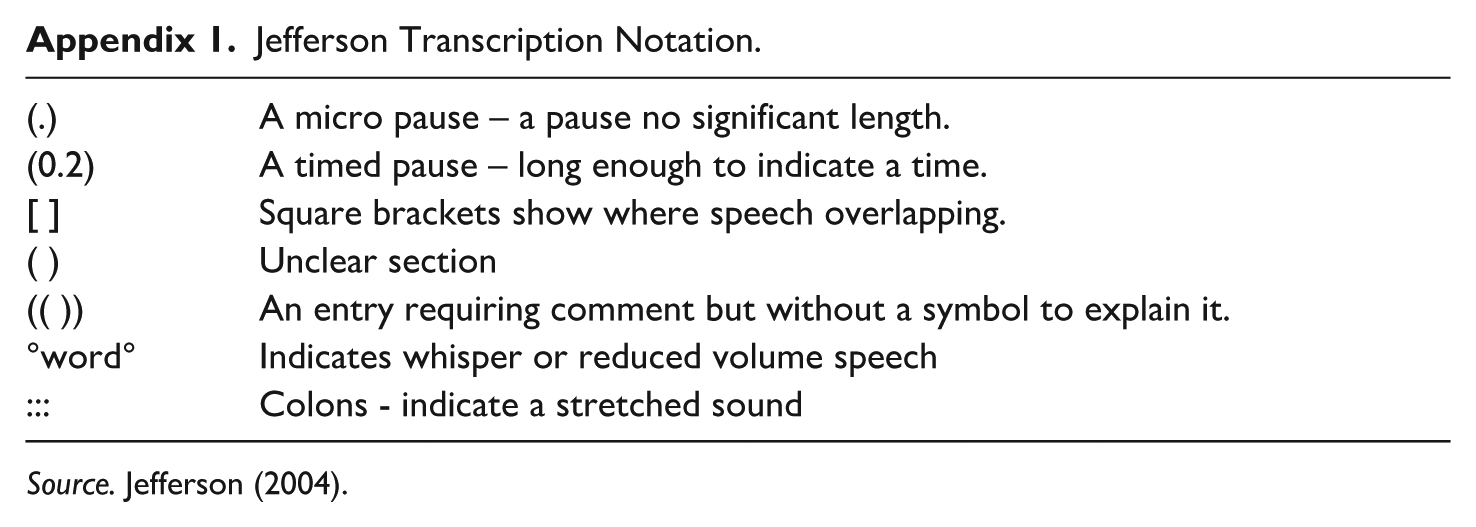
| (.) | A micro pause – a pause no significant length. |
| (0.2) | A timed pause – long enough to indicate a time. |
| [ ] | Square brackets show where speech overlapping. |
| ( ) | Unclear section |
| (( )) | An entry requiring comment but without a symbol to explain it. |
| °word° | Indicates whisper or reduced volume speech |
| ::: | Colons - indicate a stretched sound |
Source. Jefferson (2004).
Acknowledgements
We would like to thank the Jersey Probation and After-care Service for supporting this project, particularly Mike Cutland and Brian Heath, Chief Probation Officers, and the original participants of the Jersey Supervision Skills Study. We would also like to thank Maurice Vanstone and the reviewers for their helpful comments on earlier drafts.

Ethical Considerations
Ethical approval for the study was received from Jersey Probation and After-Care Service and the University of Edinburgh.
Informed Consent
Informed consent for participation and publication of the findings was given.
Funding
The authors disclosed receipt of the following financial support for the research, authorship, and/or publication of this article: This work was supported by the University of Edinburgh.
Declaration of Conflicting Interests
The authors declared no potential conflicts of interest with respect to the research, authorship, and/or publication of this article.
Data Availability Statement
The data informing this paper is not publicly available.
