




Abstract
This study examines the disparity between public perception and official statistics on recidivism rates in Japan and investigates the impacts of gender and age on these estimates. A web-based survey with 381 participants was conducted. Participants estimated five-year reimprisonment rates for seven offense categories and the overall average. Results showed that participants overestimated recidivism rates for all offenses, with significant overestimation for sex offenses, robbery, and drug offenses by 27.35, 23.11, and 18.54 percentage points, respectively. A two-factor analysis of variance revealed no significant gender effect on estimated rates. Age had a significant effect on drug offenses (F [4,371] = 3.13, p = .015, η2 = .033), with the 40s age group estimating higher rates than the 20s group. Findings underscore the discrepancies between public perception and actual recidivism, highlighting the need to understand these perceptions for effective policy and risk communication in the criminal justice system.
Why was the study done? Many people in Japan believe that former criminals are highly likely to reoffend, but these assumptions may not align with reality. Public perceptions of crime can shape policies and attitudes toward rehabilitation, yet misconceptions about recidivism rates can lead to unfair or ineffective approaches to criminal justice. This study aimed to examine these misunderstandings and provide accurate insights into recidivism trends. What did the researcher do? The study analyzed public opinions about recidivism rates in Japan, comparing these perceptions with actual crime data. The researcher asked people how likely they think released prisoners are to reoffend and compared their guesses to real data. The researcher also examined how factors like age of sex influence people’s beliefs about the likelihood of reoffending. What do the findings mean? The study found that the public often overestimates the likelihood of repeat offenses, especially for sex crimes, robbery, and drug-related crimes. Middle-aged individuals were more likely to assume higher recidivism rates compared to younger or older populations. These findings highlight the need for better public education on crime statistics. Misconceptions can shape opinions on law enforcement and sentencing policies, potentially leading to harsher approaches rather than effective rehabilitation strategies. By improving awareness and providing clear, factual information, policymakers and the public can engage in more balanced discussions about crime and justice.
Keywords
Introduction
Offender recidivism is a significant concern in criminal justice owing to its substantial social burden on security, medical care, and associated costs. Globally, the rate of reconvictions ranges from 17.6% to 54.9%, while the rate of reimprisonments ranges from 17.5% to 46.0% after 2 years (Yukhnenko et al., 2023). According to data from the U.S. Federal Bureau of Investigation, among 408,300 individuals released from prisons in 34 states in 2012, 62% were arrested within 3 years and 71% within 5 years, with recidivism rates being higher among men, Black and Hispanic offenders, and those aged 24 years or younger compared to women, White offenders, and those aged 40 years or older (Durose & Antenangeli, 2021). Several factors contribute to the variability in recidivism rates among sentenced prisoners. For instance, recidivism rates differ significantly across offense types: individuals convicted of property offenses exhibit higher recidivism rates than those convicted of violent offenses, while those convicted of sexual and traffic offenses generally exhibit lower rates than violent offenders. High rates of imprisonment, robbery, and homicide within a country are linked to an increased rate of reconviction among individuals released from prison, suggesting that a more criminogenic society corresponds to a greater likelihood of recidivism, assuming other factors remain constant (Yukhnenko et al., 2023). Furthermore, recidivism rates are influenced by various measurement variables, including definitional differences, the duration of follow-up, and the type of follow-up employed in studies. These factors can influence reported rates, thereby complicating direct comparisons between countries.
Japan considers recidivism a major issue in criminal justice policy, as repeat offenders commit a significant proportion of annual crimes (Takahashi, 2024). A national survey found that approximately 30% of repeat offenders accounted for roughly 60% of crimes from 1948 to 2006 (Someda, 2009). The Japanese Ministry of Justice uses reimprisonment rates to measure recidivism, which includes individuals released from penal institutions in a given year who commit a new crime within a certain period and are reincarcerated. Recent statistics on the follow-up of 19,953 individuals released from prisons across Japan in 2019 indicate that the reimprisonment rate was 3.7%, 15.7%, 25.0%, 30.3%, and 34.1% within 1 to 5 years, respectively (Ministry of Justice, 2024). For inmates released in 2022, the two-year reimprisonment rate was 13.2% for men and 10.8% for women. The highest rate was 18.3% for those aged 65 and older, compared to 8.2% for those under 30.
Recidivism rates are commonly used to assess the efficacy of treatment programs and criminal justice policies worldwide; however, public perception of these rates remains understudied. Roberts and White (1986) found that the public systematically overestimated recidivism rates for property offenses, crimes against persons, and sex offenses. Jung et al. (2014) found that Canadian university students perceived high recidivism for sexual and domestic violence, despite official rates being lower than other crimes, with female students estimating higher rates of domestic violence and crime overall compared to male students. The tendency to overestimate recidivism among the public is particularly pronounced for sex offenders. Brown et al. (2008) surveyed approximately 1,000 individuals on sex offender management, asking them to estimate the proportion of convicted sex offenders who would re-offend within a year. Most chose “26% to 50%,” with women generally estimating higher rates than men. Levenson et al. (2007) found community members estimated a 74% recidivism rate, much higher than the actual rate. Olver and Barlow (2010) discovered that Canadian students believe that approximately 60% of sex offenders would re-offend, again overestimating the true rate. Kamorowski et al. (2022) revealed the estimated average recidivism risk for sex offenders was 66.3%, which is significantly higher than those reported in previous studies (5%–15%). Corăbian et al. (2023) assessed university undergraduates’ attitudes, showing an estimated recidivism rate of 38% for treated individuals and 56% for untreated, both higher than official rates.
Community support is essential for successful reintegration of offenders. However, misconceptions about offenders often lead to ineffective criminal justice policies shaped more by flawed perceptions than by empirical evidence. When the public overestimates the likelihood of reoffending, it tends to advocate harsher sentencing laws, prolonged incarceration, and punitive measures driven by fear rather than data, which can fail to reduce crime, worsen prison overcrowding, and undermine rehabilitation efforts. Conversely, underestimating recidivism rates may result in excessively lenient policies that lack the necessary safeguards for public safety, neglecting the support structures crucial for rehabilitation. Ensuring that public awareness aligns with actual recidivism rates is therefore key to fostering balanced policies that promote accountability while supporting reintegration.
Several methodological limitations in previous studies have hindered definitive conclusions regarding the overestimation of recidivism. Few studies have directly compared public estimates with actual rates, often asking participants to estimate figures without standardized observation durations for offenders in the community, leading to inconsistencies in the assumed observation periods. Furthermore, the definition of recidivism varies, whether measured by rearrest, reconviction, or reimprisonment, necessitating clearer distinctions to ensure that participants share a unified understanding when responding to questions. Additionally, existing research has largely focused on sex offenders, with limited attention paid to other offense types; a broader analysis of public estimations across various crimes would provide a more comprehensive understanding of perceptions of recidivism.
Additionally, it remains unclear whether demographic variables contribute to the gap between the actual and estimated recidivism rates, highlighting the need for further investigation. Prior studies indicate that gender and age influence punitive attitudes toward offenders, with women typically favoring rehabilitation over harsh sentencing, whereas older individuals tend to exhibit more punitive views than their younger counterparts (Davey et al., 2024; Falco & Turner, 2014). Although the factors shaping punitive attitudes have been examined, the specific role of gender and age in the disparity between official statistics and estimated recidivism rates is insufficiently understood. Identifying groups prone to overestimating or underestimating recidivism would support the development of targeted educational efforts and effective justice policies. Furthermore, as most research on public perceptions of recidivism is confined to North America, broadening its scope to include diverse cultural contexts could yield valuable insights.
This study has two main objectives: (a) to examine the disparity between the general public’s perceptions and official statistics regarding recidivism rates for offenders in Japan, and (b) to examine the impact of gender and age on estimates of recidivism rates, controlling for other potential confounding factors, such as attitudes toward harsher punishment.
Methods
Participants
Participants registered as monitors with an online research firm were asked to complete a survey. The firm’s database encompasses over 10 million participants, representing a substantial cross-section of Japan’s demographic landscape, including diverse age groups and backgrounds. During recruitment, a control question was included in the survey to test attentiveness, as specified in the next subsection. The survey was administered to 400 participants for each of the five age groups (20–29, 30–39, 40–49, 50–59, and 60–69 years). The initial target group comprised 400 individuals, including 200 men and 200 women. Among the initial group, 19 individuals were eliminated owing to responses of “0” or “100” to all eight questions that assessed the number of repeat offenders. The final sample comprised 381 individuals (190 men and 191 women) with an average age of 44.85 years (standard deviation: 13.83 years).
Procedure
In January 2022, a web-based survey was conducted. The questionnaire cover page informed participants that their involvement was voluntary and they could withdraw at any time. Anonymity was assured, and submission of responses implied consent. The Directed Questions Scale (Maniaci & Rogge, 2014) was employed to exclude inattentive participants. They were instructed to choose a specific response, such as “This is a control question, so select ‘somewhat not applicable’.”
This study was approved by the Humanities and Social Sciences Research Ethics Committee of Ochanomizu University (No. 2021-175).
Measures
Estimated Recidivism Rate
The survey asked participants to estimate reimprisonment rates for seven offense types: homicide, robbery, arson, violation of the methamphetamine control law (drug offenses), forced sexual intercourse or indecent assault (sex offenses), injury or assault (violent offenses), and theft (property offenses). The rationale for focusing on these specific crime categories is that their recidivism rates are documented in official statistics. Additionally, they estimated the overall reimprisonment rate for all released offenders (general). To address methodological concerns and ensure comparability with official statistics, the survey used the 5-year reimprisonment rate from the Japanese White Paper on Crime as an indicator of reincarceration within 5 years post-release (Ministry of Justice, 2023). The White Paper’s definition was rephrased for clarity, asking participants to answer the following questions: The term “reimprisonment” in this context refers to an individual being released from prison and then reincarcerated within a five-year period for a new offense. It is important to note that this does not necessarily imply that the first offense and subsequent offense relate to the same crime. Among the 100 people who have committed each of the following offenses (including attempted offenses), how many do you think will be reincarcerated within five years of committing any offense after their release from prison? Provide a whole number between 0 and 100 as your answer.
As the White Paper on Crime includes data on attempts, participants were asked to include attempts in their responses. At the time of the survey, no news coverage specifically focused on high-profile cases involving ex-prison inmates, which could have potentially influenced participants’ estimates of recidivism rates.
Punitive Attitudes Toward Crime
The impact of an individual’s punitive attitude toward crime on the estimated recidivism rate was evaluated as a potential influencing factor. To measure these attitudes, a subscale from the Attitude Scale for Criminal Justice (Mukai & Fujino, 2020) was employed. This subscale focused on attitudes toward stricter punishment, and participants were asked to respond to five statements regarding their stance on punishment for criminals. Participants were instructed to indicate their level of agreement on a scale ranging from 1 (not at all agree) to 6 (strongly agree) for each statement. The average score of the five questions was calculated to represent participants’ overall attitudes toward punishment.
Fear of Crime
Fear of crime was also measured as a variable that could affect the estimated recidivism rate. Participants were asked to respond to the question “Do you typically feel uneasy about the possibility of becoming a victim of a crime?” using a 4-point Likert scale ranging from 1 (frequently) to 4 (not at all).
Statistical Analyses
The estimated recidivism rates for each offense were calculated by gender and age group and subsequently compared to official statistics from the 2023 White Paper on Crime (Ministry of Justice, 2023). Mean values and 95% confidence intervals (CIs) for estimated recidivism rates by offense, gender, and age group were computed. An estimate was deemed inaccurate if the 95% CI did not encompass the official recidivism rate. Following exploratory comparison with official statistics, the effects of gender and age group on recidivism estimates were evaluated. A two-way between-groups analysis of variance (ANOVA) was conducted, with the estimated recidivism rate as the dependent variable and the gender and age groups as independent variables, after evaluating the potential impact of punitive attitudes toward crime and fear of crime on gender and age groups.
Results
Public Estimated Recidivism Rates for Each Offense by Gender and Age Group
Table 1 presents the mean estimated 5-year recidivism rates per offense by gender and compares them with actual recidivism rates based on official Japanese statistics. According to official data, property offenses have the highest recidivism rate (41.6%), while homicide has the lowest (8.4%). Participants, however, estimated the highest recidivism for drug offenses (59.44%) and sex offenses (48.35%), consistent for both genders. The rightmost column of Table 1 shows the differences between estimated recidivism rates and official statistics, revealing that all estimates exceed official figures, notably for sex offenses with a 27.35-point disparity. The 95% CIs for estimated recidivism rates did not overlap with official statistics for any offense. Both men and women overestimated recidivism rates for all offense types except violent offenses. The findings indicate that participants generally overestimated recidivism rates for most offenses.
Public Estimated Recidivism Rates for Each Offense by Gender.
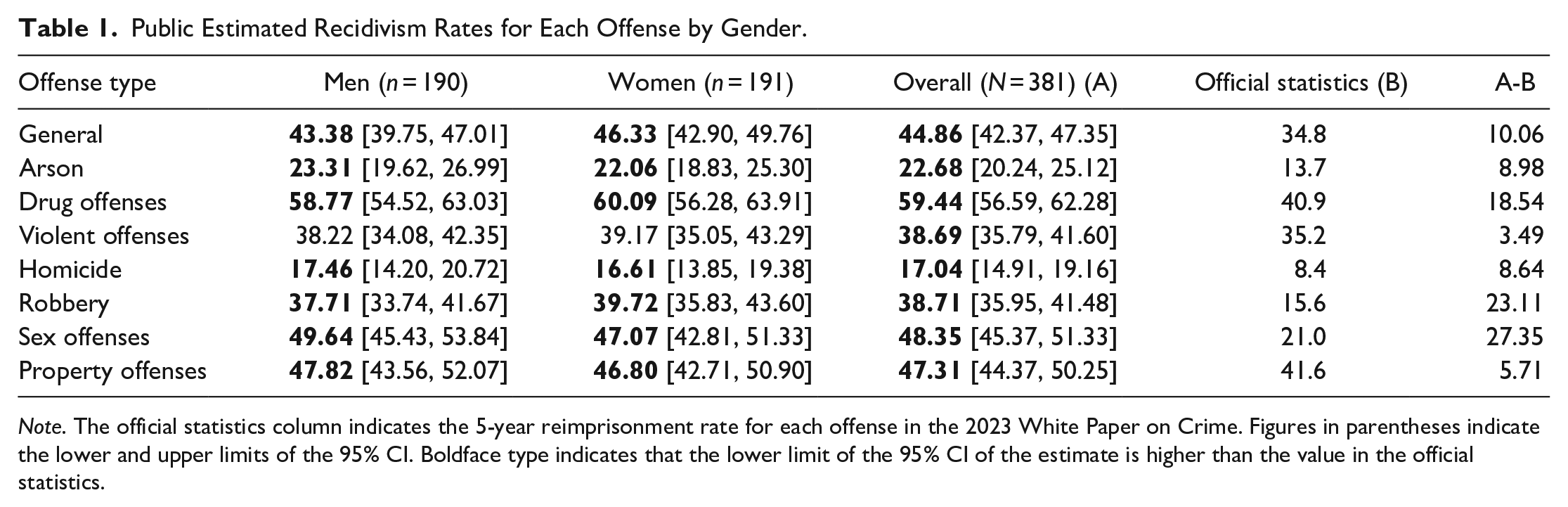
Note. The official statistics column indicates the 5-year reimprisonment rate for each offense in the 2023 White Paper on Crime. Figures in parentheses indicate the lower and upper limits of the 95% CI. Boldface type indicates that the lower limit of the 95% CI of the estimate is higher than the value in the official statistics.
Table 2 presents public-estimated recidivism rates by offense across five age groups. The public’s estimates were generally higher than official rates, except for those in their 20s, whose 95% CI lower limit was included in official statistics. Individuals in their 40s had the highest estimated rate of 48.62% for general offenses. Public estimates exceeded actual rates for arson, drug offenses, homicide, robbery, and sex offenses. Notably, the estimated recidivism rate for sex offenses among those in their 50s was 54.64%, overestimating the official rate of 21.0% by 33.64 percentage points. However, estimated rates closely matched official figures for violent offenses across all age groups and property offenses among individuals in their 20s, 30s, and 60s.
Public Estimated Recidivism Rates for Each Offense by Age Group.
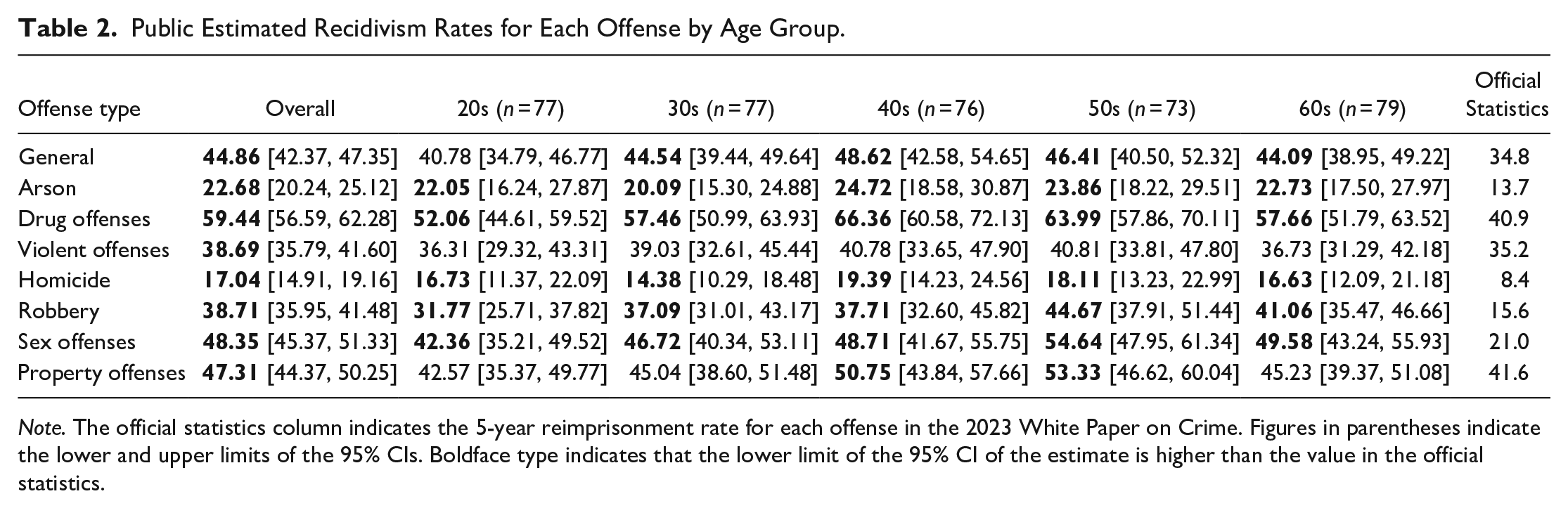
Note. The official statistics column indicates the 5-year reimprisonment rate for each offense in the 2023 White Paper on Crime. Figures in parentheses indicate the lower and upper limits of the 95% CIs. Boldface type indicates that the lower limit of the 95% CI of the estimate is higher than the value in the official statistics.
Impact of Gender and Age Group on Estimated Risk of Recidivism
Table 3 shows the descriptive statistics for punitive attitudes and fear of crime scores by gender and age group. An analysis was performed to identify disparities in punitive attitudes and fear of crime across these demographics. A two-factor ANOVA was conducted with the punitive attitude score as the dependent variable and gender and age group as independent variables. No significant differences were found in the main effect of gender (F [1, 371] = 0.01, p = .944, partial η2 = .000), the main effect of age group (F [4, 371] = 1.57, p = .182, partial η2 = .017), and the interaction (F [4, 371] = 0.99, p = .408, partial η2 = .011). A similar analysis was performed with the fear of crime score as the dependent variable and gender and age group as independent variables. No significant differences were found in the main effect of gender (F [1, 371] = 0.742, p = .654, partial η2 = .007), the main effect of age group (F [4, 371] = 0.612, p = .654, partial η2 = .007), and the interaction (F [4, 371] = 1.763, p = .136, partial η2 = .019).
Descriptive Statistics for Punitive Attitudes and Fear of Crime by Gender and Age Group.
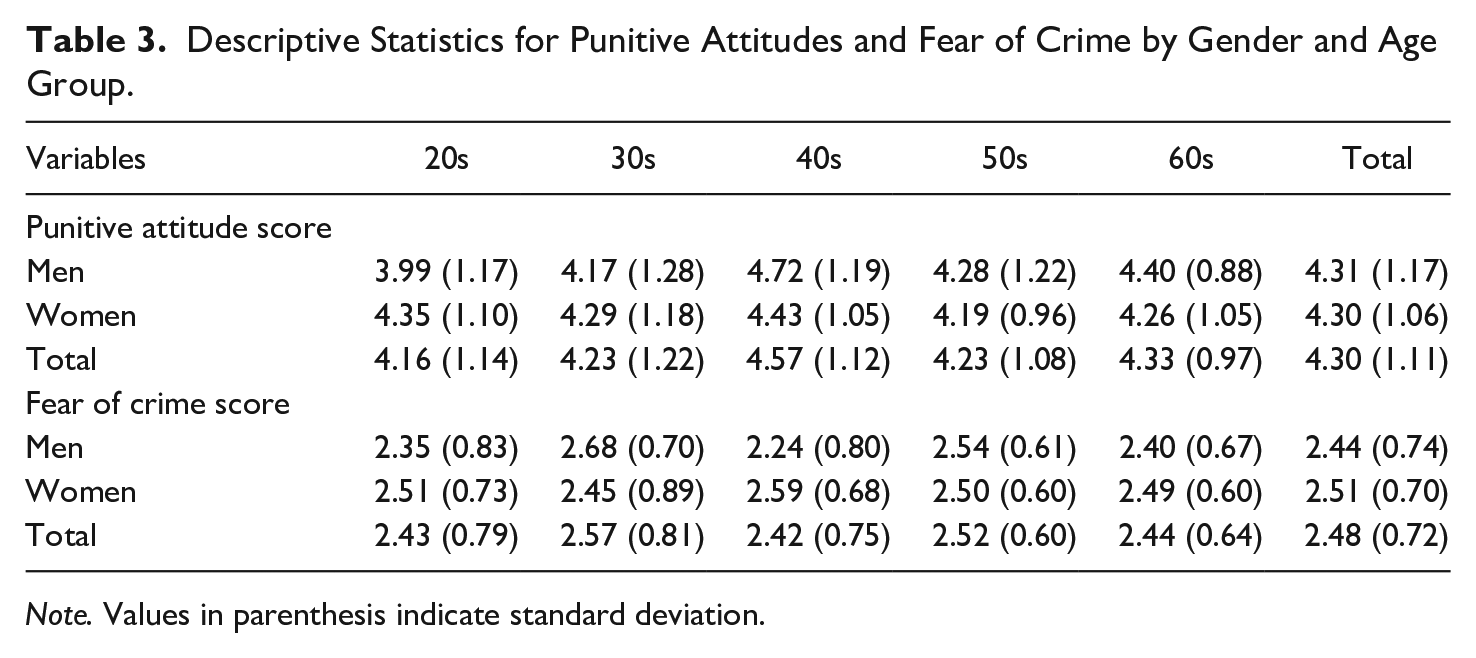
Note. Values in parenthesis indicate standard deviation.
Considering the previously discussed upwardly biased mean recidivism estimates, a 2-factor ANOVA with gender and age group as independent variables and recidivism estimates for each offense as dependent variables was conducted. Table 4 shows no significant gender effects on estimated recidivism rates for any offense. Age group effects were significant only for drug offenses (F [4,371] = 3.13, p = .015, partial η2 = .033). Post-hoc Tukey’s test revealed that the estimated recidivism rate was significantly higher in the 40s age group compared to the 20s age group.
Fixed-effects ANOVA Results Using the Estimation of Recidivism for Each Offense as the Dependent Variable.
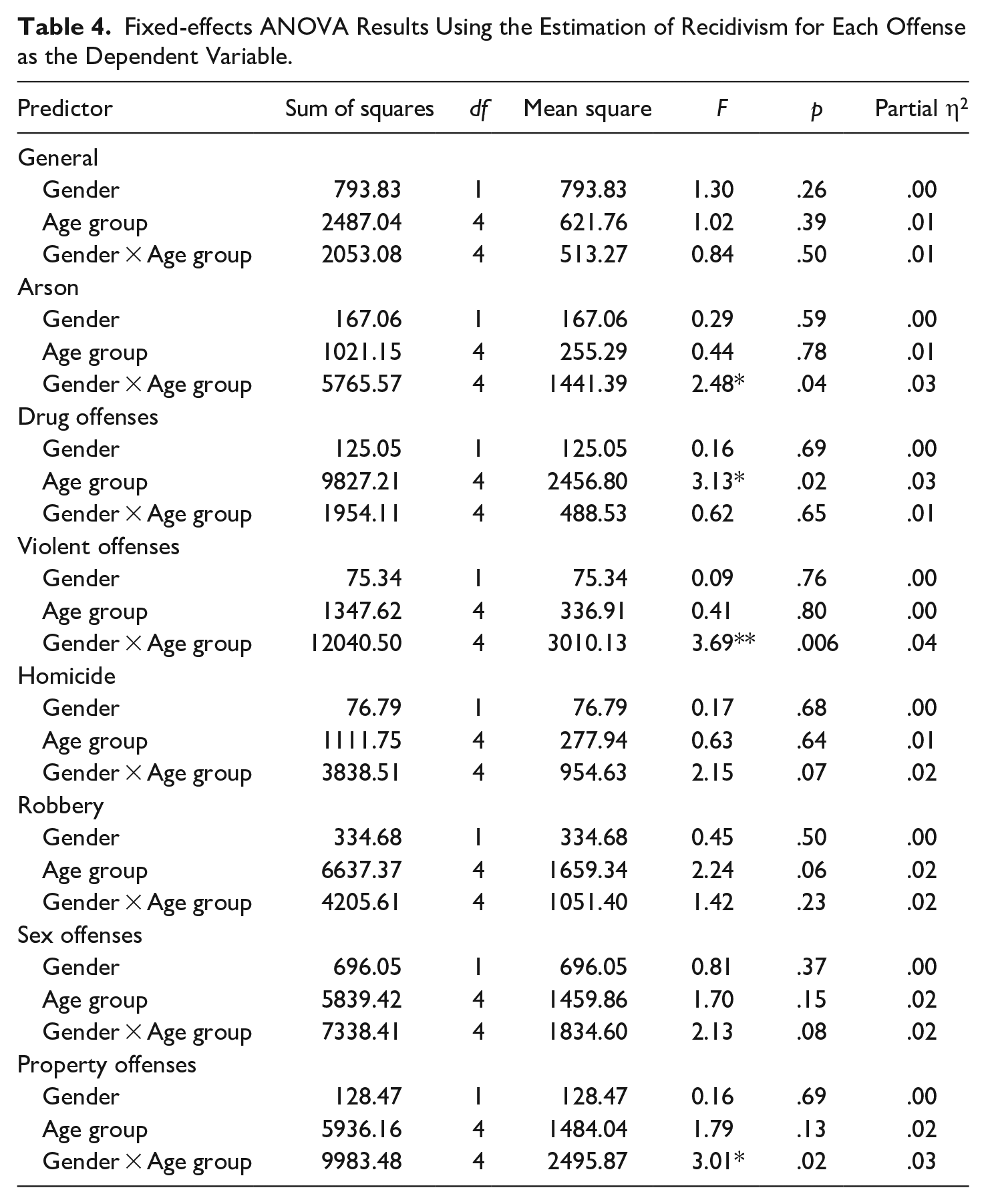
The ANOVA revealed a significant interaction effect between gender and age group on the estimated recidivism rates for arson, violent offenses, and property offenses (F [4,371] = 2.48, p = .044, partial η2 = .026 for arson; F [4,371] = 3.69, p = .006, partial η2 = .038 for violent offenses; F [4,371] = 3.01, p = .018, partial η2 = .031 for property offenses), suggesting that gender effects vary with age. Bonferroni-adjusted simple effects tests revealed that men in their 40s estimated higher arson recidivism rates than women of the same age and men in their 30s. Violent offense recidivism estimates were higher for men in their 40s compared to both men in their 20s and women in their 40s, and lower for men in their 20s compared to women in their 20s. Property offense estimates were higher for men in their 40s compared to women in their 40s and men in their 20s. These findings indicate that men in their 40s overestimated multiple recidivism rates.
Discussion
This study evaluated Japanese public perceptions of recidivism rates. Participants estimated recidivism rates highest for drug offenses, followed by sex offenses and property offenses. The findings indicate an overestimation of recidivism rates for individuals released from correctional facilities across all offense types. The gap between participants’ estimates and actual rates was particularly notable for sex offenses, robbery, and drug offenses compared to official statistics. No significant gender differences were found in estimated recidivism rates for any offense. By age, the highest mean estimated recidivism rates for arson, drug offenses, general offenses, and homicide were observed among those in their 40s, while the highest estimates for sex offenses, property offenses, and violent offenses were among those in their 50s. Although estimates from participants in their 20s were also higher than official statistics, they were closer to the actual rates and did not significantly differ for violent offenses, general offenses, and property offenses.
This disparity may be attributed to limited direct exposure to the criminal justice system and the speculative, anecdotal nature of crime information disseminated by the media, which often emphasizes sensational cases rather than providing a comprehensive overview of crime statistics. This phenomenon contributes to the discrepancy between public perceptions and empirical data. Furthermore, affective responses such as fear and anger play a significant role in shaping perceptions of crime. The subsequent subsections will examine in detail the factors underlying these discrepancies, particularly for offenses exhibiting substantial differences between estimated and actual rates.
Sex Offenses
The study demonstrates that the public’s perception of sex offender recidivism rates is significantly higher than official statistics, representing the largest discrepancy among the crimes examined. This finding aligns with Takahashi’s (2023) research involving female university students in Japan, suggesting that young women’s characteristics might influence the results. In this study, which included diverse age groups and men, participants consistently overestimated sex offense recidivism rates, indicating a general tendency to overestimate regardless of age or gender. Levenson et al. (2007) also observed that males frequently overestimate sex offender numbers, suggesting that this is a widespread societal phenomenon. The results presented in Table 4 support this assertion.
Multiple factors contribute to this disparity. Emotional responses such as fear, anger, and disgust towards sex offenses may result in an overestimation of recidivism risks. Media sensationalism, which focuses on high-profile violent cases, can potentially distort public understanding, leading to misconceptions about sexual violence (Serisier, 2017). Previous research has shown that sex offenders comprise a diverse group in terms of recidivism risk and require tailored interventions based on individual risk assessments (Hanson et al., 2009; Kim et al., 2016). However, the public’s tendency to generalize and rely on cognitive heuristics such as the availability heuristic, which focuses on easily recallable cases, may further complicate this issue.
Robbery
In this study, the participants’ estimates of the recidivism rate for robbery were 23.11 points higher than the official statistics, representing the second-largest deviation after sex crimes. This result suggests that citizens tend to overestimate the recidivism rate of robbery offenders. Robbery is regarded as a serious crime and a direct threat to personal safety and property rights and is therefore subject to strong condemnation. In particular, the possibility of physical harm, financial loss, and even long-term psychological trauma amplifies people’s aversion to robbery. Such negative feelings may lead to an exaggerated assessment of recidivism risk by respondents. Furthermore, existing research on social attitudes towards criminals suggests that former offenders with a history of violent, serious, or sex crimes tend to be evaluated more negatively than those with a history of non-violent or minor crimes (Hardcastle et al., 2011; Rogers et al., 2011). This tendency appears to stem from the perception that robbery is a crime committed deliberately and intentionally, rather than impulsively. As a result, the general public is more likely to perceive robbers as repeat offenders and to overestimate the risk of reoffending.
Drug Offenses
Official statistics indicate that the recidivism rate for drug offenders is the highest among all crime categories examined in this study. Nevertheless, the findings indicate that the public perceives the recidivism rate to be 59.4%, which is substantially higher than the actual figures, with a discrepancy of approximately 20 percentage points. Although this study does not allow for definitive conclusions regarding the underlying factors contributing to this perceptual discrepancy, several potential influences are identified. For instance, sensationalized media coverage of celebrity drug arrests may reinforce negative stereotypes of drug offenders, leading to an overestimation of recidivism rates. Additionally, drug prevention education in Japanese schools occasionally employs language that dehumanizes drug users, potentially fostering societal prejudice. Furthermore, research indicates that the lifetime prevalence of illicit drug use in Japan is considerably lower than in Western countries (Peacock et al., 2018; Shimane et al., 2021), suggesting that the drug issue is not fully recognized within Japanese society. From a public health perspective, while a low lifetime use rate is desirable, the limited social interaction with drug users may contribute to a misperception of recidivism rates among the general public. Given the scarcity of real-life encounters with drug users, media and educational narratives may heavily influence public perceptions, resulting in an overestimation of recidivism rates.
Practical Implications
The findings underscore the potential impact of public misconceptions about criminal recidivism. The prevalent tendency to overestimate recidivism rates has far-reaching implications, influencing policy decisions, shaping public attitudes, and hindering efforts to reintegrate former inmates.
A primary concern is the effect of inaccurate perceptions on criminal justice policies. Public pressure, often driven by exaggerated fears, can lead to policies that prioritize punitive measures over evidence-based rehabilitation. When policies are grounded in misconceptions rather than empirical research, they risk undermining both public safety and the successful reintegration of ex-offenders. Furthermore, widespread misjudgments about recidivism reinforce stigma and harmful stereotypes, making reintegration exceedingly challenging for those who have completed their sentences. Negative perceptions can create barriers to employment, housing, and social acceptance, perpetuating cycles of marginalization and reoffending. Research has shown that societal stigma reduces opportunities for ex-offenders, fostering a self-perpetuating system in which individuals struggle to reintegrate, thereby increasing their likelihood of recidivating (Moore et al., 2016a, b).
Given these challenges, ensuring that the public has accurate and nuanced information is essential. The dissemination of reliable data on recidivism rates can help dispel misconceptions and foster a more informed public discourse. Targeted educational initiatives are particularly effective in altering perceptions. This study reveals that while the Japanese public consistently overestimates recidivism rates, the degree of this discrepancy varies depending on the nature of the offense. Perceived recidivism rates for violent crimes tend to be more accurate, whereas those for sex offenses, robberies, and drug-related crimes are significantly misunderstood. This suggests that public education efforts should be tailored to address the specific offenses most affected by misperceptions. Furthermore, demographic factors contribute to the persistence of these misconceptions. Although gender did not significantly influence estimated recidivism rates, age-related differences were observed. Middle-aged and older men were more likely to overestimate reoffending rates, making them a potential target for educational interventions.
One promising strategy for mitigating stigma is enhancing interpersonal contact between the public and former offenders. Research indicates that social contact with rehabilitated individuals can effectively prevent stereotypes and promote more accurate perceptions (Hirschfield & Piquero, 2010; Rade et al., 2016). This approach is particularly pertinent in Japan, where the relatively low crime rate and incarceration rates in prison lead to limited firsthand exposure to justice-involved individuals. In the absence of direct interactions, public perceptions are frequently influenced by sensationalized media portrayals rather than empirical evidence.
Recent scholarly discourse underscores the significance of risk education, which entails equipping the public with the requisite knowledge and tools to more effectively assess various societal risks. Empirical studies suggest that the manner in which information regarding recidivism is conveyed can significantly shape public perceptions, particularly within judicial contexts (Hilton & Helmus, 2021). Consequently, future research should investigate strategies for effectively communicating these realities to the public. Ultimately, fostering a well-informed understanding of crime and recidivism is essential for formulating policies that judiciously balance public safety with rehabilitation. Achieving this requires a concerted effort to dispel misconceptions, reduce stigma, and facilitate the reintegration of former offenders while acknowledging the complexities of reoffending risks without resorting to oversimplification or demonization.
Limitations
This study had several inherent limitations. While examining the impact of age and gender on recidivism rate estimation, these factors alone provide an incomplete perspective, as a more comprehensive analysis incorporating additional demographic variables, such as educational background and economic status, could yield deeper insights. Additionally, because the study relied on a non-probability sample composed of registered monitors of a web research company, its findings may not adequately represent the broader population, highlighting the need for a more rigorous probability sampling method in future research to enhance generalizability. Furthermore, the study is limited to certain crime types, and a comparative analysis using official statistics across more specific crime categories could offer a more nuanced understanding of public perception.
Conclusion
This study found that the public tends to overestimate the recidivism rate for released offenders, regardless of the type of crime, albeit to varying degrees. Overestimation of recidivism rates, which has been demonstrated in previous studies, particularly for sex offenders, has also been observed in Japan. Although no significant gender effect on recidivism estimates was identified, the study revealed that middle-aged men are particularly prone to overestimating specific crimes. Future research should explore the relationship between gender, age, and recidivism estimates. Most studies on public perceptions of recidivism rates have been conducted in Canada and the United States, making this study’s focus on Japan a valuable addition to the academic understanding of cultural differences. Additional empirical research is needed to better understand public perceptions of re-offense risk and to develop strategies for successful reintegration.
Footnotes
Acknowledgements
Not applicable
Data availability statement
The datasets generated and/or analyzed during the current study are available from the corresponding author upon reasonable request.
Declaration of Conflicting Interests
The author declared no potential conflicts of interest with respect to the research, authorship, and/or publication of this article.
Funding
The author disclosed receipt of the following financial support for the research, authorship, and/or publication of this article: This work was supported by the Japan Society for the Promotion of Science (JSPS) Grants-in-Aid for Scientific Research (KAKENHI [grant number JP21K13705] and Grats-in-Aid by the Institute for Education and Human Development of Ochanomizu University. Any views expressed or errors are the sole responsibility of the author and do not reflect the views of any of the funders.
Ethical considerations
This study was approved by the Humanities and Social Sciences Research Ethics Committee of Ochanomizu University (approval number: 2021-175).
Consent to participate
The first part of the survey form clearly stated that participation was voluntary, that no one would be disadvantaged if they did not participate, and that they could withdraw consent at any time.
Consent for publication
Not applicable
