




Abstract
Justice-involved individuals who reach the end of their full prison sentence no longer benefit from the supervision and rehabilitation services offered by probation or parole. Some of these individuals, who have been assessed to be a high risk for sexual and violent reoffending and deemed to pose a significant violence risk in the community if released, are placed on a judicial order in Canada, and police are asked to supervise and manage the risk of these individuals. In the current study, the files of 45 high-risk, justice-involved individuals, who completed their sentences, were released from a Canadian prison into the province of Alberta, and supervised by police under a judicial order, were reviewed for the presence of criminogenic and non-criminogenic needs over the first year of release. The associations between these needs and proximal reintegration outcomes were examined. Our findings revealed that basic needs and responsivity issues were prevalent in the early part of supervision; however, these factors were unrelated to proximal reintegration success. In contrast, criminogenic needs were prevalent and associated with poorer reintegration. This study reinforces the role that police can play in monitoring and addressing criminogenic needs with the goal of reducing recidivism and employing the help of non-police supports to address non-criminogenic needs.
Over the past several decades, offender management and reintegration strategies have greatly evolved, and evidence-based practices have been at the forefront of risk reduction efforts. Specialized judicial contracts, such as parole orders, are standard practices to incentivize offender compliance by granting community access. However, those not eligible for these programs—specifically, individuals deemed at high risk of sexual or violent reoffending—fail to reap the advantages of community-based rehabilitation. Individuals incarcerated until the end of their sentence or warrant expiry date (WED) without being supervised in the community through parole are also often considered more likely to reoffend (Serin et al., 2020). In Canada, a judicial order may be granted by the courts. Such an order would include supervision and monitoring by local police to restrict the individual’s behaviors and movements, emulating the treatment typically received in a parole program (Harris, 2001). Although much has been written about those supervised by parole (e.g., Hyatt & Barnes, 2017; Serin et al., 2020), there is a paucity of information about individuals who are released at the end of their sentence, such as what is known about how they may criminogenically differ from paroled offenders. This paper examines the factors that may play an important role in stabilizing these high-risk individuals in the community who are no longer under the jurisdiction of the correctional or parole system. Specifically, we examine the relationship between the needs of supervised individuals and proximal reintegration outcomes for a sample of individuals who have been placed on a judicial order and supervised by a Canadian police service in the province of Alberta.
The Canadian Context
As previously mentioned, individuals who have never been supervised in the community while incarcerated are at a greater risk of reoffending than those who received community supervision (Serin et al., 2020). One way in which offenders are integrated into and supervised in the community is through parole (the reader is referred to Malakieh, 2020, for further information on the administration of adult corrections and correctional statistics). Parole is a type of conditional release that is granted while an individual is incarcerated as part of their sentence, where the individual is released to serve the remainder of their federal, or in some cases, provincial/territorial sentence in the community under the supervision of criminal justice professionals. This attempt at offender rehabilitation appears to be effective. In fact, the Parole Board of Canada (2020) reported that 91.4% of day parolees, 87.8% of full parolees, and 65.7% of those given statutory releases completed their parole sentences without committing a new offense. In Canada, everyone has the right to be assessed for full parole; however, a set of criteria determines eligibility (Corrections and Conditional Release Act, 1992). Individuals who fail to meet the criteria for parole, likely because they are deemed a high risk for committing another violent or sexual offense, may be kept incarcerated until their WED (Corrections and Conditional Release Act, 1992). At that point, the correctional system is legally obligated to release these individuals into the community (Correctional Service Canada [CSC], 2019).
However, in Canada, one effort to protect public safety includes a judicial restraint order, which can be applied after an individual has completed serving the entirety of their imprisonment sentence (or after their WED). Judicial restraint orders can be applied for and may be warranted to increase the protection of the public by incapacitating dangerous and high-risk individuals released without any community supervision (Harris, 2001; Lussier et al., 2010). Four months prior to the WED, the individual is assessed to determine whether they pose a threat to the community. If the individual is not deemed a significant threat, the individual is assisted with transportation to the release destination. However, if the individual is deemed a significant threat, a warrant expiry package is put together (i.e., comprising a summary of past offenses, information relevant to the perceived threat, and any other relevant documents; CSC, 2019). Once the release destination (i.e., where the inmate will be released at the end of their sentence) is decided, the police service that has jurisdiction over that location is notified and provided the package. The police service must apply through the courts for a judicial restraint order, and if granted by the courts, the judicial restraint order and corresponding conditions would be imposed upon the individual.
Under Section 810 of the Criminal Code of Canada (1985), there are two types of Section 810 judicial restraint orders under subsections 810.1 and 810.2. An 810.1 order is utilized when there are serious concerns that a person will commit a sexual offense against someone under the age of 16; in other words, the order applies to those who have a likelihood of offending against children, regardless of whether it involves contact or no contact (e.g., creation of child exploitative materials). An 810.2 order is applicable when there are concerns about an individual causing serious personal injury, whether violent or sexual; in other words, the order applies to those who are likely to assault another person or sexually assault an adult. Police apply to the courts requesting a Section 810 judicial restraint order, which may last 2 years, and extends supervision when no other relevant mandate exists (CSC, 2019; Harris, 2001). Consequently, the judge may order the individual to enter a recognizance (i.e., bond or agreement with conditions that must be adhered to), and if the individual refuses to enter the recognizance under Section 810, the judge may commit them for up to 1 year in prison (Criminal Code of Canada, 1985).
Little is known in the research literature about Section 810 judicial restraint orders. A recent study found that most of these individuals experienced childhood abuse and neglect, had less than a high school education, and experienced mental health problems (Jung & Kitura, 2022). Unsurprisingly, these individuals also had remarkable histories of frequent and severe criminal behaviors. In the United States, a few studies have examined post-release supervision programs (Crow & Smykla, 2021; Lawson et al., 2021; Ostermann, 2013; Weinrath et al., 2015). Contrasting from the Canadian context, these U.S. programs were initiated to provide a cost-effective and practical alternative to incarceration in already over-populated institutions (Weinrath et al., 2015). The hope was that these programs would reduce future offending by deterring individuals from reoffending through electronic monitoring tools and the threat of remand if they breach their conditions. Additionally, these programs advocate for behavioral programs and skills training to support offender rehabilitation. According to studies conducted by Cram (2020) and Gossner et al. (2016), these types of post-release supervision programs can aid in the formation of strategic collaborative relationships between police and criminal justice agencies that effectively reduce criminal behaviors and reoffending rates. In turn, it may lead to the more successful reintegration of individuals into society and positively impact overall community safety (Gossner et al., 2016).
Returning to the Canadian context, there is little to no training programs designed for police and limited empirical work that has examined police management of WED offenders who are no longer under the jurisdiction of provincial or federal corrections (see Jung & Kitura, 2022, for further discussion). In fact, risk management of individual offenders in the community is not a typical part of police work and when it is, it is often under a specialized police unit.
Theoretical Basis for Supervision Programs
Existing research suggests that post-release supervision programs are effective at reducing recidivism (Cram, 2020; Gossner et al., 2016; Lawson et al., 2021), particularly when these programs are provided to the highest risk individuals and target criminogenic needs or risk factors that contribute to one’s propensity to commit crime (Bonta & Andrews, 2017). According to Bonta and Andrews (2017), the risk, need, and responsivity (RNR) principles guide who should receive services, what services should target, and how programs may need to be tailored to each individual’s needs.
In discussing the RNR principles, the risk principle posits that individuals at a high risk of reoffending, as identified with validated risk assessment tools (Bourgon et al., 2018), should be prioritized to receive the most intensive programming (Bonta & Andrews, 2017). Weinrath et al.’s (2015) findings supported this notion, revealing that low-risk individuals given intensive supervision had higher recidivism rates. The need principle focuses on the importance of interventions targeting an individual’s criminogenic needs. These needs are dynamic and bidirectional, which may change over time and increase or decrease the probability of future criminal behavior (Jung, 2017). Often the central eight risk factors are cited as the most common criminogenic needs and include criminal history (which is a static risk factor), pro-criminal attitudes, antisocial personality patterns, education/employment problems, family/marital problems, poor use of leisure time, substance abuse, and antisocial companions (Bonta & Andrews, 2017). Lastly, the responsivity principle asserts that the intervention should be delivered in a way that considers an individual’s characteristics (e.g., motivation, learning style, cognitive deficits) that may impact the treatment response (Bonta & Andrews, 2017), and such characteristics may include poor treatment motivation, denial or minimization, developmental delays, learning disabilities, personality disorders, culture-specific concerns, mental health instability, and adverse childhood experiences (Jung, 2017). It is important to distinguish other needs that impact one’s violence risk (criminogenic needs) and treatment response (responsivity issues) from those that are more basic to functioning and to reintegrating back into society. These more basic needs may require immediate attention upon release from prison, such as housing, transportation, and funding; however, these are not central to reducing overall risk or engaging in rehabilitation.
Generally, individuals who receive services that adhere to the RNR principles (Bonta & Andrews, 2017) demonstrate decreased levels of recidivism (Dyck et al., 2018; Lowenkamp et al., 2006) and are less likely to engage in behaviors associated with criminality (e.g., substance abuse; Di Placido et al., 2006). While adherence to the RNR principles lends itself to the best outcomes, it does not always happen in practice. Miller and Maloney (2013) examined practitioners’ compliance to risk/needs assessment tools and found that while the tools were being completed, they were often not used to inform treatment decisions and were, in some cases, being unjustly manipulated to look supportive. In terms of criminogenic needs management in supervision, Bonta et al. (2010) found that probation officers rarely adhered to the RNR principles. Major criminogenic needs were largely ignored, and most of their time with clients was spent on enforcement rather than providing services that lead to behavioral changes. However, when probation officers were provided with training, they demonstrated significantly better adherence to the RNR principles (Bonta et al., 2011). Major criminogenic needs were more likely to be addressed in interventions, and supervisees reported better relationships with probation officers who had undergone the training. While we know that supervisors do not consistently follow the principles of the RNR framework in practice (Bonta et al., 2010; Miller & Maloney, 2013), there seem to be effective ways to improve these gaps in service providers (Bonta et al., 2011). Jung (2022) points out that not all needs are criminogenic, and it is important to distinguish between needs that are criminogenic and those that are responsivity issues but not criminogenic. Therefore, differentiating among basic needs, criminogenic needs, and responsivity issues in high-risk offenders can help criminal justice professionals better focus supervision on targets most relevant to reducing risk and further ensure they are adhering to the RNR principles.
The Current Study
Individuals supervised under a judicial order by police after serving their full sentence without parole have yet to be empirically examined. The current study examines the prevalence of the factors that challenge offender reintegration and the relationship between these factors and stability of these high-risk individuals in the community. Specifically, the files of individuals, who were placed on a judicial restraint order and were supervised by police detectives at a Canadian police service in Alberta, were reviewed for the presence of basic needs, criminogenic needs, and responsivity issues during their first year of supervision following the completion of serving their full sentence and release into the community. It was hypothesized that there would be a higher prevalence of all of these needs, particularly the basic ones. Hence, in addition to examining the prevalence, we examined whether these needs and responsivity challenges discriminated proximal reintegration success using three community outcomes, namely missed appointments, violating conditions, and recidivism, in order to identify any associations between basic needs, criminogenic needs, and responsivity issues with their stability in the community once released.
Method
Sample
The sample was comprised of 45 offenders placed on judicial orders and supervised in the community by a Canadian police service in Alberta upon their release from incarceration. At the time of writing, there is no data on individuals who are serving Section 810 judicial restraint orders in Canada by province/territory. Hence, it is unclear if the size of the sample is representative of those on these orders. For this particular police service, it was anecdotally reported that they receive a larger proportion of these requests because the inmate being released often identifies this city as their preferred place of residence upon release. Of these individuals, 26.7% (n = 12) were supervised under Section 810.1 (i.e., risk for sexual violence against children or “Sexual Offence,” per Criminal Code of Canada, 1985), and 73.3% (n = 33) were supervised under Section 810.2 (i.e., risk for violence, including sexual violence against adults, or “Serious Personal Injury Offence,” per Criminal Code of Canada, 1985). At the time of their release, the average age was 41.4 years (SD = 12.8) and ranged from 20.1 to 77.2 years. The majority of the sample identified as male (95.6%; n = 43), with the remaining individuals identifying as transgender female (4.4%; n = 2). With regards to ethnicity, 57.8% (n = 26) identified as Indigenous Peoples, 37.8% (n = 17) as White, and 4.4.% (n = 2) as Black.
Sources of Information
A compilation of documents was included in each case file, such as police risk assessments, case notes completed by supervising police detectives, video-recorded interviews, referral documents from federal corrections and agencies (e.g., police reports, institutional records), and reports of breaches and criminal offending during supervision as indicated by local, provincial, and federal criminal records.
Measures
Considering the number and breadth of sources reviewed in each case file, a coding process was developed to operationalize the variables of interest from the provided documentation. The present study is only one part of a broader research project aimed at examining the components relevant to the supervision of high-risk offenders under judicial orders and their subsequent reintegration into the community post-release (for the first study focused on establishing a profile of these offenders, refer to [Jung & Kitura, 2022]). A large number of variables were coded from the police documentation. Of note, items related to offender characteristics included demographic and personal information about the supervisee, such as age, ethnicity, education level, and criminal history.
To capture the range of needs across the first year of post-incarceration release, basic needs, criminogenic needs, and responsivity issues of the offender (see Bonta & Andrews, 2017; Jung, 2017, for further discussion of criminogenic needs and responsivity issues) were coded repeatedly for each 4-month time period (i.e., 0–4 months, 5–8 months, and 9–12 months). Specifically, there were seven basic needs noted: Basic necessities (e.g., food and clothing), hygiene, transportation, medical needs, victimization, finances, and accommodations. Of the central eight risk factors (Bonta & Andrews, 2017), six criminogenic needs were coded: Negative social influences, interpersonal conflict, substance use, employment, use of leisure time, and criminal attitudes. Also included were five responsivity issues: Poor attitude toward supervision, poor attitude toward treatment, denial of offending, culture or religion-specific concerns, and mental health instability. The total number of needs for each category, namely, basic, criminogenic, and responsivity, were calculated and formed continuous variables for each category of needs and for each 4-month period.
Similarly, for each 4-month period, the presence of whether the individual missed appointments, violated their supervision conditions, and/or reoffended (including formal charges for breaching conditions) was documented, using a dichotomous value of 0 for not applicable or not present and a value of 1 if the item is applicable or present.
Procedures
This research was conducted in collaboration with a local police service in Alberta, Canada, where a research agreement was approved. Further, the first author’s institutional research ethics board reviewed and approved the research prior to data collection.
The process of data collection consisted of two stages completed over 1 year. In the preliminary developmental phase, which lasted 2 months, the principal researcher and a trained research assistant examined five case files to determine an effective coding strategy. In turn, this process led to the development of the coding forms previously described. In the second phase, an extensive review of the case files was conducted to code the relevant variables over the remaining 10 months. Eligibility criteria for inclusion in the study included that the offender must have been supervised for at least 4 months, supervision occurred between 2016 and 2019, and an application for a Section 810 was in place (i.e., an application to the court is necessary before a judicial restraint order under subsections 810.1 and 810.2 is granted).
With these eligibility criteria, the first author evaluated and coded a total of 45 cases. For most cases reviewed, the first time period examined began when the police started supervising them (91.1%; n = 41). Relative to the duration of the research, 42.2% (n = 19) had supervision extend past the research end date, while 22.2% (n = 10) reached the end of supervision and 24.4% (n = 11) went on to be supervised under probation due to new supervision orders. Furthermore, 4.4% (n = 2) of offenders had moved to another jurisdiction beyond the supervision of the local police service, 4.4% (n = 2) had died during the period of supervision, and one case (2.2%) had the judicial order withdrawn by the court. Hence, the sample size varied (and reduced) over the course of the first year of post-release.
Statistical Analyses
Descriptive statistics and frequency analyses were employed to examine the prevalence of each variable of interest for this study across the three time periods for the first year of post-release time in the community. To examine the association between the summed totals for basic, criminogenic, and responsivity variables, we calculated the area under the receiver operating characteristic curve (AUC), which was used to evaluate the relationship between the total of each variable and three different community outcomes for each time period. AUC is the most commonly used and recommended effect size statistic for risk assessment scales, particularly for routine samples of offenders (Helmus & Babchishin, 2017; Rice & Harris, 2005). To evaluate the size of the AUC, we referred to Rice and Harris’s (2005) defined cut-offs with AUCs of 0.56 corresponding to a small effect, 0.64 reflecting a moderate effect, and 0.71 indicating a large effect.
Results
The following two sections provide a descriptive account of basic needs, criminogenic needs, and responsivity issues for the first year of post-release supervision of high-risk individuals under judicial orders and an examination of the associations between the total number of basic needs, criminogenic needs, and responsivity issues and reintegration outcomes (i.e., missed appointments, violation of supervision conditions, and recidivism).
Prevalence of Basic, Criminogenic, and Responsivity Variables
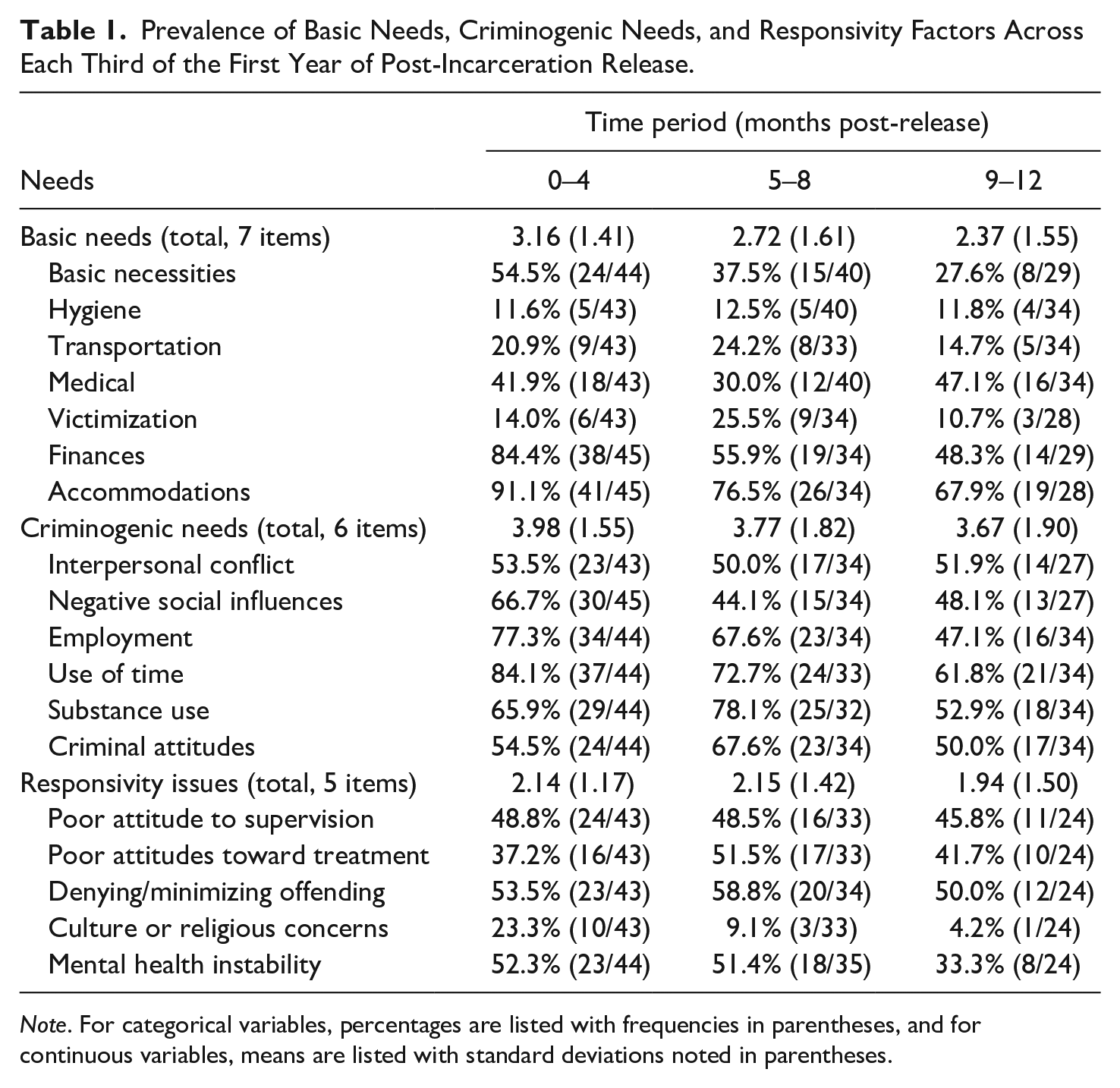
The prevalence of basic needs, criminogenic needs, and responsivity issues across the first year of supervision was examined in 4-month periods and is reported in Table 1. Of the basic needs examined, more than half of the sample experienced challenges with basic necessities, which include having no personal identification, food and/or clothing, finances, and accommodations. These were closely followed by medical problems. Most of these challenges were consistently present for approximately half or more of the sample across the year. Issues with maintaining hygiene, accessing transportation, and being victimized were only noted for less than a quarter of the sample across the first year of supervision. There seemed to be a declining trend for problems with basic necessities, finances, and accommodations across the year, although statistical significance was not examined (due to the varying sizes across each time period, which would not meet non-parametric assumptions for expected frequencies). Overall, the number of basic needs being unfulfilled decreased over time, F(1, 23) = 4.60, p = .043.
Prevalence of Basic Needs, Criminogenic Needs, and Responsivity Factors Across Each Third of the First Year of Post-Incarceration Release.
Note. For categorical variables, percentages are listed with frequencies in parentheses, and for continuous variables, means are listed with standard deviations noted in parentheses.
When we examined criminogenic needs, over half of the sample experienced all six needs at the start of their supervision (ranging from 53.5% to 84.1%). Of these needs, employment and poor use of their leisure time were present for over three-quarters of the sample. Although there appeared to be a decline across the year for employment challenges, the decline for poor use of time was less prominent, with over half of the sample continuing to use their time poorly. What appeared unchanged across the year were conflicts with interpersonal relationships (i.e., remained around 50% of the sample across the three time periods), substance use (i.e., trended upward and then declined), and criminal attitudes (i.e., also appeared to increase and then declined). There seemed to be a more consistent decrease when negative social influences were examined, with two-thirds of the sample associating with negative peers in the first 4 months and by months 5 to 8, less than half were associated with negative peers. The total number of criminogenic needs did not change across time periods, F(1, 22) = 1.09, p = .307.
Responsivity issues were present at the start of supervision for half or less of the sample. Only two of the issues examined seemed to trend downwards (i.e., declined across the year), which included concerns about cultural or religious connections and mental health instability. However, no consistent trends showing increasing or declining prevalence appeared to emerge for poor attitudes to supervision, poor attitudes toward treatment, or tendencies to minimize or deny offending behaviors. Also, the overall number of responsivity issues did not change across the year, F(1, 27) = 0.012, p = .914.
Associations with Proximal Reintegration Outcomes
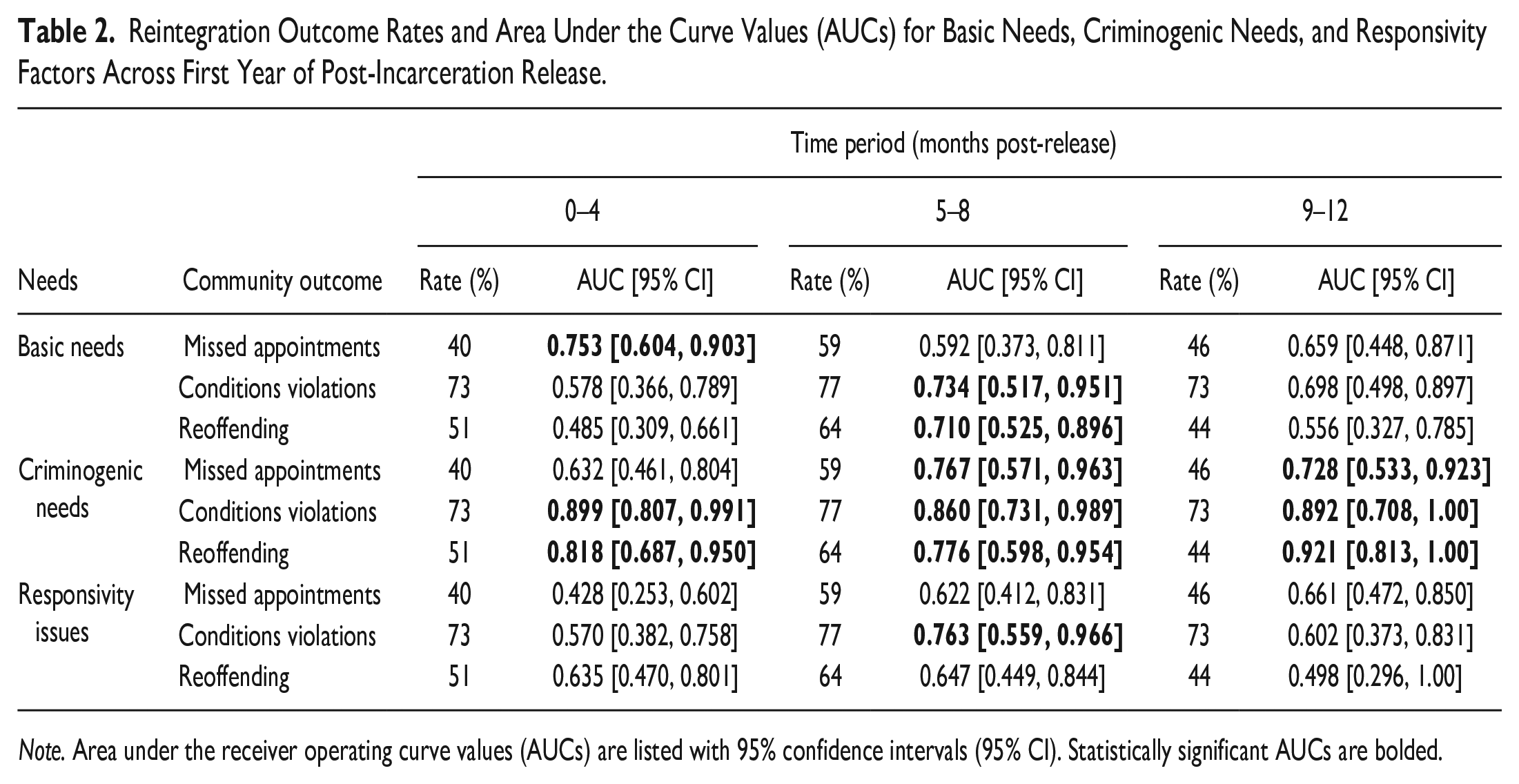
Basic needs, criminogenic needs, and responsivity issues were further examined to see if they were associated with three proximal community outcomes during each 4-month time period: Missed appointments, violations of conditions, and reoffending (see Table 2 for AUCs and outcome rates).
Reintegration Outcome Rates and Area Under the Curve Values (AUCs) for Basic Needs, Criminogenic Needs, and Responsivity Factors Across First Year of Post-Incarceration Release.
Note. Area under the receiver operating curve values (AUCs) are listed with 95% confidence intervals (95% CI). Statistically significant AUCs are bolded.
When basic needs were examined, it was found that in the first time period (i.e., first 4 months of supervision), the total number of basic needs was significantly associated with missed appointments with a large effect size (AUC = 0.753, 95% CI [0.604, 0.903]; see Table 2); however, basic needs were not associated with missed appointments in the subsequent months of supervision. Furthermore, basic needs were not associated with violations of conditions or reoffending in the initial 4 months of post-release supervision or the latter 4 months of supervision in the first year following release. Basic needs did appear to be related to violations of conditions (AUC = 0.734, 95% CI [0.517, 0.951]) and reoffending (AUC = 0.710, 95% CI [0.525, 0.896]), but only during the second third of the first year (i.e., months 5–8).
Similar to the basic needs, the total number of criminogenic needs across all time periods was also evaluated, and we found that criminogenic needs were significantly associated with all three outcomes. As seen in Table 2, criminogenic needs were associated with missed appointments for the latter two time periods (months 5–8 and months 9–12) but not for the first 4 months of supervision. Consistent across all three time periods for this first year of supervision, criminogenic needs discriminated between those who violated their supervision conditions and those who did not, and there were large effect sizes, with AUCs ranging from 0.860 to 0.899. A similar pattern was found between criminogenic needs and reoffending, and effect sizes were also large across each time period, with AUCs ranging from 0.776 to 0.921.
When we examined responsivity issues, no significant associations emerged between the number of responsivity issues and the outcomes of missed appointments and reoffending, indicating that the individuals’ characteristics were not related to their successes while released into the community. One outcome, namely condition violations, was significantly associated with responsivity issues for one of the three time periods (AUC = 0.763), which was during the midpoint of the first year of supervision.
Discussion
This study examined the needs of individuals who completed their criminal sentence and were placed on a judicial order under Section 810 of the Criminal Code of Canada (1985) across the first year of police supervision. This group of offenders has received little attention in the literature, and it is hoped this study provides some empirical findings that may guide the allocation of services for what may be a challenging group of justice-involved individuals. Our findings revealed many challenges that police are likely to face in the first year of supervision. Not surprisingly, we found that many non-criminogenic needs were prevalent among these individuals placed on judicial orders at the start of supervision, such as basic needs for identification and clothing, money, and accommodations. Across the first year, basic needs declined. Despite the decline, these non-criminogenic needs were largely unrelated to reintegration outcomes. Another set of non-criminogenic factors, namely responsivity issues, was examined. Half of the sample presented with three responsivity issues, which included negative attitudes toward supervision, not accepting responsibility for their offending behavior, and experiencing mental health issues. Unlike basic needs, responsivity challenges stayed the same across the first year, but similar to basic needs, they were not consistently related to proximal reintegration outcomes.
When criminogenic needs were examined, over half exhibited these risk factors and these needs were consistently represented by half of the sample in each time period across the year. Hence, they did not decline over the first year. More importantly, they were shown to be essential to address in supervision, as evidenced by their associations with stability in the community, which included attending appointments, adhering to supervision conditions, and no reoffending behaviors reported within the same time period.
These findings provide some empirical support for how apparent it is that nearly all released offenders faced funding and housing challenges upon release. Over the course of supervision, the relevance of these needs declined. It may not be surprising that, anecdotally, police personnel who supervised these individuals indicated that much of their time was spent helping the offender find accommodations, get valid identification cards needed to apply for social supports, and find suitable accommodations that permit housing convicted offenders. Missing appointments as an indicator of community success seemed to be associated with problems with basic needs and not with criminogenic needs in the first few months of supervision. It is reasonable to assume that the lack of basic needs, such as access to transportation, financial ability to purchase bus passes, and having a place to live, may become stumbling blocks for released individuals to make appointments post-incarceration. Therefore, attending supervision appointments with police would be considered less of a priority. Williams and Rumpf (2020) identified several burdens on those released from incarceration, and competing demands plague post-incarceration life, such as being told to attend multiple appointments to substance abuse programming, parole, reentry homes, and other appointments. Further research should examine how to best support released individuals as these competing demands are likely to be unachievable without some calculated collaboration pre-release.
Although basic needs declined during the first year of post-release, criminogenic needs and responsivity issues seem to generally remain steady throughout supervision. If criminogenic needs and responsivity issues do not decrease, then risk is not decreasing for offenders, and it is unlikely that engagement in treatment or other interventions is maximally effective. As many police detectives reported in their supervision of the individuals in this study’s sample, little time was spent focusing on risk factors directly related to the offender’s criminal behaviors. Hence, the unchanged number of criminogenic needs attests to the misdirection of resources and suggests that supervision focused solely on basic needs rather than on what police were assigned to help reduce, which should have been criminogenic needs. Consequently, less intensive focus on the offender’s criminogenic needs would mean that the goal to reduce their overall violence risk and subsequent reoffending would likely fail. Without other resources or personnel who could address basic needs (e.g., disciplines such as nursing, social work, occupational therapists), which in other contexts would typically be addressed by parole or probation services if the individual had not yet reached the warrant expiry of their sentence, police would be expected to continue to spend their time navigating and addressing non-criminogenic basic needs and less time targeting the offender’s criminogenic needs. The latter (focus on criminogenic risk factors) would be aligned with the goal of ensuring community safety, which is the role expected of police.
It is also relevant to note that our study reports responsivity issues remained present throughout the first year of supervision and did not discriminate between those who reoffended and those who did not. Although the responsivity principle purports that interventions should be delivered in a way that considers an individual’s specific responsivity issues, it is worth mentioning that responsivity issues were explicitly identified as needing intervention; therefore, unchangeable characteristics (e.g., race, sex) were not recorded as a responsivity issue unless it was noted by the supervisor or supervisee as warranting attention. As raised by Taxman (2014) and Lockwood (2022), interventions to address responsivity issues (as well as criminogenic needs) are assumed to be available through the criminal justice system. Systemic responsivity (as per Taxman, 2014; alternatively, “political responsivity”, as per Lockwood, 2022), which refers to the availability of programming through the justice system to address the needs and responsivity issues of an individual, may challenge the ability to address responsivity issues over the course of supervision. This is especially relevant given that more than half of our sample were identified as Indigenous. As such, there are likely to be multiple disadvantages for justice-involved individuals, which often lead to challenges in accessing resources and supports (Quirouette, 2016). Although less relevant to our study’s urban sample, these challenges can be exacerbated when police are supervising in rural contexts where resources are further limited (Ricciardelli, 2018).
Although police practices have evolved in recent decades from intuitive approaches to contemporary efforts in intelligent policing that have greatly moved toward evidence-based policing practices in various areas of policing (see Mitchell & Huey, 2018, for emerging areas), it was apparent in our research that offender supervision is not a typical police practice. Huey et al. (2022) draw attention to the increased demands on police who have growing responsibilities, such as being tasked with increased knowledge on risk management and consequently, face significantly greater administrative burden. When it comes to these present-day roles in risk management and offender supervision, it is abundantly clear that police may need to borrow from the existing offender management literature on community supervision by probation and parole. Both probation and parole systems in Canada and most parts of the world have advanced in the effectiveness of their work with offenders, which involves validated assessment of risk and criminogenic needs, developing reintegration plans, and the implementation of services for the offender that involve both social work tasks and counseling services within their organizations, while also outsourcing to community partner agencies as well. Supervision and management of offenders that focus on offenders’ safe reintegration into the community and finding programs necessary to help make this happen are typical duties of a probation and parole officer. There has been little to no empirical work that has examined police management of released offenders who are no longer under the jurisdiction of parole or correctional services.
Some work coming out of the U.K. examined the policing efforts in supervising registered sex offenders in the community. Much of this is preliminary and has examined police perspectives on supervising sexual offenders. Kewley (2017) conducted a mixed method study to examine police attitudes toward the individuals who they manage, and how they perceive using risk assessment (and in particular the active risk management system tool, ARMS), risk management planning, and strengths-based approaches. They found several themes emerged, such as negative views of individuals who commit sexual crimes, which would interfere with their ability to support a process of reintegration. This finding runs in contrast with the comprehensive principles of effective rehabilitation that emphasize the responsivity principle should be adhered to in order to effect the greatest reduction in risk, and specific responsivity factors that should be considered, such as the individual’s characteristics and learning styles, also include external factors, such as the therapist’s characteristics (e.g., interpersonal sensitivity, displaying prosocial behaviors, show empathy and warmth, nonconfrontative; Looman et al., 2005).
Although the research on police perspectives provides some insights into what may be obstacles for police to effectively supervise and manage individuals who are at a high risk for violence and sexual violence, work is needed to identify how to integrate these approaches in offender management. Kewley (2017) also found that police identified their training and supervision to be insufficient and that working with people who have committed sexual offenses was seen as a specialist role for police and therefore requires specialized training. In other research, it has been shown that police are suspicious of employing tools such as the ARMS or other risk classifications, and preference for experience and one’s expertise seem to take precedence when making decisions (Hoggett et al., 2019). A way to overcome these tensions may be to ensure trainers come in with specialized and relevant expertise as police trainees may question the legitimacy of the trainers and potentially the content of the training (Mydlowski & Turner-Moore, 2023).
In the current climate of social media campaigns to “defund the police,” it is not surprising that some have voiced there is some misdirection of the movement, while others highlighted that it is not an abolitionist movement, per se, but rather a shift to redirect funds to community initiatives (Stewart, 2020). Some have pointed out that shifting resources from policing to other agencies has yet to be demonstrated as an evidence-supported initiative and that police could retain resources but need to be held accountable for those responsibilities (Lum et al., 2022). Hence, moving forward, police supervision of justice-involved individuals, who are at significant risk for violent behavior and under judicial restraint orders, should be supported with extensive training of police officers in offender management, risk assessment, and engagement approaches. For instance, an approach that has shown encouraging results in the training of probation in these areas is the Strategic Training Initiative in Community Supervision (STICS), which was introduced by Bonta et al (2011) to increase engagement and adherence to RNR principles.
In addition to increasing relevant training for police, it may be more effective to employ a multi-agency and multi-level collaborative approach (Pemberton et al., 2023). This approach could be internally established by adopting a multidisciplinary team approach that includes non-police personnel with background expertise in supporting the non-criminogenic needs of the supervised individual (e.g., those with a social work, psychology, or occupational therapy background). These elements would help address the extensive resources needed to support these released individuals while the police could focus on the criminogenic needs that would be most associated with reducing overall risk and increasing community safety, thereby increasing accountability that is much needed (Lum et al., 2022). Alternatively, much has been written about an integrated offender management approach that takes a coordinated effort to build closer links among criminal justice organizations (Cram, 2020, 2023). Integrated offender management is where the most persistent and problematic offenders are identified and managed collaboratively by the police and other criminal justice agencies who work together (Cram, 2023). Through the collective knowledge, expertise, and resources of these partners, there is a more optimistic hope that the traditional police culture as seen through police perception research can be transformed as a cultural shift to a rehabilitative model.
This study provides a start to understanding the challenges police will face without the proper training and resources to manage resource-intensive clients to ensure community safety. However, it is important to note that there are limitations of this study, and therefore further research is needed. One limitation is the size of the study’s sample, which limits our statistical power to detect differences. Also, this study focuses on proximal outcomes rather than distal ones, and therefore predictive value of the criminogenic needs cannot be assumed, based on these analyses. With a larger sample and a longer follow-up, replication of these findings is necessary to draw conclusions that are broadly generalizable and applicable to other Canadian provinces, as well as non-Canadian jurisdictions. Methodologically, the reliance on police files and criminal records as indicators of recidivism, which is a common issue in validation research, is limiting. Although our study employed a number of sources, such as federal, provincial, and local criminal records, use of reported incidents in the form of official records are likely to underestimate the presence and the number of recidivistic events—both reported and not reported.
Future research that not only replicates this study and increases the sample included in the analyses, but also explores supervision beyond the first year of supervision is needed to examine the trajectory of stability and reintegration when a high risk individual has been released into the community. More importantly, examining what interventions were applied during supervision and the relevance of those interventions (e.g., was the intervention associated with the criminogenic needs of the individual) is important to examine the effectiveness of police risk management. As noted, the present study only included those offenders who have been placed on a judicial order and supervised by law enforcement. Therefore, it lacks access to a comparison group of released individuals, such as a matched group (by risk level) of inmates who successfully applied for parole. Evaluation of the effectiveness of police supervision (i.e., whether supervision is associated with reductions in risk for reoffending) is needed to establish whether these efforts culminate in the reduction in risk as we would hope to see. Hence, a comparable group from the same jurisdictional region would be needed to assess if supervision under judicial orders like Section 810 reduces overall risk and violent offenses compared to those who were not placed on an order and imprisoned until the end of their sentence.
Even with these limitations, the present study provides a much-needed examination of whether the presence of criminogenic and non-criminogenic needs is associated with reintegration success and allows us to begin forming a picture of the intensity of resources required to supervise this population. Of particular note, these findings offer a preliminary examination of the challenges that police face in their added role as a supervisor who is expected to manage the risk of released individuals at significantly higher risk for violence and sexual violence than the average person released on parole or probation. An argument can be made that specialized training—for police, in general or for those police who are placed in these distinct roles—is very much warranted and should be made compulsory if the goal is to ultimately reduce the potential harm of these individuals, as well as to ensure that the police organization’s liability is not increased. A second argument, based on our findings, is that police organizations need to direct some resources to address non-criminogenic basic needs, such as accommodations, financial aid, and general health, and to recruit the assistance of human specialists, such as social workers, to provide these essential supports that complement the work of police.
Footnotes
Author Note
We express our deep appreciation to the Edmonton Police Service for providing the opportunity to conduct this research and particularly acknowledge the help of Dacia Chiarieri-Hirsch, Kim Jay, and Megan Wells. The points of view expressed in this article do not necessarily represent the views of the Edmonton Police Service.
Declaration of Conflicting Interests
The author(s) declared no potential conflicts of interest with respect to the research, authorship, and/or publication of this article.
Funding
The author(s) disclosed receipt of the following financial support for the research, authorship, and/or publication of this article: This paper draws on research supported by the Social Sciences and Humanities Research Council (SSHRC).
