




Abstract
This study examines the factors motivating domestic violence perpetrators to participate in a voluntary-based intervention program. The experiences and determining factors around men’s positive and negative responses to this invitation were examined through semi-structured interviews with professionals, observations, and reflexive notes during the first meeting with 29 men. Two major themes emerged from the thematic analysis: the factors making men more likely to attend the first meeting or resisting the group intervention. These findings can help professionals recognize the challenges of inviting perpetrators to interventions, especially in countries with insufficient laws for mandated domestic violence perpetrator programs. The paper discusses the importance during the first meeting of building rapport and trust and recognizing complex family histories to encourage voluntary attendance and intervention engagement.
Introduction
Domestic violence perpetrator programs are one of the ways of combatting violence against women. However, their success depends on multiple factors, such as referral type, specifically mandated or voluntary. In Europe and the United States of America (USA), male domestic violence offenders commonly receive court-mandated referrals to perpetrator treatment programs (Gondolf, 2002; Healey et al., 2009; Pence & Paymar, 1993). In contrast, perpetrator programs for voluntary referrals have been developed to work with perpetrators that have not been processed through the criminal justice system. Such programs might support prevention and rehabilitation by opening ways for perpetrators and survivors to improve their healthy intimate relationships and well-being (Donovan & Griffiths, 2015). Male perpetrator programs implemented in some countries to prevent violent acts toward women may be effective, yet various factors can influence the perpetrators’ attendance and outcomes of such programs (e.g., Gover et al., 2011; Holdsworth et al., 2014; McMurran & Ward, 2010).
Research on forensic treatment and coerced offender rehabilitation programs has identified various internal and external factors related to offenders’ treatment readiness and attendance of programs (e.g., Holdsworth et al., 2014; Jung & Daniels, 2012; Mann et al., 2013). Holdsworth et al. (2014) noted that while psychosocial factors (hostility, impulsivity) predicted low levels of engagement, treatment factors (e.g., working alliance, program objectives) were more consistently linked to active engagement in interventions. Gottzén (2019) reported that the perpetrators’ prior awareness and acceptance of responsibility for their abusive behaviors motivated them to join the treatment program. Carbajosa et al. (2017) analyzed the effects of perpetrator typology (i.e., perpetrator subtypes based on the severity and frequency of the violence) on treatment adherence, completion, and intimate partner violence recidivism. They found that the typology predicted program attendance, completion, and recidivism. Finally, Daniels and Jung (2009) found that age may also determine attendance at such programs, in that older perpetrators sentenced to imprisonment were most likely to attend their treatment program.
In addition to low attendance rates, perpetrator intervention programs are commonly criticized for failing to deliver effectively due to high drop-out rates (Hester et al., 2015; Phillips et al., 2013; Westmarland & Kelly, 2013; Westmarland et al., 2010). According to some meta-analyses, court-mandated treatments are either unlikely to reduce violent acts (Wilson et al., 2021) or have minimal effects (Babcock et al., 2004). Several factors are associated with perpetrators’ engagement, commonly judicial mandates, saving a family, longing to be a “good” father, (ex)partner’s encouragement, therapeutic alliance, and group cohesion (Gregory & Erez, 2002; Mcginn et al., 2016; Pollack & Mackay, 2003). Judicial mandates play a critical role in the USA since most perpetrators are court ordered (Stark, 2007). For instance, Healey et al. (2009) report that 80% of referrals to perpetrator programs are court-mandated. If mandatory perpetrator programs are part of the criminal justice system, voluntary participation in perpetrator programs is considered as the pre-commencement phase (Donovan & Griffiths, 2015). For instance, perpetrator programs and referrals to them in Israel range from voluntary or semi-voluntary participation to court-mandated referrals. However, there is little knowledge about the differential effectiveness in ending domestic violence across the range of these referral types (Enosh, 2008).
There are inconsistent findings regarding the effectiveness of voluntary and mandatory referrals. While some researchers have concluded that mandated treatment results in more effective outcomes than voluntary treatment (e.g., Morran, 2013; Wilson et al., 2007), others suggest that voluntary attendance is essential for the success of interventions (Gondolf, 1999; Rosenbaum et al., 2001). For instance, Gondolf and Wernik (2009) claim that the only variables significantly associated with higher or positive clinician ratings are actual program attendance and voluntary referral. Likewise, perpetrators who voluntarily participate in treatment report being able to considerably reduce the level of their violent behaviors (Palmstierna et al., 2012). Featherstone et al. (2007) argue that best practice should involve voluntary participation by perpetrators. On the other hand, perpetrator programs with voluntary referrals are rare because perpetrators are usually unwilling to acknowledge their violent behavior and seek help without compulsion (Donovan & Griffiths, 2015). However, Gondolf (2009, p. 585) found that mandated perpetrators were 40% less likely than voluntary ones to be re-arrested, although the difference was not statistically significant.
Although the motivations for perpetrations vary, some male perpetrators are willing to change their violent behaviors without a judicial mandate (Heckert & Gondolf, 2000; Mcginn et al., 2016). For example, some men may want to benefit from program outcomes, such as reducing violent behaviors, improving communication skills, or learning anger management control (Turhan, 2020). These outcomes may appeal to them as an opportunity to save their family and be a “good father” (Stanley et al., 2010). Another essential condition for attendance is encouragement from (ex) partners (Mcginn et al., 2016). Perpetrators who feel supported and see a chance to repair their relationship become more motivated to make changes and engage in interventions (Turhan & Bernard, 2022). Some scholars argue that voluntary participation can both facilitate change in the perpetrator and significantly impact other perpetrators in the program (Gondolf, 2004). Many practitioners consider that voluntary participants are easier to work with, and less likely to drop out, or re-assault in the future (Gondolf, 2002).
Given perpetrators’ varied motivations for attending (e.g., increased awareness, therapeutic relationship, and bond with the group members), a single therapy approach may not work well. Hence, many researchers argue that the one-size-fits-all program approach is ineffective (e.g., Cantos & O’Leary, 2014; Hamilton et al., 2013). In the present study, the professionals only invited men who had committed violence against a current or former intimate partner. The intervention program incorporated various approaches (e.g., the Duluth model, cognitive behavioral, and positive psychology approaches) to provide effective group interventions in line with the participants’ differing needs and risk profiles. Accordingly, the present study addresses the following research question: What factors motivate domestic violence perpetrators to attend a voluntary-based intervention program?
Method
Research Design
This qualitative study investigated a new 11-week voluntary group program for male perpetrators of domestic violence in Turkey, called the Healthy and Respectful Relationship Program. The program was developed for men processed through the criminal justice system due to domestic violence. While Turkish law provides for working with men who perpetrate violence against women, there are shortcomings in practice due to the lack of community-coordinated responses to such perpetrators. This study specifically examined the factors underlying voluntary participation. Facilitators conducted face-to-face meetings with men who had received family restraining orders within the previous 6 months. The goal of the meeting was to introduce the intervention program and invite their participation. The data were examined using thematic analysis, which is appropriate when investigating an under-researched area, specifically the participants’ lived experiences during the meetings (Braun & Clarke, 2006).
Participants
The criteria for participating in the intervention program were receiving a family restraining order by a court decision within the previous 6 months, being a male aged 18 to 65, and living in Bartın, Turkey. Participants were recruited from the Violence Prevention and Monitoring Center, part of the Provincial Directorate of Family and Social Services in Bartın. This center provides services to violence survivors. The service staff provided a phone number list of 226 men (158 for the first group and 68 for the second group) who had received a family restraining order within the previous 6 months. The researchers then phoned potential participants.
Of these calls, 58 were either to phone numbers that no longer existed or were unanswered, while 39 men refused to attend the initial meeting. Of the 129 men who agreed to meet the professionals and made an appointment, only 60 attended to receive detailed information about the program and meet the professionals (Figure 1). Ultimately, only 29 meetings were analyzed because the others (six men in the initial meeting) included insufficient data for reflexive notes and data analysis, mainly because the men were unwilling to share their experiences and reluctant to attend group sessions.
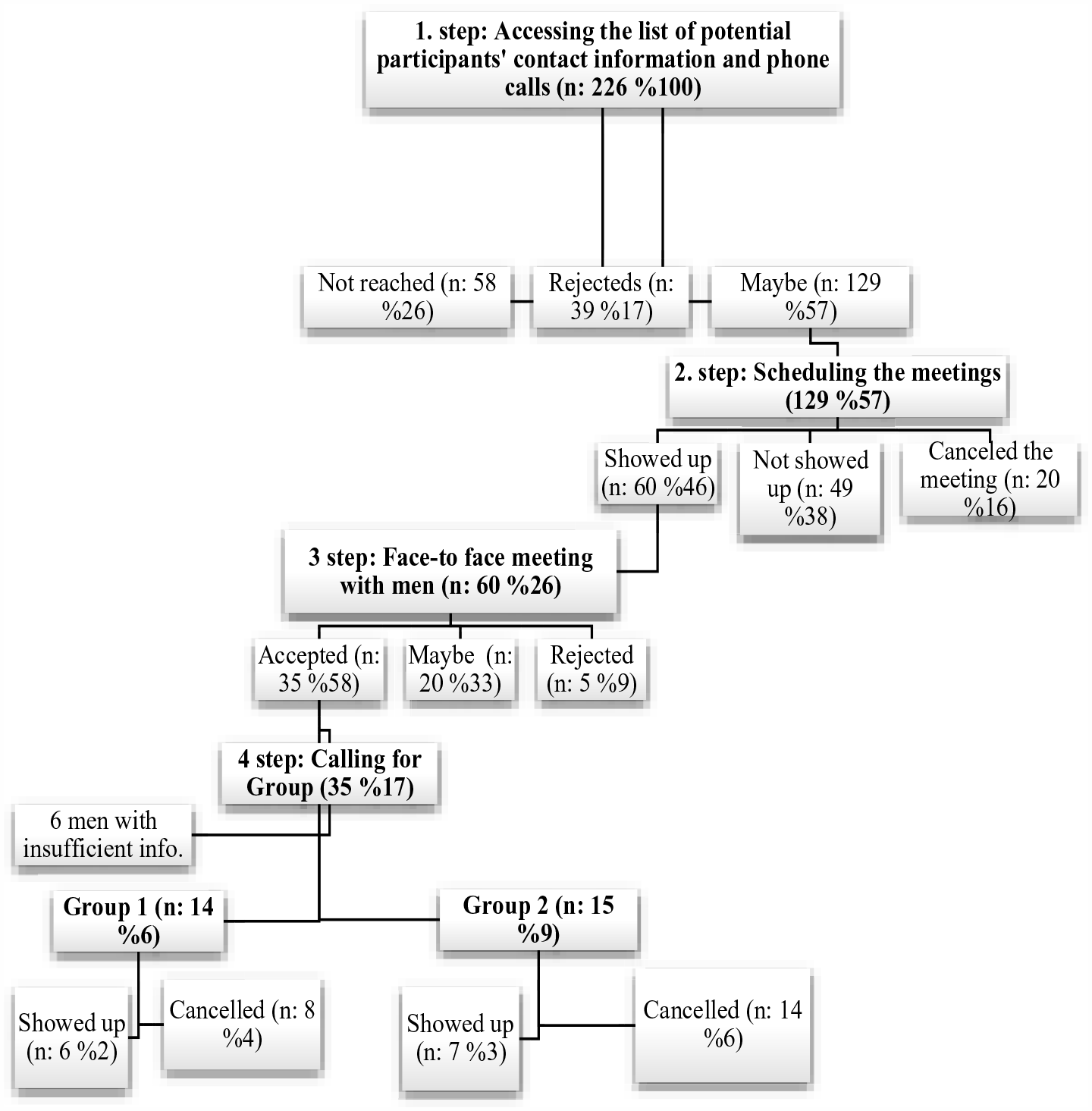
Steps for accessing participants for group interventions.
In addition to 29 male violence offenders, the current study sample comprised two professionals (a female clinical psychologist and male psychological counselor) and an observer (female social worker) who met with the 29 men. For this research, these two professionals and an observer were interviewed. Their mean age was 35, ranging from 32 to 38, and they all had graduate degrees.
Regarding the characteristics of the male domestic violence perpetrators (N = 29), the mean age was 40 years, ranging from 25 to 57 (M = 40,58, SD = ±8,23; 25−58). Regarding socio-educational status, 16 had received primary school education, nine had attended high school, and four had graduated from university. Twenty-two were full-time employed, three had a part-time job, two were unemployed, and two were disabled. Twenty were married, while nine were divorced. Twenty-two men had more than one child, five men had one child, and two men did not have a child. Regarding the place of residence, 20 participants lived in town, while nine lived in a village. Twenty-four men lived with a nuclear family, and five lived with an extended family. Regarding their criminal history, 20 (69%) had been accused of assaulting a spouse while nine (31%) had not been charged. 23 (79.3%) had been convicted of spousal violence and six (20.7%) had not. Six (20.7%) had been convicted of another crime while 23 (79.3%) had not been convicted. Only one participant (3.4%) was subject to a protection orders for his children, while five (17.2%) were subject to protection orders for their woman partner. Many of these protection orders had been applied within the previous 6 months, although they had been lifted during data collection. Finally, regarding psychological support, eight men were involved in therapy or receiving psychiatric support, while 21 reported not attending any psychological services.
Research Team and Positionality
Racial background, cultural identity, educational background, gender, and religion often impact accessing the sample, data collection, power relations, and building rapport (Charmaz, 2014; Liamputtong, 2007). Accordingly, the researchers’ philosophical perspectives and research questions were considered in the present study to identify the interrelations and the interpretation of meanings by providing their positionality (Edwards, 1998; Gadd, 2004; Gunaratnam, 2003; Marcus, 1994; Opie, 1992). Various strategies can help minimize problematic power relations and increase rapport building in interviews (Britten, 1995; Cohen et al., 2013; DeVault & Gross, 2012; Longhurst, 2010). For instance, reflexivity can reduce potential bias by making researchers aware of their relationships with participants during the research (Holloway & Biley, 2011; Kolb, 2012; Pillow, 2003; Woodby et al., 2011). Therefore, the present study included in-depth self-reflection and transparency.
Data Collection
Data was gathered from the professionals in two ways: interviews and reflexive notes. For the reflexive notes, professionals kept a reflexivity journal and noted their own beliefs and judgments about gender, violence, and patriarchy in the field while conducting the initial meetings. The data were obtained from two professionals, who conducted initial meetings and invited male participants to the group, and an observer, whose role was to observe the professionals and participants in the session. The semi-structured interviews included questions about the professionals’ position in the meetings, the effects that their gender and culture raised regarding the invitations and their relationship with the participants.
The interview questions were drafted by the first author, an expert on domestic violence, and the project executive, and checked by the second author, who is experienced in qualitative methodology and domestic violence research. The questions sought to elicit the professionals’ perceptions about the initial meetings with the perpetrators by addressing their power relationships, insider-outsider positions, and different identities, such as class, gender, and education. Sample questions included the following: What surprised you the most in the initial meeting? How did your gender, class, education, and other identities affect your relationship with the participant? What was the balance of power in the relationship? Which of your identities (e.g., gender, socioeconomic class, and culture) placed you in an insider or outsider position? How did you build trust and rapport with the participants? What conditions encourage or discourage the participant from attending the group sessions? The researchers’ interviews with the professionals lasted 20 to 40 minutes. All data collected from interviews were transcribed verbatim.
Strategies for Maintaining Trustworthiness
The following steps were taken to ensure that this study met Morrow’s (2005) three reliability criteria, namely adequacy of data, interpretation, and reflexivity. First, observation notes of the 29 meetings with the participants were analyzed, while the interviews with facilitators and the field notes provided adequate materials for trustworthiness (Creswell, 2012). Reflexivity, a critical criterion for ensuring reliability, evaluates the researcher’s awareness of their assumptions, prejudices, personal influence, and feelings (Patton, 2002). In this study, the authors used bracketing to eliminate personal influences by taking notes about the interviews during the investigation. These notes helped raise their awareness and make sense of the process during the analysis. Of the various strategies that can be applied to achieve triangulation, this study used investigator triangulation (Patton, 2002; Stake, 1995). This involves the use of notes by the observer and professionals to reduce the potential for bias if a single person collects the data and conducts the analysis. Reflexivity can also be ensured by involving multiple experts in the coding process (Merriam, 2009). Accordingly, the first and second authors independently analyzed the same qualitative data to achieve analytical triangulation.
Ethical Considerations
This study ensured confidentiality and anonymity to protect the identities and locations of the participants (Denzin & Lincoln, 2000; Mertens & Ginsberg, 2008). The names used in the results were pseudonyms. Hugman et al. (2011) argue that beneficence not only refers to avoiding harm but is also a relational process that should be meaningful for the participants. This study received Bartın University ethical approval.
Data Analysis
The thematic analysis procedures described by Braun and Clarke (2006) were used. As this study concerned an under-researched topic, it aimed to examine how the perpetrators responded during the initial meeting with professionals and how they decided whether or not to attend a voluntary group intervention. Thematic analysis was used to identify the central themes and subthemes by exploring the meanings of the research phenomenon (Braun & Clarke, 2006). The researchers read each field note and transcript several times to familiarize themselves with the data and make initial codes close to the content of the transcripts. To generate these, the first author identified the common concepts and elements in the raw data (Braun & Clarke, 2006) before textual data were fed into NVivo20 to identify the major codes. Data analysis was first carried out independently by the first author. This was then revised in collaboration with the second author before the next step. Themes were grouped within and across the field notes. The coded extracts within each theme were then compared to identify similarities and differences. The main and sub-themes were checked against the original field notes, and adjustments were made if necessary.
Results
For the interviews with the two professionals and the observer, the main themes emerged from grouping the themes: (1) Contributing factors of attending the first meeting; (2) Reasons for resistance to a group intervention (Figure 2).
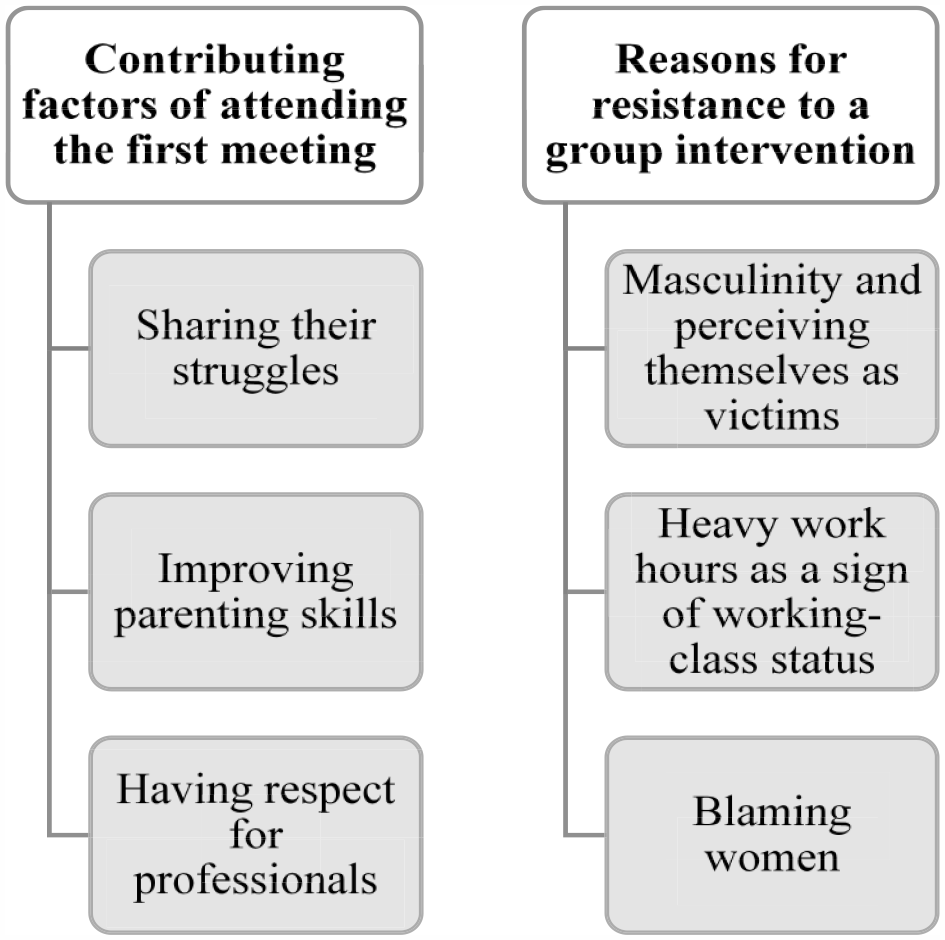
Themes and subthemes.
Contributing Factors to Attending the First Meeting
Many perpetrators shared how the sanctions of the family violence restraining order made them feel invisible because they felt judged. In addition, they felt that it ignored their experiences, feelings, and thoughts. Importantly, they shared how their social networks were broken once colleagues and friends learned about this order. Therefore, they believed that sharing their experiences in a group-based program could positively impact their lives. In addition, they were motivated to attend the initial meeting out of respect for the professionals and the possibility that the intervention could enable them to improve their relationship with their children.
Sharing their struggles
Many participants attended the initial meeting to share their perceived victimization, complaints about various systems, and problems with their intimate relationships, which they blamed on the women concerned. Some participants said they had had to return to their homes despite the restraining order because finding another place to stay was difficult. Related to this, they said that shame prevented them from staying in their parents’ house. Another critical obstacle for some participants to accept the restraining order was separation from their children. Overall, their perceived “victim” position encouraged them to share sensitive experiences with the professionals during phone calls and face-to-face meetings, which helped build a relationship. For instance, the female professional noted the following about one participant: His emphasis that he was innocent was intense. However, there was a message: “I am in a very difficult situation, understand this.” He did not complain much about the processes related to the system compared to the participants in the previous meetings. (After meeting with Irmak)
Likewise, the female observer noted that: The only issue for which we shared the same position with potential participants was that men also should be heard in domestic violence interventions. When we emphasized this in the initial meetings, their willingness to participate in a group increased. The ideas around their voices would be heard, strengthening our relationship with them. (After meeting with Kadir)
Improving parenting skills
Some men wanted to improve their parenting skills through the program. In particular, single parents were particularly willing as they highlighted how this made it difficult to raise younger children or adolescents. This can be seen from the following notes about two participants by the female observer and male professional, respectively: The presence of children aged four and six and the aim of raising them in a better home were the most important motivations that brought him to the group. He summed it up as follows: “If I did not have children, I would have ended this relationship.” (After meeting with Bora) He also wants to help his children; this is the most important point. “I want to help the children,” he said. When we told him, he did not say anything about previous marital relationships; he never talked to us about his relationship with his wife, but mostly expressed his concerns about rearing children. (After meeting with Ozan)
Having respect for professionals
Respect for the professionals’ academic status encouraged some participants to attend the face-to-face meeting. The trust established during this meeting increased their willingness to participate in the group. Regarding power relationships, the professionals held power when the participants expressed their respect and answered the questions. This trusting relationship also enabled some participants to share sensitive, private experiences, as the female observer noted: Even if we think we do not ask too many challenging questions in general, it was a great sharing for people to tell their most personal problems to the university professors at the first meeting. From this point of view, we found ourselves in a stronger position as we had access to their sensitive experiences. We researchers also explained that we were trying to build a program beneficial for them and those with similar problems. (After meeting with Umut)
Similarly, the female facilitator shared their positive experiences regarding her gender and professional positions: The fact that Mr. Irmak brought his son, who is studying at our university, with him, and when we introduced ourselves, he said that his son has the same reputation as us, it seemed like an opportunity to establish rapport. I thought he “understood our professional status” and respected that. (After meeting with Irmak)
Reasons for Resistance to a Group Intervention
Some participants were unwilling to attend the group intervention due to their heavy work schedule, masculinity, beliefs that they did not need professional help, and blaming women and/or the system. For example, some said: “We fixed the problem,” “It was a tiny problem, and we [he and his wife] are good now.” More specifically, in the initial meeting, participants often reported other problems, such as alcohol and substance use, problems with the extended family, unemployment, previous traumatic experiences, and a history of offending.
Masculinity and perceiving themselves as victims
Some participants had been significantly affected by traumatic experiences, such as betrayal. For instance, a few shared how they learned that their ex-wife had betrayed them, which made them focus on their sense of victimization regarding their shameful position as a betrayed man. This threatened their sense of masculinity in a patriarchal society. Breaking such boundaries was the key problem, as noted by the observer:
Even though the violence had been reported to the criminal justice system, the violence did not end. In fact, the violence continued because he did not want to divorce her and forced her to stay with him. He did not want to lose certain benefits based on her support during the marriage. For instance, he said, “If I divorce her, then who is going to cook for me?” (After meeting with Hakkı)
Another important struggle during a no-contact order was finding a place to stay, such as a new home or staying with parents or friends. Many of the participants reported how they tried to adjust their life to this novel situation. Their high-stress levels and anger toward their (ex) partners were interconnected with being processed through the criminal justice system as a perpetrator. These participants believed the restraining order against them was unfair, encouraging them to attend the perpetrator program. For instance, the male professional noted:
The men’s perceptions of women are not positive, and they think they are exposed to these injustices (arrest, punishment, suspension) because they are men. In other words, they say that the law gives women too many rights. (After meeting with Mert)
Heavy work hours as a sign of working-class status
The most common reason for not attending the initial meeting was unavailability due to long work hours and shiftwork, as the female observer stated: The most critical challenge to attending this voluntary work is busy work hours. Therefore, they had to refuse to participate in this program. These men go home late due to long working hours and have a hard time finding time for their family members. Socioeconomic problems and working conditions shaped the men’s decision-making (After meeting with Selman).
As this comment suggests, some participants complained about their long working hours, emphasizing that they hardly find time to spend with their families. This limited time for themselves and their family may also have increased conflicts in their relationships with family members. This may also be connected to their dissatisfaction with these relationships if their wife and children make them feel worthless. Such experiences made them less willing to attend any program.
Blaming women
Given their patriarchal background and male privilege, most participants in the initial meeting claimed that their problems were caused by women. This made them unwilling to attend the program as they thought that they had no problems themselves; rather, they were all due to women and the criminal justice system. In both the phone call and face-to-face-meeting, these participants positioned themselves as victims of domestic violence. In their stories, they interpreted their female (ex) partner’s depression or other psychological problems as a way to victimize the man rather than potentially related to her traumatic experiences. For instance, the female professional noted that: He shared information that his spouse generally provoked him, that it was not his fault, and that his spouse was disturbed. For example, he gave examples such as his wife having some mental and relational problems because she grew up without a father. (After meeting with Bahri)
The male professional also felt obstacles in listening to some participants’ inconsistent statements blaming women: The only thing that blocks me is their approach to women and contradictory statements. For example, he stated, “I did nothing, but this is what happened.” He also said, “Here, I do not batter my woman, but my woman cheated on me.” You know, the various expressions of that man. (After meeting with Kadir)
After the initial meetings with the men, 12 (six men for each group) attended the group interventions. These participants shared three main characteristics: (1) being less suspicious about the program and able to trust the professionals; (2) having a lack of toxic masculinity with less blame of their (ex) partners; and (3) making time available to attend the group. Because all 12 men were involved in the criminal justice system during the no-contact order, some expressed a lack of trust in the system and perceived the researcher as a government authority, who was sent to report on their actions. Their perceptions of the role of professionals increased their suspicion of the intervention program. The main motivation of the men who finally joined the group was a willingness to share their struggles and their perception that a group intervention as an appropriate place to share their experiences.
Discussion
This study aimed to examine the factors that motivate domestic violence perpetrators to attend a voluntary-based intervention program. Our findings showed that the participants’ belief that they are innocent prevents them from seeking professional help for their violent acts. Furthermore, no legal mechanisms forced them to attend mandated domestic violence intervention programs. According to the professionals, some participants thought they were the victims of the legal system and blamed their spouses for the restraining orders. Similarly, Lila et al. (2013) reported that psychological adjustment among intimate partner violence offenders is related to victim-blaming attitudes. A common feeling among perpetrators after receiving a no-contact order is shame. The present study also produced the novel finding that the participants’ respect for the professionals and the opportunity to share their struggles were linked to building trust and rapport, which mostly increased their willingness to attend the group intervention. Similarly, previous studies about working alliances in domestic violence perpetrator interventions have also highlighted the importance of building positive relationships (Cunha et al., 2023; Day et al., 2006; Santirso et al., 2020) and therapeutic alliances (Boira et al., 2013) to pursue engagement and behavioral change.
Another important finding of the present study was the fatherhood factor that influenced the men’s decision to attend the program. That is, some participants had concerns about raising their children and often expressed a need to learn positive parenting skills. This confirms previous findings regarding the positive relationship between being a father and engagement in such interventions (Stanley, Graham-Kevan, et al., 2012; Stanley, Miller, et al., 2012; Turhan & Bernard, 2022). However, despite their willingness to attend group interventions to improve their parenting practices, some participants were worried about their work schedules (shift work and heavy working hours), which made them unable to participate in the program. While working hours and economic conditions may shape men’s parenting practices, some scholars emphasize the importance of equal co-parenting and gender equality–oriented fathering practices (Bach, 2019; Brandth, 2016). Furthermore, factors related to a heavy work schedule are linked to the gendered division of labor in which “work is culturally defined as men’s realm” (Connell, 2000, p. 78). Therefore, social policymakers should recognize the importance of working hours and gender equality in family relationships to provide sufficient time and space for men to participate in interventions to improve their parenting skills.
Whereas the participants were motivated to attend the initial meeting in order to share their struggles and improve their parenting skills, they were hindered by masculinity and perceiving themselves as victims. For instance, the men shared their struggles and described their sense of victimization, which was linked to rigid definitions of masculinity. Moreover, toxic masculinity was related being less motivated to attend the program and increased blaming of women (Connell, 2000). Yet, despite seeming problematic, this rigid masculinity can be used to involve men in crisis in the change process. Our findings show that providing these perpetrators with a space for sharing their struggles can facilitate trust and rapport. Likewise, Buston (2018) highlighted how hyper-masculine discourses switched to softer discourses of masculinity during prison-based group interventions by concentrating on the experiences of developing caring relationships with group members and facilitators. There is disagreement regarding the value of voluntary perpetrator programs for men who have already been processed through the criminal justice system. However, voluntary attendance can also be used to motivate behavioral change. Thus, managing the masculinity crisis and creating an environment for rapport and change is important.
The issue of dropping out of domestic violence interventions has been widely discussed (Bowen & Gilchrist, 2006; Brown et al., 1997; Romero-Martínez et al., 2019; Rondeau et al., 2001). However, the role of long working hours and shiftwork have not received sufficient attention as barriers to attending domestic violence interventions. Our findings showed that many participants subject to family restraining orders were working class, which mostly prevents them from joining interventions that require regular participation. Importantly, however, some may use their class status to justify their unavailability because a few participants were willing to attend a group intervention despite doing shiftwork. That is, some perpetrators may refuse to attend the initial meeting if their long work hours are interconnected with masculinity and they blame their violence on women. Indeed, previous studies have identified these factors as key predictors of insufficient engagement in interventions (Brown et al., 2009; Kilmartin & Allison, 2013; Stover & Morgos, 2013; Turhan & Bernard, 2022; Zakar et al., 2013). Perpetrators frequently use tactics of blaming, minimizing, and denying violence (Pence & Paymar, 1993). Therefore, it is critical to make individuals accountable for their violent behavior and support them in taking responsibility for their actions and subsequent impact (Devaney, 2014). While mandatory participation is critical to enabling perpetrators to accept responsibility, our findings indicate that perpetrator programs should include both mandated and volunteering rules to encourage active participation and effective behavioral change. Mandatory attendance aims to eliminate impunity for violence, whereas voluntary attendance may facilitate the change process.
This study focused on men processed through the criminal justice system, many of whom had engaged in high levels of violence against women in family settings. However, these participants had not taken sufficient responsibility for their abusive behavior, which increased their unwillingness to attend interventions. Moreover, there was a tension between men’s participation in the program being voluntary alongside the influence of their involvement in the criminal justice system, which was involuntary. For example, some men continued to plead their innocence despite being convicted by the court. Hence, many participants dropped out after the initial meeting without participating in the voluntary group intervention due to the perception of not having any problems or being innocent. Similarly, previous studies have reported that many sexual offenders believe they were innocent, and that this denial is linked to their fear of losing support from family and friends (Lord & Willmot, 2004; Mann et al., 2013). In the present study, it was assumed that all men who had a no-contact order in the last 6 months were guilty of committing violence. However, acknowledging that there may have been a miscarriage of justice or that they could be innocent discouraged them from attending any intervention. Some of the participants who appeared to be genuinely innocent due to a lack of evidence never wanted to participate in the program. On the other hand, some men who constantly blamed women and the system were willing to attend the programs to share these problems.
Limitations
Although the present study improves our understanding of the factors determining voluntary participation in domestic violence perpetrator interventions, there are some limitations. First, this study was conducted in only one small city in Turkey. Thus, the perspectives and reactions of perpetrators in other cultures, places (e.g., cities or villages), or intervention settings (e.g., individual psychotherapy or psychiatric support) remain unclear. In particular, our study was conducted in a relatively small urban area where people often know each other. For instance, many participants worked in the same organizations or factories, which may have made them hesitant about encountering the professionals in the small city after the group intervention. Thus, the generalizability of the findings is questionable because it is unclear to what extent these results illustrate the challenges and contributing factors to voluntary participation in other settings and countries. Notably, the factors identified by the professionals and observer might have been different if the men themselves had been interviewed. Nevertheless, this study provides novel findings regarding the critical factors affecting voluntary attendance in group interventions among men involved in violent abuse of their female partners and who have been processed through the criminal justice system within the previous 6 months.
Conclusion
The challenges professionals encounter in inviting perpetrators into group interventions are complex and result in insufficient participation. Therefore, this study was critical for identifying the factors affecting voluntary involvement. The perpetrators’ willingness to attend the initial meeting and then the group intervention depended on their beliefs about benefiting from such a program, sharing their struggles, and building relationships with professionals. Conversely, they were more likely to refuse to attend if they had long working hours or shiftwork, blamed women for their violence, and exhibited a rigid form of masculinity. Given that this study identified various factors discouraging or encouraging voluntary participation, rules should be developed within the criminal justice system that include voluntary and mandated involvement in such interventions. This will motivate perpetrators to actively participate while taking responsibility for their violence.
Footnotes
Acknowledgements
Many thanks to the participants who attended first meeting with professionals. Special thanks to the support of the Violence Prevention and Monitoring Center (VPMC), part of the Provincial Directorate of Family and Social Services in Bartın. We thank Mehmet Can Demir for his support of organizing demographic information. We also thank Aslıhan Demir and Emine Eker for their help for transcriptions.
Authors’ Contributions
Study conception and design: Zeynep Turhan
Data collection: Zeynep Turhan; Nur Başer Baykal, İhsan Çağatay Ulus
Data analysis and interpretation: Zeynep Turhan; Engin Fırat
Drafting of the article: Zeynep Turhan, Emel Genç, Engin Fırat
Critical revision of the article: Zeynep Turhan; Engin Fırat; Emel Genç, Sefa Bulut
Declaration of Conflicting Interests
The author(s) declared no potential conflicts of interest with respect to the research, authorship, and/or publication of this article.
Funding
The author(s) disclosed receipt of the following financial support for the research, authorship, and/or publication of this article: This empirical research was a part of the project of “The Implementation of Healthy and Respectful Relationship Program” was funded by TÜBİTAK (Turkish Scientific and Technical Council) between 2021 and 2023. The award number was 121K732.
Ethics Approval
The study was reviewed and approved by the Ethics Committee of the Bartın University (ref: 2022-SBB-0071).
Consent for Publication
Informed consents were obtained from participants at the beginning of the interviews. The interviews began with brief information about the study objective, by highlighting the anonymity and confidentiality of the collected data, the research team, and informed consent.
