




Abstract
The construct validity of the triarchic psychopathy model has yet to be evaluated in the Swedish forensic psychiatric context. We examined associations between the three phenotypic constructs of the triarchic model of psychopathy (i.e., boldness, meanness, disinhibition), self-assessed empathy and anxiety, and clinical variables in 91 individuals undergoing pretrial forensic psychiatric evaluation in Sweden. Participants completed the Triarchic Psychopathy Measure (TriPM) and self-report measures of empathy and anxiety. Clinical variables, including psychiatric diagnoses and criminal behavior, were collected from the forensic psychiatric evaluations (FPE). All three subscales of the TriPM displayed significant and predominantly anticipated correlations with empathy and trait anxiety measures. TriPM Disinhibition was the only subscale with significant associations with the clinical variables collected from the FPEs. The results provide evidence for the reliability and construct validity of the Swedish translation of the TriPM in a pretrial forensic setting.
Psychopathy reflects a personality constellation that markedly deviates from the norm (R. D. Hare et al., 1990; Patrick et al., 2009). There is a consensus that psychopathy encompasses impaired affective reactivity associated with interpersonal difficulties and behavioral dysfunction (Verschuere et al., 2018). Opinions diverge, however, on whether “quasi-adaptive” features (e.g., reflecting stress immunity, fearlessness, and social potency) should be included in the construct (Lilienfeld et al., 2012; Lynam & Miller, 2012; Murphy et al., 2016). There is also no consensus on whether antisocial behavior, that is, any behavior that violates social norms or infringes on the rights of others (APA Dictionary of Psychology, 2023), should be considered a primary component of psychopathic personality or merely an associated consequence (e.g., R. D. Hare & Neumann, 2010; Skeem et al., 2011). Furthermore, modern conceptualizations have gravitated toward dimensional models, emphasizing different constellations of psychopathic personality traits rather than a unitary approach (i.e., that an individual is or is not “a psychopath”; Boduszek et al., 2018; Lilienfeld & Widows, 2005; Patrick et al., 2009). Therefore, common ground is lacking vis-à-vis a precise definition of the core features and boundaries of psychopathy.
The triarchic model of psychopathy was created by Patrick et al. (2009) as a framework to reconcile different theories and measures of psychopathy in various populations. It aims to identify the developmental and neurobiological foundations of psychopathy through three elemental phenotypic domains (Patrick & Drislane, 2015)—boldness, meanness, and disinhibition—that are designed to be transdiagnostic and that have demonstrated predictive properties regarding clinical symptoms, including suicide risk (Venables et al., 2015). Boldness entails low-stress reactivity, thrill- and adventure-seeking, and interpersonal dominance, with behavioral manifestations including assertiveness, persuasiveness, and venturesomeness (Patrick et al., 2009). Meanness refers to low empathy and affiliation as well as exploitative behaviors, demonstrating associations with a lack of close relationships, strategic exploitation of others, and premeditated aggression. Disinhibition reflects deficiencies in impulse control, behavioral restraint, and affect regulation, with behavioral expressions including impatience and increased risk for alcohol and drug problems. The triarchic model acknowledges that psychopathy involves varying degrees and combinations of these traits, leading to different behavioral presentations. Research supports that psychopathic traits can be viewed as extremely maladaptive versions of normal personality traits such as those included in the five-factor model (e.g., low agreeableness and conscientiousness, with additional contributions of various levels of extraversion and neuroticism; Miller & Lynam, 2015).
The self-report Triarchic Psychopathy Measure (TriPM; Patrick, 2010) is the principal instrument operationalizing the triarchic domains. It was developed on two samples, one consisting of male prisoners and the other of a mixed-gender sample of college students. In the former, each TriPM subscale demonstrated a small to moderate effect size with the total score of the widely-researched Psychopathy Checklist-Revised (PCL-R; R. Hare, 2003). In the latter sample, the TriPM subscales evidenced moderate correlations with total scores of the Psychopathic Personality Inventory (PPI; Lilienfeld & Andrews, 1996) and the Hare Self-Report Psychopathy Scale-III (SRP-III; Paulhus et al., in press), among other measures. The 19 items that constitute the TriPM Boldness subscale were sourced from the Fearless Dominance factor of the Psychopathic Personality Inventory-Revised (PPI-R; Lilienfeld & Widows, 2005), which indexes the respondent’s ability to influence others, lack of anticipatory and reactive anxiety, as well as the willingness to partake in risky events. Items that comprise the “callous aggression subfactor” of the Externalizing Spectrum Inventory (ESI; Krueger et al., 2007), entailing low empathy and various measures of aggression and dishonesty, were selected for the 19 items composing the TriPM Meanness subscale (Patrick, 2010). The 20 items that form the TriPM Disinhibition subscale were extracted directly from the ESI, representing a general tendency for irresponsibility, impulsivity, impatience, and proclivity for boredom.
Multiple studies have supported the construct validity of the triarchic psychopathy model across different samples and settings. Sleep et al. (2019) conducted a meta-analysis of 84 articles published between 2009 and 2018. They found intercorrelations between TriPM subscales consistent with theoretical expectations, supporting the model’s convergent and divergent validity and dimensionality. TriPM Boldness was positively associated with psychopathy measures related to fearless dominance, emotional stability, and narcissism, as well as indices of leadership, social potency, self-esteem, and manipulativeness, while negatively correlated with indices of neuroticism and negative affectivity. TriPM Meanness and Disinhibition were moderate to strongly correlated with other psychopathy measures indexing antisociality, manipulativeness, aggression, impulsivity, and irresponsibility. TriPM Meanness, in particular, showed strong positive correlations with callous-unemotional traits and moderate negative correlations to indices of agreeableness and empathy. The authors concluded that while the boldness domain represented adaptive traits, the meanness and disinhibition domains were more consistent with previous psychopathy models. Nonetheless, the boldness domain might be useful as a diagnostic specifier for non-violent antisocial behaviors such as fraudulence and exploitation of others.
Over the past decade, the TriPM has gained global attention with translations in various languages such as Spanish, Finnish, Italian, and Chinese (Patrick & Drislane, 2015). Translation validation research of the TriPM mostly involves university or community samples, with consistent results to the original English version. For instance, Portuguese, Greek Cypriot, and Italian translation studies displayed good internal consistency, acceptable test-retest reliability, correlations with psychopathy measures, and relevant external criteria (Fanti et al., 2015; Paiva et al., 2020; Somma et al., 2016). Researchers have further examined the triarchic model’s validity in mixed-gender adolescent samples in Portugal using the Portuguese version of the Youth Psychopathic Traits Inventory – Triarchic – Short (YPI-Tri-S; Pechorro, DeLisi, Ray, et al., 2019; Pechorro, DeLisi, Gonçalves, et al., 2019). The self-report subscales demonstrated good internal consistency, satisfactory dimensionality and invariance, and discriminant, convergent, and criterion validity, which supports the triarchic model’s construct validity.
Numerous recent studies have focused on the triarchic psychopathy model in forensic and correctional samples. These studies consistently show that the triarchic scales have theoretically consistent associations with external factors in these settings (Anestis et al., 2019; Drislane et al., 2022; Paiva et al., 2020; Pauli et al., 2019, 2021; Pechorro, DeLisi, Ray, et al., 2019; Pechorro et al., 2022; Sellbom, Laurinavičius et al., 2018; Sellbom & Phillips, 2013; Ustinavičiūtė et al., 2019; van Dongen et al., 2017; Yoon et al., 2022). For example, in a Lithuanian correctional sample, TriPM Boldness had negative correlations with negative emotionality, shyness, and introversion (Sellbom, Laurinavičius et al., 2018). In contrast, TriPM Meanness and Disinhibition positively correlated with physical and verbal aggression and externalizing dysfunction. Specifically, TriPM Disinhibition exhibited moderate to strong positive correlations with antisocial behavior, negative emotionality, and self-doubt. In a study of Lithuanian juvenile offenders (Laurinavičius et al., 2020), TriPM Meanness correlated with aggression and pro-criminal attitudes, while TriPM Disinhibition was associated with a wide range of externalizing variables, such as the history of previous convictions. Anestis et al. (2019) investigated the moderating effect of sociodemographic factors on the associations between psychopathic traits and external variables in a mixed-gender forensic sample. They found that correlations were consistent across socioeconomic status, ethnicity, and gender. In a study of male prisoners in Italy (Drislane et al., 2022), the TriPM subscales were found to have good correlations and predictive ability with relevant criterion variables, such as normative personality traits, self-reported hopelessness, self-harm, and substance abuse problems, as well as staff assessments of behavior in prison and reintegration prognosis after release from prison.
Some papers have evidenced the TriPM’s ability to discriminate between forensic and non-forensic samples. For example, when investigating the validation of the Dutch version of the TriPM, van Dongen et al. (2017) utilized data from two samples—a community sample and a forensic psychiatric sample. The authors found that the TriPM total score had good discriminant ability between the samples (AUC = 0.753, p < .001). Among the subscales, TriPM Disinhibition demonstrated the highest discriminant ability (AUC = 0.851, p < .001), while TriPM Boldness could not differentiate between the two groups. Comparatively, when investigating the validity of the Portuguese translation of the TriPM, Paiva et al. (2020) found that only TriPM Disinhibition was able to discriminate between community participants and male prisoners (AUC = 0.708, p ≤ .001). The findings suggest that the TriPM has the potential to distinguish between different samples, adding to its usefulness in clinical and forensic settings.
In summary, increasing research supports the construct validity of the triarchic constructs in diverse cultural and linguistic contexts. In Sweden, the TriPM has been investigated in correlational settings, with significant associations found between the TriPM scales and the PCL-R and measures of ADHD and cognitive functioning (Pauli et al., 2019). Furthermore, the psychometric properties of the Swedish translation of the TriPM were found to effectively measure the three domains of the model in forensic settings (Pauli et al., 2021). However, some revisions to the scales were considered beneficial in improving the instrument’s psychometric properties.
The Current Study
The primary objective of the present study is to investigate the reliability and validity (internal consistency, convergent and divergent validity) of the Swedish translation of the TriPM in individuals undergoing court-ordered forensic psychiatric evaluation (FPE) at the National Board of Forensic Medicine (NBFM) in Sweden. The NBFM performs FPEs on behalf of the court when a person is suspected of having committed a crime under the influence of a severe mental disorder (SMD). The FPEs are conducted at the two NBFM’s forensic psychiatry departments located in Stockholm and Gothenburg. SMD is a medico-legal concept that is not linked to any particular diagnosis. The majority of individuals undergoing FPE have some DSM-5-based psychiatric diagnosis (American Psychiatric Association [APA], 2013), with most suffering from psychotic conditions (e.g., schizophrenia), severe autism or intellectual disability, or neurocognitive disorders (e.g., severe dementia). A rich set of clinical and sociodemographic variables is available in this setting because investigators have the legal right to retrieve confidential documents from different authorities, including the social and medical services, the military system, and the Swedish National Police Authority.
Based on the original conceptualization of the triarchic psychopathy model, we hypothesized that scores on TriPM Boldness would show positive associations with educational attainment and negative associations with trait anxiety. Scores on TriPM Meanness would be associated with lower empathy and a history of violent crimes, while TriPM Disinhibition would demonstrate positive associations with mental health issues and antisocial behaviors and negative associations with educational attainment.
Method
Participants
In total, 197 men and women undergoing court-ordered FPE between February 2015 and May 2016 were invited to partake in this study. About 46% chose to participate, resulting in a final sample of 91 participants (92% male) with a mean age of 38 years (SD = 13.2, range 17–83). These data align with previous reports regarding gender balance and mean age among individuals undergoing FPEs in Sweden (Sturup et al., 2013). Fifty-two participants (57%) were recruited from the Stockholm department (for a detailed overview of participant characteristics and clinical variables, see Supplemental Table A).
Regarding index crimes, most participants (n = 55; 60%) were charged 1 with violent crimes (e.g., murder, assault, violence to public servant), followed by sexual crimes (n = 14; 15%; e.g., child rape, molestation, child pornography) and arson (n = 11; 12%). Previous convictions ranged from 0 to 37, with most participants (n = 51; 56%) having 1 to 10 previous convictions. Approximately one-third of participants (n = 28; 31%) were diagnosed with a psychotic disorder (e.g., schizophrenia, schizoaffective disorder, bipolar I disorder). Fewer participants were diagnosed with autism spectrum disorders (n = 16; 18%), depression or anxiety (n = 9; 10%), or other diagnoses (n = 16; 18%; e.g., intellectual disability, pedophilia, eating disorders, ADHD). Approximately one-third (n = 29; 32%) had a personality disorder (e.g., antisocial personality disorder, borderline personality disorder). About half of the participants (n = 42; 46%) had a diagnosis of a substance use disorder, of whom the majority (n = 25) consisted of mixed substance abuse. Thus, 60% of all participants with addiction problems abused more than one substance. Among participants assessed for intellectual capacity, 2 a sizable number demonstrated impairment, scoring below (n = 16; 18%) or much below (n = 7; 8%) average.
Clinical and Sociodemographic Criterion Variables
The criterion variables were collected manually from the court-ordered FPEs by one of the main authors (AF, at the time, a resident in forensic psychiatry), utilizing a data form developed for this study. The variables included psychiatric diagnoses (assigned at the FPE), personality disorder, substance use disorder, criminal behavior (e.g., number of previous convictions, criminal versatility, previous prison sentences), intellectual capacity, and educational level. A second rater (a medical student) who was blind to the original protocols completed nine study protocols (i.e., 10%). Only 4% of the responses differed between raters, which was considered good inter-rater reliability.
Self-Report Measures
The
The
The
Procedure
Data collection occurred over 15 months. All participants were informed about the study orally and in writing, and informed consent was obtained. Inclusion criteria were the ability to read and write in Swedish. Exclusion criteria were acute ongoing severe psychotic symptoms or severe intellectual disability (i.e., an inability to provide informed consent). The study was conducted separately from the FPE. To mitigate potential difficulties (e.g., stemming from cognitive limitations), designated ward staff affiliated with the research project were present to assist participants in comprehending self-reports questions as needed.
Statistical Analyses
We conducted an a priori power analysis using G*Power 3.1.9.6 (Faul et al., 2009) to determine the required sample size for detecting a correlational effect size of .30 as significant at α = .05 with 90% power. The analysis showed that a sample of 88 participants was necessary. To investigate the associations between the TriPM, IRI, and STAI-T, we calculated Pearson correlation coefficients. To determine the relationships between TriPM scores and binary clinical and sociodemographic variables, we used point-biserial correlations. To reduce Type I errors due to multiple comparisons, we applied post hoc Bonferroni corrections to both correlation calculations (0.05/30 = .0017 and 0.05/39 = .0013, respectively). All data were analyzed using SPSS version 26.
Results
Table 1 presents the descriptive statistics for the TriPM, IRI, and STAI-T in our sample. The internal consistency of the subscales was assessed according to the rule of thumb proposed by George and Mallery (2019), where alpha values between .70 and .79 are considered acceptable, values between .80 and .89 good, and values greater than .90 excellent. Cronbach’s alpha coefficient regarding the TriPM and its subscales ranged from .86 to .92 and were therefore deemed good to excellent. The internal consistency of the IRI ranged from acceptable to good, with Cronbach’s alpha values of .75 to .84. The STAI-T exhibited excellent internal consistency, with a Cronbach’s alpha value of .93.
Descriptive Statistics and Reliability of Scales Used.
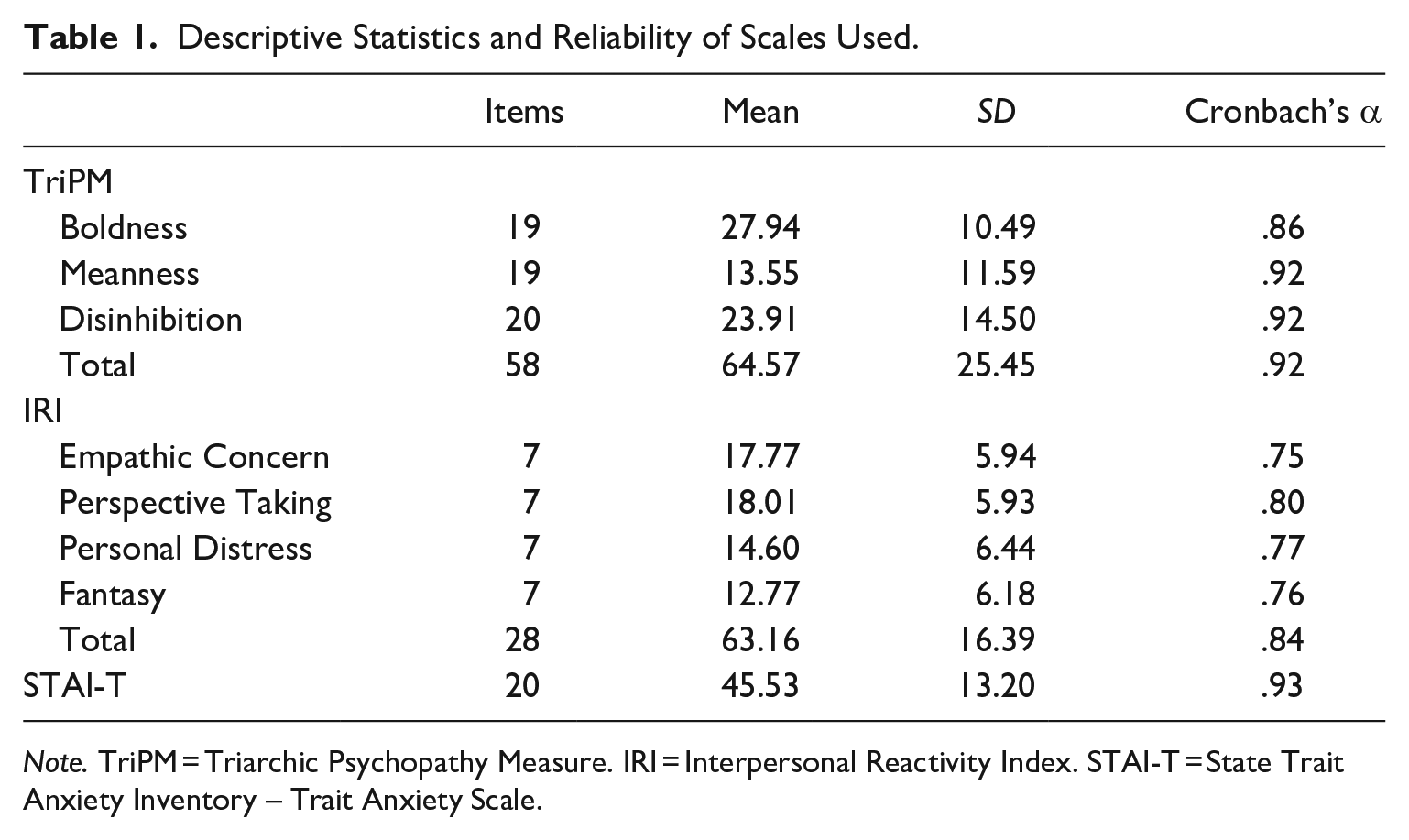
Note. TriPM = Triarchic Psychopathy Measure. IRI = Interpersonal Reactivity Index. STAI-T = State Trait Anxiety Inventory – Trait Anxiety Scale.
Table 2 presents the bivariate Pearson correlations between the TriPM, IRI, and STAI-T scales. Bonferroni corrections were applied, generating a statistical significance at p < .0014. The strength of the correlation coefficients was interpreted according to Dancy and Reidy's (2017) guidelines. Values ranging from .10 to .39 are considered weak, .40 to .69 moderate, and .70 to .99 strong. The TriPM total score showed significant positive correlations ranging from moderate to strong with the subscales (r ranging from .47 to .86). Subscale intercorrelations were only significant between TriPM Meanness and TriPM Disinhibition (r = .52). Correlations between the TriPM total score and IRI total score, IRI-EC, and IRI-PT were significantly negative and moderate (r coefficients ranging from .46 to .54). TriPM Boldness correlated significantly in a negative fashion with STAI-T (r = −.58) and IRI-PD (r = −.73). TriPM Meanness was significantly and moderately negatively correlated with the IRI total score, IRI-EC, and IRI-PT (r coefficients ranging from .58 to .69). TriPM Disinhibition was significantly and moderately correlated with IRI-PT (r = −.48) and significantly and moderately positively correlated with STAI-T (r = .53).
Bivariate Pearson Correlations Between the TriPM, IRI and STAI-T.
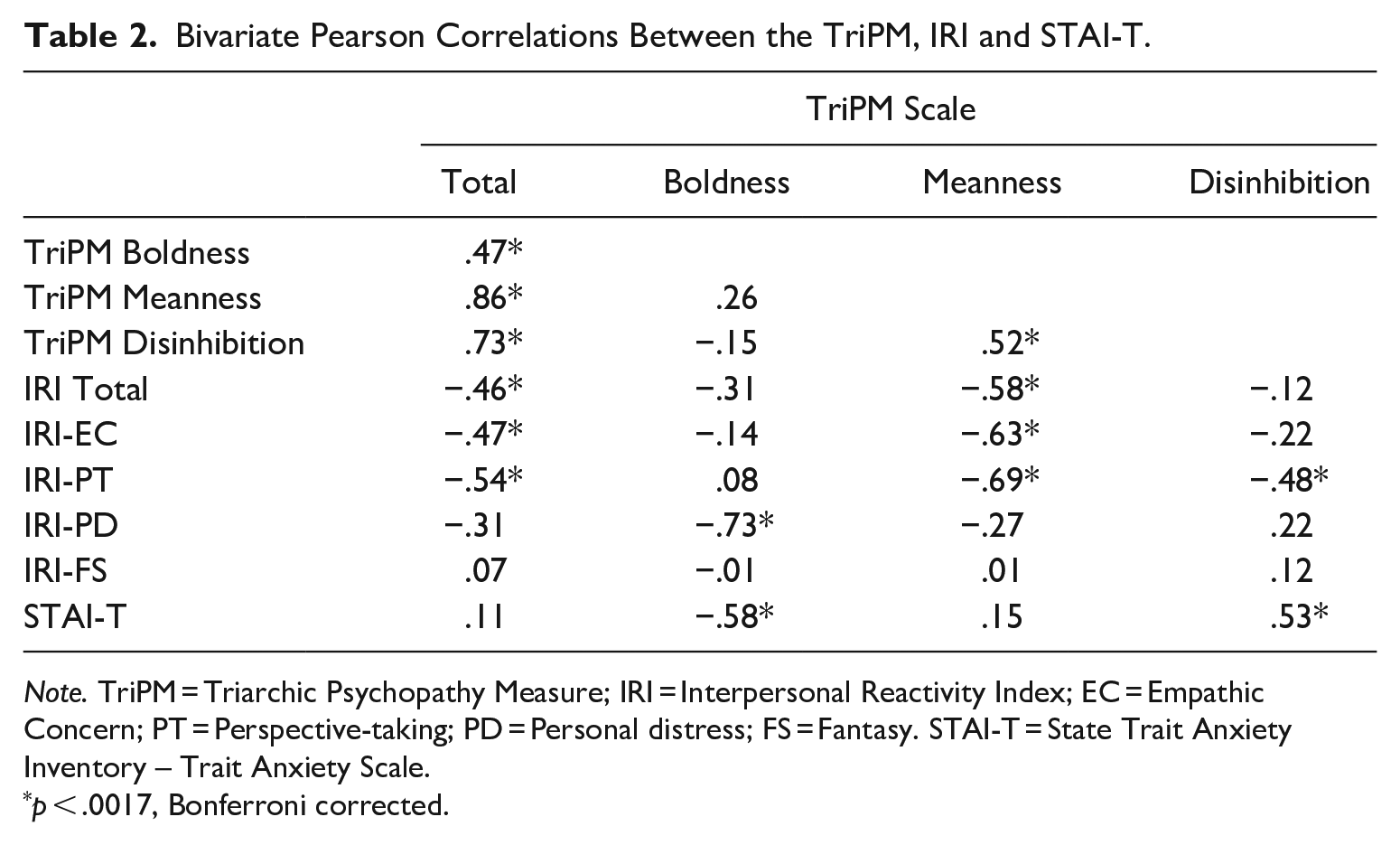
Note. TriPM = Triarchic Psychopathy Measure; IRI = Interpersonal Reactivity Index; EC = Empathic Concern; PT = Perspective-taking; PD = Personal distress; FS = Fantasy. STAI-T = State Trait Anxiety Inventory – Trait Anxiety Scale.
p < .0017, Bonferroni corrected.
Table 3 presents the point-biserial correlations for the TriPM subscales and binary clinical and forensic variables. After applying Bonferroni corrections, only TriPM Disinhibition exhibited significant correlations at p < .0013. The subscale showed a moderate positive correlation with previous sentencing (r = .53). Additionally, weak to moderate positive correlations were observed between the subscale and personality disorders, substance use disorders, previous prison sentencing, more than ten previous convictions, and criminal versatility (i.e., more than five types of offenses), with correlation coefficients ranging from .35 to .47. Finally, TriPM Disinhibition was moderately and negatively correlated with education level beyond primary school (r = −.42).
Point-biserial Correlations for TriPM Scale Scores With Binary Variables.
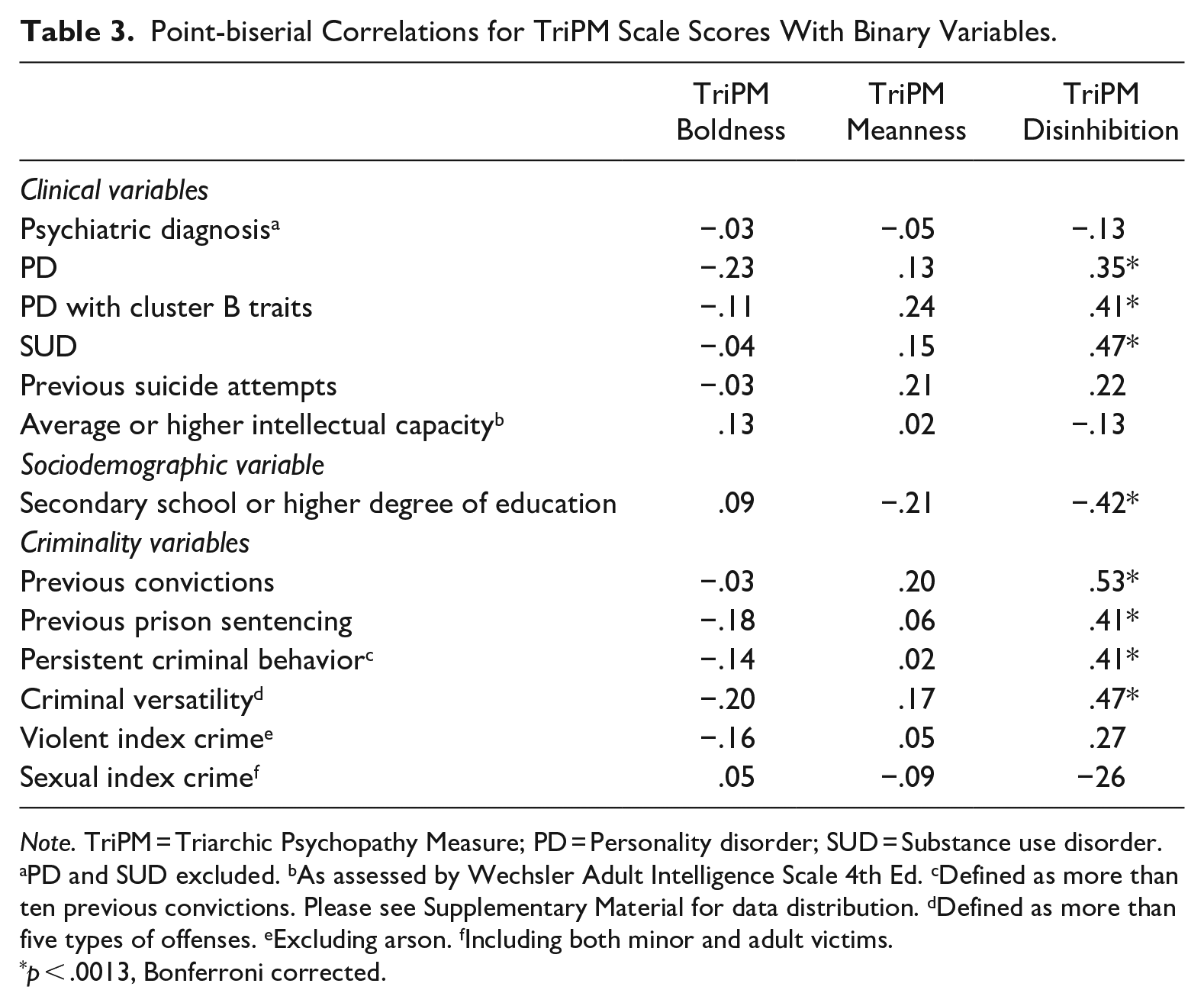
Note. TriPM = Triarchic Psychopathy Measure; PD = Personality disorder; SUD = Substance use disorder. aPD and SUD excluded. bAs assessed by Wechsler Adult Intelligence Scale 4th Ed. cDefined as more than ten previous convictions. Please see Supplementary Material for data distribution. dDefined as more than five types of offenses. eExcluding arson. fIncluding both minor and adult victims.
p < .0013, Bonferroni corrected.
Discussion
The Swedish TriPM scales demonstrated good to excellent internal consistency. The results are in line with previous research for the original English (e.g., Blagov et al., 2016; Sellbom & Phillips, 2013; Stanley et al., 2013) and translated versions of the TriPM (e.g., Fanti et al., 2015; Paiva et al., 2020; Pauli et al., 2021; Sellbom, Laurinavičius et al., 2018; Shou et al., 2016; Somma et al., 2016; van Dongen et al., 2017). This finding suggests that the Swedish translation of the TriPM is a reliable self-report measure. Significant moderate to strong correlations were observed between the total score of the TriPM and its subscales, indicating that all subscales measure the same overarching construct (i.e., psychopathy). However, TriPM Boldness provided the weakest relation of the subscales to the total TriPM score, perhaps indicating the most diluted contribution to the triarchic conceptualization of psychopathy in our sample. Furthermore, TriPM Boldness did not display any significant intercorrelations with the other subscales, whereas TriPM Meanness and TriPM Disinhibition exhibited a significant and moderate correlation. This intercorrelation pattern is consistent with findings reported by Anestis et al. (2019), who examined a forensic mental health sample. However, previous research investigating the construct validity of the TriPM has yielded inconsistent results concerning the intercorrelations between subscales (Anestis et al., 2019; Fanti et al., 2015; Pauli et al., 2021; Sleep et al., 2019; Stanley et al., 2013). In previous literature, a consistent finding is a positive intercorrelation between TriPM Meanness and TriPM Disinhibition, whereas findings are mixed regarding correlations between TriPM Boldness and the other subscales. Pauli et al. (2021) found additional correlations between TriPM Boldness and TriPM Meanness in a purely correctional sample, while studies investigating the construct validity of the TriPM in community samples have found significantly weak to non-significant correlations for TriPM Boldness and the other subscales (Blagov et al., 2016; Fanti et al., 2015; Stanley et al., 2013).
The findings in the current study indicate that the Swedish version of the TriPM displays expected convergent and divergent validity when compared to measures of empathy and anxiety. Specifically, the TriPM total score demonstrates significant and moderate negative correlations with the IRI total score and scores on the IRI-EC and the IRI-PT subscales. Generally, the IRI-EC and the IRI-PT are considered the most distinct representations of emotional and cognitive empathy (Jolliffe & Farrington, 2004) and have shown correlations with lower levels of socialization and pro-social attitudes (Beven et al., 2004), potentially able to distinguish between non-offenders and violent offenders. However, no significant correlation was observed between the TriPM total score and STAI-T. Perhaps this finding could be attributed to the fact that in our sample, the TriPM Boldness and TriPM Disinhibition subscales correlated in opposite directions significantly and moderately with STAI-T, thus canceling the correlation effects between total scores on the TriPM and STAI-T.
Adding to the convergent and divergent validity, we found a strong negative correlation between TriPM Boldness and the IRI-PD. Previous research has linked the IRI-PD with impaired emotional resilience and control, as well as social communication, rather than empathy (Beven et al., 2004; Cliffordson, 2002; Jolliffe & Farrington, 2004; Pulos et al., 2004; Stosic et al., 2022). Thus, this finding may reflect stress resiliency, which aligns with previous research (Almeida et al., 2015; Paiva et al., 2020; Stanley et al., 2013) and the triarchic model’s theoretical framework (Patrick et al., 2009). As previously mentioned, we found moderate negative correlations between TriPM Boldness and STAI-T. The result aligns with previous studies showing a negative correlation between TriPM Boldness and various anxiety measures, including the STAI (e.g., Fanti et al., 2015; Shou et al., 2016).
The present study’s findings on TriPM Meanness were consistent with our hypotheses and previous research results (Almeida et al., 2015; Paiva et al., 2020; Stanley et al., 2013), showing negative associations with the total score on the IRI and scores on the IRI-EC, and the IRI-PT. The results suggest that TriPM Meanness scores captured the emotional and cognitive components of empathy in our sample. Such a correlational pattern has also been observed in correctional and community samples (Almeida et al., 2015; Paiva et al., 2020; Stanley et al., 2013), further reinforcing the usability of the TriPM in various populations.
TriPM Disinhibition has demonstrated mixed correlations with the IRI and its subscales in previous studies, leading to inconsistencies in the literature. In our sample, TriPM Disinhibition showed only a moderately negative correlation with the IRI-PT, consistent with the findings of Almeida et al. (2015) and Paiva et al. (2020) but not Stanley et al. (2013). Interestingly, in contrast to our expectation based on the triarchic model’s conceptualization, TriPM Disinhibition did not display any significant correlations with IRI-PD in our sample. This result is unexpected and somewhat conflicting with previous research indicating that IRI-PD is a marker of impaired emotional resilience rather than empathy. As anticipated, TriPM Disinhibition correlated moderately and positively with scores on STAI-T.
In our sample, no significant correlations were found for TriPM Boldness and clinical variables. However, there were modest tendencies of negative correlations with personality disorders and indices of criminality and positive associations with average or higher intellectual capacity. Previous research has shown that the construct of boldness is, to various extents, significantly and negatively related to some personality traits (e.g., the stable tendency to experience negative emotions and thoughts, interpersonal withdrawal and mistrust; Sleep et al., 2019), previous suicide attempts (Gottfried et al., 2019), various anxiety disorders, depression, psychotic symptoms, and alcohol-related problems. According to Drislane et al. (2022), there was a weak negative correlation between TriPM Boldness scores and favorable outcomes, such as staff-rated good behavior in prison and a positive prognosis for reintegration after release, among a sample of mixed-gender offenders. Additionally, Anestis et al. (2019) found no significant correlations between a measure of boldness and history of violent behavior, number of convictions, juvenile offenses, sentencing, and IQ estimate in a mixed-gender sample of individuals at a forensic mental health clinic.
No significant correlations were found for TriPM Meanness and clinical variables in our study. However, a weak positive correlational trend was observed with personality disorders, particularly those belonging to cluster B, substance use disorders, and previous suicide attempts. These results align with previous research linking this phenotype to externalizing (Drislane et al., 2022; Pauli et al., 2019; Pechorro, DeLisi, Ray, et al., 2019; Pechorro et al., 2022) and internalizing psychopathology (Gottfried et al., 2019; Sleep et al., 2019). Contrary to our hypothesis, no significant associations were found between TriPM Meanness and violent index crimes. However, a weak positive trend was observed with previous convictions and criminal versatility. This result reflects previous research showing a significant positive correlation between the domain of meanness and indices of criminal history (Anestis et al., 2019) and negative correlations between TriPM Meanness and staff-rated good behavior in prison, social connectedness with non-incarcerated individuals, and a positive reintegration prognosis after release (Drislane et al., 2022). Perhaps our results could be explained by the fact that one-third of our sample had a psychotic disorder, which could have influenced the association with index crimes more than psychopathic traits.
Consistent with previous research (e.g., Gottfried et al., 2019; Laurinavičius et al., 2020; Pauli et al., 2019; Sellbom, Laurinavičius et al., 2018), we found statistically significant and positive correlations between scores on TriPM Disinhibition and clinical variables. Specifically, we found that TriPM Disinhibition exhibited significantly moderate and positive correlations with personality disorders and substance use disorders. This outcome is consistent with theoretical expectations, given that impulsivity is proposed to represent the most overt transdiagnostic psychopathic trait that is associated with different forms of psychiatric symptoms and behavioral conditions (Krueger et al., 2011; Nelson et al., 2016; Nolen-Hoeksema & Watkins, 2011). Concerning higher educational attainment (i.e., secondary school or higher), TriPM Disinhibition showed a significantly negative relationship in our sample. The subscale demonstrated moderate and significant positive relationships with several criterion variables regarding historical criminality. This included a particularly intriguing association with persistent criminal behavior, indicating a recurring set of criminal activities and mode of operation (please refer to the supplementary material for an overview of data distribution). Our findings are consistent with prior research on various psychiatric and correctional samples. For example, in a study on civil psychiatric patients, Factor 2 psychopathic traits (e.g., impulsivity, irresponsibility) were the strongest predictor of criminality, including past arrests (Evans et al., 2015).
Moreover, Anestis et al. (2019) found that high scores on the disinhibition domain were associated with early psychiatric hospitalization and outpatient contact, as well as antisocial behavior in childhood and adulthood in a forensic context. In a correctional setting, Gottfried et al. (2019) discovered that disinhibition is associated with violent crimes and prior convictions in female prisoners. In a Swedish correctional context, Pauli et al. (2019) demonstrated positive associations between TriPM Disinhibition, ADHD symptoms, and PCL-R lifestyle and antisocial facet scores.
From a clinical perspective, psychopathy is characterized by disinhibition in combination with boldness and/ or meanness (Patrick et al., 2009). Given our more stringent limit for statistical significance, it is not unexpected that TriPM Disinhibition emerges as the most salient TriPM subscale in our findings. Our result is consistent with various conceptualizations of psychopathy (R. Hare, 2003; Lilienfeld & Widows, 2005) and provides further support for the validity of the triarchic model. Additionally, the stable expression of disinhibition and its association with indicators of criminality align with DeLisi’s unified theory of crime (DeLisi, 2009), which posits that psychopathy is the most comprehensive explanation for antisocial behavior.
It is reasonable to expect that future assessments of psychopathy will focus on combinations and severity of psychopathic traits and their potential interactions to provide more descriptive information about clients (i.e., beyond that an individual “is” a psychopath or not). For this purpose, the use of several complementary assessments designed to capture the dimensionality of psychopathic traits could be valuable, also including recently developed measures such as the Psychopathic Processing and Personality Assessment (PAPA; Lewis et al., 2021) and the Psychopathic Personality Traits Scale – Revised (PPTS-R; Boduszek et al., 2022). Such nuanced assessments could be valuable in psychiatric and correctional settings as part of broader risk assessments, given the demonstrated association between psychopathy and broader measures of “dangerousness,” including violence, aggression, and institutional misconduct (Gillespie et al., 2023). The TriPM is an easily applied instrument that could give important and valuable information about the specific psychopathic traits of particular interest in the forensic field as additional research accumulates from relevant populations and settings worldwide.
Strengths and Limitations
One major drawback was the moderate participation rate (46%). One explanation could be that detainees were already undergoing an exhaustive FPE process, encompassing lengthy clinical interviews. It could also be that many potential participants found the whole judicial situation burdensome and, as such, chose to limit their engagement to the most fundamental aspects of the FPE. It is unclear whether our results would generalize to female forensic or correctional populations, given that most participants were men. Future studies on the correlates of TriPM scores using the Swedish translation of the TriPM in criminal justice settings should include larger mixed-gender samples, including participants from the forensic psychiatric care units. The degree of psychopathic traits in such settings is expected to be more similar to levels seen in pretrial forensic psychiatric settings.
We did not include any additional psychopathy measures to assess the validity of the TriPM further. Moreover, measures investigating the concurrent validity of the three triarchic constructs were limited (e.g., we did not include impulsivity measures to investigate overlap with TriPM Disinhibition). Due to the small sample size of the current study, it was not possible to conduct a factor analysis. Even though some recent studies have failed to demonstrate a three-factor solution of the TriPM (Roy et al., 2021), the internal structure of an instrument only encompasses one aspect of the greater construct validity (Patrick et al., 2021). Also, more research would be needed on potential alternative structures of the triarchic model using large samples before any substantial doubts about the original structure of the model should be raised. Nevertheless, our subscale results should be interpreted with some caution.
Finally, self-report measures of psychopathic traits could suffer from drawbacks, such as the participant being dishonest or lacking insight; however, the advantages of self-report measures include time efficiency and the assessment of response styles. Several studies have demonstrated that self-report measures used to assess psychopathic traits align with the perceptions of knowledgeable others in confidential research settings and are generally negatively associated with positive impression management (Sellbom, Lilienfeld et al., 2018).
Conclusion
This study provides empirical evidence supporting the Swedish translation of the TriPM with respect to its internal consistency, convergent and divergent validity, and predictive validity. Our findings bolster expectations of preferential correlates across the triarchic constructs (i.e., how the three phenotypes relate to conceptually relevant criterion variables) in a relatively unique study group of forensic psychiatric detainees using multiple self-reports, psychiatric evaluation records, and official legal history. TriPM Disinhibition stood out in terms of significant associations with several clinical variables (e.g., personality disorder, substance use disorder, previous convictions, persistent criminal behavior, criminal versatility, and lower education level). Moreover, the TriPM scales demonstrated expected significant associations with self-report reported empathy and trait anxiety. The results provide increased insight into various psychopathic traits in a forensic/correctional sample.
Supplemental Material
sj-docx-1-ijo-10.1177_0306624X231188233 – Supplemental material for Psychopathic Traits in a Swedish Court-Ordered Forensic Sample: Preferential Associations of Boldness, Meanness, and Disinhibition
Supplemental material, sj-docx-1-ijo-10.1177_0306624X231188233 for Psychopathic Traits in a Swedish Court-Ordered Forensic Sample: Preferential Associations of Boldness, Meanness, and Disinhibition by Karolina Sörman, Ayman Fakih, Shilan Caman, Shannon E. Kelley, Kamo Poghosyan, Petter Gustavsson, John F. Edens and Katarina Howner in International Journal of Offender Therapy and Comparative Criminology
Footnotes
Availability of Data and Material
Not applicable
Code Availability
Not applicable
Ethics Approval
This study was performed in line with the principles of the Declaration of Helsinki. Approval was granted by the Regional Ethical Review Board in Sweden (#2015/14-31/4).
Declaration of Conflicting Interests
The authors declared no potential conflicts of interest with respect to the research, authorship, and/or publication of this article.
Funding
The author(s) received no financial support for this article’s research, authorship, and/or publication.

Supplemental Material
Supplemental material for this article is available online.
Notes
References
Supplementary Material
Please find the following supplemental material available below.
For Open Access articles published under a Creative Commons License, all supplemental material carries the same license as the article it is associated with.
For non-Open Access articles published, all supplemental material carries a non-exclusive license, and permission requests for re-use of supplemental material or any part of supplemental material shall be sent directly to the copyright owner as specified in the copyright notice associated with the article.
