




Abstract
Despite high suicide mortality in U.S. jails, there is limited research into precursors for suicide in this population, such as suicidal ideation. The current study examined the prevalence and correlates of lifetime and jail-specific suicidal ideation among a sample of 196 individuals (137 men) in custody in a U.S. jail. Nearly half the sample had reported lifetime suicidal ideation (45%), whereas 30% had reported jail-specific suicidal ideation. Adjusted correlates of lifetime suicidal ideation included a history of mental illness (OR = 2.79) and drug use (OR = 2.70). Adjusted correlates of jail-specific suicidal ideation included a history of mental illness (OR = 2.74), drug use (OR = 3.16), and a dehumanizing custodial environment (OR = 3.74). Some theoretically and empirically relevant factors were not significantly associated with suicidal ideation. Both expected and unexpected findings are discussed within the context of suicide theory and research, and practical implications are explored.
Introduction
Globally, suicide is a leading cause of death (Naghavi, 2019) and many individuals will experience suicidal ideation without acting on those thoughts or engage in non-lethal suicidal behavior (Klonsky & May, 2014, 2015; Nock et al., 2008). In the United States, the suicide mortality rate is 14.5 per 100,000 and, further, there are approximately 25 suicide attempts for every completion (see Drapeau & McIntosh, 2020). In addition, recent data suggest that 4.9% of U.S. adults reported experiencing suicidal thoughts in 2020 (National Institute of Mental Health, 2022). While suicide is a significant issue among community-based populations, justice-involved individuals are at even greater risk (Webb et al., 2011), especially those in custody (Zhong et al., 2021). In U.S. correctional facilities, the average annual suicide mortality rate is 43 per 100,000 in local jails (Carson, 2021a) and 18 and 11 per 100,000 in state and federal prisons, respectively (Carson, 2021b). Furthermore, a series of international studies of men and women in custody suggest that between 20 and 58% had a lifetime history of suicidal ideation (16–40% with suicidal ideation while in custody), whereas 11 to 37% had made a suicide attempt over their life course (for review of prevalence estimates, see Favril et al., 2017; Favril, O’Connor, et al., 2020; Favril, Stoliker, & Vander Laenen, 2020; Favril & Vander Laenen, 2018; Godet-Mardirossian et al., 2011; Sarchiapone, Jovanović, et al., 2009; Stoliker & Abderhalden, 2023; Zheng et al., 2021).
Ideation-to-action theories of suicide generally view suicidal ideation as a prerequisite for suicidal behavior (Klonsky et al., 2018; see also Klonsky & May, 2015; O’Connor & Kirtley, 2018; Van Orden et al., 2010). Within this perspective, the formation and progression of suicidal thoughts are suggested to be the result of various psychosocial stressors, including thwarted belongingness and perceived burdensomeness (Van Orden et al., 2010), “pain” and a lack of connectedness to people or other reasons for living (Klonsky & May, 2015), and humiliation and defeat (O’Connor & Kirtley, 2018). These stressors, combined with the perception that they are unresolvable (e.g., hopelessness), serves as a basis for individuals to view suicide as a viable option. However, the progression from thoughts to acts of suicide occurs only when an individual possesses the capability to inflict (lethal) self-harm (Klonsky et al., 2018; see also Klonsky & May, 2015; O’Connor & Kirtley, 2018; Van Orden et al., 2010). Therefore, the development of suicidal thoughts and progression to suicidal behavior are viewed as separate processes under this paradigm. Factors that have often emerged as correlates of suicidal ideation among people in custody include historical or recent psychiatric issues, poor social support, substance use, a history of violence directed toward self and others, childhood adversity and abuse, exposure to suicidal behavior, as well as younger age, lower educational attainment, single status, and white race/ethnicity (for a review of correlates, see Abderhalden & Alward, 2022; Favril et al., 2017; Favril, O’Connor, et al., 2020; Favril & Vander Laenen, 2018; Godet-Mardirossian et al., 2011; Sarchiapone, Carli, et al., 2009; Sarchiapone, Jovanović, et al., 2009; Stoliker & Abderhalden, 2023; Stoliker et al., 2020; Zheng et al., 2021).
Given that suicidal ideation is regarded as one of the strongest correlates of suicide attempts (Favril et al., 2022) and completions (Zhong et al., 2021) in custodial settings, improving knowledge on the nature of suicidal thinking among people in custody may help in the development of effective interventions and, ultimately, prevent suicide-related deaths in these facilities. With that said, relatively few studies have assessed the cognitive (ideation) phase of the suicidal process among people in custody (for a review, see Favril et al., 2017; see also Stoliker et al., 2020; Zheng et al., 2021), especially within U.S. jails specifically (Schaefer et al., 2016; Stoliker & Abderhalden, 2023). To that end, the current study aimed to build upon extant research into suicidal ideation among people in custody, with particular focus on investigating the prevalence and correlates of lifetime and jail-specific suicidal ideation among people in custody in a U.S. jail. Importantly, this study expands upon previous work (Stoliker & Abderhalden, 2023) to (a) assess the nature of suicidal thoughts both during incarceration and over the life course, and (b) incorporate correlates that have been seldomly examined in past research into suicidal ideation among persons incarcerated in jail (e.g., adverse childhood events, dehumanization).
Method
Procedure and Participants
This study used secondary data derived from a cross-sectional survey conducted in March of 2019, which collected information on the health and social characteristics of individuals incarcerated in a jail facility in Texas, U.S. In particular, the participating facility was a rural southern jail with people held for various offences (primarily drug and property crimes) and consisted of dormitory style housing (with serious offenders housed in traditional two-person cells). All individuals in the facility were eligible to participate, except those who were under 18 years of age, had limited proficiency in English, and were housed in segregation or mental health units (due to operational protocol). It is important to note that excluding individuals in these units could bias results, especially if they experience elevated levels of suicidal ideation. Participant recruitment and data collection were completed in a single day, which is a preferred strategy in jail facilities given the short period of incarceration for most individuals. Specifically, the third author (FA) and trained research assistants visited eligible housing units to provide a verbal description of the study and survey. Following this, paper-and-pencil surveys (and consent forms) were administered by the research team to all eligible individuals in the unit(s). All surveys were submitted back to the research team irrespective of completion. Ethical approval was granted by FA’s university Institutional Review Board on March 14, 2018. Further detail on participant recruitment and data collection for this study sample can be found in (Abderhalden, 2022).
Overall, 196 individuals completed the survey, which was just under one-third (31%) of the total number of people present in the facility (N = 633) during the survey period. Among the total sample, ages ranged from 19 to 67 years (M = 35.63, SD = 10.65) and approximately 30% identified as women, transgender, or “other” gender. 1 Over one-quarter (29%) of participants identified as white race/ethnicity (the remainder identified as Black, Latinx, or “other” race/ethnicity) 2 and the majority had a high school education or higher (73%). Over three-quarters (85%) of the sample identified as heterosexual (the remainder identified as bi-sexual, homosexual, questioning, or “other” sexual orientation) and nearly half were single or widowed (45%). In addition, approximately 22% of participants were incarcerated for a violent or sexual offence. 3 Table 1 presents further detail on participant characteristics according to the total sample, as well as stratified according to the subset who reported lifetime and jail-specific suicidal ideation.
Participants’ Characteristics.
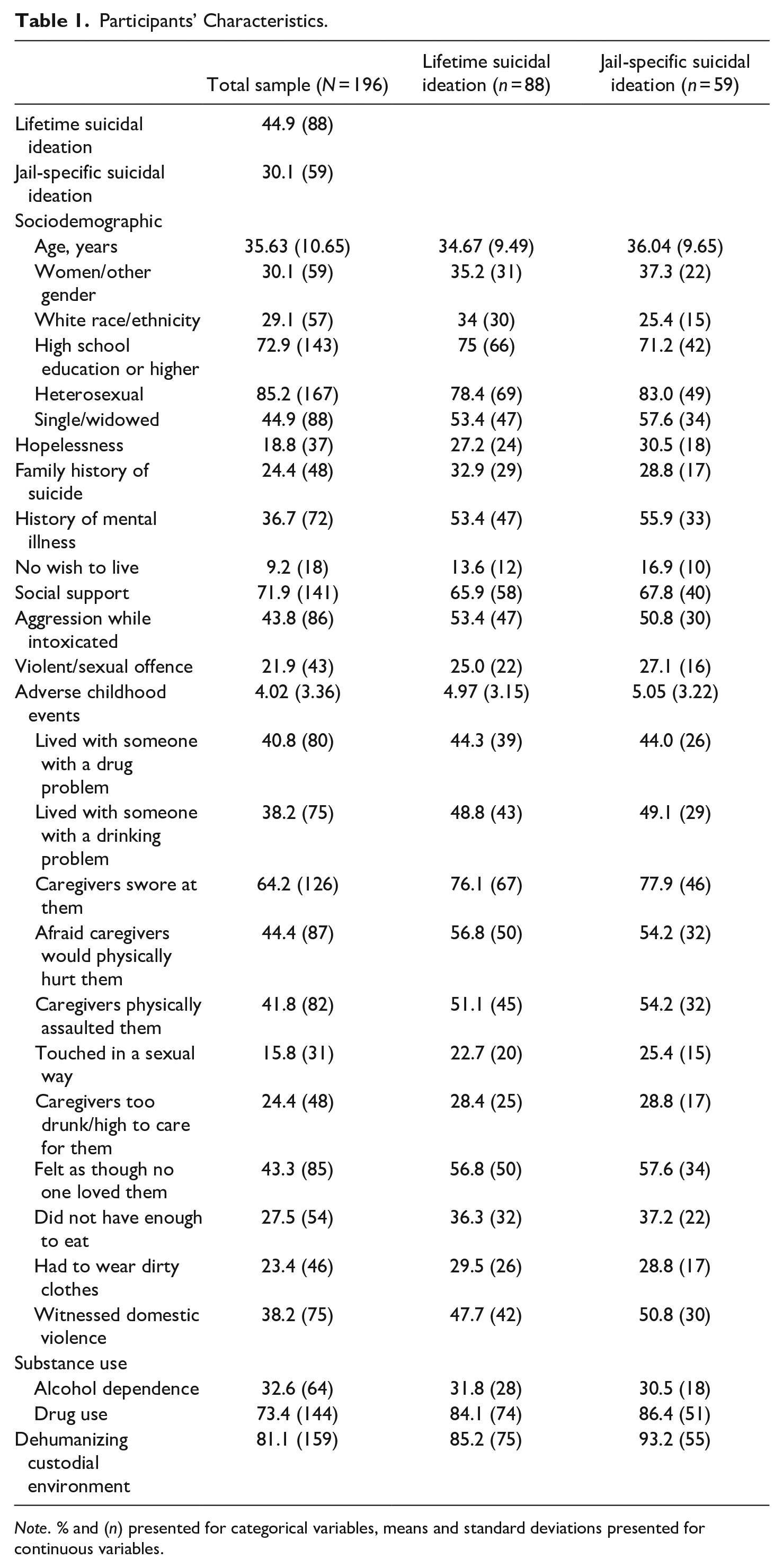
Note. % and (n) presented for categorical variables, means and standard deviations presented for continuous variables.
Measures
Suicidal Ideation
Measures of suicidal ideation captured lifetime history and jail-specific experiences. To assess lifetime suicidal ideation, participants were presented with the item “I have had thoughts about killing myself in the past” and were asked to indicate the frequency of these thoughts (i.e., never, rarely, sometimes, often). Responses to this item were collapsed to create a dichotomous variable according to those who indicated rarely, sometimes, or often (coded 1) versus never (coded 0). To assess jail-specific suicidal ideation, participants were presented with the item “I have had thoughts about killing myself since being in jail.” Again, participants were asked to indicate the frequency of these thoughts (i.e., never, rarely, sometimes, often) and responses were collapsed to create a dichotomous variable according to those who indicated rarely, sometimes, or often (coded 1) versus never (coded 0). Both measures of suicidal ideation were designed by the third author (FA) and, therefore, were not derived from a validated instrument.
Sociodemographic Variables
The survey included several sociodemographic variables, such as age in years (continuous), gender (women/other vs. men), race/ethnicity (white vs. other), education (high school or higher vs. less than high school), sexual orientation (heterosexual vs. other), and relationship status (single/widowed vs. other).
Clinical Variables
The selection of “clinical variables” (i.e., targetable risk factors) was informed by both past research into suicidal ideation involving custodial populations (see Favril et al., 2017; Favril & Vander Laenen, 2018) and concepts underlying ideation-to-action theories of suicide (see Klonsky et al., 2018). To measure hopelessness, the following items were used: “I look forward to the future with hope and enthusiasm” (agree = 1, disagree = 0) and “I might as well give up because there’s nothing I can do to make things better” (agree = 1, disagree = 0). These items were combined to create a single binary measure, whereby a negative response to the first item, and a positive response to the second item, was interpreted as hopelessness (yes = 1, no = 0). Though much less detailed than a scale measure, the use of a single self-report measure of hopeless thinking is consistent with previous research in prisons (Abderhalden et al., 2020; Stoliker, 2020; Stoliker et al., 2020) and jails (Abderhalden et al., 2022; Stoliker & Abderhalden, 2023). To assess family history of suicide, a single binary measure was included based on the survey item, “has anyone in your family ever committed suicide?” (yes = 1, no = 0). To measure participants’ history of mental illness, a single binary item was used that asked, “do you have a history of mental illness?” (yes = 1, no = 0). Similarly, whether participants had no wish to live was measured according to a single binary item that presented respondents with the statement, “I have no wish to live” (agree = 1, disagree = 0). Furthermore, two items were combined to create a single binary measure of social support (yes = 1, no = 0): “I receive a great deal of emotional support from my friends and family” and “I am very satisfied with my level of support from my friends and family.” In addition, aggression while intoxicated was included based on previous research (Favril, Stoliker, & Vander Laenen, 2020) and was captured as a single binary measure according to an item that asked participants, “have you gotten into fights when under the influence of drugs?” (yes = 1, no = 0). The type of offence that resulted in the current incarceration was coded into violent/sexual (e.g., assault, sexual assault, robbery, homicide) versus non-violent (e.g., property, traffic, violation of parole, drug).
Several survey items captured adverse childhood events (ACEs), which were used to create a quantitative scale reflecting the total number of ACEs experienced by participants during the first 18 years of life, ranging from 0 to 11 (Cronbach’s α = .868). Specifically, this scale captured ACEs according to the presence of the following events (yes = 1, no = 0): (a) “did you live with anyone who had a drug problem when you were under the age of 18?”; (b) “did you live with anyone who had a drinking problem when you were under the age of 18?”; (c) “my parents, or other adult in the household, swore at me”; (d) “a parent, or other adult in the household, made me afraid that I may be physically hurt”; (e) “a parent, or other adult in the household pushed, grabbed, slapped, or threw things at me”; (f) “someone in my household touched or fondled me in a sexual way”; (h) “my parents, or other adult in the household, were too drunk or high to take care of me”; (i) “I felt as though no one in my family loved me”; (j) “I didn’t have enough to eat”; (k) “I had to wear dirty clothes”; (l) “my mother, or stepmother, was physically harmed by another adult in front of me.” All ACEs items were developed by the third author (FA) and, therefore, were not derived from a validated instrument. In this regard, the scale does not capture all relevant adverse childhood experiences (e.g., those that occur outside the household or family unit). Table 1 presents prevalence rates for each item on this scale according to the total sample and suicidal ideation history.
Substance use was captured according to both alcohol dependence and drug use. Alcohol dependence was based on the CAGE-questionnaire (Bush et al., 1987), which is a four-item screening test where two or more positive responses suggests dependence. Participants with two or more positive responses were therefore coded as 1 for alcohol dependence (and 0 otherwise). To measure drug use (yes = 1, no = 0), two items were combined to create a single binary variable. Participants were asked, based on the 12 months prior to the current incarceration, “have you used drugs other than those required for medical reasons?” and “have you used prescription drugs other than what they are prescribed for?” Finally, to assess whether participants experienced a dehumanizing custodial environment (yes = 1, no = 0), two items were combined to create a single binary variable. Participants were provided with the statements, “most officers treat inmates like they are animals” and “most officers view inmates as just numbers.”
Data Analysis
The Statistical Package for the Social Sciences (SPSS version 28) was used to clean and analyze the data. Prior to conducting descriptive and inferential analysis, a missing values analysis was conducted. Results from Little’s MCAR test demonstrated there was a range of 0.5 to 17% missing values across all items and, further, data were found to be missing completely at random, χ2 (2) = 5.67, p = .059. Multiple imputation (MI) was used to handle missing data to reduce bias in estimates. In MI estimation, SPSS settings were configured to: have all variables act as predictors and were imputed; set constraints so that imputed values were within the range of valid scores; and perform a total of 20 imputations. All results are therefore based on pooled estimates of the 20 imputed data sets. Measures of central tendency and relative frequencies are provided in Table 1. Bivariate and multivariate binary logistic regression models (Tables 2 and 3) were further specified to identify factors that differentiate those with lifetime suicidal ideation (n = 88) from those without lifetime suicidal ideation (n = 108), as well as factors that differentiate those with jail-specific suicidal ideation (n = 59) from those without jail-specific suicidal ideation (n = 137). All explanatory factors were simultaneously entered into multivariate regression analyses irrespective of bivariate associations. Probability values <.05 were considered statistically significant.
Bivariate and Multivariate Analysis for Lifetime Suicidal Ideation, Compared to No Suicidal Ideation (N = 196).
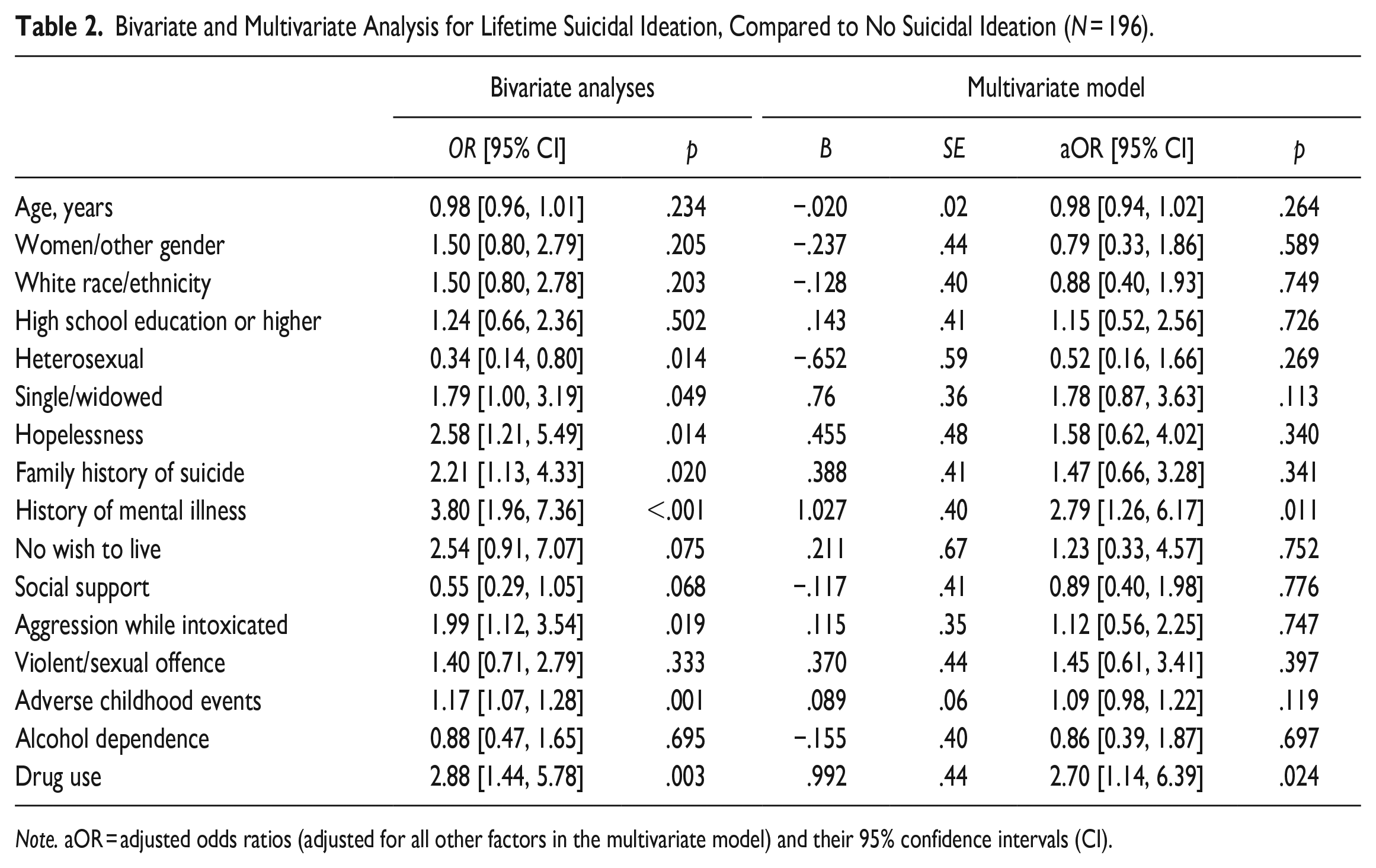
Note. aOR = adjusted odds ratios (adjusted for all other factors in the multivariate model) and their 95% confidence intervals (CI).
Bivariate and Multivariate Analysis for Jail-Specific Suicidal Ideation, Compared to No Suicidal Ideation (N = 196).
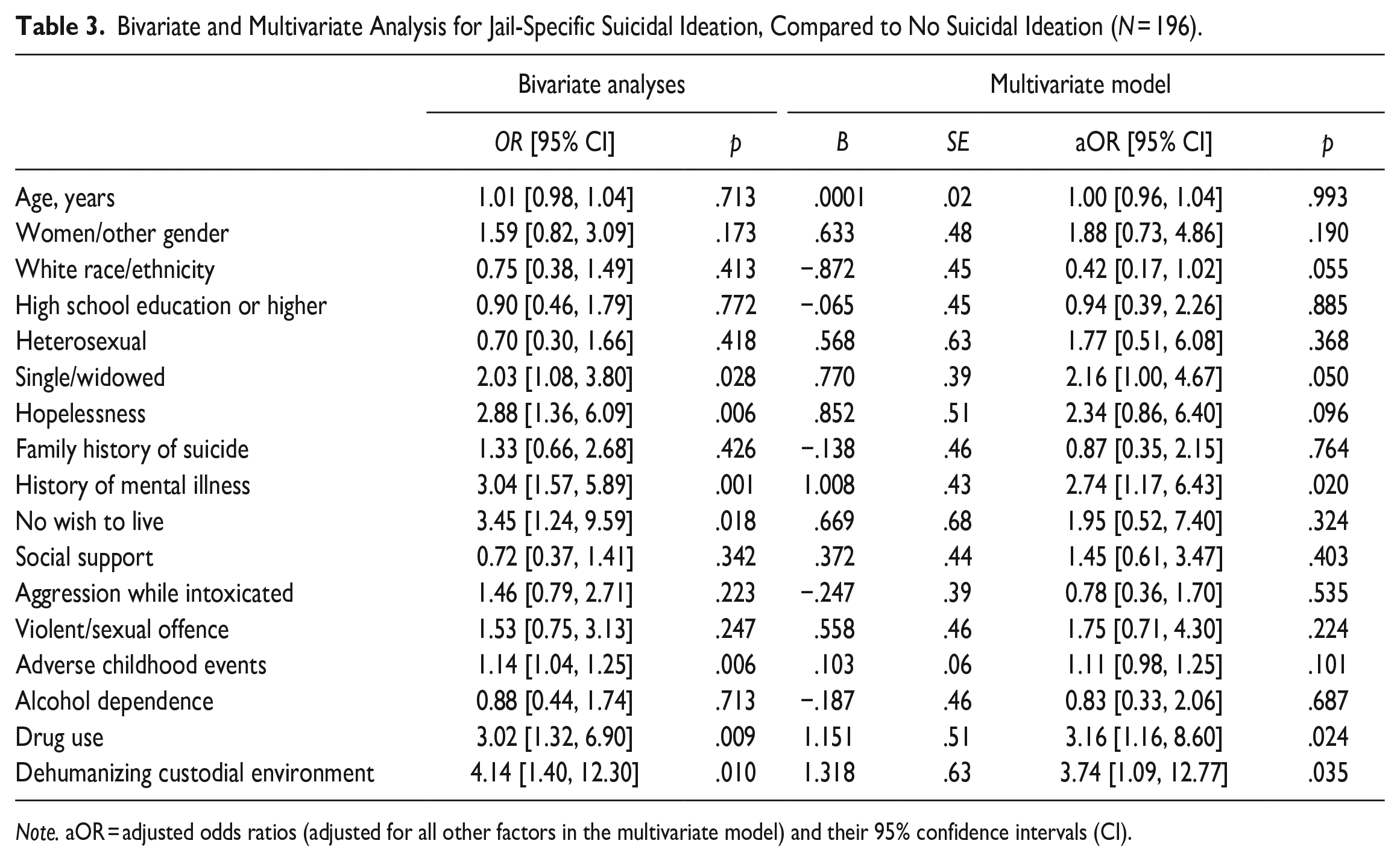
Note. aOR = adjusted odds ratios (adjusted for all other factors in the multivariate model) and their 95% confidence intervals (CI).
Results
Prevalence of Lifetime and Jail-Specific Suicidal Ideation
Among the total sample (n = 196), approximately 45% (95% CI [38, 52]) reported a lifetime history of suicidal ideation and 30% ([24, 36]) reported experiencing suicidal ideation during the current period of incarceration (Table 1). With respect to key sociodemographic characteristics, those who identified as women/other gender reported a higher prevalence than men on lifetime (52.5 vs. 42.3; OR = 1.50, [0.80, 2.79]) and jail-specific (37.3 vs. 27.0; OR = 1.59, [0.82, 3.09]) suicidal ideation. Those who identified as white race/ethnicity reported a higher prevalence than others on lifetime suicidal ideation (52.6 vs. 41.7; OR = 1.50, [0.80, 2.78]), but not jail-specific suicidal ideation (26.3 vs. 31.6; OR = 0.75, [0.38, 1.49]). Furthermore, participants who reported a lifetime history of suicidal ideation were slightly younger than those who did not (M = 34.70 vs. 36.42; OR = 0.98, [0.96, 1.01]), whereas participants who reported experiencing suicidal ideation during the current period of incarceration were slightly older than those who did not (M = 36.04 vs. 35.46; OR = 1.01, [0.98, 1.04]).
Bivariate and Multivariate Analyses
Lifetime Suicidal Ideation
As shown in Table 2, bivariate analyses indicate that eight variables (i.e., sexual orientation, relationship status, hopelessness, family history of suicide, history of mental illness, aggression while intoxicated, adverse childhood events, and drug use) were significantly associated with lifetime suicidal ideation (vs. no lifetime suicidal ideation). With respect to multivariate analysis, only two variables were significantly associated with this suicidal outcome measure. Specifically, those with a history of mental illness (aOR = 2.79, [1.26, 6.17]) and reported drug use (aOR = 2.70, [1.14, 6.39]) were nearly three times more likely to report lifetime suicidal ideation than those without.
Jail-Specific Suicidal Ideation
As shown in Table 3, bivariate analyses indicate that seven variables (i.e., relationship status, hopelessness, history of mental illness, no wish to live, adverse childhood events, drug use, and experience of a dehumanizing custodial environment) were significantly associated with jail-specific suicidal ideation (vs. no jail-specific suicidal ideation). With respect to multivariate analysis, only three variables were significantly associated with this suicidal outcome measure. Again, those with a history of mental illness (aOR = 2.74, 95% CI [1.17, 6.43]) were nearly three times more likely to report jail-specific suicidal ideation than those without. Those who reported drug use (aOR = 3.16, [1.16, 8.60]) and experiencing a dehumanizing custodial environment (aOR = 3.74, [1.09, 12.77]) were over three times more likely to report jail-specific suicidal ideation than those who did not report these factors.
Discussion
The suicide mortality rate in U.S. jails is more than twice the rate witnessed in prison facilities (Carson, 2021a, 2021b) and the general U.S. population (Drapeau & McIntosh, 2020). Although suicidal ideation is regarded as a prerequisite for suicidal behavior (Klonsky & May, 2015; O’Connor & Kirtley, 2018; Van Orden et al., 2010), and empirical evidence has suggested a strong link between suicidal thoughts and attempts (Favril et al., 2022) and completions (Zhong et al., 2021) in custodial settings, only a handful of studies have assessed the cognitive phase of the suicidal process among people in custody in U.S. jails (Schaefer et al., 2016; Stoliker & Abderhalden, 2023). Overall, our findings concur with previous research into suicidal ideation among custodial populations, as well as suicide theory (i.e., ideation-to-action). However, there were also some inconsistencies in this regard.
Prevalence of Suicidal Ideation
With respect to the prevalence of lifetime and jail-specific suicidal ideation in the current sample, estimates (45% and 30%, respectively) are within the range of previous findings for lifetime suicidal ideation (20–58%) and suicidal ideation while in custody (16–40%) across various samples of men and women in custody in high-income countries (Favril et al., 2017; Favril, O’Connor, et al., 2020; Favril, Stoliker, & Vander Laenen, 2020; Favril & Vander Laenen, 2018; Godet-Mardirossian et al., 2011; Stoliker & Abderhalden, 2023; Zheng et al., 2021). Furthermore, we have previously suggested that, much like suicide mortalities, non-fatal suicidal events may be more common in U.S. jails versus prisons (Stoliker & Abderhalden, 2023). Indeed, the prevalence of lifetime suicidal ideation in the current sample (45%) was greater than that found in a nationally representative sample of individuals incarcerated in state and federal prisons in the U.S. (23%). However, it is important to also acknowledge the variability across prisons with respect to the prevalence of lifetime suicidal ideation (2–71%), which suggests that the nature of this issue is unlikely to be consistent across correctional facilities (Stoliker et al., 2020). On the one hand, researchers may consider future studies that assess variability in the nature of suicidal ideation across U.S. jails (at national and other jurisdictional levels) to build evidence on facility-level contributions to these issues (e.g., see Stoliker, 2018; Stoliker et al., 2020). On the other hand, managerial staff and administrators may consider investigating the nature of suicidal ideation within their facilities (e.g., via screening questionnaires) to incorporate the necessary resources to address this issue.
Theoretical and Empirical Considerations
Consistent with ideation-to-action theories of suicide (Klonsky & May, 2015; O’Connor & Kirtley, 2018; Van Orden et al., 2010), our findings suggest that factors that may contribute to one’s capability for suicide (e.g., see May & Victor, 2018) and, thus, precipitate the progression from thoughts to acts of suicide, are not similarly associated with the cognitive phase of the suicidal process (Klonsky et al., 2018). Put simply, factors underlying suicidal ideation differ from those underlying suicidal behavior. Specifically, a history of exhibiting violence towards others (i.e., aggression while intoxicated and incarceration for a violent/sexual offence), as well as the cumulation of ACEs, were not significantly associated with lifetime or jail-specific suicidal ideation. In support of these findings, previous ideation-to-action studies with custodial samples have revealed that attempters are more likely than ideators to have a history of violent offending (Favril & O’Connor, 2021; Favril, Stoliker, & Vander Laenen, 2020) and exhibit certain aggressive behavior (Stoliker & Abderhalden, 2023). In addition, Sarchiapone, Carli, et al. (2009) identified that violent offences are linked to a lifetime history of suicide attempts but not ideation in a sample of 903 Italian men in custody. These findings substantiate the key principle underlying ideation-to-action theories of suicide, in that behavioral processes are distinguishable from cognitive processes based on one’s capacity to inflict (lethal) self-harm (i.e., overcoming the fear of pain and death).
Related to the above, Clements-Nolle et al. (2009) identified a link between the frequency and severity of childhood trauma(s) and suicidal behavior in a sample of 247 women incarcerated in a U.S. state prison, suggesting that persistent exposure to painful childhood events contributes to the enactment of suicidal thoughts in adulthood. A study of men in custody in Italy, however, suggested childhood trauma is directly and positively associated with both lifetime suicidal ideation and attempt (Sarchiapone, Jovanović, et al., 2009). Interestingly, a study of 899 men in custody in France (Godet-Mardirossian et al., 2011) suggested the link between childhood adversity and recent suicidal ideation is mediated by certain personality traits, whereas another study of 626 women in custody in China (Zheng et al., 2021) highlighted a similar link between childhood trauma and current suicidal ideation via negative emotions (i.e., depression, anxiety, and hopelessness). This might suggest that the effect of adverse childhood events on suicidal cognitions is explained through proximal predictors of suicidal ideation, such as psychological disposition (Klonsky et al., 2018). In other words, a causal pathway may exist whereby adverse childhood events influences psychological well-being, which could then precipitate suicidal thinking. Related to this point, our data revealed that a history of mental illness was significantly and positively associated with lifetime and jail-specific suicidal ideation, which is consistent with many previous studies conducted in a custodial setting (e.g., see Favril et al., 2017; Favril, O’Connor, et al., 2020; Schaefer et al., 2016). However, post hoc analyses did not support any conclusions for a mediating effect of mental illness on the relationship between childhood adversity and suicidal ideation in the current sample (findings can be made available upon request). Further investigation of this pathway is required as varying assessments of childhood adversity have been used in this area of research.
Broadly, substance abuse (Sarchiapone, Carli, et al., 2009) and, specifically, drug use (Stoliker, 2020) has been linked to suicidal ideation, but not suicide attempt, among people in custody. While substance use is expected to play a role in suicide capability (May & Victor, 2018), the current study similarly identified drug use (but not alcohol dependence) as an independent correlate of lifetime and jail-specific suicidal ideation. This emphasizes the importance of investigating the specific characteristics of substance use (e.g., type, psychological effects, patterns and modes of use, etc.) that play a role in precipitating or inhibiting suicidal events (Favril, Stoliker, & Vander Laenen, 2020; Stoliker, 2020), including suicidal ideation. Albeit substance use has been identified as a shared risk factor of suicidal ideation and attempts among people in custody (e.g., see Favril, Stoliker, & Vander Laenen, 2020; Stoliker & Adberhalden, 2021) and, therefore, adopting this fine-grained approach could shed light on the aspects of substance use that distinguish ideation versus action processes.
Within ideation-to-action theories of suicide (e.g., Klonsky & May, 2015; Van Orden et al., 2010), social support is regarded as a central mechanism in precipitating (when absent) or inhibiting (when present) suicidal thoughts. Indeed, a series of studies in the custodial setting have signified that a lack of social support is associated with suicidal ideation over the life course and while incarcerated (e.g., see Favril et al., 2017; Favril, O’Connor, et al., 2020). However, we did not find a significant association between perceived social support and lifetime or jail-specific suicidal ideation in the current sample. This does not necessarily suggest that social support has a null effect on suicidal thoughts among people in jail (Stoliker & Abderhalden, 2023). Instead, it points toward the need to further investigate the unique position of those in custody in U.S. jails, as well as the underlying characteristics of their social support networks—for instance, sudden and recent change in life circumstances and the dissolution of supports (due to incarceration), as well as the (un)availability of pro-social supports (in the community and in custody). Although social connection agreeably offers some level of protection against suicidal thoughts, in some cases one’s suicidal cognitions may develop due to their exposure to suicide attempts of significant support figures (Abrutyn & Mueller, 2014). A family history of suicide was not a significant correlate of lifetime and jail-specific suicidal ideation in the current sample; however, it could be that the relationship to the support figure (i.e., friends) is most critical in shaping whether and how one thinks about suicide as an option for managing distress (Abrutyn & Mueller, 2014). Social support and its influence on suicidal cognitions among people in custody is therefore an area that warrants deeper investigation.
Given that hopeless thinking may be closely tied to various psychosocial stressors and, thus, may play a key role in precipitating suicidal cognitions (e.g., see Klonsky et al., 2018; Klonsky & May, 2015), it was expected that hopelessness would be linked to lifetime and jail-specific suicidal thoughts; however, current findings did not support this. Notably, a study of men and women in U.S. state and federal prisons found that hopelessness distinguished (repeat) suicide attempters from suicide ideators, in that it was positively associated with attempt status (Stoliker, 2020). This might suggest that (a) prerequisites for suicidal behavior (i.e., suicidal ideation and its associated precipitators) are simply reflected in the volitional phase of the suicidal process or (b) feelings of hopelessness are more important for propelling people toward suicidal behavior versus only thinking about suicide. Furthermore, an understudied area of inquiry is the link between dehumanization and suicidal thoughts and behaviors. In the current study, it was found that people who believed correctional officers treated them as subhuman were more likely to report suicidal ideation in jail. This coincides with unpublished data by Robison et al. (2022), which suggest both suicidal ideation and attempts are significantly and positively associated with meta-dehumanization (i.e., the perception of being treated as less than human) among a sample of 410 jail incarcerated individuals. Future research should consider uncovering the mechanisms that link dehumanization to thoughts of suicide.
Practical Implications
Theoretically, the ideation-to-action framework would suggest that strategies to reduce suicidal thoughts and prevent suicide attempts should acknowledge the distinct processes and explanations of these phenomena (Klonsky et al., 2018). That is, supports and interventions should address the cognitive and behavioral spectrum of the suicidal process separately given the differing factors that map onto these suicidal events. Our data provide some support for this position. Relatedly, a recent meta-analysis of community-based studies suggested that safety-planning type interventions for suicide prevention significantly reduced suicidal behavior, but not suicidal ideation (Nuij et al., 2021). Interventions that specifically target suicidal behavior, such as suicide safety planning, may therefore succeed in altering one’s behavior but fail to change cognitive and emotional distress (Nuij et al., 2021). Although primarily concerned with pretrial jail detainees and suicidal events following release, it will be interesting to see the results from Johnson et al. (2020) implementation and evaluation of a safety planning intervention during detention to reduce (post-release) suicidal events in this population (e.g., suicide, suicide attempts, and suicide ideation). If found effective in reducing suicidal ideation (and behavior) in pretrial jail detainees following release, it might be worthwhile to consider expanding this intervention to the jail population more broadly. In any case, and as noted by Nuij et al. (2021), cognitive behavioral therapy (CBT) and dialectical behavior therapy (DBT) are effective psychotherapeutic interventions for addressing suicidal ideation (Mann et al., 2005; Zalsman et al., 2016).
Taken together, psychotherapeutic interventions that target both suicidal thinking (e.g., CBT and DBT) and behavior (e.g., suicide safety planning) should be implemented in jail settings to provide a holistic approach to addressing suicidality. At present, there is limited evidence surrounding the efficacy of these interventions with respect to jail populations. Therefore, further research is needed to identify how these programs should be designed and implemented to meet the specific needs of this population (and facility operations), as well as to provide insight into how effective certain strategies are for addressing suicidal thinking versus behavior (see Johnson et al., 2020).
Limitations
This study is one of few that has examined the “development” of suicidal ideation within a sample of people in custody through an ideation-to-action framework. It also contributes to a greater understanding of the suicidal process in an understudied population, despite the high risk of suicide mortality in U.S. jails (Carson, 2021a). Irrespective of the strengths of this study, we note several limitations both to provide caution concerning the interpretation of findings as well as to guide future research. First, factors that are commonly linked to the development of suicidal ideation, such as psychiatric illness and substance use (among others), oftentimes emerge as key correlates of attempt status (e.g., see Favril, Stoliker, & Vander Laenen, 2020). Thus, a major limitation of studies informed by the ideation-to-action framework which draw upon cross-sectional data is the inability to discern the targeted effects of these shared risk factors. For instance, psychiatric illness and substance use are unequivocally linked to both suicidal ideation and behavior (e.g., see Sarchiapone, Jovanović, et al., 2009), however, the specific role these factors play in each competent of the suicide continuum is less clear. Future studies should shed light on the differential effects these factors have on the development of suicidal thoughts and progression to attempts. Second, this study is plagued by many other common shortcomings of cross-sectional research designs, including the inability to discern causal order and inconsistent timestamps of variables (e.g., lifetime and recent). In this case, we assumed that all explanatory factors preceded the suicidal outcome measures; however, it is plausible there is also reverse causation (e.g., suicidal ideation preceding substance use). It is also unclear whether the predictor and suicidal outcome measures had occurred within a shared timeframe. Furthermore, cross-sectional data limit conclusions surrounding the ideation-to-action process, in that it is difficult to discern whether the identified relationships truly reflect a “developmental process” from exposure to risk to suicidal ideation. Interpretations in this regard should therefore be approached with caution.
Third, a self-report questionnaire was employed, and many variables were assessed as single-item dichotomous measures with limited detail. For instance, our measure of mental illness was vague and did not capture specific disorders (see Favril, Stoliker, & Vander Laenen, 2020; Stoliker et al., 2020), and our measure of drug use did not assess the context of use (e.g., frequency, duration, quantity, type). Further to this point, single-item binary assessments for both lifetime and jail-specific suicidal ideation were used. These measures lacked crucial detail surrounding the nature of these events (Favril & O’Connor, 2021), including frequency, recency, severity (e.g., passive or active), and chronicity. Future work should capture these details to provide greater insight into the seriousness of suicidal ideation both before and during incarceration. Taken together, the use of fine-grained (and empirically reliable and validated) psychometric tests, as well as clinical interviews (e.g., see Sarchiapone, Carli, et al., 2009; Sarchiapone, Jovanović, et al., 2009), would enhance detail and confidence surrounding target variables as well as improve explained variance. Related to the adequate measurement of specific concepts, future research involving jail populations should consider assessing the reliability and validity of the ACEs scale used in the current study, as well as incorporating other validated measures of adverse childhood events (see Clements-Nolle et al., 2009). Fourth, the sample only included individuals in a single jail in a large U.S. state and, therefore, results may not be generalizable to the broader U.S. jail population.
Conclusion
There are a host of complex factors that either precipitate or inhibit the suicidal process—more specifically, suicidal ideation—among people who are incarcerated in jail. While factors predictive of suicidal ideation among people incarcerated in jail mirror those found in prison and community-based samples, further investigation is needed to identify the underlying mechanisms of these associations for those in jail. Assuredly, this would lead to a stronger evidentiary base for the processes that lead to the development of suicidal thoughts, which could, in turn, inform the development and evaluation of suicide prevention strategies that target suicide cognitions.
Footnotes
Declaration of Conflicting Interests
The author(s) declared no potential conflicts of interest with respect to the research, authorship, and/or publication of this article.
Funding
The author(s) received no financial support for the research, authorship, and/or publication of this article.
