




Abstract

Duindam, H., Creemers, H. E., Hoeve, M., & Asscher, J. J. (2021). A quasi-experimental study on the effectiveness of Dutch Cell Dogs in incarcerated youth. International Journal of Offender Therapy and Comparative Criminology, 65(5), 644–666.
The authors discovered small imputation errors for one participant in their dataset during thesis advising, and the incorrect inclusion of another participant. After correction of these errors, the conclusions about their moderator results have changed. The changes are summarized below:
Age
Age is no longer a moderator for therapeutic functioning (F (4, 130) = 2.158, p = .08).
Type of facility
Type of correctional facility was now found to be a moderator for the wellbeing outcome (F (14, 120) = 1.882, p = .035). Univariate post-hoc analyses demonstrated that type of facility moderated the outcomes for self-control (F (2, 120) = 4.993, p = .007) and empathy (F (2, 120) = 3.267, p = .04). At post-hoc test, a significant difference between COR and SCR remained only for the outcome of empathy, indicating that over time empathy reduced for the DCD group and increased for the TAU group (see Table 4).
Type of facility continued to moderate therapeutic functioning (F (4, 130) = 3.353, p = .009), but only for treatment motivation (F (2, 33) = 5.430, p = .005), which was no longer significant at post-hoc test. Type of facility no longer moderated the therapeutic alliance outcome.”
As a consequence, the following parts in the article have changed:
Moderator Analyses
Significant moderator effects, including mean, standard deviations, and Cohen’s d effect sizes, are displayed in Table 4.
Age
Age moderated the effectiveness of DCD on institutional infractions, F (2, 77) = 4.673, p = .012. For post hoc analyses, median split was used to create two age categories: juveniles (<18-years-old, 47.8% of the sample) and adults (≥18-years-old, 52.2% of the sample). These analyses showed that DCD participation was not significantly associated with changes in infraction rates in both the juvenile and adult group.
Cultural background
Cultural background moderated the effectiveness of DCD on institutional infractions, F (1, 76) = 16.474, p < .001. Post hoc analyses revealed that, compared to TAU, there was a reduction in institutional infractions following DCD for participants with a first or second generation immigrant background, F (1, 46) = 8.887, p = .005. In contrast, institutional infractions of DCD participants with a native Dutch background increased over time, F (1, 30) = 10.588, p = .003.
Facility type
Facility type (i.e., correctional vs. secure residential) moderated the effectiveness of DCD on well-being (F (14, 120) = 1.882, p = .035) and therapeutic functioning, F (4, 130) = 3.353, p = .009. For well-being, post hoc analyses demonstrated type of facility moderated the outcomes for self-control (F (2, 120) = 4.993, p = .007) and empathy (F (2, 120) = 3.267, p = .04). At post-hoc, a significant difference remained only for the outcome of empathy in the SCR group, indicating that over time empathy reduced for the DCD group and increased for the TAU group (see Table 4).
For therapeutic functioning, post hoc analyses revealed that type of facility only moderated the outcome of treatment motivation (F (2, 33) = 5.430, p = .005), which was no longer significant at post-hoc test.
Discussion
In line with the corrected findings the following sentences in the discussion section were removed:
For juvenile (18−) participants and participants in secure residential care facilities, DCD was associated with a decrease in the quality of the treatment alliance.
In addition, for the juveniles (18−) participants, the quality of the therapeutic alliance decreased over time following DCD.
A relatively large proportion of the 18− juvenile participants resided in secure residential care (55%); we also found a reduction in the quality of the therapeutic relationship for DCD participants in secure residential care (compared to correctional facilities). These findings suggest that in addition to age, facility type may have also played a role in the effectiveness of DCD. Informal observations by the DCD trainers suggest that, particularly in the secure residential care facilities, participation in DCD may have affected the perspective of the juveniles on their relationship with their group leaders and social workers. It may even have resulted in increased awareness of dysfunctional relationships, which may have caused adverse effects.
This touches upon a broader challenge concerning the implementation of programs in secured settings.
The following sentence was added:
For participants in secure residential care facilities, DCD was associated with a decrease in empathy over time.
Corrected Table 3 and Table 4 are attached.
Effects of DCD (n = 60) Versus TAU (n = 77) on Primary and Secondary Outcomes.
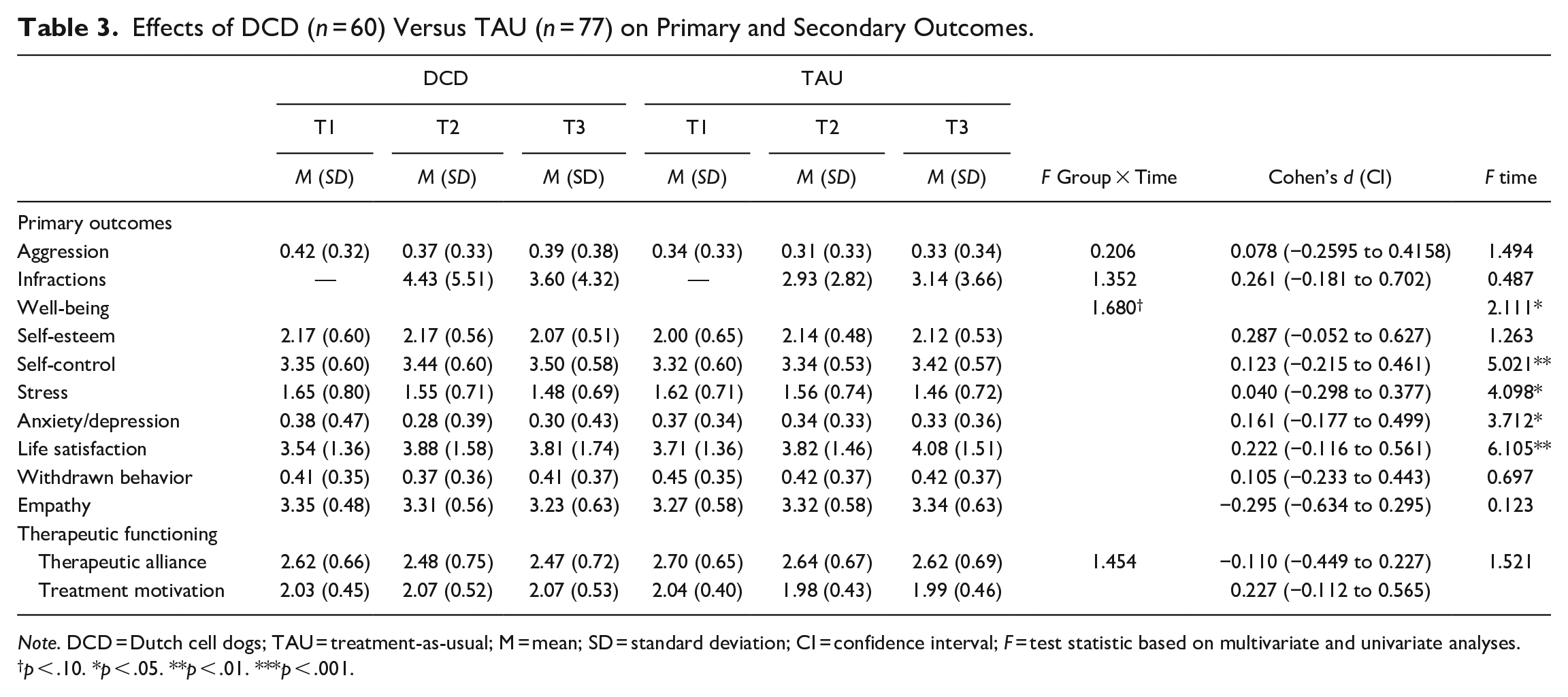
Note. DCD = Dutch cell dogs; TAU = treatment-as-usual; M = mean; SD = standard deviation; CI = confidence interval; F = test statistic based on multivariate and univariate analyses.
p < .10. *p < .05. **p < .01. ***p < .001.
Significant Moderator Effects.
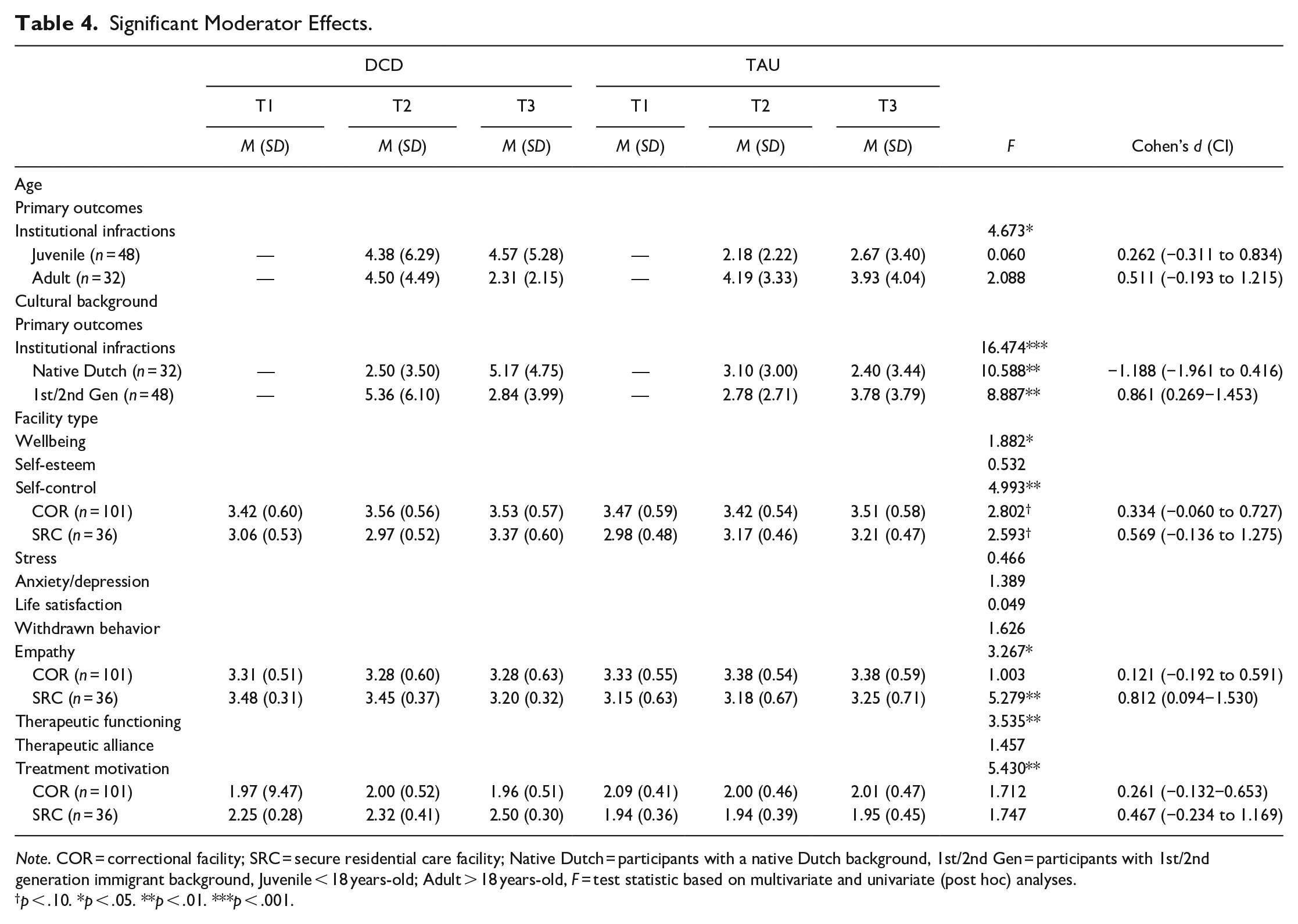
Note. COR = correctional facility; SRC = secure residential care facility; Native Dutch = participants with a native Dutch background, 1st/2nd Gen = participants with 1st/2nd generation immigrant background, Juvenile < 18 years-old; Adult > 18 years-old, F = test statistic based on multivariate and univariate (post hoc) analyses.
p < .10. *p < .05. **p < .01. ***p < .001.