




Abstract
The aim of the present study was to examine construct validity and reliability of the German reactive proactive aggression questionnaire (RPQ) in a sample of delinquent boys (N = 156). A confirmatory factor analysis with a two-factor model of reactive and proactive aggression showed a good fit to the data. The factor structure of the original RPQ could be fully replicated in the German translation, and Cronbach’s alphas were good for both subscales. Concurrent validity of the RPQ was demonstrated by significant correlations with the subscales of the inventory of callous unemotional traits. In future studies, the German RPQ can be used to assess reactive and proactive aggression in judicial and forensic psychiatric care in Germany. The present findings also provide support for the use of the RPQ in cross-cultural comparisons.
The topic of aggression has frequently been addressed in scientific literature as an important risk factor for various forms of antisocial behavior, including delinquency and conduct problems (Cima & Raine, 2009; Loeber & Dishion, 1983; Raine, 2014). Already since the 1960’s research has focused on the different types of aggression (Moyer, 1968) and the role of brain structures and neuro-hormones to understand human aggression, especially in the context of offending (Bass & Nussbaum, 2010; Levi et al., 2010) and psychiatric problems (Raine, 2014).
Aggression can be defined as: “acting violently with the purpose of causing harm. This often means harming a person whereby the conduct oversteps the boundaries of what is socially acceptable. To the other party, situations like these often call upon emotions, such as fear, pain, sorrow and/or anger” (Anderson & Bushman, 2002). Pulkinnen (1987) made a first attempt to refine the term “aggression” by distinguishing between offensive and defensive aggression. Although there has been a scientific debate whether one should distinguish between different types of aggression (Bushman & Anderson, 2001), several studies indicate that aggression is better explained if it is differentiated into its functions of reactive and proactive aggression (Dodge, 1991; Dodge & Coie, 1987; Dodge et al., 1997; Vitaro et al., 2002, 2006).
Reactive aggressive behavior is a response to a perceived threat or provocation, accompanied by feelings of anxiety and loss of control. Reactive aggression originates from frustrations and irritations within the person, and has been shown to be related to hostile intent, rejection, and negative life experiences at a young age (Dodge et al., 1997; Kempes et al., 2005; Vitaro et al., 2002), based on the frustration-aggression model (Dollard et al., 1939).
Proactive aggressive behavior is goal directed, and aims to influence others in an aversive way within a situation that is not provoked. This type of aggressive behavior is planned, instrumental and often cold-blooded, and purposefully intended to cause harm and to dominate others (Dodge, 1991; Polman et al., 2007) or to reach a certain goal or objective (Dodge & Coie, 1987). Proactive aggression has shown to be associated with delinquency (Card & Little, 2006; Fite et al., 2008; Miller & Lynam, 2006), antisocial personality traits (Cima & Raine, 2009; Raine et al., 2006), and is often present in youth designated as “callous” and “unemotional” (Asscher et al., 2011). Cima and Raine (2009) provide an overview of behavioral correlates of both reactive and proactive aggression. Raine et al. (2006) demonstrated that a two factor (reactive-proactive) model fitted their data significantly better than a one factor model, and developed the reactive proactive questionnaire (RPQ). To date the dimensions of reactive and proactive aggression, which are assessed with the RPQ, have not been tested by means of a confirmatory factor analysis in Germany, and little research has been conducted to examine these two forms of aggression in Germany in relation to delinquency and callous unemotional traits.
Callous and unemotional (CU) traits can be regarded as a compilation of cold-blooded actions and emotions, such as lack of guilt, shallow affect, lack of empathy, restriction of emotions, and the inability to take responsibility for actions and an increased risk for severe aggressive behavior (Frick et al., 2014; Frick & White, 2008; Kimonis et al., 2015; Kotler & McMahon, 2005). CU-traits can be distinguished in feelings of callousness, uncaring and unemotional (Frick, 2004). Cima et al. (2013) demonstrated that the proactive aggression subscale was significantly and positively related to ICU total and ICU Callousness subscale scores, while the reactive aggression subscale was significantly but negatively related to the ICU scores. Both proactive and reactive aggression were unrelated to the unemotional subscale of the ICU.
It seems important (also for treatment purposes) to be able to use a reliable and accurate self-report measurement instrument to investigate and distinguish between reactive and proactive aggression. One frequently used instrument is the Reactive Proactive Aggression Questionnaire (RPQ), developed and validated by Raine et al. (2006), which has been translated into several languages (as e.g., Dutch: Cima et al., 2013; Portuguese: Pechorro et al., 2015; Italian: Fossati et al., 2009; East Asia: Fung et al., 2009; Chinese: Seah & Ang, 2008; Serbian: Dinić & Raine, 2019), and demonstrated good cross-cultural validity (Baş & Yurdabakan, 2012; Cima et al., 2013; Dinić & Raine, 2019; Fossati et al., 2009; Fung et al., 2009; Pang et al., 2013; Pechorro et al., 2015; Seah & Ang, 2008).
Raine et al. (2006) demonstrated that a two-factor model with reactive and proactive aggression gave a significantly better fit to their data than a one factor-model, and reported good reliabilities (Raine et al., 2006). Subsequent studies found similar reliability estimates across different samples and languages (e.g., Borroni et al., 2014; Cima & Raine, 2009; Seals et al., 2012), but a German translation and validation is not yet available.
The current study examined the construct validity of the German RPQ in a sample of detained German youth offenders. The replicability of the original two-factor structure will be examined (Raine et al., 2006), as well as its associations with CU-traits. Concurrent validity is demonstrated by a positive correlation between proactive aggression and CU-traits. Given results of previous research a positive correlation between the aggression subscales and CU traits is expected.
Method
Participants
The delinquent sample was recruited from inmates of a German youth prison in Nordrhein-Westfalen. A total of 156 male participants aged 17 to 25 years (M = 20.44; SD = 1.64) agreed to participate in the study. All prisoners lived in supervised living groups of 15 to 20 inmates. The main reason for detention was inflicting personal injury (62%), theft (44.9%), robbery/extortion (45.5%), and possession or dealing of drugs (18%; assessed by means of self-report, multiple answers were possible). Most respondents had German nationality (73%), 13% Turkish, and 14% other nationalities. Education levels were generally low: 33% did not complete any education, 45% completed the lowest level of education (German Hauptschule, lower secondary school). All adolescents voluntarily agreed to participate in this study, signed an informed consent declaration, and were told that their answers would be treated confidentially and anonymously and would be accessed only by the researchers. Ethical approval had been obtained from the Institutional Review Board of the University of Maastricht, The Netherlands.
Instruments
Reactive Proactive Aggression Questionnaire (RPQ)
To produce a German translation, the first author of this study, a bilingual native Dutch and German speaker, translated the Dutch RPQ (Cima et al., 2013) into German. The German Version was then back-translated by another Dutch and German native speaker. The original RPQ, developed by Raine and colleagues in 2006, as well as the Dutch translation, both consist of 23 items ranging on a three-point Likert type scale (from 0 = never, 1 = sometimes, to 2 = often) and make a distinction between reactive aggression (11 items, e.g., “Gotten angry when frustrated”) and proactive aggression (12 items, e.g., “Vandalized something for fun”). The RPQ assesses both physically and verbally aggressive behaviors, and in the case of reactive aggression assesses anger generated in response to external stimuli (Raine et al., 2006). The original scale has shown to be a valid and reliable instrument to investigate reactive and proactive aggression with a significant proactive-reactive inter-correlation and good internal consistency (total scale: α = .90; reactive: α = .81; proactive: α = .84; Raine et al., 2006; see also Cima et al., 2013).
Inventory of Callous Unemotional Traits (ICU)
The ICU scale developed by Frick (2004) is a 24-item self-report measure, with four response categories ranging from 0 = not at all true to 3 = definitely true. The ICU consists of parent, teacher, and self-report versions. In the present study, the German version of the self-report questionnaire was used. This self-report scale has been shown to be a reliable and valid instrument to investigate CU-traits in adolescent offenders (Kimonis et al., 2008). The scale is divided into three subscales: Callousness (e.g., “the feelings of others are unimportant to me”; α = .70), Unemotional (e.g., “I hide my feelings from others”; α = .64), and Uncaring (e.g., ”I try not to hurt others’ feelings”; α = .73; Kimonis et al., 2008). There are 12 reverse scored items (see also Essau et al., 2006; Kimonis et al., 2008) The three subscales form a higher order callous-unemotional dimension (α = .77). The present study showed good reliabilities for the overall ICU-factor (α = .81), and the subscales callousness (α = .72) and uncaring (α = .76). For the subscale unemotional, reliability was sufficient (α = .60).
Statistical Analysis
To examine whether the translated German RPQ could replicate the two-factor structure of the original RPQ, a confirmatory factor analysis was conducted using the Lavaan package in the R environment (Rosseel, 2012). To account for non-normally distributed ordinal variables, the mean and variance-adjusted weighted least squares (WLSMV) estimation procedure was used (Li, 2015). The goodness of fit for the factor solution was evaluated by calculating several indices; the Comparative Fit Index (CFI), the Tucker-Lewis Index (TLI), the Standardized Root Mean Square Residual (SRMR), and the Root Mean Square Error of Approximation (RMSEA).
For a valid model a cut-off value of CFI > 0.90, TLI > 0.90, SRMR < 0.09, and RMSEA < 0.06 is required (Kline, 2005). Calculation of Cronbach’s Alpha and correlational analyses were conducted in SPSS version 24 to examine internal consistency reliability and subsequently test concurrent validity of the RPQ. Concurrent validity is demonstrated if reactive and proactive aggression significantly correlates with the subscales and the overall ICU in the expected direction (positive).
Results
Construct Validity and Reliability of the RPQ
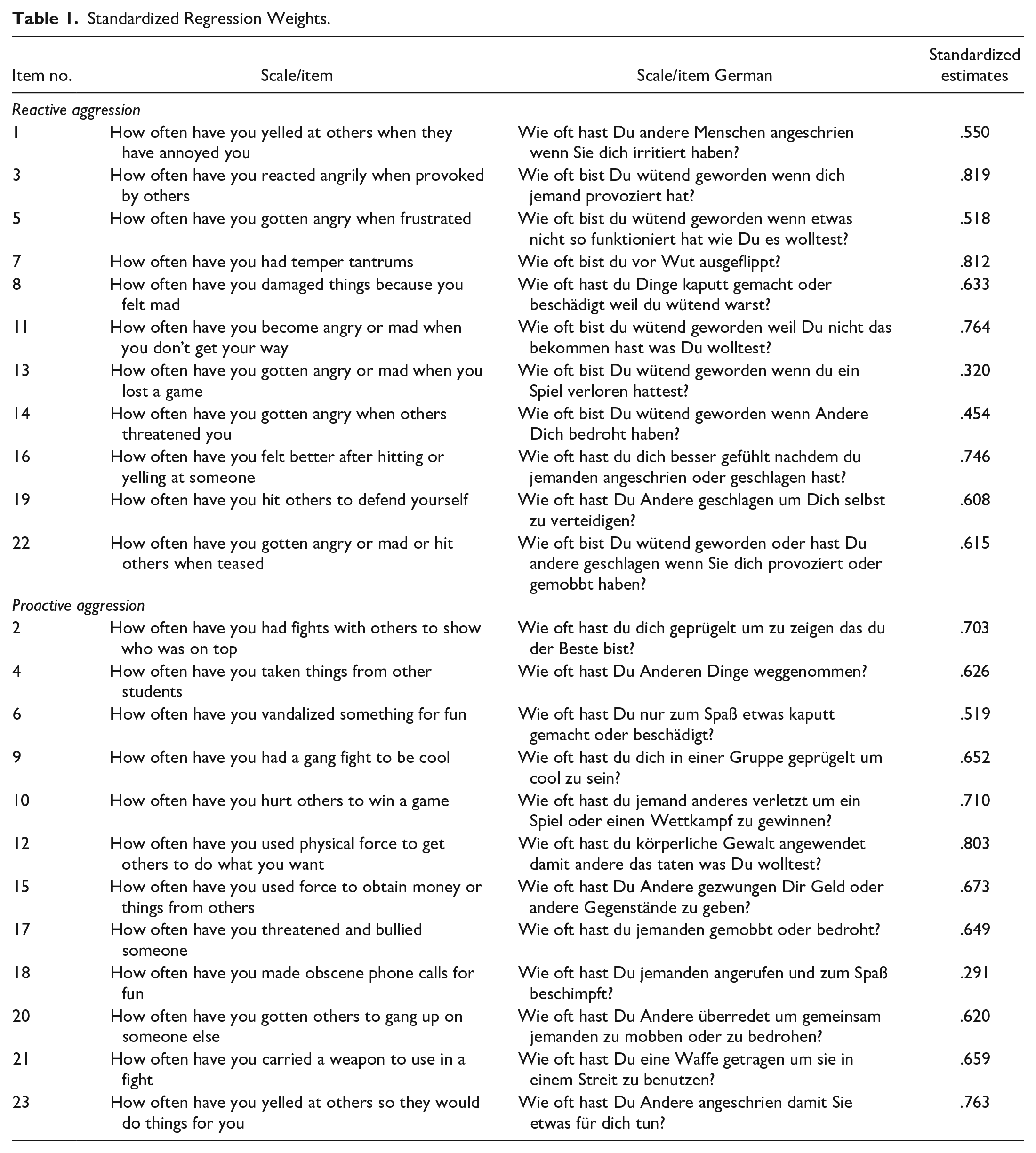
A confirmatory factor analysis (CFA) of the 23 items was performed. A two-factor (reactive–proactive) model was examined because of the two-factor structure of the instrument and outcomes of previous validation studies. We exploratively examined a one-factor model, which showed a significantly worse model fit than the two-factor model. The initial model showed insufficient fit to the data: χ²(230) = 468.24, p < .001, CFI = .889, TLI = .878, RMSEA = .082, SRMR = .101. Model fit increased by allowing residual errors of similarly worded items to correlate, such as “item 4” and “item 15,” “item 2” and “item 9,” “item 17” and “item 20,” “item 7” and “item 8,” and “item 19” and “item 22” (Brown, 2006). The final model showed a good fit to the data: χ²(224) = 337.51, p < .001, CFI = .947, TLI = .940, RMSEA = .057, SRMR = .086. Standardized factor loadings ranged between .29 and .82 (see Table 1). The factors Reactive aggression and Proactive aggression were significantly correlated (r = .70, p < .001). The two-factor model that best fitted the data contained 11 items for reactive aggression and 12 items for proactive aggression.
Standardized Regression Weights.
Cronbach’s alpha were good for reactive (α = .81), proactive (α = .84) aggression subscales and for the total scale (α = .90) and comparable to previous studies.
Concurrent Validity
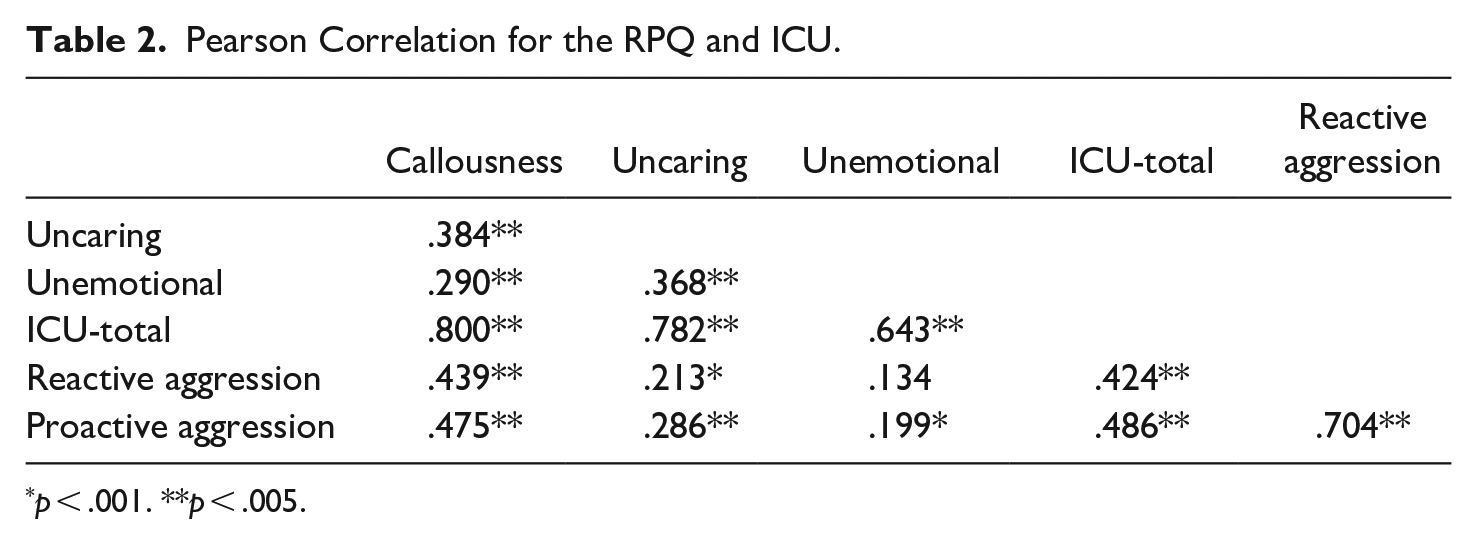
Pearson’s correlations were computed to examine concurrent validity of the RPQ. Results indicate that reactive aggression was significantly correlated with the ICU-total, and the subscales callousness and uncaring, but not with the unemotional subscale (see Table 2). Proactive aggression was significantly correlated with ICU-total, callousness, uncaring, and unemotional (see Table 2).
Pearson Correlation for the RPQ and ICU.
p < .001. **p < .005.
Discussion
The present study investigated the validity and reliability of the two-factor (reactive and proactive) structure of the translated German RPQ in a sample of adolescent male offenders. It was expected that the German RPQ would replicate the two-factor structure (Cima et al., 2013; Pechorro et al., 2015; Raine et al., 2006) of reactive and proactive aggression in a group of delinquent adolescents in detention. Confirmatory factor analysis supported the two-factor structure of the original RPQ (Raine et al., 2006), indicating that in the German translation there is also a distinction between the two types of aggression.
Outcomes are in line with previous research (e.g., Baker et al., 2008; Baş & Yurdabakan, 2012; Cima et al., 2013; Pechorro et al., 2015; Raine et al., 2006; Seah & Ang, 2008), and support the use of the RPQ (Kempes et al., 2005; Polman et al., 2007). The factor loading of item 18 was weak (.29), which is in line with the results of Cima et al. (2013), who found a factor loading of .31, and Raine et al. (2006), who found a factor loading of .41. Deletion of this item did not result in a better model fit. Correlations between the RPQ and its dimensions were statistically significant, and analysis of the internal consistency statistics revealed good to very good reliabilities, which is also in line with previous research (e.g., Cima et al., 2013; Pechorro et al., 2015; Raine et al., 2006).
It was expected that reactive and proactive aggression were positively related to CU-traits. Results support concurrent validity by finding correlations between the different subscales. Interestingly, proactive aggression was related to all subscales of callous unemotional traits, whereas reactive aggression was related to callousness and uncaring, but not to unemotional traits. The lack of association with unemotional is in line with findings of Pechorro et al. (2015), who also did not find a correlation between proactive aggression and unemotional traits in a sample of juvenile delinquents in Portugal. Findings of Cima et al. (2013) indicated that the proactive aggression subscale was more strongly related to the psychopathy concept. Furthermore, this study found that juveniles proactive aggression and not reactive aggression was related to psychopathic traits as measured with the ICU (Frick, 2004).
The present study has some limitations. The sample only consisted of male prisoners. As there are differences in the expression of aggression between males and females (Björkqvist, 2018), future studies should focus on a mixed sample to generalize the present findings. It would be interesting to include non-offender and criminal female samples in future research on reactive and proactive aggression in order to examine measurement invariance of the RPQ. A second limitation was that we only used self-report measures, which constitutes a risk for biased results due to social desirable answering tendencies of the participants, and inflation of correlations due to common method variance (Podsakoff, MacKenzie, Lee, et al., 2003; Podsakoff, MacKenzie, Podsakoff, et al., 2003). Future research should also include observed aggression scales to test convergent validity. Finally, the present results were cross-sectional. Future research should be longitudinal in order to examine predictive validity.
The present findings support the two-factor structure of the translated German RPQ in juvenile delinquents and also concurrent validity and reliability. Results add to the actual body of knowledge that the RPQ is a valid instrument in different cultures, ethnic groups and samples. It was the first study to examine validity and reliability in a sample of delinquent youth in Germany. Results of the present study contribute to the valid and reliable assessment of reactive and proactive aggression by means of the RPQ in research and clinical practice.
Footnotes
Declaration of Conflicting Interests
The author(s) declared no potential conflicts of interest with respect to the research, authorship, and/or publication of this article.
Funding
The author(s) received no financial support for the research, authorship, and/or publication of this article.
