




Abstract
Past studies on criminal expertise showed that some sexual offenders possess skills related to avoiding detection. An important question that remains unaddressed in the literature, however, is whether unsolved cases can be used as a “proxy” for expertise. The present study sought to provide the first empirical examination of criminal expertise in a sample of solved (n = 732) and unsolved (n = 309) stranger sexual assault cases involving theft. We used binary logistic regression to determine whether behavioral indicators of criminal expertise predicted case status. Findings showed that the most relevant factors related to case solvability were not related to detection avoidance strategies used by the offender, but rather, whether semen evidence was found at the crime scene and the number of sexual acts performed against the victim. Interestingly, cases involving fetish theft were also more likely to remain unsolved. Implications for theory and practice are discussed.
Sexual assault is one of the most common violent offenses, while also being one of the most under-reported crimes (Du Mont et al., 2003). Even when sexual assault cases are reported, prosecution rates for sexual crimes are among the lowest compared to other violent crimes (Sommers & Baskin, 2011). In fact, studies have shown that only a minority of sexual crimes have suspects that are likely to be arrested, charged, and convicted (e.g., Spohn et al., 2014). Despite these issues, there has been little empirical insight regarding which factors influence solvability in sexual assault, as most studies have focused exclusively on homicide solvability factors (see Braga & Dusseault, 2018; Regoeczi et al., 2018) and data for unsolved sexual assault is often difficult to obtain. According to the criminal expertise perspective, however, some offenders develop domain specific skills or “expertise,” which enables them to be better, more intuitive decision-makers during the offense and more capable of avoiding detection (Ward, 1999).
Several studies using the criminal expertise framework on sexual offenders have shown that some individuals have developed in-depth knowledge and skills oriented around detection avoidance that differentiate them from more novice or less sophisticated offenders (e.g., Bourke et al., 2012; Chopin et al., 2021). Although interesting and informative, these studies do not examine whether expertise is related to case solvability. Indirect evidence of criminal expertise have been examined in other studies, although these studies have provided mixed evidence as to whether an offender’s actions to avoid detection negatively impact case solvability (e.g., Balemba et al., 2013; Chopin et al., 2019). Nonetheless, past samples (e.g., Chopin et al., 2019) may not adequately capture criminal expertise and no studies have directly used this framework to explore the role of expertise on solvability over the entire crime-commission process (pre-crime, crime, and post-crime). As such, the present study seeks to offer the first empirical examination of the role of criminal expertise on case solvability using a sample of stranger sexual assault cases involving theft.
Literature Review
Although most of the research on crime solvability has focused on homicide, there are two competing perspectives from this literature that can offer insight as to why sexual assault may remain unsolved. According to the discretionary perspective (Riedel, 2008), victimology (e.g., age, gender) is most influential in how vigorously and diligently police will work to investigate and solve a crime. For example, studies have shown that sexual crimes involving younger victims are more likely to be solved more by police (e.g., Chopin et al., 2019). Contrasting the discretionary perspective, is the non-discretionary perspective (Riedel, 2008), which suggests it is the characteristics of the offense itself (e.g., weapon use, forensic trace evidence) that are most important to solvability. As such, the non-discretionary perspective argues that police are motivated to solve all crimes but are not able to do so in some cases due to external situational factors. For instance, Chiu and Leclerc (2020) found that sexual assaults involving higher criminal effectiveness (e.g., fewer witnesses, less forensic evidence) and lower levels of victim interaction (e.g., less engagement/interaction with victim verbally and minimal force used) were associated with unsolved cases.
In line with a non-discretionary perspective, is the notion of “criminal expertise.” In sexual offending, criminal expertise refers an offender who has developed offense related skills and uses a sophisticated modus operandi involving detection avoidance strategies (Chopin et al., 2019). It was Ward (1999), however, who was the first to propose that the literature on expertise (e.g., Ericsson, 2006) could be applied to the field of sexual offending. In particular, he suggested that some sexual offenders who had multiple child victims but have remained undetected for long periods of time will develop a type of “functional” (i.e., criminal) expertise, which involves learning the necessary skills and knowledge to function well in a particular domain (i.e., continue to offend while eluding detection). Accordingly, this perspective does not necessitate that offenders develop extensive experience and repeated practice directly within their domain to become an expert (Ó Ciardha, 2015). Moreover, expertise can be developed in many ways, even without the commission of a contact sex offense. For example, the development of offense related skills and knowledge through covert modeling and rehearsal (e.g., through sexual fantasies), through observational learning (via other offenders—e.g., online forums, pedophile groups, etc.), symbolic modeling (e.g., pornography or literature) and finally, through an offender’s own experience with sexual abuse (e.g., physical or sexual abuse as a child) (Ó Ciardha, 2015; Ward, 1999).
Criminal expertise is an important concept for case solvability because this perspective suggests that offenders who possess criminal expertise will be more successful at offending and avoiding detection. In particular, Ward (1999) suggested that expertise in these offenders would manifest into “tangible competencies” that can be observed directly in their offense behavior, such as better risk appraisal skills, taking precautions with the offense location, being able to regulate their emotional state, more capable of manipulating and disarming victims, deceiving authorities, and maintaining normal relationships with friends, families, and partners. More recently, studies have applied the criminal expertise framework to examine the behaviors of offenders before, during, and after the commission of their crime (Chopin et al., 2019; Reale et al., in press). These studies shown that the crime-commission process involved in sexual offending differs in skills and sophistication, and some offenders have developed specific skills related to detection avoidance (Chopin et al., 2021; Reale et al., in press). Although interesting and informative, these studies have not provided any insight into the role of criminal expertise (i.e., sophisticated MO and detection avoidance strategies) on case solvability.
As Ó Ciardha (2015) has noted, however, unapprehended offenders would arguably contain more experts compared to apprehended offenders as they have successfully evaded detection. Thus, an important question that remains unaddressed in the literature on criminal expertise and sexual offending is whether unsolved cases can be used as a “proxy” for criminal expertise (Ó Ciardha, 2015). To date, studies in sexual offending have only indirectly examined criminal expertise in relation to crime solvability. For instance, in a study of solved and unsolved sexual homicide, Balemba et al. (2013) identified a “forensically aware” theme, which included offenders who were most likely to use sophisticated and controlled behaviors during the commission of their crime. A key feature of the forensically aware type was also the lack of both intrusive sexual acts (i.e., vaginal or anal intercourse) and semen evidence found at the crime scene. Although this type was the most likely to remain undetected, in some circumstances, forensically aware offenders were still apprehended.
Additionally, Chopin et al. (2019) examined factors related to solvability in stranger and acquaintance sexual assault and accounted for victim, crime characteristics, and forensic awareness strategies (e.g., precautions taken to protect their identity and destroying and removing evidence). They found that unsolved cases were more likely to have older, single, or stranger victims, victims who were attacked while they were walking or jogging, and offenders who wore condoms. Similar to Balemba et al. (2013), they also found that some forensic awareness strategies (e.g., threatening the victim not to report) were positively associated with case status. Although Balemba et al. (2013) did not find strong support for the notion that an offender’s actions to avoid detection will be assoiciated with case solvability, it offers limited insight as to whether criminal expertise is related to case solvability because it did not examine all relevant behavioral indicators of criminal expertise over the crime commission process. Moreover, the nature of these offenses (e.g., single-offense, acquaintance victims) may not be well suited for capturing criminal expertise variables in sexual offending.
Current Study
Although past studies have shown that sexual offenders possessed more sophisticated modus operandi’s and had skills in detection avoidance, whether unapprehended offenders” can be used as a “proxy” for expertise (Ó Ciardha, 2015) has yet to be adequately examined. The present study therefore seeks to provide the first empirical exploration of criminal expertise in a large sample of solved and unsolved sexual assault cases. Our sample is also unique in that all cases of sexual assault involve stranger victims who also had personal items (valuable, fetish, or both) stolen from them. We chose to examine sexual assaults with a “hybrid” theft element, because of its potential relevance for capturing criminal expertise in unsolved cases. For example, studies have found that sexual offenders who also steal from their victims (i.e., “hybrid offenders”) are more likely to have a history of criminal behavior (e.g., Davies et al., 1997; Harris et al., 2013; Schlesinger & Revitch, 1999). Theft of fetish items, in particular, can also be a marker of a paraphilic offender and sexual dangerousness and is also associated and with escalation in sexual offending (Brankley et al., 2014; Schlesinger & Revitch, 1999). Thus, hybrid sexual offenses involving theft may offer a better opportunity to examine the role of criminal expertise in case solvability than single-offense sexual assault. We also chose to focus on stranger victims, not only because these cases tend to be more difficult for police to solve (e.g., Bouffard, 2000), but also because acquaintance rapes have been found to have distinctive offending patterns (see Bownes et al., 1991; Koss et al., 1988). Thus, differences in victim-offender relationships could impact how expertise manifests behaviorally in some offenders (e.g., target appraisal, victim control methods, whether an offender takes steps to protect their identity, etc.). The present study therefore aims to explore whether behavioral indicators of criminal expertise are a feature of unsolved stranger sexual assaults involving a hybrid theft element.
Method
Sample
The sample included a total of 1041 cases of single incident contact sexual offenses, that also involved theft of personal property (i.e., valuable, fetish, or both items) from a victim. Of these 1041 cases, 732 are solved and 309 are unsolved. Solved cases in this database are those in which the police identified and apprehended a known suspect, whereas unsolved cases are those in which the offender is unknown to authorities. Solved cases do not account for following legal procedures, as legal convictions depend on may circumstances that many not pertain to the crime itself (e.g., victim does not wish to press charges). Contact sexual act for the purposes of this study included any of the following: vaginal (59.5%), anal (23.1%), simulated (1.1%) and digital (27.8%) penetration; fellatio (43.3%), cunnilingus (6.4%), anilingus (0.7%), fondling/rubbing against victim (55.9%); kissing (26.4%), licking (6.2%), sucking (3.7%) body parts; inanimate object insertion (3.4%); and vaginal/anal fisting (0.5%). All victims are female and strangers to the offender (i.e., who did not know each other).
The sample was obtained from a national police database operated by the Ministry of Interior in France, with offenses that range from 1991 to 2018. Although the use of DNA evidence emerged in the 1980’s, it was not widely used by French Police until 1998 (Krikorian & Vailly, 2018), which may impact the ability to capture “forensic awareness” variables in offenses that occurred during the 1990’s. We believe this concern is limited, however, given that the vast majority of the cases (92.3%) occurred since the year 1998. Moreover, Beauregard and Martineau (2015) found in their sample of sexual homicide, that the use of forensic awareness strategies has remained stable (M = 0.4–0.5) from 1991 to 2010. Lastly, we found no positive significant associations between the year of the offense and the use of forensic awareness strategies by offenders (available upon request) and thus do not believe this constitutes as a methodological concern for the present study. Detailed and unique information about the crime-commission process is completed by criminal investigators assigned to the case and is recorded in investigative files that are compiled, analyzed, and entered into the database by a team of crime analysts who are experts in violent crimes. This database was maintained by crime analysts who use different sources of information (e.g., forensic and investigative reports, witness and offender interviews, etc.) related to the criminal case. Information related to forensic awareness strategies comes from forensic services, legal medicine, and interviews with the victims and is compiled and entered into this database. Although missing data is possible, for the current study there are no missing data for any of the variables used. Ethical approval has been obtained for this study.
Measures
Dependent variable: Case status (Solved vs. Unsolved)
To be classified as solved (coded as 1), the case had a suspect who was identified and apprehended by police. To be classified as unsolved (coded as 0), the case had no suspect apprehended and the offender is unknown to authorities.
Independent variables
Offender MO (Criminal Expertise)
For MO, all 13 variables reflect criminal sophistication in modus operandi behavior and can infer the presence of expertise in sexual crimes (e.g., Beauregard & Proulx, 2017; Ceccato, 2014; Chopin et al., 2021; Davies, 1992; Davies et al., 1997; Park et al., 2008; Reale et al., in press). All variables under MO were coded dichotomously (0 = no; 1 = yes) with the exception of one continuous variable, the number of sexual acts (range = 1–11). We separated these MO variables into three phases to reflect the crime-commission process (pre-crime, crime, and post-crime phases).
The pre-crime phase included variables that have been found in previous literature to be indicative of planning and expertise in sexual crimes (e.g., Beauregard & Proulx, 2017; Ceccato, 2014; Chopin et al., 2021; Davies, 1992; Davies et al., 1997; Reale et al., in press; Ward, 1999). (1) victim was targeted by offender, (2) offender brought weapon to offense, (3) offender selected a deserted crime location (where witnesses are unlikely to hear, see, or interrupt the crime), (4) offender used a con approach (e.g., befriended the victim, posed as a person of authority, offered assistance, etc.).
The crime phase included offense behaviors found in previous literature to be related to a sophisticated modus operandi in sexual offending (Chiu & Leclerc, 2020; Chopin et al., 2019, 2021; Davies, 1992; Davies et al., 1997; Park et al., 2008; Reale et al., in press; Ward, 1999). These included: (5) precautions taken to protect identity (e.g., wearing a mask, gloves, or disguise,), (6) acted on the victim (i.e., precautions taken to control the victim—e.g., using restraints, blindfolding or gagging the victim; threatening, bribing, or asking the victim not to report), (7) acted on the environment (i.e., precautions taken to control the environment—e.g., barricading windows or doors, using a look-out, disabling alarms or telephone, sabotaging victim’s vehicle), (8) types of items stolen (1 = valuable; 2 = fetish; 3 = both), (9) physical/verbal resistance from victim, (10) non-sexual violence (i.e., no beating, stabbing, or asphyxiation), (11) offender verbally reassured victim, (12) sexually intrusive acts (vaginal/anal penetration), (13) number of sexual acts committed (range 1–11).
The post-crime phase included behaviors that have been identified in previous literature as indicative of expertise in detection avoidance or previous experience in sexual crimes (e.g., Beauregard & Proulx, 2017; Chopin et al., 2019, 2021; Davies, 1992; Davies et al., 1997; Park et al., 2008; Reale et al., in press; Ward, 1999). These included: (14) victim was intentionally released by the offender (i.e., as opposed to escaping or being rescued), (15) destroyed or removed forensic evidence, (16) semen found on victim or at crime scene.
Control variables
On the basis of both discretionary and non-discretionary perspectives of crime solvability (Riedel, 2008), the following victimology (demographic and lifestyle characteristics) as well as crime characteristics (i.e., location and time of day) were used as controls related to case status.
Victimology
In line with a discretionary perspective, certain victim demographics (e.g., age) are relevant for crime solvability. For example, it has been hypothesized that younger victims are more vulnerable, therefore more pressure is put on police to solve these crimes quickly (Du Mont et al., 2003). It has also been hypothesized that certain lifestyle characteristics of the victim, such as whether the victim consumed alcohol prior to being raped, may influence the extent that police work to solve the crime (e.g., Du Mont & Parnis, 2000). Other studies have shown that certain lifestyle characteristics (e.g., being single, Chopin et al., 2019) and routine activities (e.g., walking or hitchhiking; Chiu & Leclerc, 2020; Chopin et al., 2019; Reale & Beauregard, 2018) can be associated with case solvability in sexual crimes due to the increased likelihood of the victim being alone with no witnesses present. Accordingly, the following victimology variables are included in the present study: (17) victim age (range = 15–95), (18) victim was single (at time of the offense), (19) victim used drugs or alcohol, (20) victim was engaged in domestic activities (e.g., watching television), (21) victim was sleeping, (22) victim was walking, (23) victim was engaged in a social activity (e.g., out to eat, at a bar, visiting a friend, on a date), (24) victim was in a vehicle or in a parking lot, (25) victim was traveling to or from somewhere. All variables are coded dichotomously (yes = 1, no = 0) and are reflective of circumstances that occurred prior to the offense.
Crime characteristics
The crime scene location and time of day the offense occurred are other non-discretionary factors that can impact case solvability (Chopin et al., 2019; Coupe & Blake, 2006). For example, Chopin et al. (2019) found that sexual assaults that occur outdoors were more likely to remain unsolved, whereas rapes occurring in residences were more likely to be solved. This is likely because when crimes occur outdoors, traces of forensic evidence are more likely to degrade, making their detection and collection difficult, which lowers the chances of obtaining a usable profile (Martin et al., 2019). This is particularly relevant to consider in stranger victim sexual crimes where the collection of forensic and trace evidence is needed to help identify a potential suspect. As such, we included the following crime characteristics related to location and time of the offense: (26) crime occurred at night, (27) crime occurred in a residential location (e.g., victim or offender’s home), (28) crime occurred in an outdoor location (e.g., park, woods).
Analytical Approach
A three-step analytical process was used to analyze the data. As a first step, bivariate analyses (i.e., chi-square and Kruskall-Wallis for non-parametric continuous variables) were conducted comparing solved and unsolved cases using victimology (demographic and lifestyle characteristics) and crime characteristics (location/time of day and MO-criminal expertise). To determine which variables to include in the multivariate analyses, we opted to retain variables with p-values less than .150 to ensure all potentially relevant variables at the multivariate level were accounted for (Hosmer et al., 2013). This is especially important due to the exploratory nature of the analyses because more traditional levels, such as .005, can fail to identify variables known to be theoretically important (Bendel & Afifi, 1977; Mickey & Greendland, 1989). We also tested for multicollinearity and no correlations were higher than .298 (available upon request). For the second step, a four-block sequential binary logistic regression predicting solved cases was performed. The first model included victimology and crime characteristics related to the location/time of day and were used as control variables. The second model included the control variables, and also introduced criminal expertise variables related to the pre-crime phase. The second third model retains variables from model one and two, and also introduced criminal expertise variables related to the crime phase. Lastly, the fourth model included all variables from Models one to three, as well as introduced criminal expertise variables in the post-crime phase. We chose to model our analyses using this approach as it allowed us to not only understand the impact of each variable while accounting for other significant variables in the model, but also to identify whether expertise in certain stages of the crime-commission process was more important in explaining the difference between solved and unsolved cases. Finally, based on the findings from the multivariate analyses, we conducted a supplementary chi-square analysis on one of the variables in our final model. We discuss our rationale for this in the following section.
Results
Table 1 presents the results of the bivariate analyses between case status (unsolved and solved) and the independent variables. Interestingly, we find that most victimology variables are not associated with case status. There were, however, some exceptions. More specifically, in terms of the victim characteristics, it was more common for cases to be solved when the victim was single at the time of the offense (χ2 = 2.86, p = .091). For the victim’s routine activities, it was less common for cases to be solved when the victim was walking prior to the offense (χ2 = 11.05, p = .001). Next, we examined bivariate associations between case solvability and crime characteristics related to the crime scene location and time of day, as well as MO related to criminal expertise. In terms of the location/time of day, we observed that it was more common for cases to remain unsolved when the crime occurred at night (χ2 = 2.36, p = .125). We also observed that cases involving residential locations were more often solved (χ2 = 3.50, p = .061), whereas cases involving outdoor locations were more often unsolved (χ2 =11.78, p = .001). In terms of criminal expertise, we examined all three phases of the crime-commission process. We found that in the pre-crime phase, cases were more often solved when the victim was targeted (χ2 = 5.89, p = .015) and when the offender used a con approach on the victim (χ2 = 6.30, p = .012). In the crime phase, we observed that cases were more often solved when the offender took precautions related to acting on the victim (χ2 = 2.37, p = .123) and the environment (χ2 = 6.51, p = .011) and when the offender reassured the victim (χ2 = 11.46, p ≤ .001). A greater number of contact sexual acts (χ2 = 15.23, p = <.001) was also found to be associated with cases that are solved (M = 2.81, SD = 1.69), compared to unsolved (M = 2.37, SD = 1.45). Additionally, in the crime phase, we observed that the type of item stolen (valuable, fetish, or both) is associated with case status (χ2 = 4.17, p = .124). Lastly, in the post-crime phase, we observed that cases were more often solved when semen was found on the victim or crime scene (χ2 = 25.88, p ≤ .001).
Bivariate Analysis of Independent Variables and Unsolved and Solved Cases (N = 1,041).
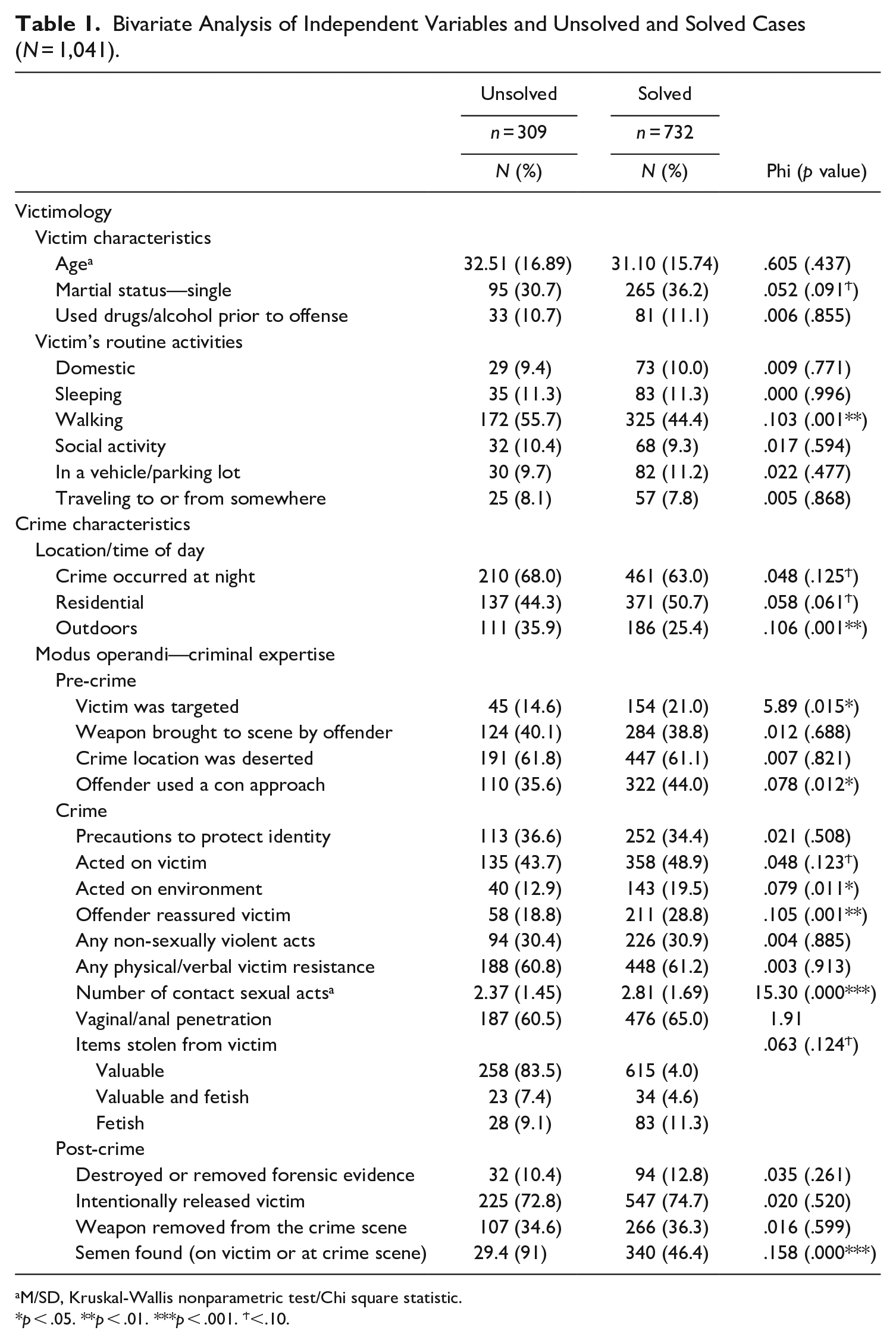
M/SD, Kruskal-Wallis nonparametric test/Chi square statistic.
p < .05. **p < .01. ***p < .001. Ϯ<.10.
Table 2 presents the findings of the binomial sequential regression between solved (= 1) and unsolved (= 0) cases. Model 1 includes victimology and crime characteristics related to location and time of day as control variables. Findings from Model 1 indicated that when the victim was walking prior to the offense, the case was less likely to be solved (β = -.321, p = .029). We also note that when a victim was single at the time of the offense, the case is more likely to be solved (β = .243, p = .097) and when the offense is outdoors, the case is less likely to be solved (β = −.368, p = .056), however both variables are only approaching significance.
Binary Logistic Regression Using Situational Crime Characteristics and Criminal Expertise to Predict Solved Case Status (N = 1,041).
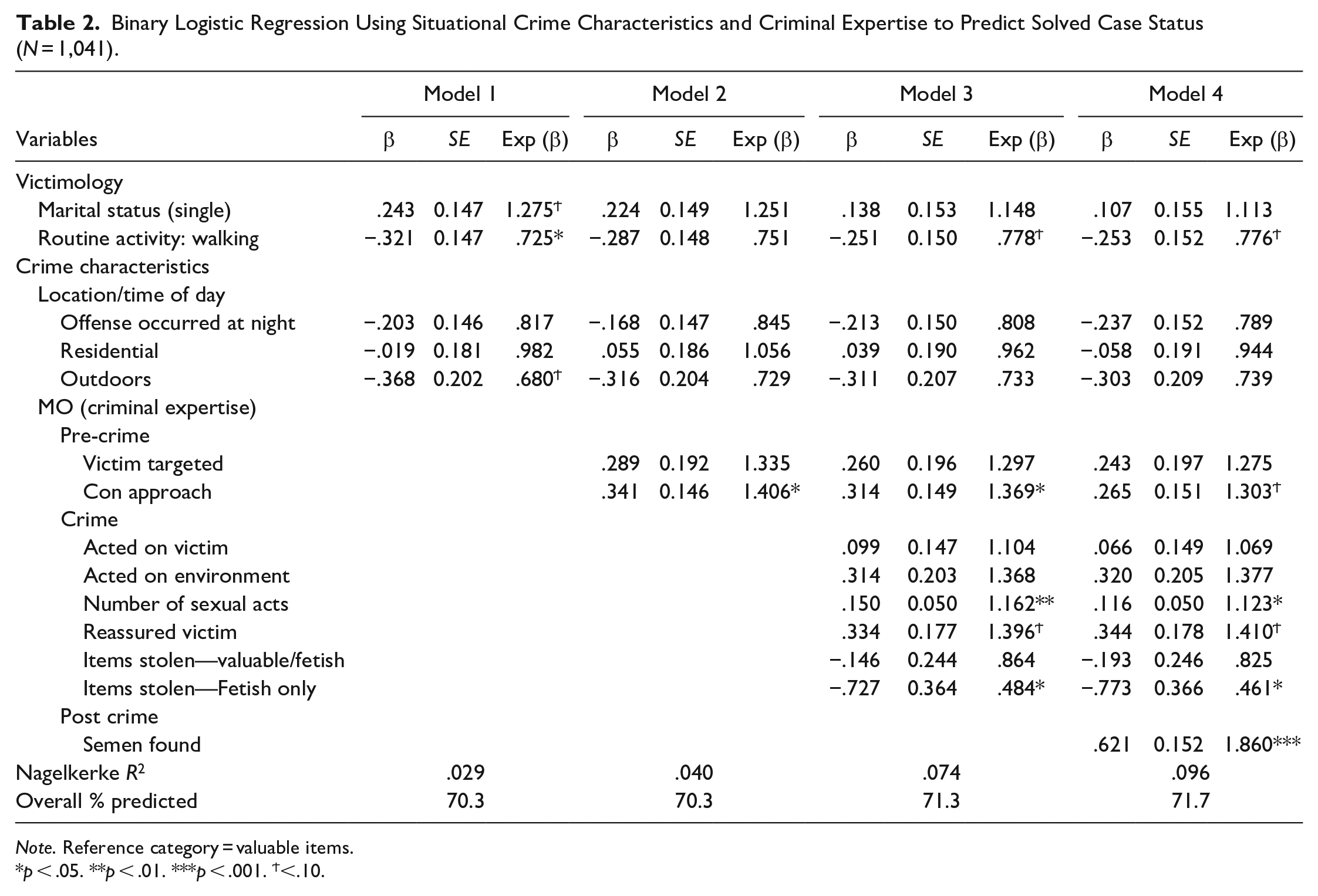
Note. Reference category = valuable items.
p < .05. **p < .01. ***p < .001. Ϯ<.10.
Model 2 adds pre-crime characteristics related to an offender’s expertise. We observed that our control variables related to the victim walking (β = −.287, p = .053) is no longer statistically significant when accounting for the pre-crime variables in Model 2. In terms of pre-crime variables, we found that when an offender used a con method of approach on their victim the case was more likely to be solved (β = .341, p = .20).
Model 3 adds crime characteristics related to an offender’s expertise. Whether the victim uses a con approach remains significant (β = .314, p = .035) once accounting for the crime characteristics, in Model 3. Additionally, findings from Model 3 indicate that during the crime phase, a one-unit increase in contact sexual acts committed against the victim was associated with 1.12 times greater odds of the case being solved, compared to unsolved (β = .150, p ≤ .003). Moreover, when the offender steals fetish items, compared to valuable items, the case was less likely to be solved (β = −.727, p = .046). Lastly, although only approaching significance, we note that when the offender verbally reassured their victim the case was more likely to be solved (β = .334, p = .059).
Lastly, Model 4 adds post-crime characteristics related to an offender’s expertise. With the exception of con approach, all variables from prior models remained significant. Additionally, we also observed that in the post-crime phase, when semen is found on the victim or at the crime scene, the case is more likely to be solved (β = .62, p ≤ .001).
After conducting the binary logistic regression analyses, we observed that the only variable significantly associated with unsolved case status was when fetish items are stolen from the victim, compared to valuable items. This is an interesting finding that we felt was necessary to explore further to better understand its relationship to criminal expertise. In particular, given that all offenders in the sample committed a contact sexual offense in addition to theft, we were interested in better understanding whether offenders who steal fetish items also commit less intrusive sexual acts. Accordingly, we conducted a supplementary chi-square analysis between the type of items stolen and whether the offender committed vaginal or anal penetration. Findings revealed that when the offenders stole only fetish items (n = 53, 47.7%), compared to both valuable and fetish (n = 43, 75.4%) or valuable items only (n = 567, 64.9%), it was significantly less common for the offender to commit vaginal or anal penetration against the victim (χ2 = 16.20, p = <.001).
Discussion
A key area that has yet to be addressed in the criminal expertise literature is whether certain proxies can be used to determine criminal expertise in sexual offenses. In particular, Ó Ciardha (2015) suggested that unapprehended offenders should be compared to apprehended offenders, in order to determine whether there are more experts in unsolved sexual crimes given that these offenders in these cases had successfully evaded prosecution. Accordingly, we aimed to determine whether unsolved stranger sexual offenses involving theft would show evidence of a more sophisticated and skilled crime-commission process, specifically oriented around detection avoidance. To examine behavioral indicators of criminal expertise, we accounted for all three stages of the crime-commission process. Findings suggested that behavioral indicators of expertise are not a “feature” of unsolved sexual offenses in the current sample. In other words, it does not appear that undetected cases of sexual assault can be used as a “proxy” for criminal expertise (Ó Ciardha, 2015). Nonetheless, our analysis revealed several important findings that are relevant not only for criminal expertise literature, but also provide greater insight into which factors are most relevant in the solvability of stranger sexual crimes.
Although we found little evidence to suggest that unapprehended offenders are more sophisticated or skilled at avoiding detection, we did however, find that both the number of sexual acts committed by the offender and whether semen found at the crime scene were significantly associated with case solvability. Locard’s exchange principle (Locard, 1920) suggests whenever two objects come into contact an exchange of materials occurs between them. This exchange may allow investigators to form connections between a suspect and a crime scene, or a suspect and a victim, based on the transfer of materials. Thus, findings from the current study suggest that the more contact an offender has with their victim, the greater likelihood they have of being apprehended. This is similar to what was found in the “sloppy/reckless” theme from Balemba et al.’s (2013) thematic examination of solved/unsolved sexual homicide. Cases that fell into the sloppy/reckless theme were the most likely to be solved by law enforcement and were also the most likely to contain semen evidence. Similarly, Chiu and Leclerc (2020) found that for stranger sexual assault, solved crimes generally occurred with more severe sexual outcomes and the presence of forensic evidence. Thus, perhaps what makes more of an impact on the solvability of a stranger sexual assault is not skills or expertise in detection avoidance, but rather, when the offender does not show concern for forensic evidence despite engaging in high-risk behaviors. In particular, engaging in sexual acts with the victim and stealing their valuable items may lead investigators to the most important evidence that can be used to identify a suspect in stranger victim cases. It is also interesting to note that certain behaviors associated with criminal expertise (e.g., using a con approach and verbal reassurances) may increase one’s likelihood of detection. This finding is similar to both Chiu and Leclerc (2020) and Chopin et al. (2019), who also found strategies that involve a greater level of victim-offender interaction were positively associated with case solvability as they may increase the chance of identifying offender (i.e., better able to describe their assailant), particularly if they are stranger to the victim.
Considering that cases involving stranger victims are more difficult for police to solve (e.g., Bouffard, 2000), it is possible that cases where semen evidence was collected received greater priority for forensic analysis. This appears to be somewhat contradictory from previous studies on the role of semen evidence to rape solvability. Evidence from rape conviction studies have suggested that forensic evidence tends to play a minor role in solvability in comparison to witness testimony (e.g., Ingemann-Hansen et al., 2008; Sommers & Baskin, 2011). For instance, Chopin et al. (2019) found that crime characteristics appeared to have more importance to rape solvability than forensic traces. Similarly, LaFree (1981) found that the best predictor of sexual offender arrest was when the victim was able to identify and describe the suspect. However, LaFree (1981) study occurred before the use of DNA analysis in sexual crimes, and both LaFree (1981) and Chopin et al. (2019) do not focus exclusively on stranger sexual crimes. Thus, perhaps this finding is indicative of a shift toward forensic evidence as a superior means of identifying suspects in stranger sexual crimes. As Chopin et al. (2019) note, the limited contribution of forensic evidence to rape solvability may be especially apparent for cases where the victim and potential suspect are known to one another as there is usually no need to prove the identity of the suspected offender (e.g., DNA or bodily fluid testing), but rather, whether the victim consented or not (Hazelwood & Burgess, 2016). Thus, it is possible that police prioritize the submission of DNA analysis in rape cases with perpetrators who are strangers to the victims.
Importantly, we observed that the only crime-comission process variable associated with unsolved case status was when fetish items are stolen from the victim, compared to valuable items. This is an interesting finding that we felt was necessary to explore further to better understand its relationship to criminal expertise. For instance, we cannot exclude the possibility that this may simply relate to valuable items (e.g., stolen credit cards, cellphone) being more traceable, and thus offering an alternative means for police to identify the suspect when there is an absence of other evidence. Nonetheless, it is also possible to hypothesize that fetish items are stolen by offenders who spend less time and/or commit less intrusive sexual acts with their victim, and as a result, leave less forensic evidence behind. This is similar to the “forensically aware” theme identified in both solved and unsolved cases of sexual homicide in Balemba et al. (2013). In Balemba et al. (2013) study, “forensically aware” offenders were the least likely to commit intrusive sexual acts and semen was rarely found at the crime scene.
To explore this possibility, we conducted a supplementary analysis of the variable items stolen compared to sexually penetrative acts (i.e., vaginal/anal insertion with a penis). The analysis showed that offenders who steal fetish items from their victims less frequently commit sexually penetrative acts against the victim. Thus, it may be that offenders who steal fetish items are also those who are most “forensically aware” because they prioritize theft of fetish items over sexually intrusive acts that are at a greater risk for semen evidence being left behind. For example, offenders who have stolen fetish items may use these items as a way to “re-live” the offense or achieve sexual gratification post-offense in replacement of engaging in more high-risk sexual acts (e.g., vaginal/anal penetration) during the offense (e.g., Brankley et al., 2014).
Moreover, given that there is a link between fetish theft and escalation in sexual offending, this may reflect a particularly important subgroup of undetected offenders. More specifically, progressively violent behaviors that develop from paraphilias can manifest into criminal activity, such as burglary, assault, rape and murder, and may even develop into sadistic sexual activity (Burgess et al., 1986). For example, MacCulloch et al. (1983) found that individuals with repetitive sadistic masturbatory fantasies can become compelled to seek out opportunities to “try-out” their fantasies, leading to increasingly more dangerous behavior. These fantasies are also thought to serve as a platform for which offenders develop their expertise (Ward, 1999). Thus, it is possible that some unsolved cases include offenders who have escalated from sadistic fantasies to fetish theft and contact sexual offending while remaining undetected.
The notion that expertise could be related to offenders with paraphilias is an important consideration, as paraphilias are more common in sexual offenders who commit homicide than sexual offenders who do not (Koch et al., 2011). For instance, Schlesinger and Revitch (1999) found that over a third of sexual murders had prior convictions for burglary. In particular theft of fetish objects was found to be directly related to escalation, and in some cases, escalated to sexual assault or murder. Unfortunately, given the nature of the data, we are not able to adequately address this possibility. However, future research should consider whether fetish theft during a sexual assault—in the absence of more intrusive sexual behaviors—could be an indication of a sophisticated or expert type of sexual offender who is at risk of escalating to more serious crimes.
Lastly, although we did not find strong evidence to support the notion that criminal expertise is related to case solvability, it is important to acknowledge that our study does not account for all extraneous factors that could be related to solvability. For instance, studies have also shown that the skills of the investigators can play a role in case solvability (James & Beauregard, 2020), and others have suggested that it may not be because of the offender or the police, but some cases are not solved simply due to circumstances and bad luck (Rossmo, 2009). For example, Balemba et al. (2013) found a subset of sexual homicide offenders who were sloppy and reckless in their crime-commission process but remained undetected, likely due to situational circumstances that worked in their favor. Moreover, it remains possible that offender expertise may impede or delay the investigation, but ultimately not impact the ability to solve the case. Future research should therefore consider the impacts of criminal expertise on other aspects of the investigation, such as the length of time to case clearance.
We believe the present study provides important insights for the criminal expertise literature on sexual offending, nonetheless, this study is not without limitations. The first and most obvious is due to the nature of the data. Unsolved cases were explored as a type of proxy for criminal expertise, and although we did not find strong support for its utility as an indicator of expertise, it is important to note that police databases are limited to crimes that have been reported and investigated by police. Thus, we cannot control for the possibility that serial sexual offenders are misclassified as single-incident offenders, which could impact the ability to capture criminal expertise between solved and unsolved cases. Second, our study involved sexual assaults that also involved a secondary offense of personal theft, which may not be generalizable to other types of sexual assault. Moreover, we examined criminal expertise in stranger rape exclusively. Therefore, it is possible that our findings are not generalizable to cases where the victim is known to the offender. Additionally, our sample is from France, and thus may not be generalizable to other countries. Future research should attempt to replicate these findings on other sexual crimes (e.g., sexual homicide, cases involving child victims) and include more detailed qualitative information pertaining to an offender’s expertise. Despite these limitations, we believe these findings have important theoretical and practical implications.
Implications and Conclusion
The current study aimed to investigate whether criminal expertise is a feature of unsolved sexual assault. More specifically, accounting for both victimology and crime characteristics on solvability, we sought to determine whether the crime-commission process of unsolved cases involved more criminal expertise. Our findings suggested that the demographic and lifestyle characteristics of the victim have a limited impact on solvability. Rather, in-line with previous research on case solvability in sexual crimes (e.g., Chiu & Leclerc, 2020), we observed that offenses with the least semen evidence and lowest levels of victims-offender interaction that appear to have the most impact on solvability. In particular, we found the extent of the sexual acts committed and whether these leave semen evidence at the crime scene to be the most important factors. From a criminal expertise perspective, these findings appear somewhat counter-intuitive, as an “expert” sexual offender has been conceptualized as one who offends with a high-level of sexual intrusiveness (Chopin et al., 2021). Nonetheless, we did observe that cases with offenders who stole fetish items from their victims were more likely to remain unsolved. In particular, this could be a strategy used to replace high-risk contact sexual behaviors during the offense, as the fetish items can be used post-offense as a mechanism to achieve sexual gratification (Brankley et al., 2014) or an indication of an offender who is “trying out” their fantasies and is in the beginning stages of a series of increasingly more dangerous sexual crimes (e.g., MacCulloch et al., 1983; Schlesinger & Revitch, 1999). Moreover, this process of using deviant fantasies as a platform for practice is hypothesized to be directly related to the develop of criminal expertise (Ó Ciardha, 2015; Ward, 1999).
These findings also have practical implications, as they provide insight into which cases should be harder to solve. More specifically, these findings can be used by police to aid in determining which cases require more resources from the start of the investigation to ensure that best chances of solving the case. Moreover, our results emphasize the importance of collecting forensic and trace evidence in cases of sexual assaults that involve stranger victims. This is especially important to consider as even the presence of DNA taken from a rape kit, even when police do not have a suspect, can contribute to case clearance and prosecution (Alderden, 2008). Importantly, we also identified that the absence of semen evidence in cases of sexual assault involving fetish theft should not be over-looked. In fact, these cases may represent a subset of paraphilic offenders, who are especially at risk of escalation, and who may be more skilled and avoiding detection. This finding also stresses the importance of examining expertise on different samples of sexual offenders, future research should consider examining the role of expertise on case solvability in other types of crimes, such as sadistic sexual homicide.
Footnotes
Declaration of Conflicting Interests
The author(s) declared no potential conflicts of interest with respect to the research, authorship, and/or publication of this article.
Funding
The author(s) received no financial support for the research, authorship, and/or publication of this article.
