




Abstract
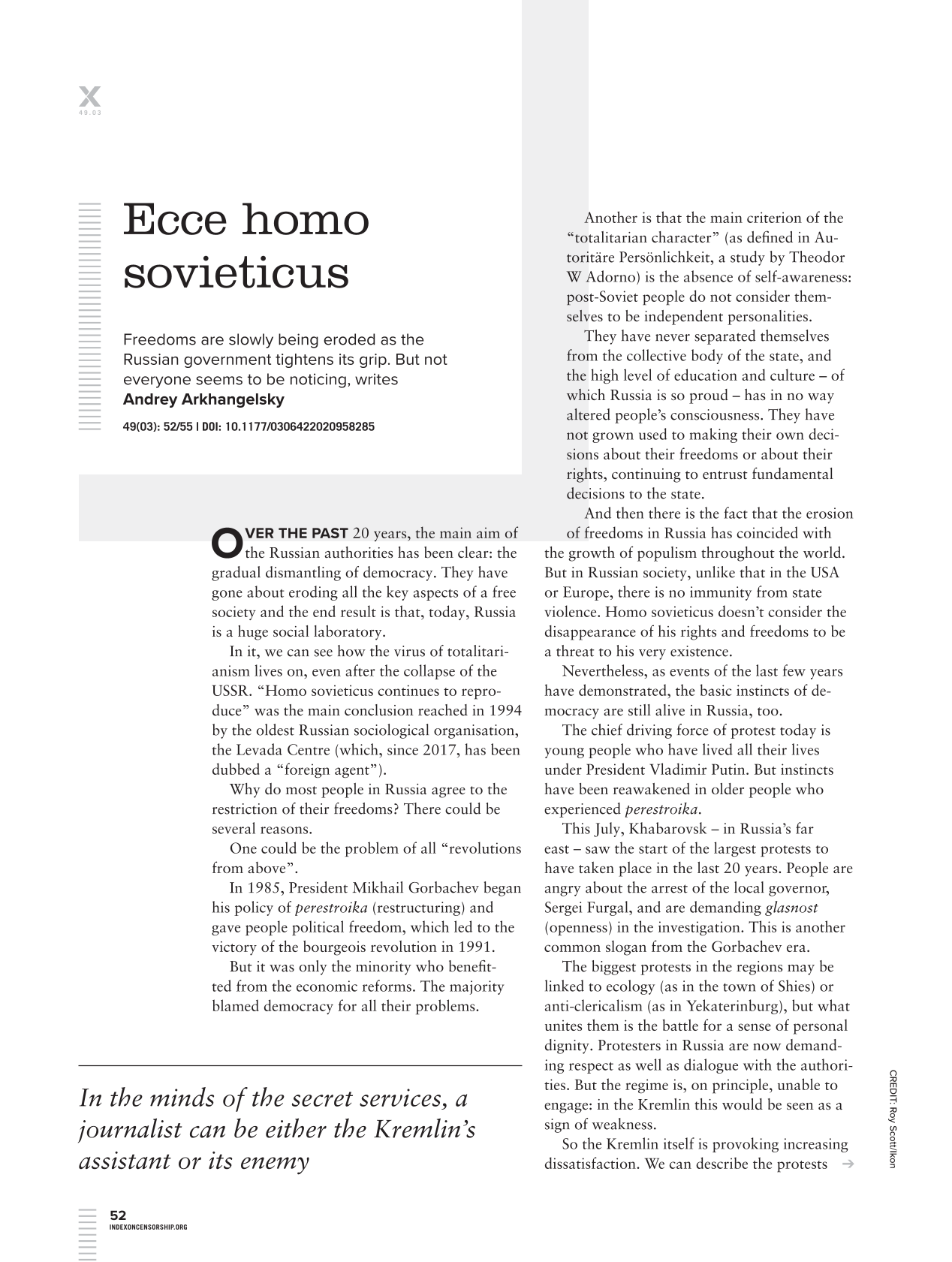
Freedoms are slowly being eroded as the Russian government tightens its grip. But not everyone seems to be noticing, writes
In it, we can see how the virus of totalitarianism lives on, even after the collapse of the USSR. “Homo sovieticus continues to reproduce” was the main conclusion reached in 1994 by the oldest Russian sociological organisation, the Levada Centre (which, since 2017, has been dubbed a “foreign agent”).
Why do most people in Russia agree to the restriction of their freedoms? There could be several reasons.
One could be the problem of all “revolutions from above”.
In 1985, President Mikhail Gorbachev began his policy of perestroika (restructuring) and gave people political freedom, which led to the victory of the bourgeois revolution in 1991.
But it was only the minority who benefitted from the economic reforms. The majority blamed democracy for all their problems.
Another is that the main criterion of the “totalitarian character” (as defined in Autoritäre Persönlichkeit, a study by Theodor W Adorno) is the absence of self-awareness: post-Soviet people do not consider themselves to be independent personalities.
They have never separated themselves from the collective body of the state, and the high level of education and culture – of which Russia is so proud – has in no way altered people’s consciousness. They have not grown used to making their own decisions about their freedoms or about their rights, continuing to entrust fundamental decisions to the state.
And then there is the fact that the erosion of freedoms in Russia has coincided with the growth of populism throughout the world. But in Russian society, unlike that in the USA or Europe, there is no immunity from state violence. Homo sovieticus doesn’t consider the disappearance of his rights and freedoms to be a threat to his very existence.
Nevertheless, as events of the last few years have demonstrated, the basic instincts of democracy are still alive in Russia, too.
The chief driving force of protest today is young people who have lived all their lives under President Vladimir Putin. But instincts have been reawakened in older people who experienced perestroika.
This July, Khabarovsk – in Russia’s far east – saw the start of the largest protests to have taken place in the last 20 years. People are angry about the arrest of the local governor, Sergei Furgal, and are demanding glasnost (openness) in the investigation. This is another common slogan from the Gorbachev era.
The biggest protests in the regions may be linked to ecology (as in the town of Shies) or anti-clericalism (as in Yekaterinburg), but what unites them is the battle for a sense of personal dignity. Protesters in Russia are now demanding respect as well as dialogue with the authorities. But the regime is, on principle, unable to engage: in the Kremlin this would be seen as a sign of weakness.
CREDIT: Roy Scott/Ikon
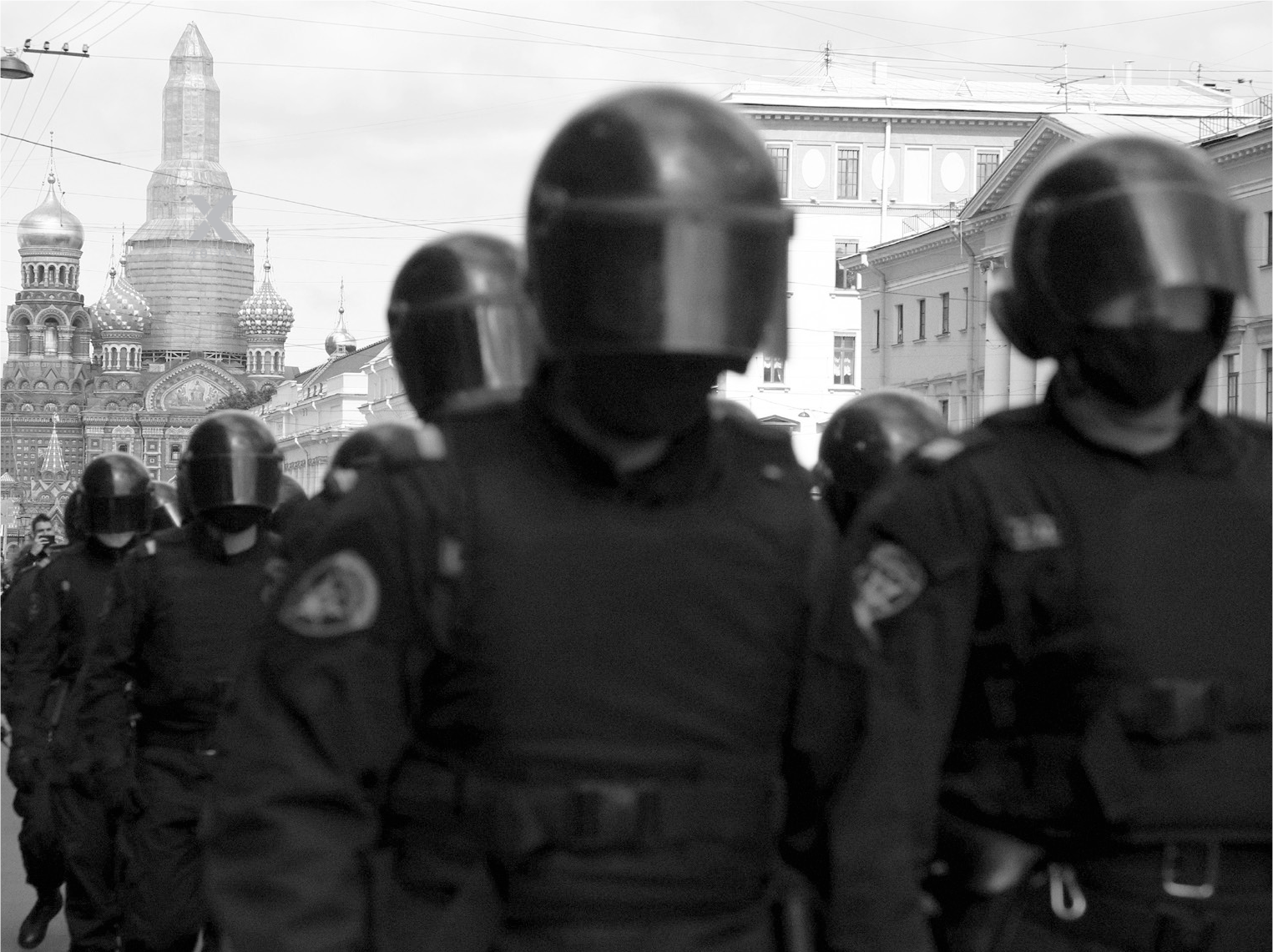
In St Petersburg law enforcement officers march past The Church of the Saviour on Spilled Blood during an anti-Kremlin rally in August
CREDIT: Anton Vaganov/Reuters
So the Kremlin itself is provoking increasing dissatisfaction. We can describe the protests that are happening today in Russia as “moral”. But for now, moral protest has not become political protest. (The only protests we can call “political” are those in Moscow and St Petersburg, but it is only a minority who support them.)
The process of disappearing public freedom began, many would argue, with the nearelimination of independent television and the loss of the NTV and TVS TV companies in 2002-2003. The only independent channel left today is cable channel Dozhd.
After the terrorist attack on a school in Beslan in 2003, Putin abolished direct elections for regional governors. A new wave of restrictions on freedom began in 2012, following the first demonstrations during Putin’s time in office, which protested about alleged rigging of the elections to the state Duma.
The political opposition continues to come under constant pressure. All public gatherings or demonstrations must be approved in advance – despite the Russian constitution, as before, guaranteeing freedom of assembly – and two or more people gathering are threatened with legal proceedings.
Repressive laws have also been passed: “on forbidding the propagation of ideas about non-traditional sexual orientation” (2013); and on “undesirable organisations” and “foreign agents” (2014). These restrict the activities of human rights and civil society organisations and encourage discrimination against members of the LGBTQ community.
In 2019, parliament passed a law making it possible to exclude the Russian part of the internet from the rest of the world (the so-called “Chinese variation”), as well as imposing control over social media messaging. More and more, we hear about the secret services torturing people who have been accused of crimes or are under suspicion, such as the case of the youth organisation Set (Network), which was accused of being involved in terrorism.
In 2020, the very principle of being able to change the elected authorities has been smashed. After the alterations made to the constitution, Putin can stand for election again in 2024, and could rule the country until 2036.
Furthermore, all elections will now take place over the course of three days. This new procedure creates huge possibilities for falsifying the results and the changes represent the last step in removing any legitimacy from elections in Russia.
The main aim of any authoritarian regime is survival. But when that regime begins to feel its strength, it goes on the attack. Other recent populist changes to the constitution, introduced in July, can now be used as repressive measures and represent a ban on freedom of thought.
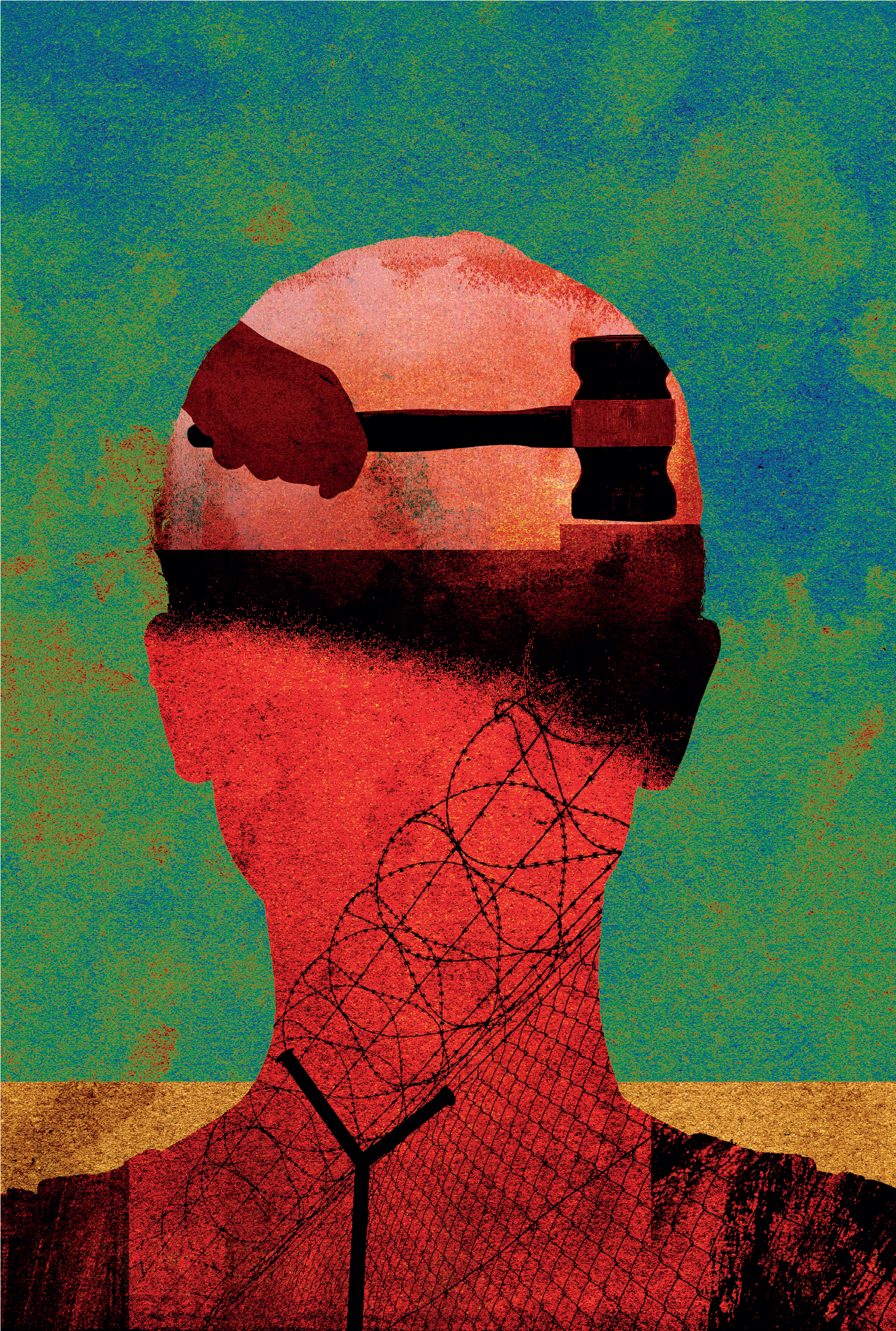
Freedom of speech is suffering most. Over the past 10 years, dozens of independent publications have closed because pressure has been put on their owners. Now they are going after individual journalists.
In 2018, Svetlana Prokopyeva, a journalist from Pskov, was accused of inciting terrorism in an article she wrote about an explosion in the FSB reception hall. She was recently given a suspended sentence and a fine.
Most often they go after those engaged in investigative journalism. In July 2018, Orkhan Dzhemal, a journalist specialising in military affairs, Alexander Rastorguev, a producer, and their cameraman, Kirill Radchenko, were shot dead while they were investigating the activities of private Russian military company the Wagner Group in the Central African Republic.
While those who carried out the killings are as yet unknown, independent experts have shown that these murders were carefully planned and carried out.
In 2019, Ivan Golunov, an investigative journalist at the Meduza publishing house, was accused of drug-dealing. Only after a public protest was he found not guilty and released.
In the summer of 2020, former journalist Ivan Safronov – now an adviser to the head of the Russian space agency – was accused of espionage. Specialists consider that these cases have all been brought as acts of revenge because of the individuals’ professional activities.
And it is often those engaged in independent professions who are the targets of such cases. In 2020, theatre director Kirill Serebrennikov was found guilty of embezzling state funds in a case he maintains was politically motivated. It dragged on for three years, and he received a six-year suspended sentence and a massive fine.
Late in 2019, a case was opened against artist Yulia Tsvetkova (also this year’s Index arts award winner) for her drawings in a series she called The Vagina Monologues. She could receive up to six years imprisonment.
Finally, there is the widely publicised case of human rights activist Yury Dmitriev, who was uncovering the names of people who had been shot during Stalin’s Terror. The court accused him of paedophilia and eventually handed him a three-and-a-half-year prison sentence.
The leadership in the Kremlin (there can be no doubt that these serious cases are all controlled by the highest authority) continue to live in the past, in the world of Soviet dogma. In their view of the world, there is no place for people wanting to lead their own lives.
The Kremlin simply cannot comprehend that people may have their own principles, convictions or goals. It cannot understand that a person may wish to uphold the truth rather than another’s particular interests.
There was no place for a profession such as “investigative journalist” in the USSR, and they do not see that such a profession can be part of the fabric of society now. In the minds of the secret services, a journalist can be either the Kremlin’s assistant or its enemy.
All these processes are not simply about the pursuit of certain individuals. They are bringing a charge against democracy itself. They don’t like “abstract ideas” in the Kremlin, such as the kind of social structure we have now in Russia.
They prefer the situational ethic (just do what’s convenient now) and rhetoric (you can justify any action with the use of the right words). But this hybrid of values leads to a lack of an adequate response even to their own actions. In this way the Kremlin is creating yet another historical experiment: it is trying to create a synthesis of democracy and totalitarianism, of freedom and slavery.
In this, much depends on the psychology of Putin himself. Probably up to a certain point he was a supporter of what was modern; at least, while it referred only to technology. But when the individual uses this modernity for the sake of progress, it becomes a nightmare for the Kremlin.
But there is one thing we can say for sure: the “era of stability” (economic stability in exchange for civil freedoms), which has been the main foundation of post-Soviet authoritarian regimes, is coming to an end. The authoritarian regime has ceased to be effective economically, and the pandemic has hastened this process. The authorities are aware of their weaknesses, which is why they are becoming more aggressive.
The most surprising thing is that the new ethic which is coming from the West is also changing post-Soviet people and a new battle is beginning in the post-Soviet space.
It is a battle for what will be considered the norm in the years ahead. The law or lawlessness? Freedom or madness? A life in which there is a place for the individual or one in which all is subsumed by the totalitarian state?
For now, at least, all is not lost.
Footnotes
Translated by