




Abstract
Not everyone laughed. For the joke, Chargui was interrogated by seven prosecutors and sentenced to six months in prison for inciting hatred against religion. It wasn’t just the content of the post that was up for discussion but her religious beliefs.
The 27-year-old is vocally atheist on her Facebook page, which has 25,000 followers and was given a blue tick on the day that we met in late July. She said: “They asked me, ‘Are you atheist?’ and when I said yes, they asked me, ‘Do you take medication?’ [and] ‘Have you consulted a psychologist?’” Two weeks later, and after appealing her sentence, she left the country to live in Germany.
Questioning Chargui about her religious beliefs in this way was a violation of Article 6 of the constitution, which “guarantees freedom of conscience and belief”, according to a political analyst and a former professor of law, Mohamed Kerrou. “This demonstrates a social conservatism that is embodied by the judges, which is shared by the majority of Tunisians and by the world, in fact,” he said. “It shows that there is a gap between the judges and the text.”
“Charisma”, a politician and business-woman from the holy city of Kairouan, thinks the text itself is flawed. “The constitution is schizophrenic – there are parts where it accepts difference and parts where it does not,” said the 36-year-old, who does not want to use her real name for security reasons. In 2014, the first article was drafted ambiguously in a bid to satisfy both secular and Islamist sections of society, stating that “Tunisia is a civil state and Islam is its religion”. Article 6, which guarantees freedom of belief, is itself ambivalent since it also “protects the sacred”.
Since the 2000s, Tunisia has seen an increase in both secularism and religiosity, said Mohamed, with the latter given a boost in 2011 when the Islamist party Ennahdha was in power. A survey commissioned by the BBC found that Tunisians are increasingly identifying as “not religious” – 30% in 2018-19, twice as many as in 2013.
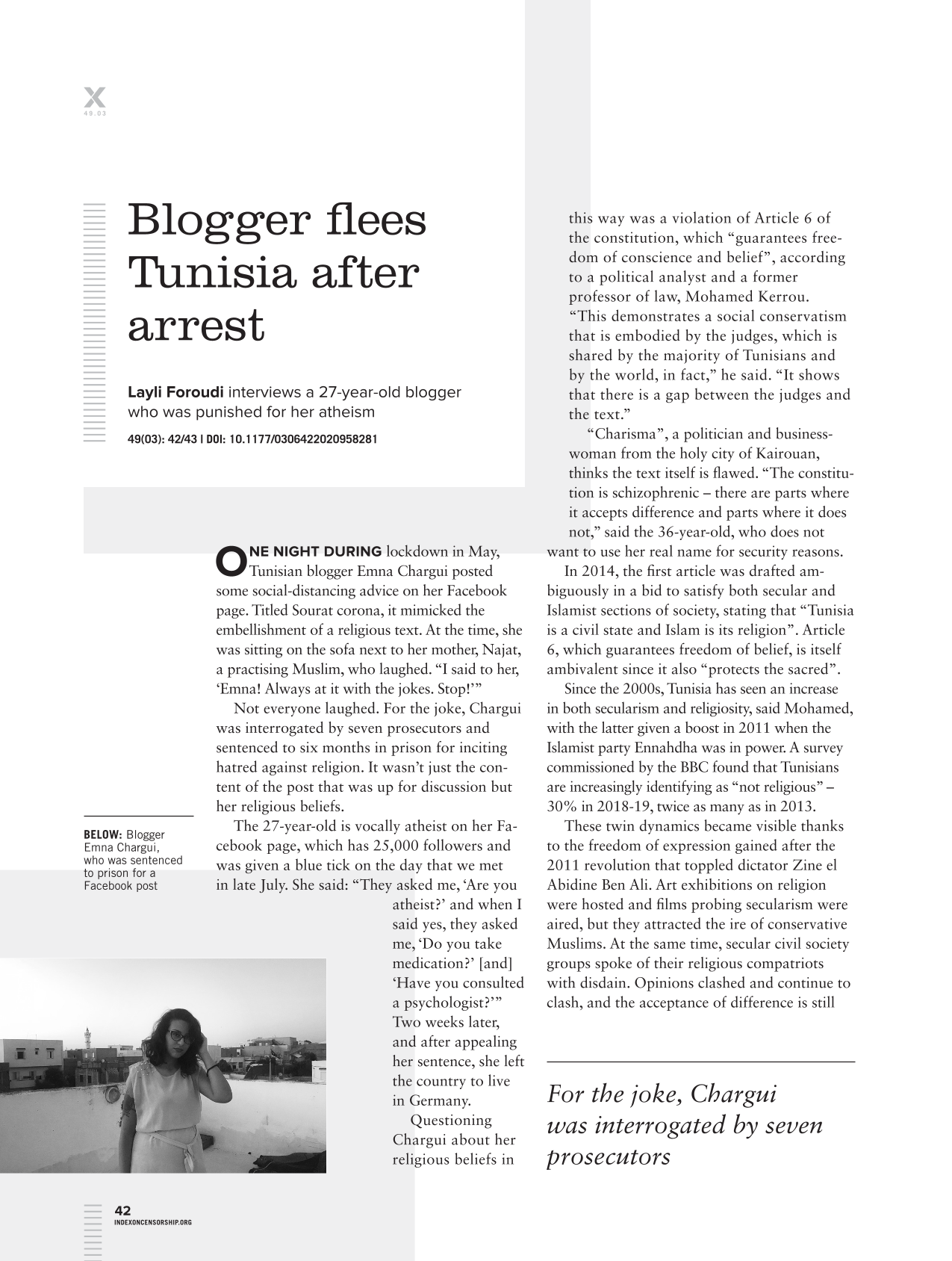
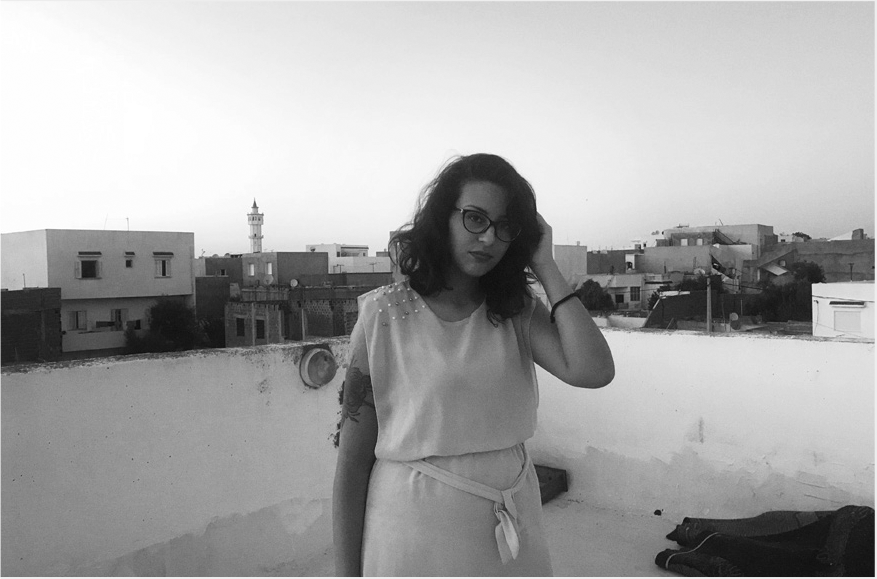
Blogger Emna Chargui, who was sentenced to prison for a Facebook post
CREDIT: Layli Foroudi
CREDIT: Otto Dettmer/Ikon
These twin dynamics became visible thanks to the freedom of expression gained after the 2011 revolution that toppled dictator Zine el Abidine Ben Ali. Art exhibitions on religion were hosted and films probing secularism were aired, but they attracted the ire of conservative Muslims. At the same time, secular civil society groups spoke of their religious compatriots with disdain. Opinions clashed and continue to clash, and the acceptance of difference is still elusive for many, whether religious or non-religious.
Freedom of expression has been a double-edged sword as these clashes are not always civil.
Khaled Maaref, a resident of the Beb Mnara neighbourhood in the Medina of Tunis, said that if we had met before 2011 he would have spoken to me, but in a whisper. “We had in our head that Ben Ali was everywhere,” said the 56-year-old, who was warned by his Salafi neighbours that he should keep quiet for his safety. “I have more freedom to speak now, but I risk my life.”
For Maaref, more freedom has meant more freedom for extremist religious groups, too. As a result, atheists are able to exercise their new-found freedom more so than before but so are Salafists and other groups, who are threatening those speaking out.
Perhaps the biggest factor in keeping atheist voices silent is a more banal social conservatism. Sitting with a group of friends in a cafe in the southern city of Gabès, Mohamed, a 26-year-old with a construction business, tells me how he has been navigating Ramadan during the coronavirus lockdown. He discreetly eats bread and cheese in his bedroom, with the door closed.
“I can’t talk about atheism with anyone here,” he said, referring to his friends and speaking to me in English. “If you say you are atheist, they won’t accept you – they insult atheists. People will say, ‘Don’t buy from that shop, he is an atheist’.”
The same logic applies to politics. Charisma says that accepting the “non-religious” label would ruin her.
“They will not accept me into their region, into their home. They will judge me just by that and fight against me,” she said. It would hinder her work, she believes, since “the most important thing is to be close to people and see what they are suffering from, whether they are religious or not”.
Maaref became persona non grata in two political parties – Afek Tounes and Mashrouu Tounes – because he always pushed the atheism issue. “They say [to me], ‘We are for atheism and co-existence but it isn’t the moment to speak about that, we need to wait’,” he said.
Chargui’s strategy is to speak. She had the right to refuse to answer the judge’s question on her beliefs, but she relished the opportunity. “The goal is to show myself,” she said. “If I don’t then I risk living in a country that doesn’t create laws for people [like me]. If we don’t show ourselves, no one will know that we exist.”
But she no longer lives in the country; she can speak only from afar.