




Abstract

Kashmiri journalists talk to
Covering this region, Indian-administered Jammu and Kashmir, has always been challenging but six months on from new tougher regulations, many say things have never been this bad.
The Indian government imposed direct rule over the region in August 2019 after revoking nearly all of Article 370, a provision in the Indian constitution that provided some autonomy to the region. But pressure on media freedom was racheted up even further with the introduction of the New Media Policy 2020. Journalists were, of course, already operating under tremendous pressure – harassment, intimidation, the choking of advertisement revenue, imprisonment, draconian laws and a communication blockade – all of which are forcing journalists to self-censor.
Many journalists had witnessed attacks and some have lost their lives, such as Shujaat Bukhari, editor of a local English daily, who was killed outside his office in 2018.
Qazi Shibli, editor of The Kashmiriyat, an online news portal based in Kashmir, was released on 25 April this year after spending nine months in a prison in Uttar Pradesh, more than 900 kilometres away from his home. Shibli was detained again by local police on 31 July and held for 17 days.
“It is very tough to get out in the field with such a sorry state of history of harassment and such strict restrictions. We have to go on telling ourselves this is our reality, we live this every day. This is unfortunately the new normal, we have to tell ourselves, we will risk, we will report the truth and then we might get shot,” Shibli said.
Geelani, who has worked in the past for German news organisation Deutsche Welle, was recently charged under the Unlawful Activities (Prevention) Act. Geelani believes that the very idea of journalism has disappeared. He feels that journalists, opinion makers and civil society voices are deeply concerned not only about freedom of expression but also about freedom after expression.
“The constant surveillance of the written or spoken word from the state apparatus is Orwellian in nature. The idea is to kill independent journalism and criminalise opinions in Kashmir,” he said.
Shahana Bashir Butt, a broadcast journalist working for Press TV, has been covering Kashmir for the past 12 years. She told Index that the little sense of security that the people of Kashmir used to have earlier is lost now.
“Earlier, reporters would report facts as they are or would do a little bit of editing as per the demand of the organisation, but now the entire process of information seems to be censored. It passes through many gates and by the time it reaches the audience the essence or meaning is lost,” she said.
Restrictions have killed many stories in Kashmir that would otherwise have made big headlines, Butt believes.
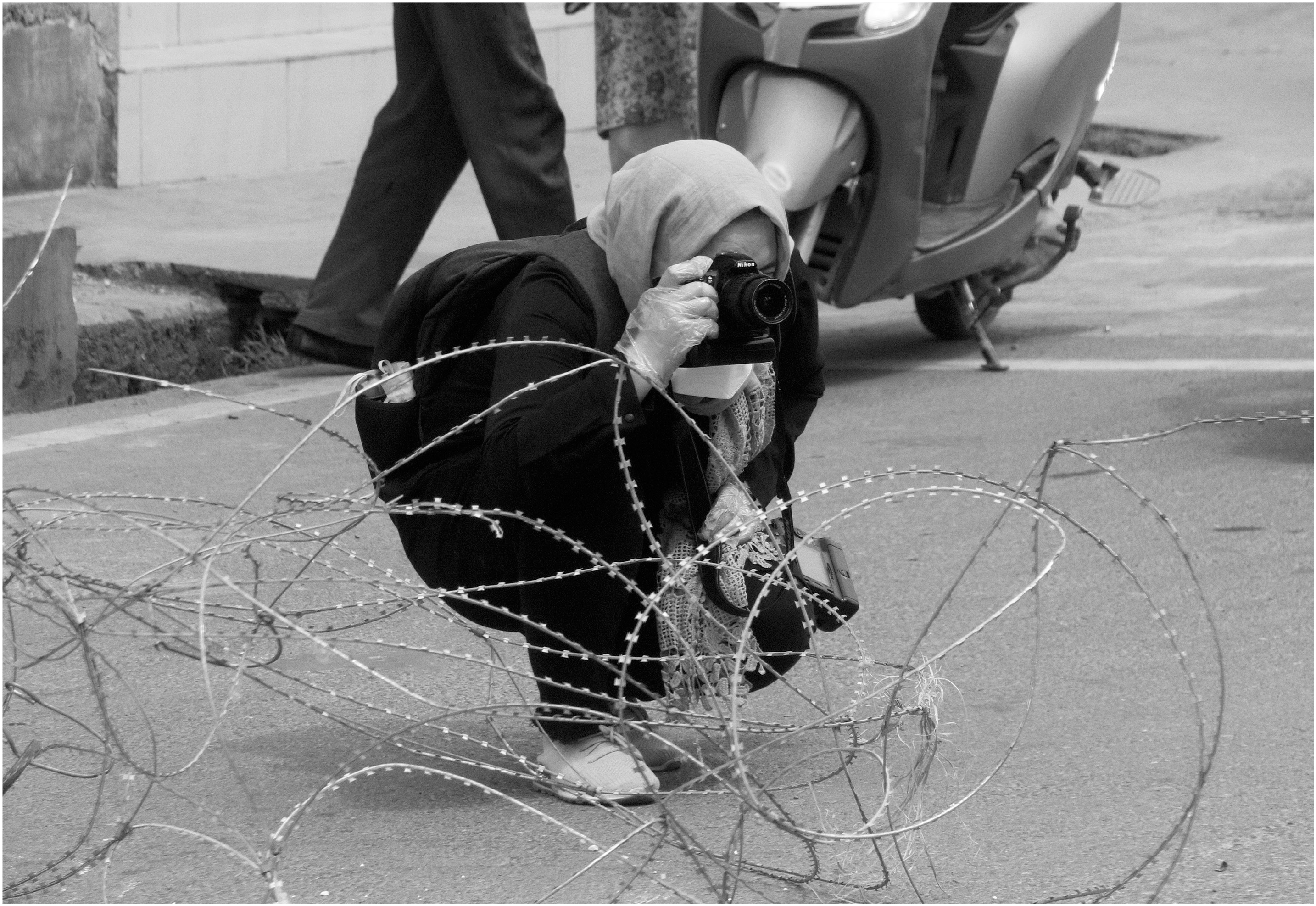
Kashmiri photojournalist Masrat Zahra takes photographs of a checkpoint in Srinagar, Kashmir in April. Police have charged Zahra under the Unlawful Activities (Prevention) Act for posting images on Facebook
CREDIT: Faisal Khan/Getty
Despite the digital threats that are associated with using VPNs, journalists here are forced to use them. With the restricted speed of the internet in Kashmir since August last year and the frequent bans on social media, VPNs are essential.
“I have to ask for extended deadlines,” Shibli said. “The sort of scrutiny one is under, it gets really tough. Unread messages in my inboxes are often read, even before I read them … this is the sort of scrutiny I am under.”
Journalists work by adopting creative and novel means at huge personal risk. Sharing his and others’ experiences, Geelani says that in the absence of internet services and communication channels, many journalists write stories on the ground, store them on thumb drives, book flights to Delhi or elsewhere to access the internet, and then send the emails to the respective organisations.
Not all journalists are tech-savvy, though, he says. “I was obviously helped by some of our younger colleagues who do understand the cyber world more than we do.”
A few years ago, in order to get news out, many journalists would write stories and then ask friends working in television to make small videos of them, which could then be sent to newspaper offices via the outside-broadcast vans.
Geelani says that the New Media Policy is “dictatorial and straight from the Nazi manual”. He says it grants unbridled powers to a clerk in the department of information and public relations to initiate criminal proceedings against editors, proprietors and journalists for what he or she deems to be “fake news”, “unethical”, “seditious” or “anti-national”.
In a letter published in May, UN experts expressed serious concern over the working conditions of journalists in Kashmir who were booked under a different act, the Unlawful Activities Act. The letter stated that a “free, uncensored and unhindered press and other media constitute one of the cornerstones of a democratic society”.
The muzzling and suppression of independent voices is resulting in a fabricated narrative of Kashmir as a peaceful area of India. “The state has sunk deep into the belief of ‘my way or the highway’, which is unfortunate in any democratic set-up,” Shibli said.
Geelani describes himself as an optimistic person but said: “I see hopelessness and helplessness all around. I fear that darker days lie ahead.” Many journalists, including senior and accomplished ones, have been summoned to police stations, interrogated over their routine stories for hours, and mentally harassed, with criminal cases registered against several of them. “What I fear is that journalism will be converted into stenography, where a journalist will be forced to be the mouthpiece of the powers-that-be. Such are the unbridled powers that the bureaucracy and police enjoy in Kashmir. Big Brother is always watching you – the Ministry of Truth and the Ministry of Love, as Orwell described in Nineteen Eighty-Four.”
Based on her experience working in Kashmir, Butt predicts a bleak future for journalism here. “I know journalism will die a slow death and new journalism will be born that will be ‘mouthpiece journalism’ or a one-sided narrative,” she said.
But despite all the challenges that the media face in the region, the value of fighting to get the truth out is not going away easily, according to Shibli. “The journalist fraternity in Kashmir has inherited the principles of truthfulness; hence cowing down to dissolve themselves into these false perceptions is defiance of an inherent tradition, which not many choose.”