



Abstract

Will we lose gardens as havens of peace, freedom and reflection? The Idler editor
Was I even allowed to be sunbathing and sitting on a bench? I had to check with my teenage daughter, a strict promoter of government rules of behaviour during the coronavirus pandemic, that I wasn’t doing anything wrong.
My reasoning self then kicked in and I told myself that the helicopter was probably chasing a criminal.
However, had I been like poet William Blake and his wife, who enjoyed cavorting naked in their Peckham garden, I might have been a trifle disturbed.
Gardens are supposed to be a haven of freedom and privacy in an increasingly constrained world. In the garden, you can be as you like. You can cavort naked, grow roses and parsley, and fall asleep.
In the garden, we can do what we want, when we want and how we want, free from prying eyes.
As Francis Bacon wrote many years ago:
“God Almighty planted a garden. And indeed it is the purest of human pleasures. It is the greatest refreshment to the spirits of man.”
While reclining on a 17th-century balcony in the lovely medieval town of Korkula, in Croatia, last year, my repose was disturbed by a buzzing noise.
“It’s a drone!” said my 14-year-old son, excitedly. I looked up and, sure enough, there in the blue sky hovered a little unmanned aircraft.
We watched as it hovered near us, peering. I took a picture of it in a sort of ineffective act of surveillance revenge. It then slowly moved off into the distance. I felt that I’d been spied upon.
Was the drone – a flying camera – sending photographs back to base? Had it been sent by Silicon Valley overlords to take photos of the ancient medieval town for the purposes of gathering free data of some sort which they would later sell to the highest bidder? Had it taken a photo of me doing something wrong?
Either way, the experience was distinctly unsettling and left me wary of the possibility that surveillance tech could destroy the sanctity and privacy of our gardens.
If you’re a believer in Naomi Klein’s “shock doctrine” theory (that crises are exploited to establish controversial policies while citizens are too distracted to engage or to resist) then you will also believe that the powers-that-be could have used the fear
generated by the coronavirus to step up their surveillance operations.
On 26 March, The Guardian ran a story with the headline “UK police use drones and roadblocks to enforce lockdown”.
Police in the Peak District, the piece said, had used drones to take pictures of people caught in the terrible and selfish act of walking their dogs. The drone was also used to take pictures of number plates which were traced to Sheffield, a full 30 minutes’ drive away.
CREDIT: Hiob/iStock; Sinisa Maric; Mudassar Iqbal; Mark Frary
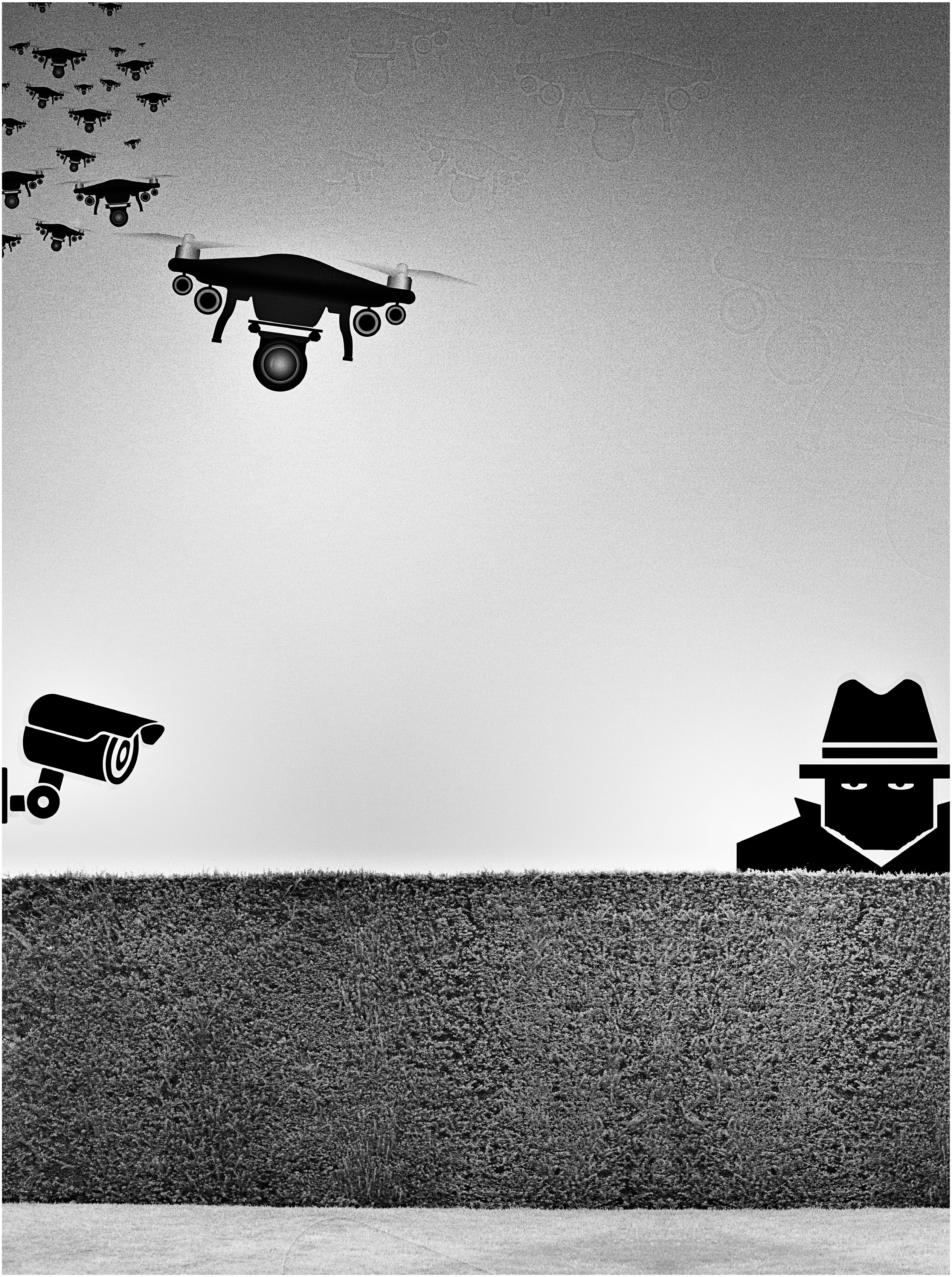
I called Silkie Carlo, who runs the civil liberties pressure group Big Brother Watch. She said that while most people would continue to enjoy their gardening activities unobserved, lockdown had provided an opportunity for further encroachments on civil liberties.
“Drones over gardens is a realistic prospect,” she said. “Safeguards around drones have certainly been relaxed during lockdown. As a surveillance method it is now on the table.”
That’s a pretty worrying thought.
My mother, now in her late 70s, has recently rediscovered her own small garden in Oxford, having not visited it for seven years, being not particularly keen on mud and the natural world.
Living on her own, she has suffered terribly during lockdown and tells me on the telephone that her life is not worth living. She just cannot stand being told what to do.
I suggested she installed a shed in her garden and she leapt at the idea. Now this garden project has become an expression of her free will and autonomy. Her new garden, with its cosy private cabin, will be a patch of independence.
If she saw a drone hovering overhead I think she would make good on her much repeated threat to “go to Sweden”.
Drones are already being eyed up to be used for transportation, and in April the UK government announced that it would be trialling their use to carry medical supplies from Hampshire to the Isle of Wight.
Whether this is the thin end of a large surveillance wedge (who could object to the movement of medical supplies?) remains to be seen. It would seem logical to conclude, however, that the spying industry will be hoping to use drones as much as possible.
The US military already has no fewer than 94 different types of “unmanned aerial vehicles” in use and in development. Their names have a poetic quality to them, I think, including the Northrop Grummann Firebird Intelligence-Gathering Unmanned Aircraft and the General Atomics Predator Intelligence/Surveillance/ Reconaissance Unmanned Aerial Vehicle.
The idea of little unmanned cameras getting in your face while you are trying to nod off in your deckchair with a G&T might sound fanciful. But who would have predicted 20 years ago that half the world would be carrying surveillance devices in their pockets, thereby telling Californian techies not only where we are but what we are doing and our consumer preferences?
Enjoy your remaining freedoms while they last.