Abstract
With an election on the horizon and with Covid-19 as an excuse, spies are everywhere in Uganda. It’s hard to know who to trust, writes
On the surface, the targets are street vendors. President Yoweri Museveni warned food sellers in March that he would send his spies to catch traders who take advantage of the Covid-19 lockdown to hike prices, in a statement he made to the nation. Fear and anxiety have since gripped the business community. Among the food sellers is Sylvia, 55, who was hoping to raise prices to help her recover lost operating costs and make some profit. But the president’s stern warning sent a chill down her spine.
“I’m scared because I have been living under this regime for the past 34 years and I know this man very well. He does not joke when he says something,” she told Index in the capital Kampala. “I’m very worried. Maybe we are being monitored day and night by some dark forces out there, and these spies can be anyone, from your neighbour, a customer, a hawker to anybody that you see on the streets.”
Ali, a small-scale farmer, slammed the president for threatening to send spies to the market.
“We face huge challenges and he goes on TV to talk about sending spies. It’s not fair,” he said.
Anthony Masake, of human rights and civil liberties organisation Chapter Four Uganda, said it was not new for the government to use spies and informers to achieve its objectives.
“What, however, is more crucial is what action police take against traders found to have hiked prices or hoarded goods. If they arrest them or bring any criminal charges against them, that would be unacceptable and an over-reach on the exercise of the emergency powers.”
Many suspect the crackdown on food sellers is just an excuse to stop opposition to the president in its tracks. As it stands, opposition politicians and local leaders are banned from distributing food parcels to the poor by order of the president, who insists food donations have to go through the government-organised taskforce. Opposition MP Francis Zaake was reportedly tortured after being arrested for distributing food to constituents, as reported by his lawyer on television station NTV Uganda.
Every sunrise in Uganda brings further infringements of privacy rights, as a young football player found out when his game was interrupted by police. Gun-blazing cops – some in civilian clothes – burst on to the ground where they were exercising and arrested two of his friends, whipping them and ushering them into a police van. He managed to escape but continued watching from afar.
“I still don’t understand how the cops found out that we were playing football because the place where we were exercising was out of reach of the general public. There are definitely some spies let loose in our neighbourhood.
“We no longer have privacy in this country and we are being treated like terrorists because of this coronavirus thing,” he said.
Scores of people have been arbitrarily arrested across the country, including mothers with babies, food vendors, the young and the elderly, journalists, LGBTQ people and foreigners, according to Human Rights Watch.
As public anger grows in the face of what many observers describe as an abuse of power, an incensed Masake is urging the government to stop arresting people who allegedly violate preventative measures, and suspend pre-trial detention.
Adrian Jjuuko, executive director at Human Rights Awareness and Promotion Forum in Uganda, believes the coronavirus outbreak has become the perfect excuse for a regime wishing to exercise more control over its population.
“Amidst a cloud of fear, anything goes. The president of Uganda issues and un-issues directives as he deems fit, sometimes backed by no laws at all,” Jjuuko said.
“The right to privacy is a fundamental right and, therefore, if the state is without lawful justification interfering with people’s communications, then it would be in violation of this fundamental right.”
Masake is concerned about how responsible the state is going to be in exercising the restrictions.
“Resorting to criminal liability for individuals who fail to adhere to the extra privacy restrictions is deeply concerning for me. I am afraid authoritarian regimes are likely to ride on the current emergency powers to step up surveillance and other infractions on the right to privacy even after the pandemic,” he said.
“Moving forward, there is a need to question the president and the executive on the emergency measures put in place to ensure that they adopt a human rights-based approach.
“Despite its challenges, any lockdown should be under a state of emergency to ensure that the measures are enforced in an institutional framework where parliament and the cabinet play their roles actively – within the confines of the 1995 constitution.”
Chitanga Gideon Hlamalani, a regional analyst at the organisation Political Economy Southern Africa, based in Johannesburg, condemns the Ugandan government’s overreach under the guise of managing Covid-19.
“This is done with a clear repressive rule targeted at mitigating the growing democratic dissent, particularly to young people who oppose the continuation of Museveni’s stay in power,” Zimbabwe-born Chitanga said.
There’s a growing fear that the young could become the security forces’ main target. The manager of an internet cafe told Index: “People with unfamiliar faces come here almost every day to ask us why the internet cafe is not operating. But I have never seen them here [before], or in this neighbourhood, so I suspect that there could be some sort of operatives or detectives assigned to see if we are gathering people here. I can’t take this nonsense anymore.”
The young cafe manager was wearing a T-shirt with “Free Bobi Wine” emblazoned on it. Musician and opposition politician Wine – real name Robert Kyagulanyi Ssentamu – is an increasingly popular figure among the Ugandan youth, who are fed-up with Museveni’s more than three decades in power.
Many citizens worry that the situation could get worse in the run-up to the 2021 presidential election. More than 20 candidates, including Wine, have already expressed their intention to run for election in the hope of unseating the 75-year-old Museveni.
“Everybody wants Bobi Wine to win because people are tired of this grandfather, a president who sends operatives to spy on his people, including food sellers who are putting their lives at risk to help us during these trying times,” one 40-year-old woman said.
“We are going to see more and more police brutality as we draw near 2021, and spies being deployed everywhere to flush out Bobi’s supporters. That’s for sure.”
Masake agrees. “The use of spies and informers during election periods is a common practice in Uganda’s elections,” he said. “It often goes further to forming vigilante groups along party lines, and this often facilitates increased rights violations.”
Chitanga added: “There is a very high agitation for change in Uganda, with many people, especially the youth, rallying around Bobi Wine… I’ll not be surprised if Museveni uses every trick in the book to ensure that he stays in power and wins the next election, including using Covid-19 as a platform to extend his brutal and authoritarian regime.”
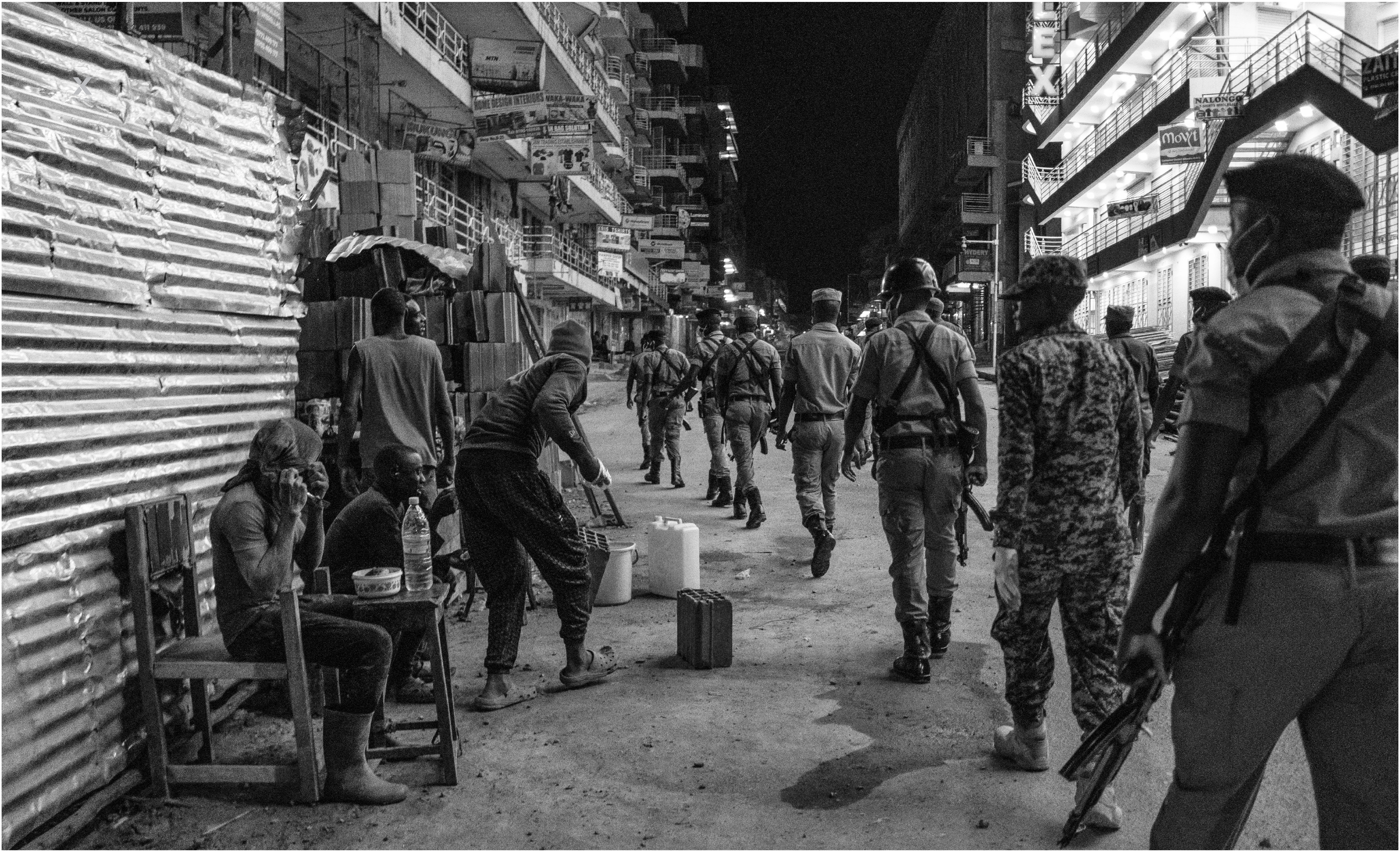
Ugandan military and police patrol the streets of Kampala in April 2020
CREDIT: Sumy Sadurni/Getty