




Abstract

She is maintaining a round-the-clock sit-in in the busiest part of the South Korean capital, in front of the Ministry of Unification – South Korea’s government agency that handles relations with North Korea – to draw attention to what she sees as an emergency: the dire circumstances faced by many North Korean defectors who live in the South.
Her presence here started when she and a few other activists embarked on hunger strikes to call on the government to investigate two troubling, high-profile incidents involving North Koreans. In late December, after 12 days without eating, Kim lost consciousness and was rushed to hospital.
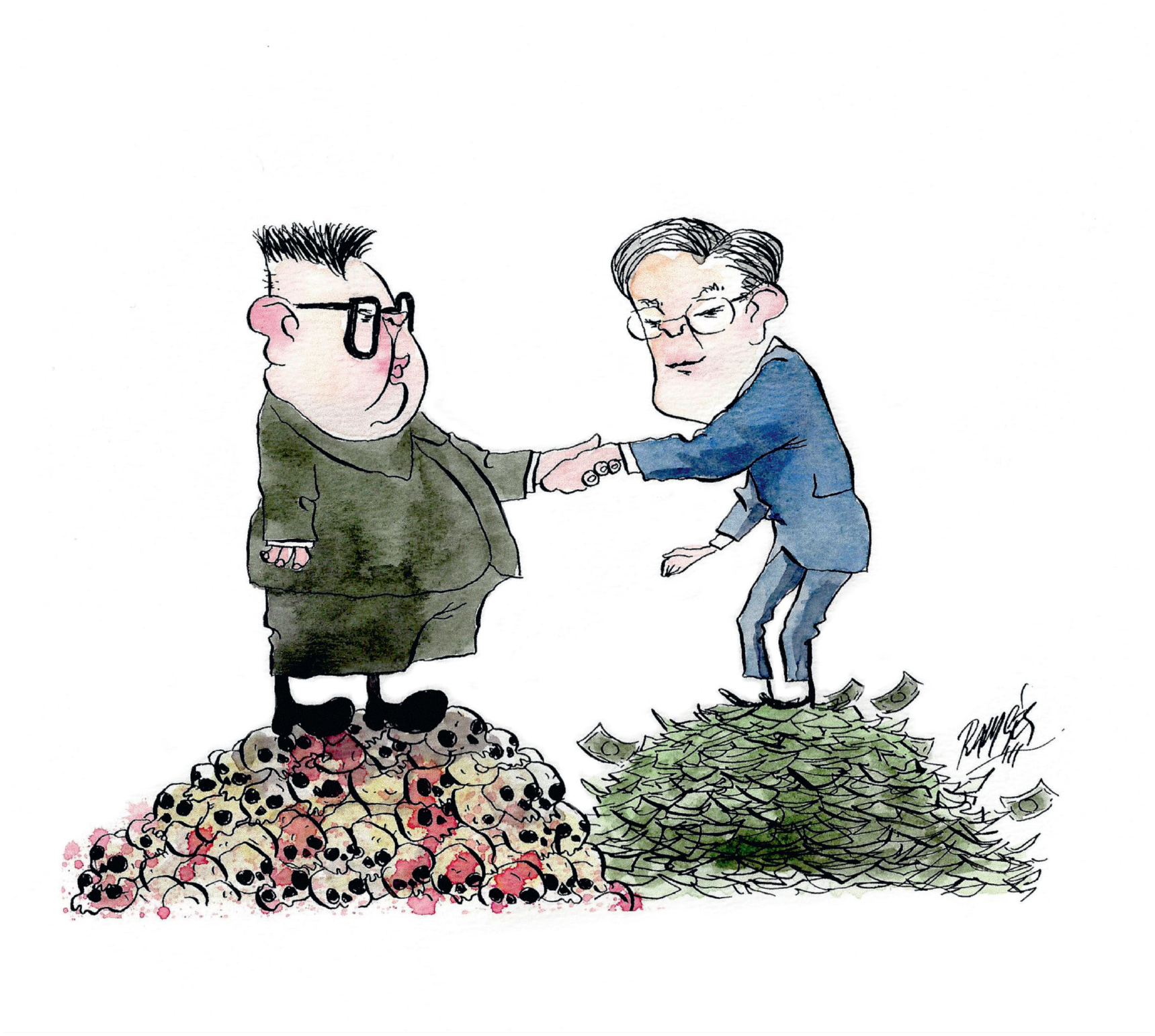
CREDIT: Ramses Morales Izquierdo/Cartoon Movement
While shaken by that experience, she is continuing her campaign, albeit with regular eating habits. On this particular chilly winter night, Kim is huddled on a heated ground-sheet with three guests – a fellow North Korean activist, a South Korean pastor and a journalist – who are sharing North Korean-style rice cakes, glutinous blobs of rice flour coated in sweetener.
“This government refuses to acknowledge that North Korea is a failed society and they want to suppress anyone who points that out,” Kim told Index from inside the tent.
“President Moon Jae-in and his government are ignoring North Korea’s grave human rights abuses in a misguided effort to mollify [North Korean President] Kim Jong-un and improve relations with Pyongyang, but by doing so, they betray the long-suffering people of North Korea,” said Phil Robertson, Asia deputy director at Human Rights Watch.
Since taking power in 2017, the government of President Moon Jae-in has carried out unprecedented shows of rapprochement with North Korea, starting with the North’s participation in the 2018 Winter Olympics in the South, and including summits between leaders.
Kim and other critics argue that to accomplish these headline-grabbing feats, Moon has made a Faustian agreement to never mention the dire human rights abuses in the North, while working to depict North Korea as a normal country with a leadership that sincerely plans to get rid of its nuclear weapons.
After three inter-Korean summits, co-operation between the two sides is currently frozen and the Moon administration has no tangible achievements it can point to as evidence of the efficacy of this approach. The lack of progress with North Korea is one factor working against Moon as his administration faces crucial general elections in April.
While sleeping in a tent on a pavement through the winter may be a daunting prospect for most, Kim can handle it. Kim, 48, fled North Korea, one of the world’s most repressive societies, in 1997 for China. Over the next 10 years, as she attempted to save enough money to get to South Korea, she was arrested three times by police and sent back to the North. Each time she fled again, and eventually she made it to Seoul in 2007.
She admits that in the South she has found freedom and opportunities that never would have been available to her in the North, but two events in recent months have shaken her faith in her adopted homeland, and driven her to take action. In September last year, South Korea’s defector community was shocked when the bodies of Han Sung-ok, 42, and her six-year-old son were found in a low-rent apartment in Seoul, apparently after having starved to death.
The headlines wrote themselves: a person who fled a poor country ended up starving to death in a rich country. Kim said she and other defectors wondered how the mother and son were left to die slowly without intervention from the authorities. South Korea’s Child Welfare Act mandates local governments to step in and provide the necessities of life to a child if a parent is unable or unwilling to.
Another incident occurred a few months later when the South Korean government announced that it had repatriated two North Korean fishermen who were accused of murdering 16 fellow crew members and dumping their bodies into the waters west of South Korea. Under South Korean law, all North Koreans are entitled to South Korean citizenship and must be allowed to remain in the South if they choose. The Seoul government sent the fishermen back to the North even though they asked to remain.
Kim would like the South Korean government to consult her and others with experience living in North Korea, a country that practises capital punishment and maintains a large, brutal network of prison camps.
The case involving the fishermen was particularly concerning for defectors and people still in North Korea. “That made people think that South Korea is a country where the government doesn’t follow its own laws. People looked at those young men being sent back, and they saw how they were treated and wondered, ‘Could that happen to me?’ Or to their son or their brother,” Kim said.
“The Moon government talks about peace and co-operation, but they refuse to even discuss how the policies of the North Korean government affect the people who live there. Everything they do goes through the regime and does nothing to help the people of North Korea.”
Kim sees her role as helping South Koreans understand what North Korea is really like. “I can still see with the eyes of a North Korean,” she said.
Explaining the repatriation, Lee Sang-min, a spokesman for the Ministry of Unification, told reporters that the two North Koreans had committed murder and were therefore not eligible for protection under South Korean law.
“We consulted among various government bodies and made the decision out of consideration of the South Korean people’s safety,” Lee said at a press conference.
More generally, in explaining its tendency to avoid speaking out about North Korea, the Moon administration has pointed to Article 4 of the South Korean constitution, which states that “the Republic of Korea shall seek unification and shall formulate and carry out a policy of peaceful unification”.
Whether or not to press North Korea on its rights record is an old source of disagreement between the right and left of South Korea’s political spectrum. The right argues that the suffering in the North is intolerable and that keeping silent about abuses serves only to legitimise a dictatorship and undermine South Korea’s reputation as a state that respects human rights. The left, currently in power, contends that drawing attention to abuses in the North will scare North Korea away from the negotiating table. Overt condemnations of North Korean human rights abuses will thwart progress before it starts, the thinking goes, making it prudent to refrain from finger-wagging.
It is not only domestic groups that have been critical of Moon. In December 2019, 67 international human rights groups sent him an open letter criticising the repatriation of the fishermen, and the government’s decision not to co-sponsor a UN resolution on North Korean human rights.
Another veteran activist, Doh Hee-youn, 52, argues that the Moon administration’s North Korea policy is one reason behind the number of North Koreans defecting to South Korea in 2019 being the lowest in 18 years.
“Even while sanctions are creating ever harsher conditions there, people in the North no longer look at South Korea as a place where they can feel safe, and some therefore think it’s better to stay put for now,” Doh said in an interview at his office in Seoul.
Doh is best known as the activist who worked to smuggle the manuscript of The Accusation, a novel by Bandi, a pseudonymous writer in North Korea, out of the country.
He still has contacts in the North and says that, with the country subject to harsh international sanctions and rapprochement with the South going nowhere, times are tense. “People are increasingly dissatisfied,” Doh said. “The tension is building up. Eventually, it will explode.”