




Abstract
As Swedes embrace a trend to have microchips implanted in their bodies,
They are getting glass-encased microchips implanted between their thumbs and index fingers – the incision is quick but stings and feels a bit like being stabbed with a fork, says 19-year-old student Olof.
“I wanted one because it’s cool and it’s something us techies are into because we like being at the forefront of technological developments,” he explained.
Radio-frequency identification microchips use the same technology found in credit cards, key fobs and public transport passes. In Sweden, companies ranging from the national rail service to a water park have installed such readers, meaning that anyone who has been chipped can, with a simple swipe of the hand, open doors, pay at vending machines or validate tickets.
Sina Amoor Pour, a bio-engineer trained to perform chip implants, lets the chipping event attendees into the building by swiping his hand against a reader. Amoor Pour says that today’s crowd is pretty typical: males across a fairly wide age range.
Olof plans to copy his public transport pass to his new chip. By cloning the travel pass, Olof can ditch his plastic card.
Implanted microchips, enthusiasts like to emphasise, replace the need to carry around passes, keys and credit cards. But you can’t use a single microchip at multiple locations, which is why a few of the attendees at the Stockholm chipping event are opting for two implants.
“I’ll use the one in my right hand for the underground and the one in my left hand at the gym,” said 24-year-old Adam.
The RFID chips are passive, meaning they don’t have a battery or power source, and so do nothing until they interact with a reader. Since they don’t emit a signal, they can’t be tracked. But there are microchips that use near-field communication and these can store data, such as your contact details and blood type. Some choose to add virtual business cards to their implants, which can be shared using a smartphone app.
It’s that ability to store data that causes some to fear they make bearers vulnerable to hacking. Although you cannot currently store a large amount of data on the microchips, they may become more sophisticated in the future and, even today, if you have an NFC reader on your phone and place it against someone’s chip you can read the information off it. With an NFC reader/ writer, you can also change a chip’s content.
“The more data is stored in a single space, the more attractive the chips will be to hackers,” said Ben Libberton, a science communicator based in Stockholm.
“You have to consider the issue of keeping the gathered data safe, as well as the question of how the data is harnessed.” He believes there should be safeguards in place and that lawmakers should regulate the microchips.
Back at the chipping event in Stockholm, Adam says he thinks there’s little need to worry about hacking or privacy breaches. “The implants aren’t visible and I’m not a public figure. You’d have to know that I was wearing a microchip and then get up pretty close to scan my hand with a reader. Why would someone go through all that trouble? After all, you can find lots of personal data, including my home address, through a simple internet search. I’m also walking around at all times with a device that is truly traceable – my smartphone.”
The organisers of the chipping event are “biohackers” – DIY biological engineers who often experiment on their own bodies. Biohackers are the pioneers of the microchipping trend, which by some estimates has been adopted by around 4,000 Swedes as well as others around the world. But the biohacking scene in Sweden is different from scenes elsewhere, says Moa Petersen, a lecturer in digital cultures at the University of Lund.
“Biohacking movements vary in character, and the way it’s developed in a particular country to some extent reflects the local society and culture,” said Petersen, whose book The Swedish Microchipping Phenomenon came out last year.
What’s notable about how it has developed in Sweden is that it is celebrated and done in the open, with companies organising implant parties as PR stunts and as an activity at staff events.
At a 2017 seminar organised by the national rail company, Karin Svensson Smith – who was then a member of the government’s transport commission – got microchipped in front of a press scrum and told reporters it would make travelling by train a “more seamless” experience.
“Microchipping has been de-dramatised here in Sweden,” said Petersen. For her, the Swedes’ overall tech-positive attitude, along with a high level of trust and the safety net offered by the welfare state, comprise the trinity that holds the key to understanding why the trend has taken a relatively strong hold in Sweden.
She says that the biohackers she interviewed wanted to “take control of their own data”.
At present, the microchips do little more than act as digital badges, even if many evangelists believe the future of implant tech lies in more advanced usage. Among those evangelists is Hannes Sapiens, a pioneer of the trend, who has travelled around the world to give talks about implant tech.
“Sweden is a high-trust society and that has certainly been a factor,” he said. “However, it’s my conviction that the most important factor for implant tech taking off here is that Sweden is a powerfully tech-literate society… and if you understand how a technology works, you also understand that you need not be afraid of it as long as you use it in the right way.”
Sapiens is not overly concerned about the risk of privacy infringement and says chip implants cannot be used for surveillance purposes “in any meaningful way”.
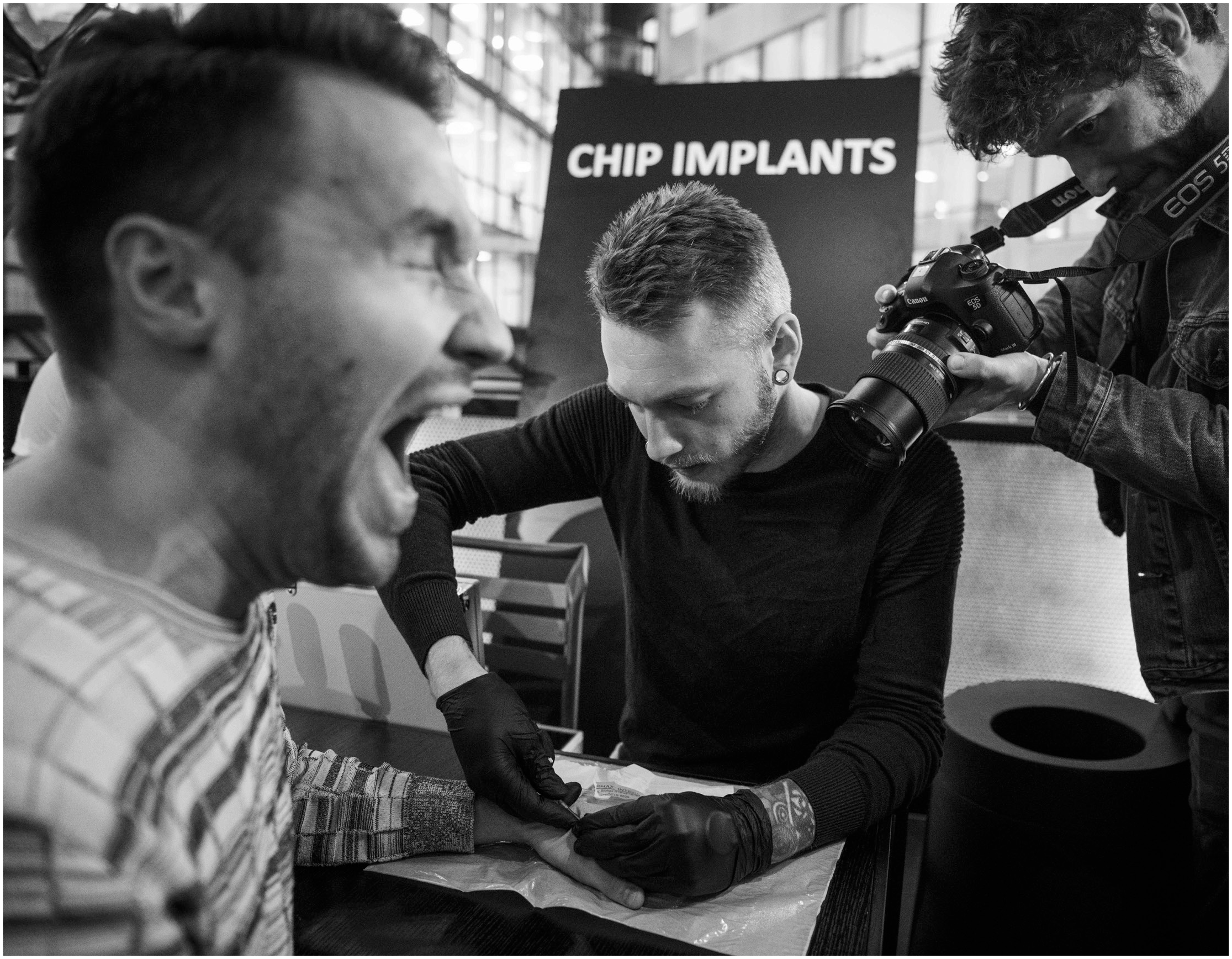
A man has a microchip inserted under his skin at a “chipping” event at Epicenter, Stockholm in 2018. Some estimates put the number of Swedes who have been chipped at 4,000
CREDIT: Jonathan Nackstrand/Getty
He lists three reasons. First, the RFID chips are passive – they can’t be tracked since they don’t emit signals. Second, in order to activate the chip implant you have to touch it to a reader; and while someone can scan it without your consent, they would have to get up close since the chips can’t be read at a distance. Third, the implants can’t collect data. They are repositories of data that you have to actively put into them.
Sapiens also believes the chips are a more privacy-friendly alternative to biometric identification technologies such as face recognition and fingerprints.
It’s that possibility to control and protect one’s data that drives microchip enthusiasts. Arguably, biohackers are driven by distrust, or at least by a desire to wrest their own personal data away from third parties. Jowan Osterlund, founding CEO of Biohax International, says he has microchipped about 6,000 people around the world, the majority of them in Sweden. He himself has four microchip implants.
“The coolest thing about it is that it allows me to lock my digital identity. That means I own and control my digital identity,” he said.
Despite his reservations, Libberton believes implants offer “huge potential” for monitoring health. “All things being equal, I would love to have that kind information myself. The question is – and this is my main reservation – how do I get that information? Does it come straight to me, and is it private? Or is it shared with other companies so that, if my glucose levels increase, I can suddenly get an increase in my health-insurance premiums?”
Libberton does not have a principled objection to integrating technology into the body but he is concerned about how the information is gathered and shared.
“My main worry is that we’re becoming more and more willing to sacrifice privacy for the sake of convenience.”
Chips With Everything
NEW JEANS? NEW TRACKING DEVICE
Tommy Hilfiger added Tommy Jeans Xplore to its range in 2018, a clothing line in which each item has a Bluetooth smart-chip installed. The chip is linked to an app which allows the company to track how often the customer is wearing the clothes and where.
ALEXA IS LISTENING
Reports have emerged that Amazon staff listen to recordings in order to “improve the customer experience” of that small, voice-activated device in the corner of the room. Internal chat rooms exist for staff to swap funny things they hear and distressing activities.
BIG BROTHER, BIG BOSS
Crossover, a talent management company, was said to be using surveillance technology that included taking photos of employees at their desks every 10 minutes. Tracking devices have also been used on nurses in a hospital in Florida, USA, to help the hospital know which stations need a bigger stock of medical supplies.