




Abstract

Matteo Salvini stirs up public distrust in Italy’s media. But part of the problem is many Italians did not trust journalists in the first place, writes
A crowd of Salvini fans had gathered to make clear Lerner was not welcome in Pontida.
“Go away! What are you doing here?” some were filmed saying.
“Clown!” others added. “Piece of shit!”
“You’re not Italian, you Jew!”
On the same day, Salvini supporters attacked La Repubblica video-journalist Antonio Nasso, punching his camera.
Afterwards, Salvini chose to put his weight behind the attacks with what appeared to be, at least, partial support. Among other things, he said Lerner “was looking for it” and that “these are not journalists but… slanderers”.
The episode is symptomatic of how Salvini’s sardonic jeers and strongman rhetoric against reporters might be encouraging anti-journalist feelings among his supporters.
It’s a situation that is not exclusive to Italy. Strongmen leaders around the world regularly attack the media – we live in an era in which critical stories are dubbed as “fake news”, journalists are branded as “enemies” and political rallies are dominated by chants against news organisations.
But what has happened in Italy should be a salutary lesson for the world of journalism. The low standards that are reflected too often within the country’s media mean that Salvini has been pushing at an open door when it comes to building on public distrust of journalists.
“Italians already didn’t have any trust in the media,” said Leonardo Bianchi, a news editor at Vice Italy who often reports on far-right and neo-fascist groups, and the author of La Gente (The People), a book on resentment among Italians. “Some haven’t had any trust in them for a very long time – for many different, and in some cases right, reasons,” he said. “Salvini merely exploits this lack of trust for electoral gains.”
Trust in the media is “particularly low” in Italy, according to the 2019 Digital News Report by the Reuters Institute for the Study of Journalism. The report put trust in the media at 40% and found that only 33% of Italians thought the media scrutinised the powerful well – the second-lowest score in Europe after Hungary. To put these figures into context, in the October regional election in Umbria, Salvini’s Lega party won 37% of the vote, and the far-right Brothers of Italy (FdI) party added another 10%. These parties appear to be held in higher esteem than journalists.
Salvini speaks at a national demonstration against the new government in October 2019
CREDIT: Antonio Masiello/Getty
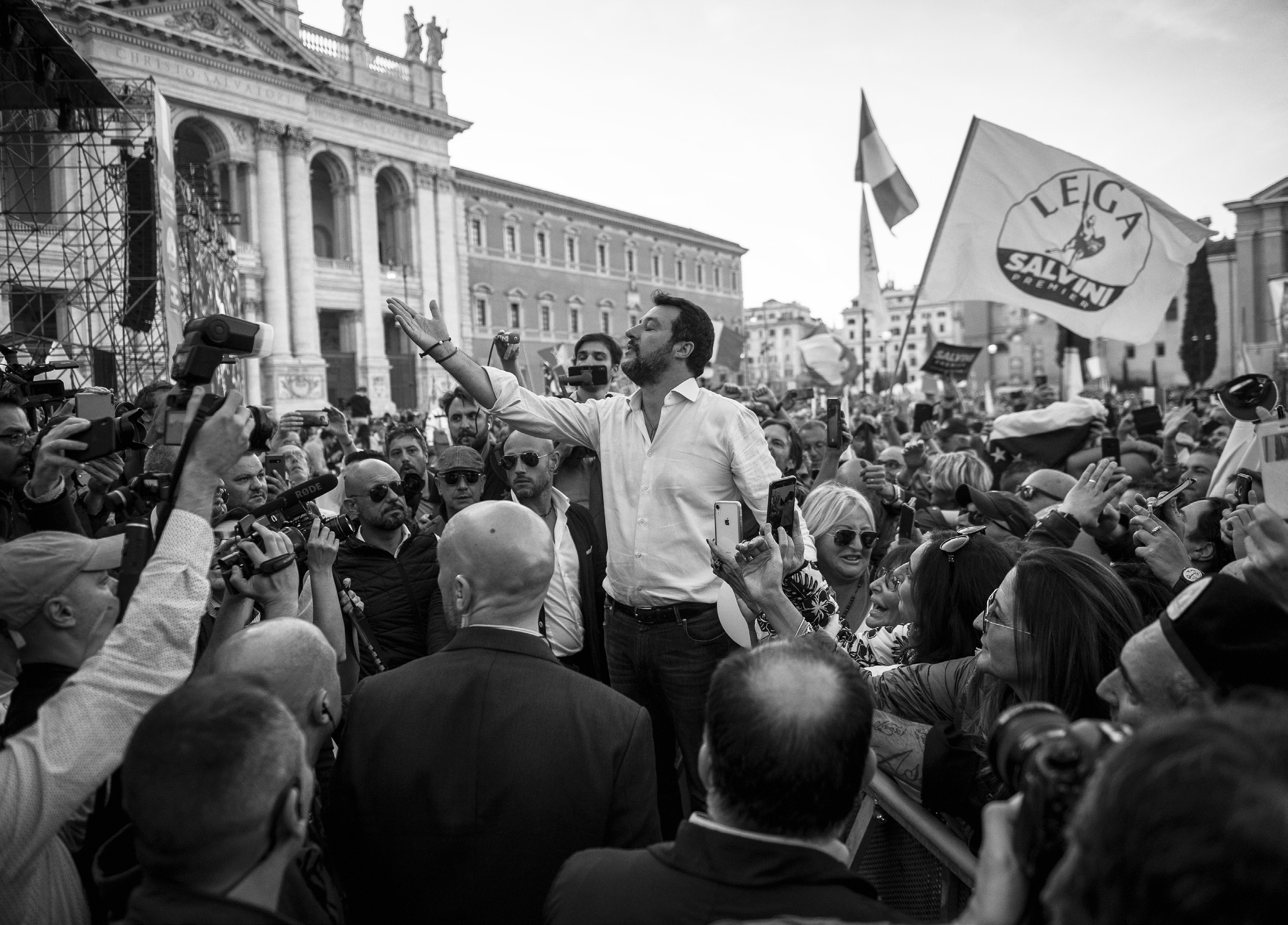
Many observers think that to win back public trust, Italian media might have to go back to basics.
Lorenzo Pregliasco, co-founder of polling and communications consultancies Quorum and YouTrend, is among those who think the media have to fix some bad habits to be more credible. “I think the media can improve in doing the job people expect them to do,” he said. They need to avoid publishing “unverified stories, fabricated quotes and fabricated interviews”.
Some of these are widely accepted practices. A few depend on a lack of journalistic rigour – it’s not unusual for newspapers to use edited or fabricated quotes in headlines to sum up somebody’s position. In some cases, they opt for clickbait headlines, hasty production and verification, and poor judgment. For example, it’s common for newspapers across the political spectrum to republish unbalanced and unfiltered clips from Salvini’s Facebook Live broadcasts.
“We have been carrying around many of these problems for a very long time,” said Arianna Ciccone, co-founder of the International Journalism Festival in Perugia. “There has never been a ‘golden age’ of Italian journalism in this sense.”
She says that fixing these bad practices would be the best place to start to address both low trust levels and attacks plaguing Italian media. “The true defensive weapon against politicians’ attacks [on the media] is quality journalism,” she said, defining “quality journalism” as accurate, in-depth and transparent reporting. This appears to be a low bar. “Simply verifying a story before publishing is quality journalism,” she added.
Bianchi, of Vice Italy, agrees. To fight back against attacks and attempts to discredit reporters, “we must work upstream”, he said. “We must be credible and be perceived to be.”
Improving the standard of journalism in Italy wouldn’t by itself prevent the macho behaviour of people such as Salvini. But it would make it harder for the media to be such an easy target for populists.
A few outlets, such as Il Post, have carved out their niche around more sober headlines and factual reporting, but their reach remains limited compared with the mainstream press.
And while scale and financial constraints make it hard for Italian publications to emulate the journalism produced by The Guardian or The New York Times, Ciccone believes Italian media could be inspired by smaller operations that produce accurate in-depth reporting around the world – she cites Mother Jones and ProPublica in the USA and Mediapart in France.
Asked if anyone was going in the right direction, Ciccone replied: “There are many excellent journalists in Italy.” She named a few. Any publications? There is silence, then a nervous chuckle, then another pause. “No comment.”
Salvini: “Gets More Airtime Than Any Other Politician”
It might be hard to reconcile these words with his better-known, scornful attacks on journalists. Isn’t he the guy who praised Vladimir Putin, Viktor Orbán and Recep Tayyip Erdogan – not exactly Europe’s champions of freedom of expression? Doesn’t he have a track record of attacks on critical reporters? Doesn’t he rely on Facebook Live to bypass journalistic scrutiny?
Yet, according to reporters who have followed Salvini for years, his more “friendly” face might be as important as his strongman persona to understand his relationship with the media.
“I see two faces,” said Alessandro Franzi, a reporter who followed Salvini’s rise between 2012 and 2018 and co-wrote a book profiling Salvini titled Il Militante (The Campaigner).
“Onstage and in front of his supporters, Salvini needs to attack journalists as ‘enemies of the people’. This is the strongman face he wears at rallies or during his Facebook Live broadcasts, where he launches tirades against reporters and the “partisan” press, which he portrays as constantly attacking him. “His attacks on journalists are part of his game and the rhetoric that holds up his type of leadership.”
His authoritarian tendencies have also surfaced when he tries to condition the Italian media landscape. For example, he pushed to appoint journalist Marcello Foa, who peddled absurd conspiracy theories, including some about Hillary Clinton and Satanic rites, as head of Italy’s public broadcaster Rai.
But on the other side, Salvini has excellent ties with the media that he “has cultivated since his very early days”, according to Franzi. “Offstage, he is a leader who takes everyone’s questions because, in the end, he needs the media.”
The good relationships pay dividends. Salvini is a constant fixture on Italian TV, playing the role of man of the people, drinking wine, eating traditional food, praising Jesus and speaking plainly – so much so that people such as Bianchi argue that the media give Salvini preferential treatment.
Italy’s communications regulator Autorità per le Garanzie nelle Comunicazioni found that Salvini enjoyed more Italian TV news airtime in July 2019 than any other politician – 225 minutes. His closest competitor was the Five Star Movement’s Luigi Di Maio, who failed to reach 100.