



Abstract

In a special investigation into how authoritarian leaders are sharing tactics,
The new strategies of repression have at their heart the relentless exploitation of social media, often using state-funded troll armies to find and monitor anyone critical of the regime, its leader or its policies – and then to repeatedly belittle, bully and besmirch them.
“We have entered an environment that suggests that authoritarian regimes have placed a premium on adapting and migrating their techniques to the digital landscape… to undermine the credibility of activists and oppositionists,” said Christopher Walker, of the Washington-based National Endowment for Democracy.
There is growing evidence of what could be termed “authoritarian best practices” spreading from one country to another. Russia’s repressive crackdown on non-governmental organisations began in 2005 by Moscow labelling those organisations that received overseas funding as “foreign agents” – a term synonymous with “spy”, “traitor” and “enemy of the state”.
This tactic has since been widely copied, including by Hungary, Pakistan and China, which recently brought in strict new laws to control and restrict NGOs. Some of these tactics are also widespread in Latin America.
Russia’s use of troll armies to carry out large-scale attacks on critics and disinformation campaigns to promote Moscow have also been copied by other leaders.
In Mexico, this technique has been used for years against journalists. In June 2015, Index reported on the army of automated bots which swept in to silence dissent when President Enrique Peña Nieto’s official visit to London attracted online protests (Summer 2015, 44.02, p.127-29).
Walker said: “The speed and opacity that is associated with social media initiatives can offer well-resourced and purposeful authoritarian powers a privileged position to attack independent voices. In an era of globalisation, through the use of widespread technologies the ability to hound and intimidate activists now transcends national borders.”
A report last year from Oxford University’s Samantha Bradshaw and Philip Howard, Troops, Trolls and Troublemakers, a Global Inventory of Organised Social Media Manipulation, detailed the state funding of “cyber troops” in 28 countries, including Azerbaijan, North Korea, Iran, Turkey, Poland and Ecuador. It concluded that such methods were “a pervasive and global phenomenon” and a danger to democracy.
“When you say a lie a million times on social media, it is a fact. If you have no facts, you have no truth,” said Maria Ressa, a Filipina journalist often criticised by the government of President Rodrigo Duterte.
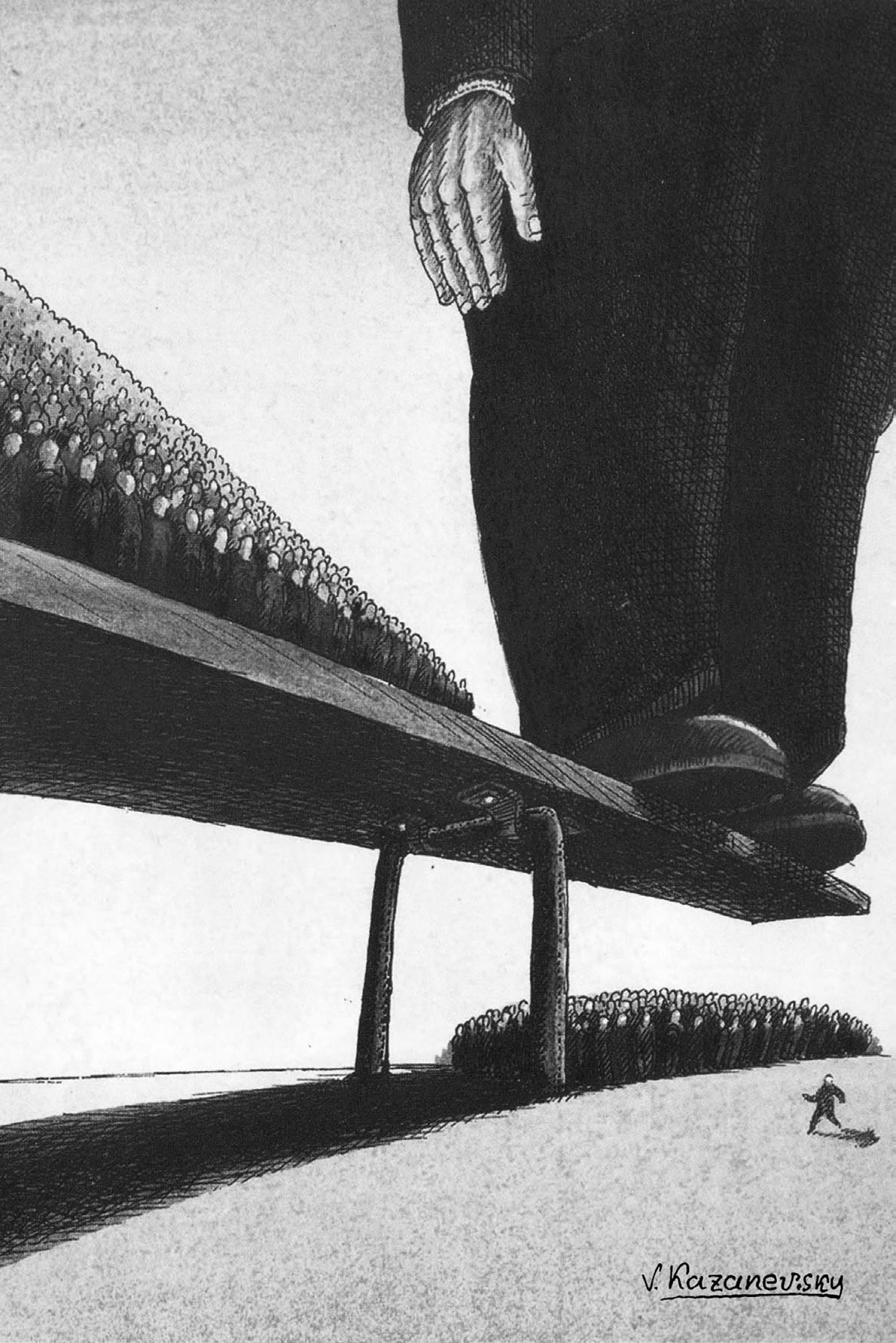
CREDIT: Vladimir Kazanevsky/Cartoon Movement
Index on Censorship’s research below shows that there are five regularly used categories of smears currently favoured by authoritarian regimes:
Accusing an opponent of working for “foreign interests”, or even spying, to undermine the state.
After initially censoring coverage of the pro-democracy demonstrations in Hong Kong, Chinese state media recently launched a series of personal attacks against leading protesters, accusing them of being traitors and of colluding with “Western agents”.
In August this year, Jair Bolsonaro, Brazil’s right-wing president, accused the head of the country’s space research agency, Ricardo Galvao, of treachery, alleging that he “worked for foreign NGOs”. Galvao was sacked after his agency reported a statistic Bolsonaro did not like - that deforestation had increased by 88% over the previous year.
In the USA, government officials have recently been accused of orchestrating a smear campaign against Alexander Vindman, a White House security adviser who gave evidence against President Donald Trump over the Ukraine inquiry. Pointing out that Vindman was born in Ukraine (he moved to the USA as a baby), Trump supporters posted that he must be a spy, with one former White House official tweeting: “Some people might call that espionage.”
The “traitor” smear has also been deployed by Hungary’s prime minister, Viktor Orbán, in particular against the Hungarian-born philanthropist, George Soros. Orbán has accused Soros – and NGOs funded by his organisation – of working for “foreign interests” to undermine Hungary’s government.
Sexualising female opponents to degrade and humiliate them has been described by Nina Jankowicz, of the Wilson Centre in Washington, as “sexualised disinformation”.
Jessikka Aro, a Finnish journalist who exposed pro-Kremlin troll factories in 2014, became a victim of their activities herself and was subjected to years of harassment online. The attacks included false claims that she was a prostitute soliciting officials from the CIA and Nato, and threats to rape and kill her. In Ukraine, doctored nude images of former Ukrainian politician Svitlana Zalishchuk appeared online after she criticised Russia.
In the USA, two far-right conspiracy theorists known for perpetuating false sexual assault claims against Trump’s political opponents recently held a press conference to accuse Elizabeth Warren, a Democrat presidential candidate, of an affair with a former marine 40 years her junior. Meanwhile, Democrat congress-woman Katie Hill resigned after nude photos of her were leaked and published in the media.
A label to create fear and undermine opponents. Since 2013, the Turkish government has waged a campaign against cleric Fethullah Gülen, President Recep Tayyip Erdogan’s political rival, by claiming he runs an “armed terrorist network” with links to the CIA. According to documents provided to the Robert Mueller 2016 US presidential election inquiry, a lobbying firm owned by former Trump national security adviser Michael Flynn was contracted to dig up damaging information about Gülen, who lives in self-imposed exile in the USA. In November 2016, Flynn authored a comment article in The Hill, describing Gülen as “a shady Islamic mullah” and “radical Islamist”.
Ethiopia has invoked the country’s anti-terrorism laws against critics numerous times. Five journalists who had been reporting on human rights violations are currently being held on terrorism charges, although no evidence has yet been brought against them.
For the past three years, Maria Ressa, founder of influential news site Rappler.com, has been attacked and criticised by the Philippines government in the media, online and in the courts. Ressa has been accused of trying to overthrow the government and being a foreign agent, and has been charged with 11 separate offences under the country’s tax evasion, cyber-libel and anti-dummy laws. She has also been trolled on social media, with allegations that she has links to the CIA, among many other claims. Ressa believes the personal attacks against her are linked to reports by Rappler that more than 20,000 people had been killed in the government’s war on drugs – a number four times higher than the official figure.
In 2011, the Chinese government arrested and imprisoned the activist and internationally-renowned artist Ai Weiwei for 81 days before charging him with tax irregularities. He claimed the charges were politically motivated.
This range of smears and insinuations has long been used as a propaganda tool.
Once these allegations are made via social media they can become permanently associated with the name of the accused. They have been regularly used in Russia against government critics. In 1997, the historian Yuri Dmitriyev uncovered human remains in a forest in Russia’s northern Karelia region which provided the first evidence of mass executions during Stalin’s Great Terror in the 1930s. At first, local authorities acknowledged the discovery and erected memorials to the thousands believed to have been killed there. But in 2016, as the site and Dmitriyev gained international attention and President Vladimir Putin sought to rehabilitate Stalin’s reputation, official attitudes changed. Within months, the 63-year old historian was charged with child pornography and imprisoned. The charges were dropped in 2018 due to a lack of evidence, but weeks later he was arrested again and charged with sexual assault. He is currently awaiting a second trial.
Dmitriyev’s case is not unusual in Russia. In September this year, anonymous posters claiming that Andrey Rudomakha, an environmental activist and government critic, was a “paedophile” were posted around the city of Krasnodar. The posters included photographs of Rudomakha as well as his home address.
But those making such smears can be caught out. In Poland, deputy minister of justice Łukasz Piebiak resigned after recordings emerged of him planning a smear campaign to spread salacious rumours about the private lives of 20 senior judges who had opposed unpopular government judicial reforms.