




Abstract
After years of music being banned by the Houthis in Yemen, a new orchestra is attracting a squad of young women.
“This piece is part of our teaching programme,” explains Abdullah Ali al-Dubai, director of a new orchestra in Yemen, before giving the starting nod to his student orchestra of violinists, guitarists and oud players. The tone is a little off, but the phrasing is smooth.
“It’s a perfect practice piece for a young string orchestra,” the director comments humbly, smiling warmly when the piece comes to an end.
The performance may have been a teaching exercise but, figuratively-speaking, al-Dubai could also be the last of the Mohicans for his own generation – namely, a member of the 1970s Yemeni national orchestra, which was disbanded in the early 1980s. Yemen once had a highly respected musical tradition but the number of performances has plummeted and concert halls remain empty. In the city of Sana’a and northern Yemeni villages, Houthi militias have regularly stormed events – even weddings – seizing instruments and placing those playing music in public under temporary arrest. They describe music as an “impure and corrupt form of expression not to be encouraged”. But for the first time in years, music is coming back to Yemen, with al-Dubai’s orchestra in Sana’a marking the re-emergence.
What started with just 10 students a year ago has already grown to a 40-strong squad, all of whom are keen to exercise their musical free expression. But they still encounter harassment when out in public. Fourteen-year-old Ahlam Abdul Wahab, who grew up being ridiculed on the streets, has found a refuge in the orchestra.
“If people catch sight of my violin in its case when I’m out, they insult me. They hiss and yell, ‘Hey girl, you there with the oud, why don’t you come and play at my wedding?’ I hate them but there’s nothing I can do about it.”
When she goes to music lessons, Abdul Wahab has to hide her violin in a bag for fear of being attacked. Her love of music has become a battle of wills – a personal civil war in war-torn Yemen. “I play and I want to learn to play for a variety of reasons. The first one is to rid Yemeni society of the idea that musicians are servants, from the lowest classes of society. It’s a belief we’ve carried with us, especially in northern Yemen, since the rule of the imams, before the republic and after Ottoman rule. The second is that it’s [seen as] immoral for girls to play music – this is not true. My family and the musical director are both behind me and are proving that we can.”
Al-Dubai, who is proud of the fact the orchestra has many women in it, said: “[Women] have the potential to bring great change to society. The more women receive musical training, the more men will be affected by their enthusiasm. Music is an instrument of peace and we need peace in Yemen. Peace alone.”
How has al-Dubai managed to escape the Houthis’ grip? He says a deal was struck a year ago in which he was allowed to run the orchestra as long as it never gave public performances, and it operated only in the academy, inside the courtyard of the academy or at home. This compromise, for al-Dubai, is currently his only option if he wants to play and teach music.
“It’s a big, unexpected, amazing step,” he said of the orchestra’s growing success, adding that about 50 people are applying to join the orchestra each year – a significant number for Sana’a.
Still, al-Dubai is nostalgic for the days of old.
“I grew up a musician in the Yemen of Ibrahim al-Hamdi and was in a band called Ibrahim Mohammed al-Hamdi. For six long years, we were trained by musicians from North Korea. They had all studied at the institute and taught us everything they knew about western music,” he said.
Al-Dubai smiles contentedly at the memory. “There were 27 of us – 25 men and two women. Television was black and white. We toured the whole country and played in every province because the television didn’t reach beyond Sana’a. International tours followed soon after. We even went to the United States.”
Glimpses of these golden years are captured in the pictures taken by photographer Abdulrahman al-Ghabri.
“I was a personal friend of the blind poet Abdullah al-Baradouni,” al-Ghabri told Index. “I toured with the national orchestra, I photographed the great vocalist and oud player Ali al-Anisi. They were different times: we were free to express ourselves, to live according to the traditions of our culture. But this all changed after the 1970s.”
For al-Dubai, life without music is not only sadder, it is less hopeful, and hope is in desperate need in Yemen right now. There is hope among his students, though.
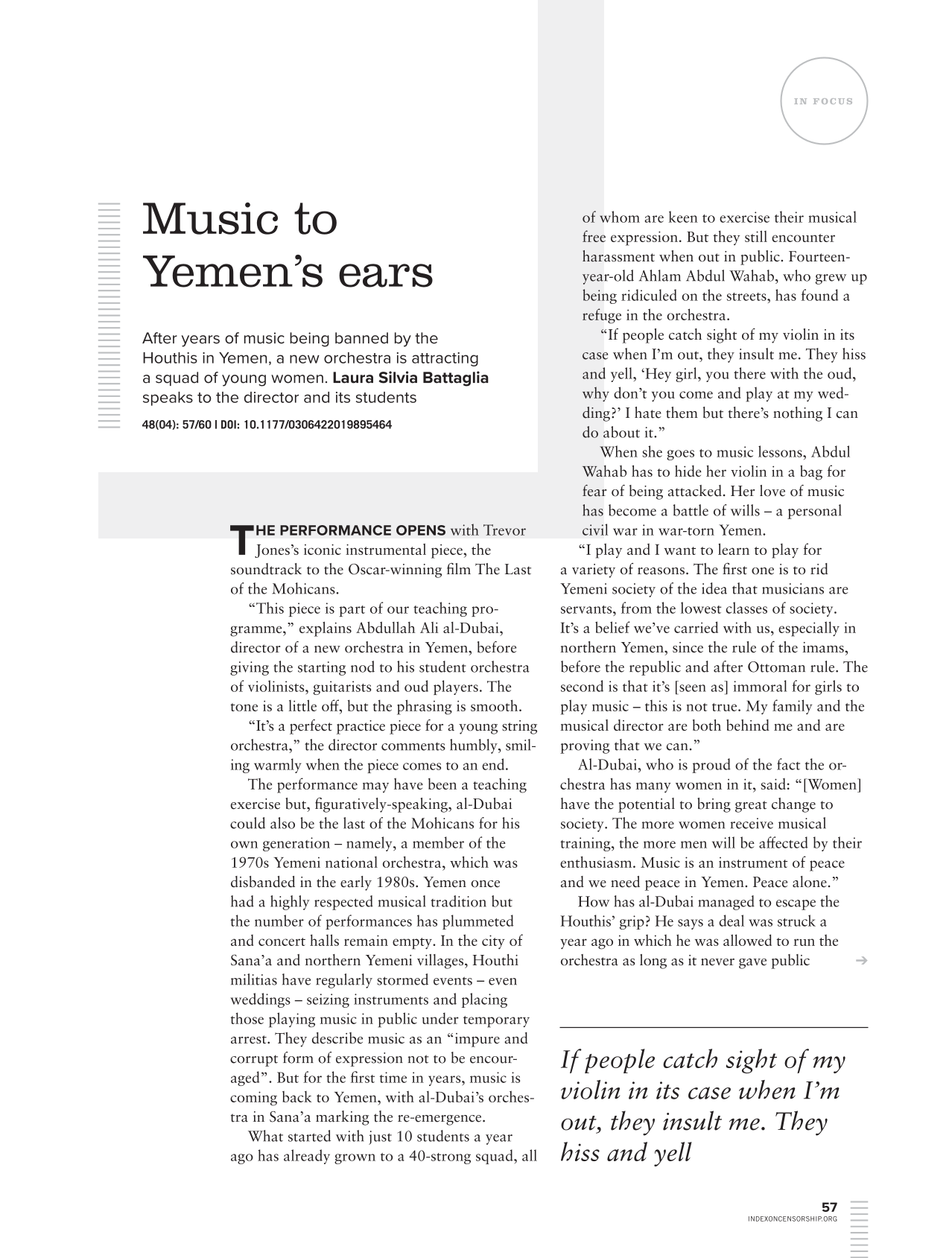
A student in Abdullah Ali al-Dubai’s new orchestra, who are forbidden from playing in public, practices the traditional oud
CREDIT: Mohamed Al-Sayaghi/Reuters
Mohammad Sultan al-Yousifi, who sees himself as both a poet and a musician, said: “The director al-Dubai has gone to great lengths to set up the orchestra. We want to pick up the baton and grow Yemeni music until we can perform it in public. So what if we can’t do it now? In the future we will: for now, it’s important to prepare the ground.”
Fairuz Dhaif Allah agrees with her younger colleague. At 40, she’s the only adult female in the orchestra and the music school has been a breath of fresh air for her.
“I studied music when I was young. I learned to play the piano. Then I married, I had children and all sorts of things happened to the city. Ironically, the war now offers us this glimmer of hope. I play oud in this tiny orchestra. In part I enjoy it and in part I think that you have to start from the little things to counter the ignorance and sexism of our society.”
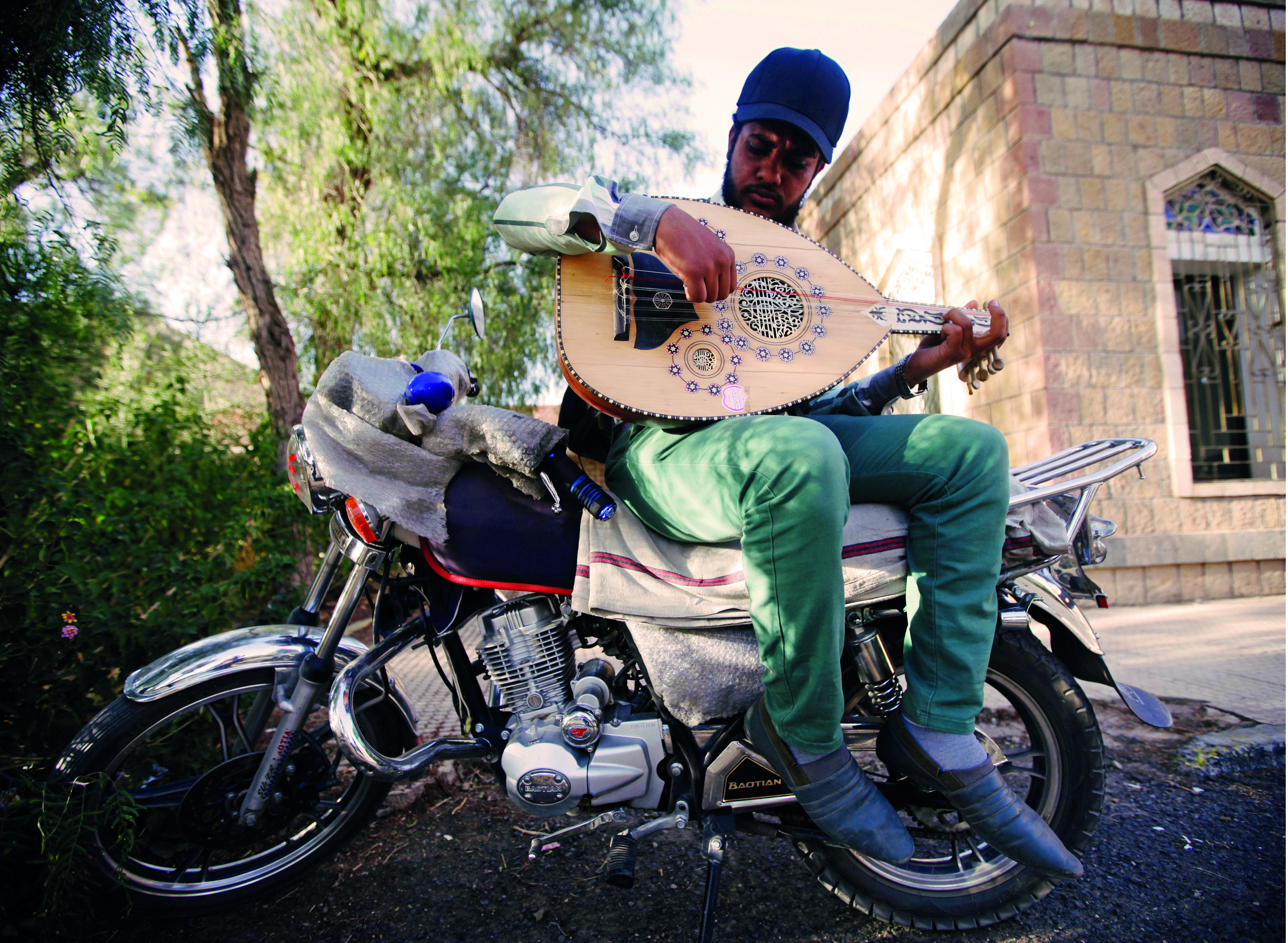
Yemeni girls, part of Abdullah Ali al-Dubai’s orchestra, play guitars at the cultural centre in Sana’a
CREDIT: Anadolu Agency/Getty
Al-Dubai’s ambitions don’t end here. He wants to make sure that other kinds of music, not just classical, become accepted. And he already has people who want to channel this vision.
Ahlam’s 13-year-old sister would like to learn freestyle. Her inspiration is Yemeni rapper Amaani Yahya, who rose to fame as a teenager during the Arab Spring of 2011 and now lives in exile in the USA. In order to become even remotely as famous as her hero, Ahlam’s sister has learned how to improvise on the keyboard.
“But the next step is to get away from here, just like Amaani,” she told Index.
Maybe exile won’t be needed if orchestras such as al-Dubai’s rise in prominence and put music back on Yemen’s map.
Footnotes
Translated by