Abstract

Analysts believe the situation in Western Sahara may soon escalate but, as
Today, Hamudi works as a freelance journalist based in Spain and is part of the Sahara Press League, which integrates Saharawi journalists based in Europe to allow them to “be ambassadors of a conflict we want to be known”, as Hamudi told Index.
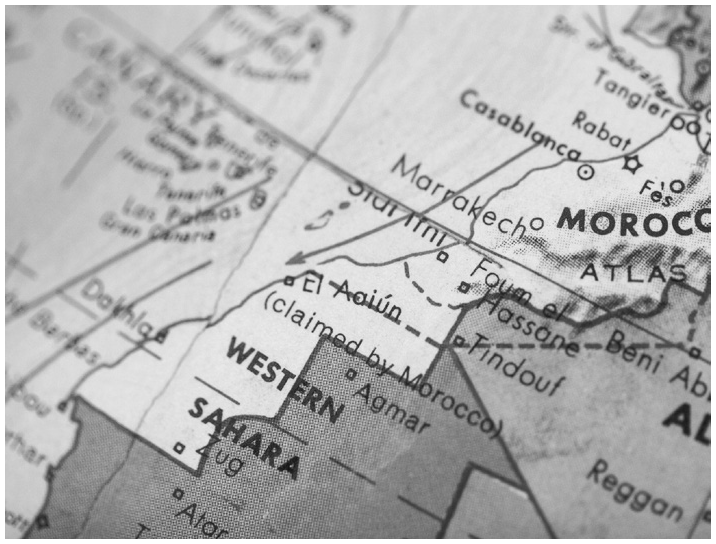
There is very little known about what is happening in Western Sahara, which is a disputed area mainly controlled by Morocco and bordering Algeria and Mauritania. A report that came out this year from the Spanish branch of Reporters Sans Frontières, called Western Sahara: A Desert for Journalists, warned about the information-drought in the territory.
A map showing part of north Africa, including Morocco and Western Sahara
CREDIT: Chris Pecoraro/iStock
“There are no independent media nor Saharawi journalists recognised as such by the Moroccan authorities,” the report said.
Thus, the struggle for the establishment of borders and the control of the territory has resulted in the absence of freedom of expression and the press. “Morocco does not want to talk about Western Sahara, and every time a Moroccan journalist tries to report on it, he is dismissed and prosecuted for attacking national integrity,” Alfonso Armada, president of RSF Spain, told Index. “In addition to the artificially drawn geographical borders, a border of silence has been established.”
The instability of Western Sahara dates back to 1976, when Spain left the area after more than a century of colonisation. After Spain’s withdrawal, it was initially split between Morocco and Mauritania. In 1979, Mauritania withdrew, abandoning its claim, but Morocco immediately claimed the whole territory. Today, it is divided between areas controlled by Morocco and those controlled by the Polisario Front, the national liberation movement wanting independence for the Saharawi people. As of December 2017, nearly 175,000 Saharawi refugees were living in camps in Tindouf, Algeria, according to figures from UNHCR, the UN Refugee Agency.
In addition, Western Sahara is divided by an earth wall, called the Berm, with barbed wire fences and guards. At 2,700km, it is one the largest walls in the world and was built by Morocco during the 1980s to contain the Polisario.
The area now exists in a kind of stalemate policed by the United Nations. During Morocco’s King Mohammed VI’s 20-year reign, four UN special representatives for the Sahara have resigned without resolving the conflict, despite the fact that the UN defends the right to self-determination in Western Sahara.
That’s why, according to recent reports in the Wall Street Journal, US President Donald Trump’s security adviser, John Bolton, has condemned the UN’s lack of success and thrown his weight behind a “contentious” plan “turning the screws on the UN and trying to force the rival parties to cut a deal”. That deal, according to the WSJ, is unlikely to include a new independent country of Western Sahara. Either way, if UN troops withdraw there could be conflict in a region which has recently been relatively stable.
But because of a complete lack of freedom of the press, there is very little discussion of the situation or reporting from either side. Hamudi feels ashamed that “the situation of the press in Western Sahara is not under scrutiny as it is in Turkey, Venezuela or Saudi Arabia”. He added: “There is no freedom of expression. One cannot practise journalism. [It’s] not only Sahrawi journalists: foreign correspondents are returned to their country, and Morocco does not even allow international observers in.”
Indeed, journalism in Western Sahara is closely monitored by Moroccan authorities who, as Freedom House reflects, “ensure that reporting does not dispute Morocco’s sovereignty over Western Sahara”.
As RSF says, there are numerous cases of repression exerted by Morocco on the press – torture, detentions, persecutions, harassment, slander, technological sabotage and long jail terms.
Reporters El Bachir Khadda, Hassan Dah, Abdellahi Lakhfawni and Mohamed Lamin Haddi were arrested in 2010 while covering the Gdeim Izik protest camp in Western Sahara’s Southern Province. They are still in prison and are being prosecuted for crimes including allegations that they belonged to an armed group and caused the death of Moroccan officers through violence. The crimes they are alleged to have committed carry sentences of between 20 years and life imprisonment.
In June 2014, Mahmoud El Haissan, a television correspondent for RASD, which is based in the Tindouf refugee camps in Algeria, filmed a confrontation between pro-independence demonstrators and Moroccan security forces in Laayoune. El Haissan was later arrested at home and taken to Laayoune’s Cárcel Negra (black prison) for “belonging to an armed group, obstruction of public roads, attacks on officials in the exercise of their duties and destruction of public property”. He was sentenced to 18 months in jail and suffered physical abuse.
Foreign journalists are not free to report. In fact, as Armada highlights, foreign correspondents were expelled nine years ago, and “information on Western Sahara is very sporadic”.
In June this year, Spanish photojournalist Judith Prat was expelled from the Western Saharan city of Laayoune two hours after arriving in the city. In February, Spanish journalist Ana Cortés and her Italian colleague, Giovanni Cortceli, who were attempting to report from the border area, were arrested by Moroccan authorities, interrogated, assaulted and finally deported.
The only people still reporting from the area is Equipe Media, a group of journalists and activists set up in 2009 to break the information blockade imposed by Morocco. In order to do their job safely, Equipe Media journalists have to resort to clandestine meetings. “Laayoune is taken militarily. No journalist can access Western Sahara – we are targets for Moroccan police forces,” said Mayara. “We manage to hold our meetings in secret places or in the countryside. We also get in touch secretly with the organisers of demonstrations to know where they will take place and send our cameramen to roofs in the area so that they can film.”
No matter what, journalism proudly does its best to survive. “We are working under such conditions that we could say a new way of doing journalism has been born in Western Sahara,” said Mayara. “We understand it is hard, but we will continue reporting despite risks and threats.”
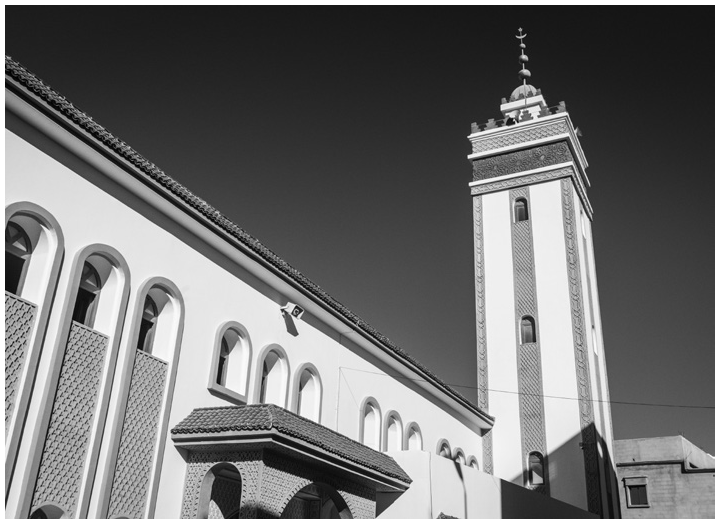
A mosque in Dakhla, Western Sahara
CREDIT: Henryk Sadura/Picfair