




Abstract

CREDIT: Robin Heighway-Bury/Ikon
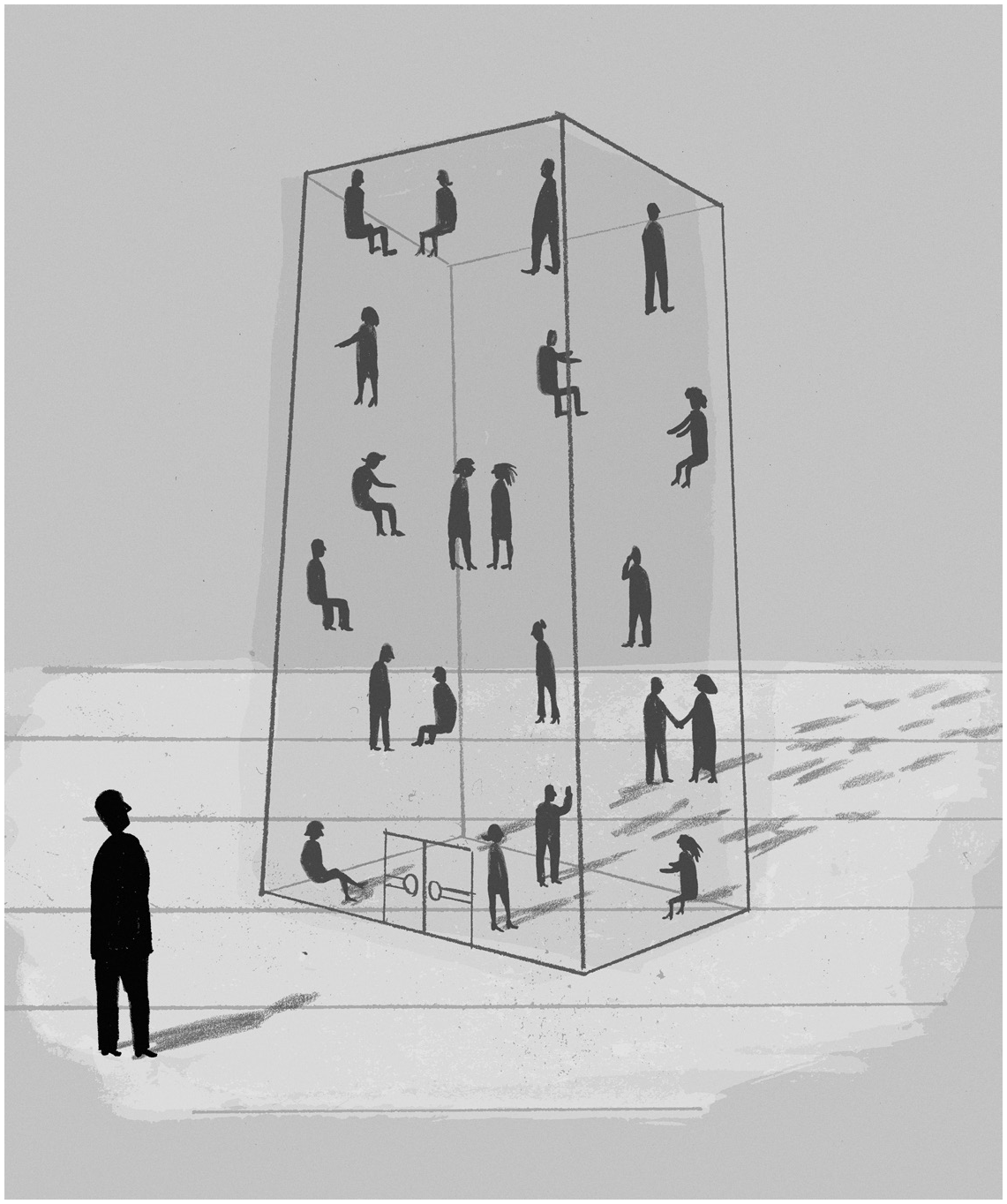
For this issue, we have taken plays by Samuel Beckett and Václav Havel, an address by Nadine Gordimer and an essay by Arthur Miller, all published in this magazine in the 1970s and 1980s, and asked contemporary writers Emilie Pine, Elif Shafak, Kerry Hudson and theatre director Nicholas Hytner to give us their reactions.
All four of the past authors were personally affected by government actions which directly threatened them and sought to curtail their freedom of expression: Beckett in Nazi-occupied France, Gordimer in apartheid South Africa, Havel in communist Czechoslovakia and Miller in the anti-communist McCarthy trials of 1950s USA.
Shafak is the only one of our contemporary writers who has direct experience of living in a country, Turkey, where writers, artists and academics are imprisoned. But all four have insights about how the impact of free speech being closed down. Pine revels in Beckett’s brilliance at portraying small gestures of resistance. While both Hudson and Hytner look at how Havel and Miller understood how the powerful distort reality to hide the truth.
Bringing Ideas Out of Quarantine
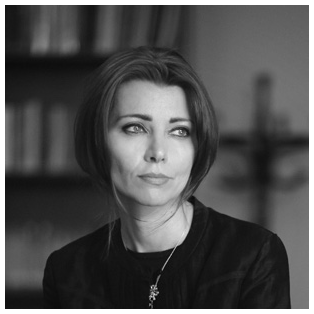
Turkish novelist ELIF SHAFAK sees parallels between the isolation from intellectual ideas NADINE GORDIMER describes in apartheid South Africa and the information bubbles of today’s digital world
Writer Elif Shafak
CREDIT: Zeynel Abidin
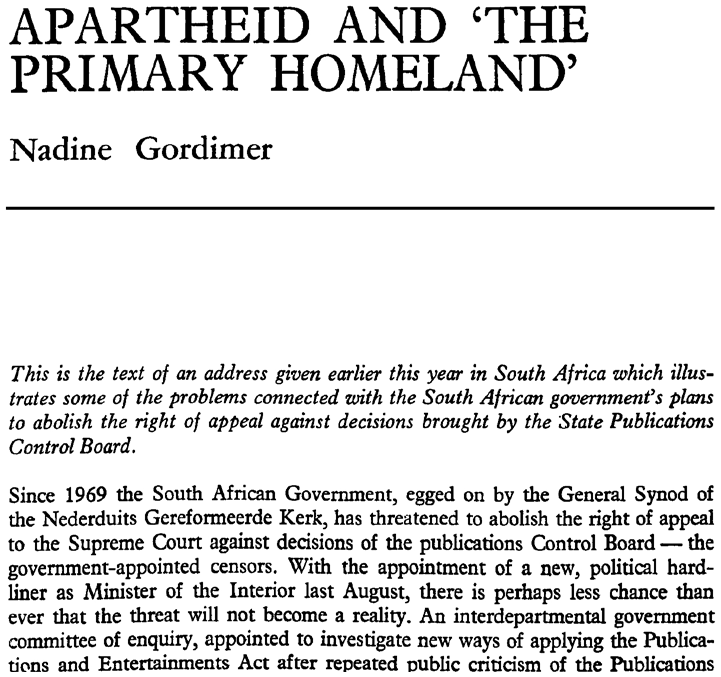
In a climate of growing fear and intimidation, there is not only top-down censorship but also a widespread self-censorship. How does censorship work as part of the grand design of systematic discrimination, human rights violations and oppression? This is the question that the brilliant writer and political activist Nadine Gordimer tackles in her address, and she does so with wisdom, courage and integrity. Although she addresses a particular moment in time and a specific location (South Africa from 1948 to the early 1990s), her words are strikingly relevant for all of us anywhere in the world today. In the age of growing populist nationalism and its next-in line, populist authoritarianism, there will be more and more writers and poets who, one way or another, find themselves dealing with censorship (or self-censorship), just like there will be more and more of us catapulted into a state of exile (or self-imposed exile).
Much has been said about what happens to the state apparatus or the structure of politics and the character of politicians under oppressive regimes. What is a bit harder to talk about is what happens to society when freedoms are lost, diversity is crushed and segregation and discrimination are institutionalised.
Yet this was the question that preoccupied many east European intellectuals such as the Polish writer and poet Czesław Miłosz. It is a question that preoccupies Gordimer as she shows how the apartheid regime permeates every aspect of daily life.
Imagine generation after generation growing up in a climate in which critical-minded artists and writers, from the Martinique French political philosopher Frantz Fanon to the Kenyan-born American academic Ali Mazrui, are either banned or silenced and a large number of books by African authors are expurgated. The thing about censorship is that it’s not only pervasive but also insatiate – unable to stop. It aims not only at books that deal with political issues but also at books that explore the complexity of the human condition, stories that promote empathy and understanding of others.
In times of apathy and lands of autocracy, empathy is often regarded as an act of defiance.
The intellectual isolation and epistemic quarantine that Gordimer observed in apartheid South Africa is not a thing of the past. In the age of digital tribes and political clans we are being pushed into “either-or” dualities and clashing certainties. Different people get their sources of information from different channels and therefore believe in alternate “realities”, while truth is being attacked and eroded systematically. We live in a world in which there is too much information, very little knowledge and even less wisdom.
Censorship, abundant information (and disinformation) and continuous apathy… they all numb us inside, little by little, day by day. We become desensitised. After a while, we do not really register the news, we just scroll up and down. After a while, numbers do not mean a thing – whether it’s 5,000 refugees or 500,000 refugees, we stop feeling the pain of others; we stop caring. And that is the most dangerous threshold.
If enough people have become sufficiently numb, upon that fertile ground authoritarian narratives can sow the seeds of all kinds of racism, sexism, xenophobia and discrimination.
Censorship succeeds not when books are banned or authors are put in prison but when readers stop reading. When people become uninterested, disconnected, desensitised. The long fight for a pluralistic, democratic and truly egalitarian future must therefore always rely on inclusion, empathy, diversity and connectivity.
APARTHEID AND “THE PRIMARY HOMELAND”
By Nadine Gordimer, September 1972, vol. 1, issue: 3-4
Nadine Gordimer (1923-2014) was a Nobel Prize-winning South African novelist and activist who, for much of her life, was engaged in the literary struggle against apartheid. Index published her articles until a few years before her death. Under apartheid, Gordimer’s novels Burger’s Daughter and July’s People were banned.
What It Is To Be Unseen
Academic and writer EMILIE PINE reflects on SAMUEL BECKETT’s play Catastrophe and the power of the silenced to face down their oppressors
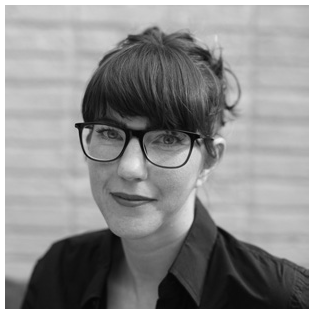
Author Emilie Pine
CREDIT: Ruth Campbell
The play consists of a lone performer (P) standing on a block, with a director (D) who orchestrates P’s movements, aided by his female assistant (A). The director’s treatment of both his assistant and the performer – “Step on it, I have a caucus”, “Down his head” – projects his total authority over them. Though set in a theatre, there are suggestions throughout the play of Beckett’s deliberate evocation of the still all-too-familiar tropes of tyrannical regimes.
D’s direction to “whiten” P’s skin implies the erasure of individual – and racial – identity; P’s pyjama costume hints that he has been taken from his home during the night, his clenched hands imply coercion; the spotlight trained upon P is reminiscent of interrogation techniques; and A’s collaboration with D illustrates the failure of solidarity between subjected groups. Most of all, D’s angry instruction that P utter “not a squeak” illustrates the enforced silencing of the subjugated “other”. Though we may have forums today that act as loudspeakers for silenced voices, this instruction still resonates chillingly for me, knowing that there are so many people for whom free speech is still an impossibility.
Throughout D and A’s deliberations about creating a spectacle of catastrophe, P stands with head abjectly bowed, enduring their manipulations and derogations. And at the end, as recorded applause begins, it seems as if P has indeed been obliterated in the quest for catastrophe.
Yet the protagonist does not submit. Instead, at the end of the play he “raises his head” and “fixes the audience” with his gaze. In response, the applause “falters” then “dies”. P is victorious in his disruption of both the spectacle of his suffering and the director’s power.
Perhaps most revolutionary for me, and still relevant today, is the power of the attention that P commands at the end. In Beckett’s first play, Waiting for Godot, the character Vladimir appeals to a witness: “Tell him… [He hesitates]… tell him you saw us. [Pause.] You did see us, didn’t you?”
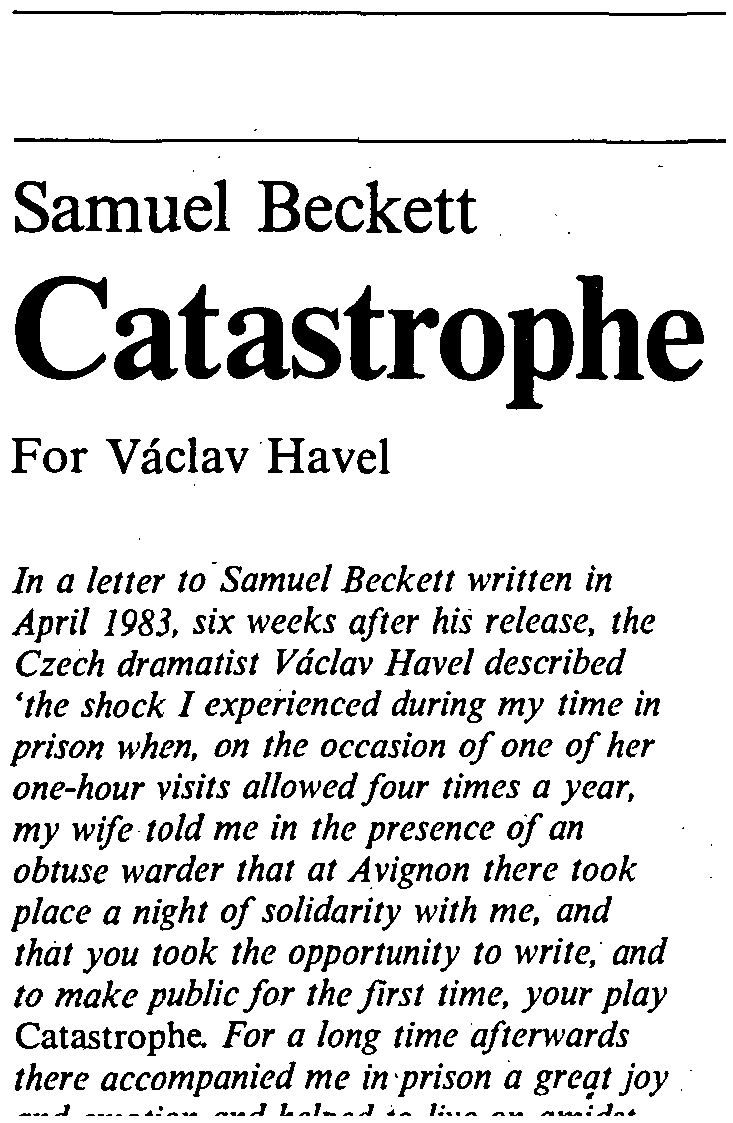
This painful demand resonates throughout all of Beckett’s theatre work as he stages the human need to be seen and validated by an external witness.
This is what P requires at the end of Catastrophe. The attention of the audience not only recognises the necessity of resistance to tyranny, but the equal necessity of witnessing acts of resistance. Beckett’s play gave Havel, cloistered and invisible in prison, the strength to endure because it revealed to him that he was not unseen. In witnessing Havel and the unnamed “P”, Catastrophe illustrates the vital role of engaged and active audiences who applaud not the catastrophe but the act of resistance.
This play is not a historical document. Although the world today is different to the one that Beckett used as his backdrop, the global stage is still marked by oppressive regimes that silence those who dare to have a different point of view.
The solidarity that is unavailable to P during the play may, however, be granted these days through the work of magazines such as Index, organisations such as Amnesty, and the simple power of embodied and digital connections that we have seen change systems. It is only through this kind of work, through speaking out and listening when others speak out in turn, that we can create spaces in which both the individual and the collective can be witnessed, and can act as witnesses.
CATASTROPHE: FOR VÁCLAV HAVEL
By Samuel Beckett, February 1984, vol. 13, issue: 1
Samuel Beckett (1906-89) won the Nobel Prize in Literature in 1969. The Irish playwright and critic is best known for his plays Waiting for Godot, Endgame and Krapp’s Last Tape as well as his novel Molloy. He wrote in both French and English and spent much of his life in France.
We Are Still Tempted
Novelist KERRY HUDSON considers VÁCLAV HAVEL’s play Temptation and what it says to us today
Author Kerry Hudson
CREDIT: Nick Turner
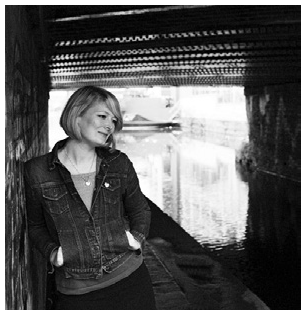
Years after leaving prison, he was seized to write the play within 10 days, after which he descended into two days of extreme sickness.
In 2019, the play resonates as it must have when it debuted in 1986. Certainly, it helps that Havel modelled his own Faust, Foustka, on his personal experience so that even as he duplicitously tries to squirm himself out of one corner into another, he is empathetic, flawed and deeply relatable.
Havel had stated that his was a play about choices. Foustka’s choice is whether to carefully dance (often literally at work socials) around the banal, narrow-minded, double-think of the Institute of Science at which he works, or to go over entirely to the black magic offered by the Mephistopheles-like character, Fistula.
Perhaps the most interesting aspect of reading this play on the page is how Havel crafts his language to replicate the structural confines that each “choice” represents to Foustka. Where the institute scenes feature long, pointless speeches, multiple repetitions, frequent jostling for position and status, the scenes where Foustka converses with Fistula are concise, witty and often cuttingly cruel.
As a woman reading this play decades later it would be remiss of me not to say that the depiction of women within this regime is very much through Havel’s unrelenting male gaze. A female scientist who, though wearing a white coat, spends most of the scenes at the Institute looking into a compact. A young secretary who is used as a sexual foil is then cast out. Even Vilma, Foustka’s partner, spends much of her time running around in a lace negligee begging to be subjugated and beaten for sexual pleasure. Perhaps the intention was to show that women will always end up the worst off and even a totalitarian regime is still, essentially, a man’s world, but this aspect aged far less well than the rest of the narrative which feels, sadly, timelier than ever.
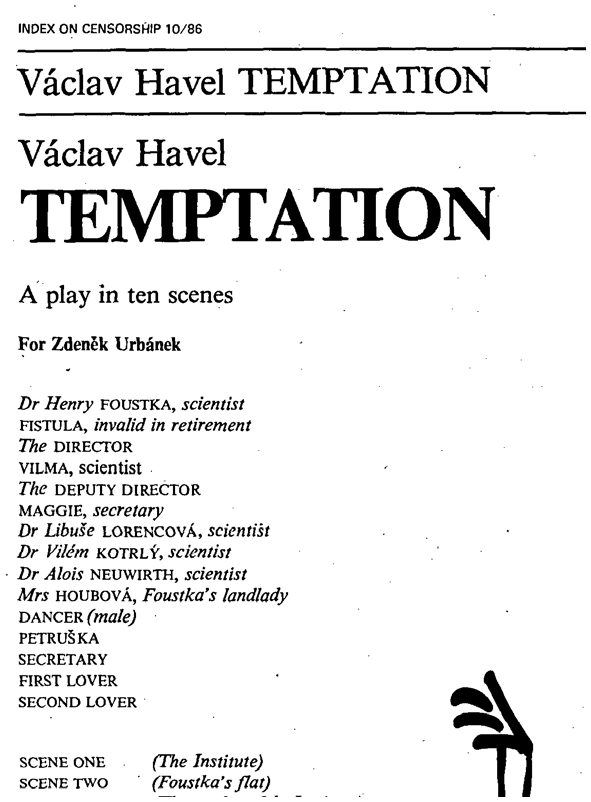
Of course, there is no real choice for Foustka and it emerges that, in fact, the Director of the Institute has been working with his “friend of long standing”, Fistula, all along. The machinations of power were always bigger than Foustka, no matter what freedoms he naively assumed.
As Boris Johnson becomes the leader of the Conservative Party and UK prime minister without a general election and US President Donald Trump nods happily along to baying cries of “send them home” at rallies, one can’t help thinking that we must have invoked the devil ourselves, and with the help of Haajah, “the spirit of politics”, that we too have been robbed, or given up, all of our assumed choices just like Foustka.
TEMPTATION: A PLAY IN 10 SCENES
By Václav Havel, November 1986, vol. 15, issue: 10
The Czechoslovakian playwright and poet Václav Havel (1936-2011) was also a political dissident under communism, and spent four years in prison for his work. He was often published in Index magazine. In 1989 he led the Velvet Revolution and became president of Czechoslovakia in December that year
There is Worse to Come
NICHOLAS HYTNER believes ARTHUR MILLER was more optimistic about the powerful than Shakespeare, who better understood the ways of today’s populist leaders
Theatre director Nicholas Hytner
CREDIT: Dave J Hogan/Getty
We have regressed.
In William Shakespeare’s Julius Caesar, the “great mass” of the Roman people are suckers for the powerful.
“The sin of power,” writes Miller, is “to convince people that the false is true”.
Caesar refuses the crown three times. The Republican elite knows what he’s up to. One of them dismisses the mob’s applause with contempt: “If Caesar had stabbed their mothers they would have done no less.”
To be fair, Caesar doesn’t make this claim on his own behalf, unlike US President Donald Trump who boasted during the 2016 election campaign that he could shoot somebody in the middle of Fifth Avenue without losing any voters.
The attachment of the Roman senators to their institutions is fiercer than our own. To protect their ancient privileges they murder Caesar, persuading the incorruptible Brutus to lead them. Some of them want to murder Caesar’s cheerleader, Mark Antony, too, but Brutus – who wants the conspirators to appear “to the common eyes” as purgers, not murderers – won’t have it. Convinced of his own rectitude, he goes on to allow Mark Antony to speak after him at Caesar’s funeral. It does not occur to him that “reality is quite simply the arena into which determined men can enter and reshape just about every kind of relationship in it”.
Brutus’s funeral oration, which celebrates Caesar as it justifies his assassination, is rational and rhetorically impressive. But when he cedes the stage to Mark Antony, a fabulous storyteller, he is routed.
“I am no orator,” says Antony, “but, as you know me all, a plain, blunt man.” It’s the least of his fabrications. He describes Caesar’s murder in thrilling, gory detail, though he doesn’t let on that he wasn’t there to witness it. He produces Caesar’s will and promises every Roman a handout of 75 drachmas. Whatever it takes. UK prime minister Boris Johnson promised £350 million a week for the National Health Service as a Brexit dividend. He’s an enthusiastic student of Shakespeare, so he’ll know that the 75 drachmas never materialises. Job done, Antony has Caesar’s will altered: he needs the money to wage civil war.
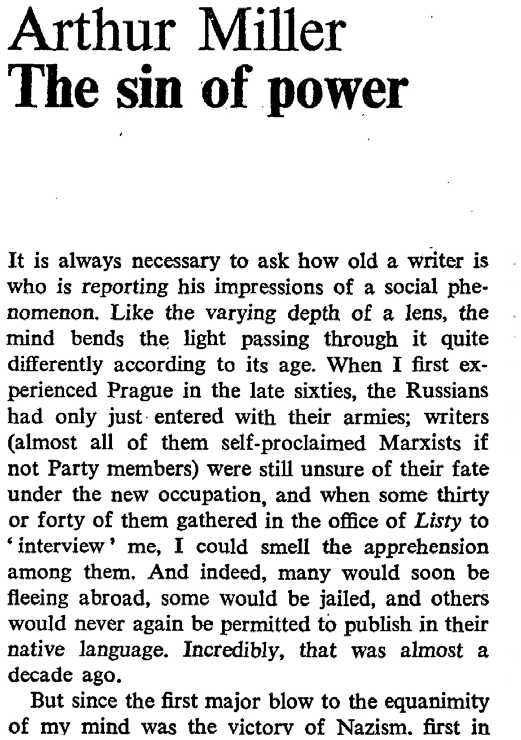
The heirs of Mark Antony (heirs at least of his dishonesty, demagoguery, narcissism and sexual incontinence) are in charge now. It is they who, in Miller’s words, “distort and falsify the structures of reality”.
Shakespeare offers no quick fix. One of the Roman plebeians predicts that after Caesar’s violent death “there will a worse come in his place”, which is spot on: the collapse of the Republic ushers in centuries of imperial despotism. Scepticism towards the powerful turns out to be less widespread than Miller hoped. Power has found a way of disguising itself, particularly online. Maybe somebody will work out how to respond with stories as good and as gripping as Antony’s – stories that seek not to reshape reality but to explain it, stories that acknowledge the myriad conflicting claims on the world as it is.
THE SIN OF POWER
By Arthur Miller, May 1978, vol. 7, issue: 3
American playwright Arthur Miller (1915-2005) wrote All My Sons, the Pulitzer Prize-winning Death of a Salesman, and The Crucible. Many of his plays were turned into Hollywood films. In 1956 Miller was called before the USA’s House Committee on Un-American Activities but refused to name any alleged communist writers. He was convicted of contempt but appealed and won.
Footnotes
Additional research by