



Abstract

Twenty-one years after the signing of the Good Friday Agreement – which was supposed to herald a bright and peaceful future – questions abound about Northern Ireland’s democratic deficit.
“The poison of the past is a toxic influence on the politics of the present, and always will be, unless we can honestly face up to what happened,” said journalist Anne Cadwallader, author of Lethal Allies: British Collusion in Ireland, a book using historical documents to show how part of the British army and the Royal Ulster Constabulary worked with extreme loyalist gangs, leading to the killings of around 120 people in counties Armagh and Tyrone in the 1970s.
Loyalists in Northern Ireland want to stay part of the United Kingdom rather than joining with the Republic of Ireland. The term is often used to describe those who are prepared to use, or support, violence.
Cadwallader added: “The battle has now moved from bombs and bullets to conflicting versions of history.”
Some 36% of 18-to-30-year-olds surveyed earlier this year said they had no trust in the Northern Ireland Assembly, according to a report from the British Council, while only 2% had “complete trust”.
The assembly – set up as part of the 1998 Good Friday Agreement reached by Northern Ireland’s politicians and the British and Irish governments – has been suspended since 2017 after a row between the two main parties over a £490 million overspend of public funds.
Kieran McEvoy, a professor of law and transitional justice at Queen’s University Belfast, told Index that the failure to deal with history played no small part in corroding public confidence in political institutions.
One way information about that history is now coming to light is through testimony to public inquests. But these are not always straightforward, and are limited in scope.
When Democratic Unionist Party leader Arlene Foster was first minister, she tried to block a plan to complete inquests into 94 controversial deaths dating back to The Troubles within five years. The High Court ruled in 2018 that she was acting unlawfully, and the decision was overturned.
“Actions like Foster’s corrode trust between political parties and make it difficult for republicans to sell to their constituents – who are putting on the pressure around legacy inquests – continued power-sharing with the DUP,” McEvoy said.
However, the single biggest frustration to legacy issues is the British government’s continuing obfuscation over the role of the state in the conflict, Cadwallader says, with a tactic of “deny, delay and die”.
Ciarán MacAirt (centre) from the Time for Truth campaign announces a march in June 2019 to demand funding for further inquests into those killed during the Troubles, a period of conflict in which an estimated 3,700 were killed
CREDIT: Rebecca Black/PA

“Deny what happened; when evidence emerges delay proceedings through the courts and so on; and hope that, eventually, those people who lost loved ones during the conflict will just die.”
Families – along with journalists, academics and campaigners – have endeavoured over the years to uncover the truth, sometimes with great success. They rarely do this without coming up against the British Official Secrets’ Act or being stonewalled by the “security veto”, where information is denied on national security grounds, or by finding that important documents have been lost or destroyed in suspicious circumstances.
“It was a pretty dirty war, and a lot of wicked stuff happened in terms of state torture, collusion and all the rest of it, so there are elements of the military and security establishment that are not keen for that past to be exposed,” McEvoy told Index. “The British state has done a lot to undermine legacy-related work, and that’s been most obviously manifest in the failure to have a public inquiry into the Pat Finucane case.”
Pat Finucane was a Belfast solicitor who challenged the British government in the 1980s over human rights issues. His most famous client was the Irish Republican Army hunger-striker Bobby Sands, who achieved international publicity for the republican cause by demanding that he and others should be treated as political prisoners.
But Finucane was murdered by loyalist paramilitaries in 1989, with several subsequent investigations suggesting they were supported by the British security forces.
In 2012, UK Prime Minister David Cameron apologised to his family for the “shocking levels” of British state collusion with loyalist parties in his killing, as revealed in the Pat Finucane Review, headed by barrister Desmond de Silva. And in February 2019, the UK Supreme Court ruled that the investigation into his murder was ineffective and didn’t meet human-rights law standards. But despite these findings, no full public inquiry to get to the bottom of the murder has been authorised by the government. Indeed, back in 2011, Cameron reportedly told the Finucane family that “people in buildings all around here,” gesturing around Downing Street, “won’t let it happen”.
Researchers attempting to discover the truth about past actions say they find obstacles in their way. Last year, a record number of historical documents were withheld by the British security forces, including documents relating to Finucane’s murder.
Setbacks for affected families have only increased since the Historical Enquiries Team, a unit of the Police Service of Northern Ireland, tasked with investigating unsolved murders, was closed down in 2014 because of budget cuts. Cadwallader says that although the HET was imperfect, she could not have written Lethal Allies without it. “It was a unique experiment that’s unlikely to be repeated because what we got was so damning,” she said. “We lifted a corner of the carpet and they are now trying to nail it down forever.”
Nailing down the carpet was perhaps the intention when the police arrested Belfast journalists Trevor Birney and Barry McCaffrey in August 2018 for their work on No Stone Unturned. The award-winning documentary examined state collusion in the 1994 Loughinisland massacre, when members of the loyalist Ulster Volunteer Force killed six civilians and wounded five others in a pub in County Down. More than 100 officers turned up at the journalists’ homes accusing them of document theft, under the UK’s Official Secrets Act. Charges were dropped in June.
In order to deal properly with the legacy of Northern Ireland’s troubled past, all sides must be more open, Cadwallader adds, and that includes the Irish government and paramilitaries.
On the non-state side, a reluctance to open up “is down to risking political leverage, protecting political careers, and reputational damage”, Anthony McIntyre, a former IRA man imprisoned for the murder of a member of the UVF in 1976, told Index.
McIntyre was a lead researcher on an oral history project at Boston College, in the USA, that collected testimonies from former republican and loyalist paramilitaries on the condition that they would only be made public after their deaths. “We were conscious that without the retrieval and preservation of historical material, valuable material would be lost to posterity,” he said.
The British government and the Northern Irish police used subpoenas and the US court system in attempts to access the archive, and in October 2018 the UK’s High Court ordered that McIntyre’s interviews be handed over. He is currently taking an appeal to the UK Supreme Court. He says the actions of the state have “limited understanding of the conflict” and have suffocated the ability of future historians and researchers. “It also puts police in charge of what society will know about major areas of activity that is deemed illegal.”
Nichola Corner, sister of murdered journalist Lyra McKee, at the end of a three-day peace walk from Belfast to Derry. Speakers called on politicians to come together to resolve differences and restart the Northern Ireland Assembly
CREDIT: Liam McBurney/PA
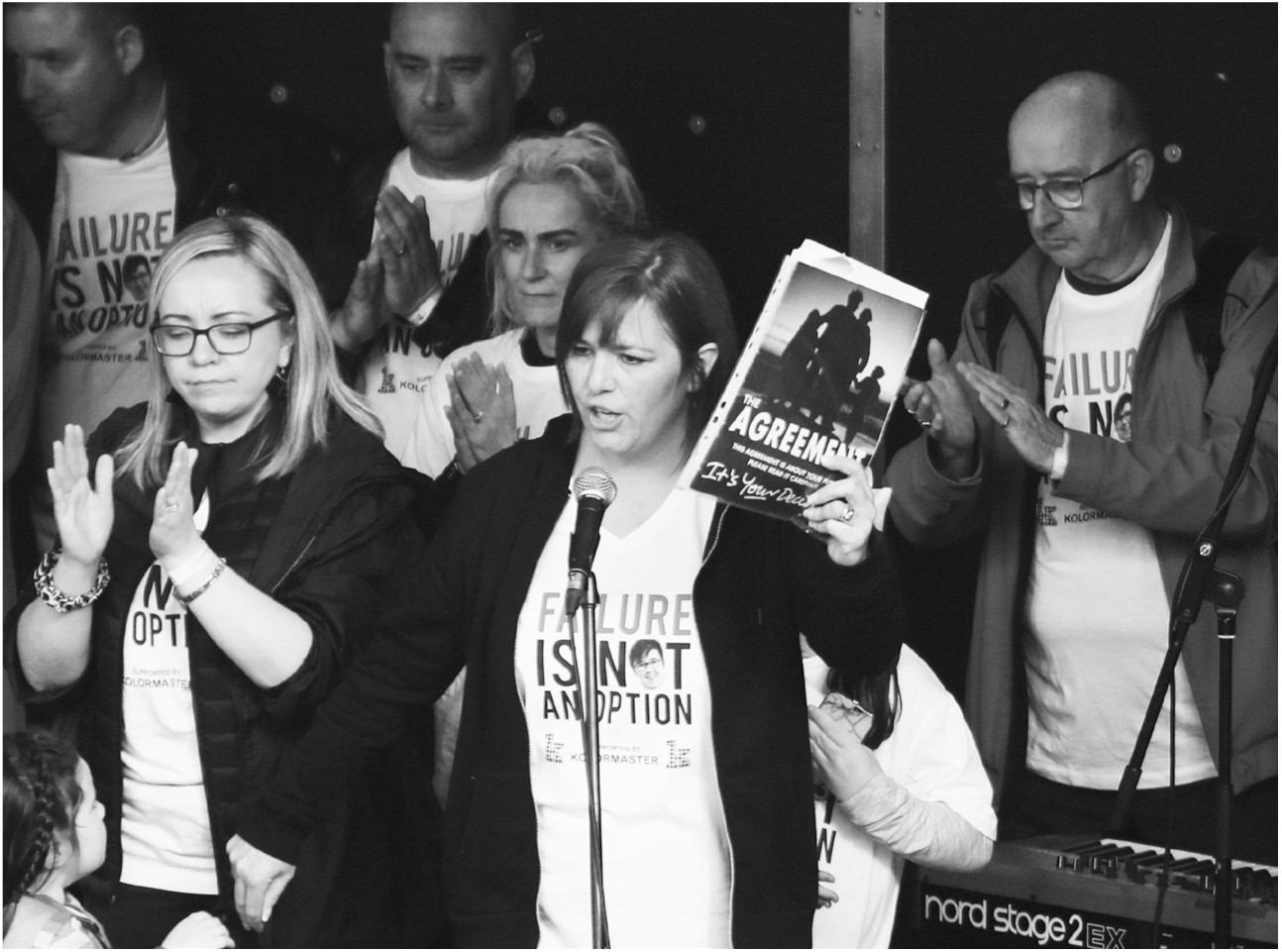
But McEvoy argues that overall responsibility for legacy lies with the UK parliament at Westminster. “It is not a devolved matter, and even the PSNI want it off their plate,” he said.
“I’m also not a zealot in terms of the relationship between truth and reconciliation. The truth will not suddenly reconcile us all, but it does ‘narrow the space for permissible lies’,” he adds, referencing the words of Canadian historian Michael Ignatieff in this magazine (Articles of Faith, Vol 25, 2/1996, p111).
Without a proper understanding of the history of the conflict by the British public, legacy issues will only get so far, says Cadwallader. “They think they know what went on during the conflict – that it was a war between two atavistic tribes in which the British government was a neutral arbiter – but they can’t know because they’re not being told.”
And without a clearer understanding of their past and a sense that the truth is being told, the people of Northern Ireland will continue to mistrust those who govern them.
High Court Rules on Press Freedom in Northern Ireland
During the raid, police seized documents, personal computers and USB sticks belonging to family members and copied a computer server that contained years of sensitive reporting.
The Lord Chief Justice of Northern Ireland Sir Declan Morgan quashed the warrants at a judicial review at the High Court in Belfast and, in early June, ordered the return of materials.