



Abstract
Argentinian author
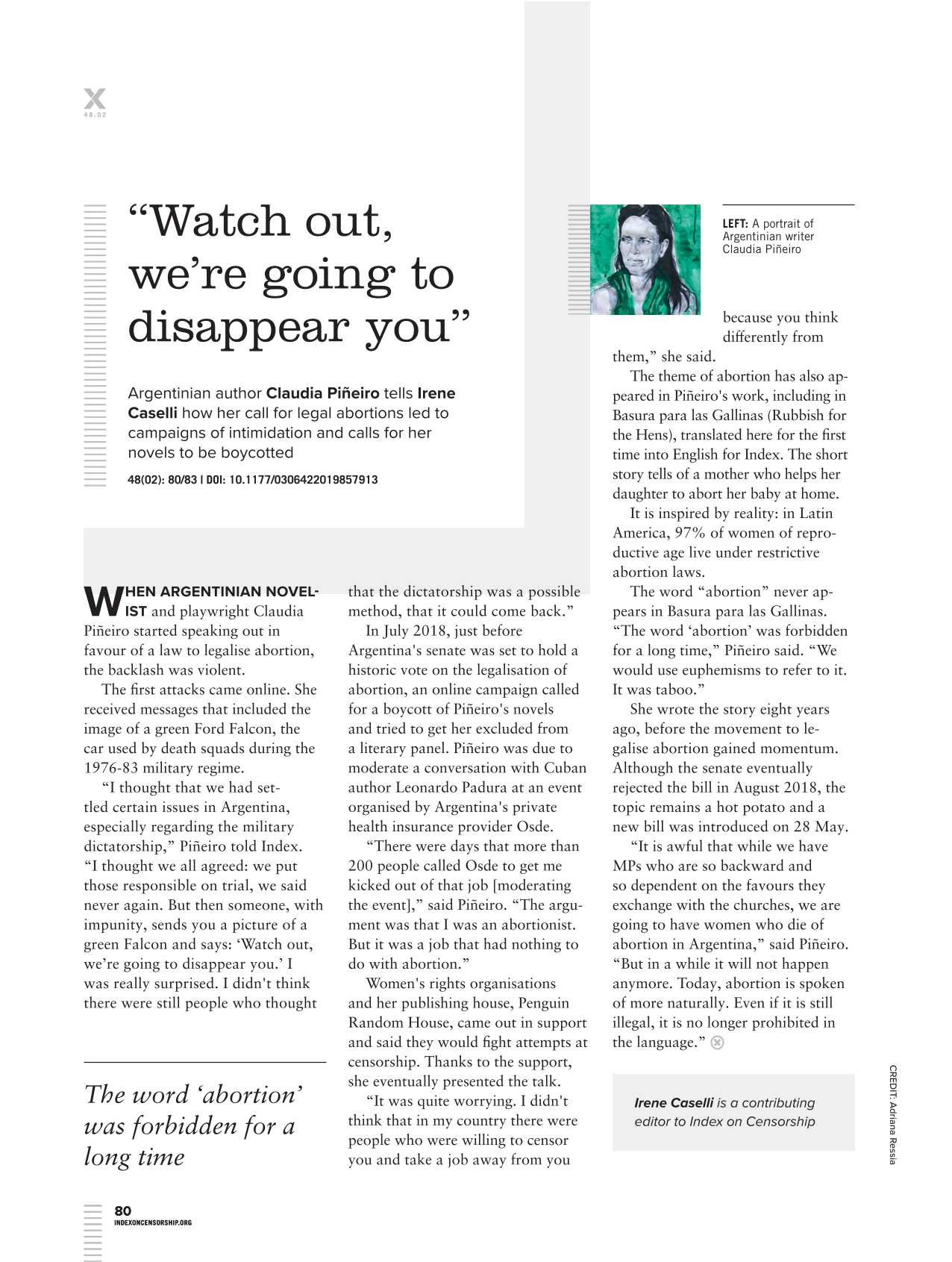
A portrait of Argentinian writer Claudia Piñeiro
CREDIT: Adriana Ressia

The first attacks came online. She received messages that included the image of a green Ford Falcon, the car used by death squads during the 1976-83 military regime.
“I thought that we had settled certain issues in Argentina, especially regarding the military dictatorship,” Piñeiro told Index. “I thought we all agreed: we put those responsible on trial, we said never again. But then someone, with impunity, sends you a picture of a green Falcon and says: ‘Watch out, we’re going to disappear you.’ I was really surprised. I didn’t think there were still people who thought that the dictatorship was a possible method, that it could come back.”
In July 2018, just before Argentina’s senate was set to hold a historic vote on the legalisation of abortion, an online campaign called for a boycott of Piñeiro’s novels and tried to get her excluded from a literary panel. Piñeiro was due to moderate a conversation with Cuban author Leonardo Padura at an event organised by Argentina’s private health insurance provider Osde.
“There were days that more than 200 people called Osde to get me kicked out of that job [moderating the event],” said Piñeiro. “The argument was that I was an abortionist. But it was a job that had nothing to do with abortion.”
Women’s rights organisations and her publishing house, Penguin Random House, came out in support and said they would fight attempts at censorship. Thanks to the support, she eventually presented the talk.
“It was quite worrying. I didn’t think that in my country there were people who were willing to censor you and take a job away from you because you think differently from them,” she said.
The theme of abortion has also appeared in Piñeiro’s work, including in Basura para las Gallinas (Rubbish for the Hens), translated here for the first time into English for Index. The short story tells of a mother who helps her daughter to abort her baby at home.
It is inspired by reality: in Latin America, 97% of women of reproductive age live under restrictive abortion laws.
The word “abortion” never appears in Basura para las Gallinas. “The word ‘abortion’ was forbidden for a long time,” Piñeiro said. “We would use euphemisms to refer to it. It was taboo.”
She wrote the story eight years ago, before the movement to legalise abortion gained momentum. Although the senate eventually rejected the bill in August 2018, the topic remains a hot potato and a new bill was introduced on 28 May.
“It is awful that while we have MPs who are so backward and so dependent on the favours they exchange with the churches, we are going to have women who die of abortion in Argentina,” said Piñeiro. “But in a while it will not happen anymore. Today, abortion is spoken of more naturally. Even if it is still illegal, it is no longer prohibited in the language.”
Rubbish for the Hens
She lifts the bag by its edges and shakes it up and down so that the weight of the rubbish compresses the contents and frees up more space for the knot. She ties it twice, two knots. She checks that the bow is firm by tugging the plastic loops to each side. The knot tightens and doesn’t come undone.
She sets the bag aside and washes her hands. She turns on the tap and lets the water run while she pours detergent onto her hands. When she was a girl, they didn’t have detergent at home, they used white soap if there was any. Now she has detergent – she brings it home from what they buy by the barrel at work. She fills an empty soda bottle and sticks it in her backpack. They didn’t have plastic bags either when she was a girl, her grandmother put all the leftovers or scraps that could serve to fertilise the earth or feed the chickens into a bucket and they burned everything else behind the fence, on the earthen track. Into the bucket went the potato peelings, the apple cores, the rotted lettuce, the overripe tomatoes, the eggshells, the brewed maté leaves, the chicken entrails, their hearts, the fat. Since she lives in the city, however, she uses plastic bags, reused shopping bags or bags bought specifically to contain rubbish like the one she’s just tied. She sticks all the leftovers and rubbish into a single bag without separating them, because where she lives now there are no chickens, nor land to be fertilised.
She shuts off the tap and dries her hand with a dry cloth. She looks at the alarm clock that she left that afternoon on top of the fridge, it’s time to put the bag out on the street for the rubbish lorry to take away. She walks down the narrow hallway all the neighbours share. Dangling from her left hand she carries the bag, held tight by the knot. She must leave the bag on the pavement just a few minutes before the binmen pass by. In her right hand she carries the handful of keys that weighs almost as much as the bag. The metal keyring is a cube with the logo of the cleaning company she works for, and from its silvered circle hang the keys to this building and those of each of the five offices she cleans; the keys of a previous job where she no longer works; the two keys of the door towards which she’s walking now, with the rubbish bag banging against her leg as she moves; the key to the door of her house, ground floor in the back; that of the basement where they store the bicycle her husband uses to go to work when he has a job; and that of the door to her daughter’s room, which she’s just added to the keyring after locking it.
When she reaches the door to the street she turns the handle but it doesn’t open, she leaves the bag on the ground and works her way around the ring, key by key, until she reaches the right one. She sticks the key in the lock and opens the door. First one door and then the other. The second key was added after thieves got into apartment H. She keeps the door open with a foot while she picks the bag up once more. On this short trajectory to the tree where she will leave it for the binmen, she carries it hugged against her chest. In embracing it she realises that the knitting needle broke the plastic and is aimed at her, as if pointing at her. She looks at it but doesn’t touch it. She turns the bag so that the metal needle no longer points at her.
CREDIT: Sam Darlow

When she reaches the tree she sets the bag on the ground again, beside other bags that others left before her. With her foot she pushes the needle so it goes inside the bag from which it shouldn’t have poked out. The needle goes in until it hits something and then she can’t push it any further lest it poke out the other side and wind up make things worse. She remains watching the hole the needle had made, expecting to see a viscous liquid coming through it, but the liquid doesn’t flow out. If it were to do so, and someone were to ask her, she’d say it was from any of the other things she threw inside to fill the bag. But nothing comes out of the hole.
She plays with the keys as she waits for the rubbish lorry. She spins the keys one by one around the ring. It is night-time although the afternoon is still not over, the cold of July biting her face. She rubs her arms to warm herself. She shakes the keyring as if it were a rattle. That’s it, its ending. She wishes she could go back inside her house to see how her daughter is, but she can’t leave the bag there alone. She fears someone sniffing in her rubbish in search of something that might be of use. Or a dog, attracted by the scent. She knows that animals can smell things that we humans can’t. Where she lived with her grandmother there were animals, dogs, a donkey, chickens, once they even had a pig.
She is cold but can’t go and let some dog voraciously attack the bag she’s just taken out for the binmen. In her grandmother’s house there were three dogs. Her grandmother also used a needle, but not the plastic bag, instead one of the two buckets. What her sister expelled went into the bucket for the chickens. She saw her grandmother remove it from her sister, that’s how she knows how to do it: to stick in the needle, wait, the cries, the bellyaches, the blood, and then gathering what came out into the bucket and throwing it to the hens. She learned by watching her grandmother. And that’s how she did it today, just as she remembered.
Only this time it will turn out better, because she now knows what she needs to do if her daughter shouts out in pain and doesn’t stop bleeding. She knows where to bring her. Her daughter won’t die. In the city it’s different, there are hospitals or medical clinics nearby. Her grandmother didn’t know what to do, there was no place to take her sister.
Where they lived there hadn’t been anything, not even neighbours. There were no bunches of keys that opened and closed so many doors. There were no people sorting through what others left behind. No plastic bags. There was nothing. But there were chickens, who ate up the trash.
Footnotes
Translated by