




Abstract

Local Mexican journalists on the US border are so intimidated by drug cartels they are afraid to report the news, writes
In this border state facing Texas, newspapers keep quiet on the region’s rampant cartel activity. Instead, locals turn to anonymous Twitter accounts for updates on shootouts and blockades.
With crimes against the press threatening local media across the country, Tamaulipas offers a nightmare vision of what could lie ahead, a violent state where violence and self-censorship have left citizens in the dark.
In December last year, a box containing the severed head and hands of an unidentified man was left outside the offices of the Expreso newspaper in Ciudad Victoria, the state capital. “The fear is a constant,” an Expreso journalist told Index, on condition he remained anonymous.
“The criminals know who you are, where you live and how many family members you have. They know everything.”
The media blackout began its slow descent in February 2000 with the murder of Luis Roberto Cruz, a reporter for Multicosas magazine in the border city of Reynosa. Thirteen more journalists have been killed in Tamaulipas since, according to press freedom watchdog Article 19.
The violence intensified in 2006 when assailants opened fire on the offices of El Mañana newspaper, in the city of Nuevo Laredo, detonating a grenade and paralysing a journalist. The Inter-American Commission on Human Rights described the event as “the first attack using weapons and explosives against the facilities of a media outlet during the war on drug trafficking”.
The media silence in Tamaulipas is tied to the state’s strategic location in Mexico’s ongoing drug war. Cartels have long smuggled cocaine and other contraband through Altamira port on the Gulf Coast. The 17 border crossings with Texas also provide access to the illegal drugs market in the USA.
Turf wars between competing criminal factions have raged ever since Los Zetas, a paramilitary group linked to the Gulf cartel, broke ties with their former allies almost 10 years ago, and the local press has increasingly become a pawn in the hands of cartel commanders.
Criminals force media workers to limit reports of violence in order that their illegal activities can continue uninterrupted, and without the government deploying extra troops or police. But cartels occasionally commit deliberate acts of violence in order to force a government crackdown, a practice known as “heating up” a rival’s turf. In such instances, cartel operatives will demand newspapers send reporters to cover the story. Compromised journalists, known as enlaces, or links, manage this practice of editorial encroachment. The enlaces work for the cartels and make sure newspapers publish certain stories and censor others.
This elaborate system grew in response to the intensity of the cartel conflict in Tamaulipas, says Guadalupe Correa author of the book Los Zetas Inc: Criminal Corporations, Energy, and Civil War in Mexico.
“You have groups that are highly militarised and you have the government going after them,” she said. “That generates incentives to control information as if it were a war between armies.”
The restrictions on the press mean many rely on citizen reporters such as Loba Indomable (Indomitable Wolf). Loba uses Twitter to provide drug war news, uploading graphic photographs of crime scenes or videos of gunfights provided by concerned citizens. She tweets the updates she believes to be authentic and tries to sift out empty rumours or cartel propaganda. Loba told Index she was motivated by a desire to keep law-abiding citizens safe. However, she accepts there are significant downsides to citizen journalism.
CREDIT:Antonio Rodriguez/Cartoon Movement
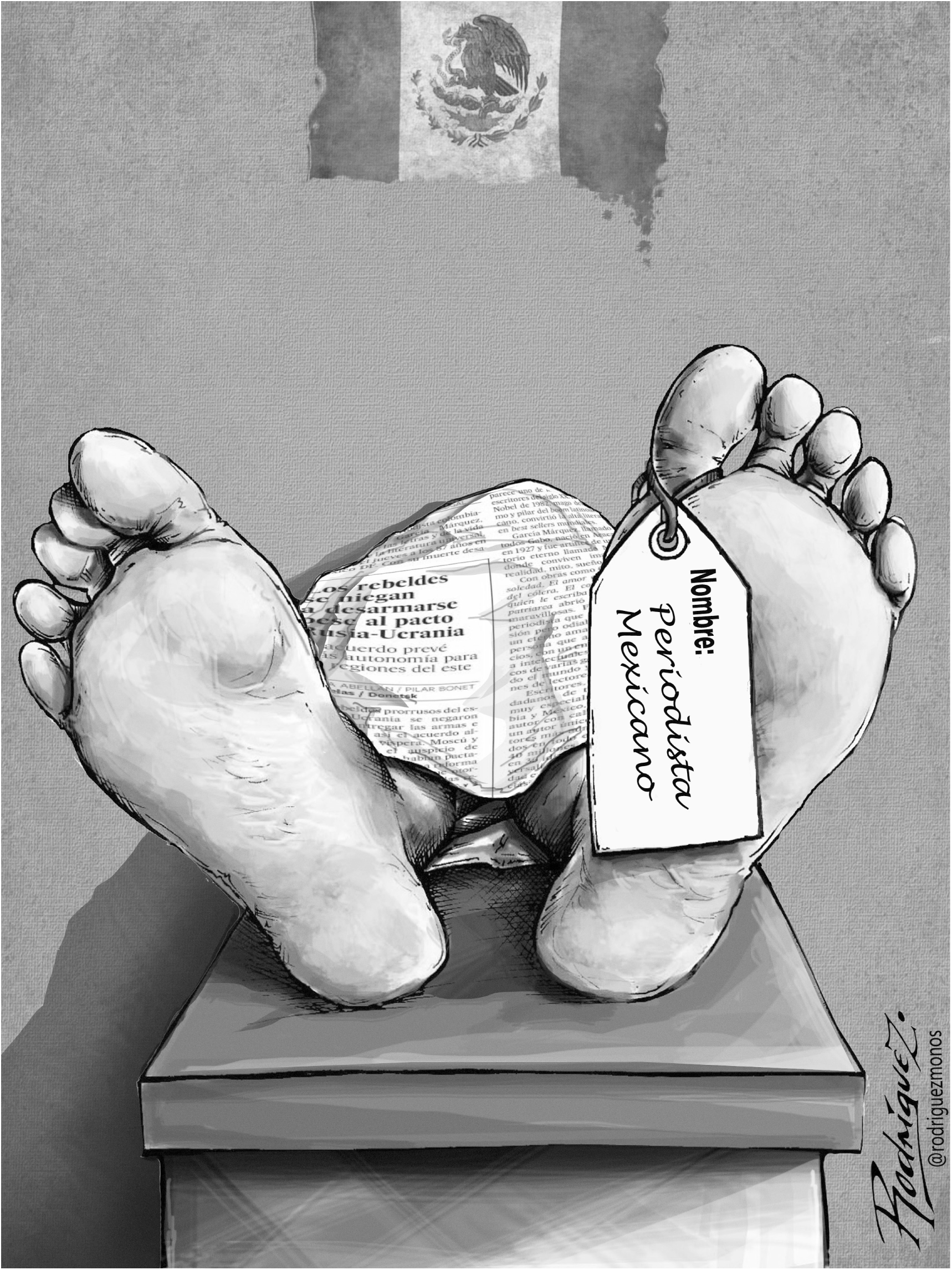
“Not all of the social media accounts are trustworthy,” she said. “There are accounts falsely claiming to be linked to the army. I know they are fake, but others might be taken in.”
In recent years, cartels have increasingly targeted online reporters, including Loba.
But cartel bosses are not the only people threatening press freedom in Tamaulipas. Politicians are also linked to silencing critical voices. In January last year, masked assailants stabbed political columnist Carlos Domínguez Rodríguez to death in his car when he stopped at traffic lights in Nuevo Laredo. The late reporter’s son, also called Carlos Domínguez, believes the former mayor of Nuevo Laredo was behind the killing. Six suspects were arrested in connection to the crime, including three journalists and the former mayor’s nephew.
Domínguez told Index that writing about politicians was more dangerous for journalists than reporting on drug traffickers, especially as the line between the two had become increasingly blurred in recent years.
“If they keep targeting reporters, we will end up without any information that is uncomfortable for the government,” Domínguez said. “We cannot say we live in a democracy when freedom of expression is not guaranteed.”
Dying For Local News
According to Article 19, 122 journalists have been killed across the country in connection with their work since 2000. Three in every four of these murders occurred in the northern frontier or southern states.
Blighted by drug cartels drawn to their border crossings and seaports, these regions also suffer from widespread political corruption.
Local journalists are at particular risk in this environment, with 95% of those killed for their work reporting for local outlets, according to the Committee to Protect Journalists. Given that trend, there is a real danger of more “silent zones” emerging in Mexico.
The border state of Chihuahua came under the international spotlight in 2017 when its largest daily newspaper, Norte de Ciudad Juarez, closed due to security concerns. The publication returned with 15 special editions last year but has not resumed daily circulation.
In recent years, violence against the press has risen most sharply in Mexico’s poor southern zone. In Guerrero state, criminals have increasingly sought to control local media as the region becomes the main supplier of heroin to the USA.
But nowhere has deteriorated more than the south-eastern state of Veracruz, which became Mexico’s deadliest place for journalists in 2012.
Just below Tamaulipas on the map, the state shares the cartel problem ravaging the Gulf Coast. But many reporters in Veracruz still cover shootouts and massacres, in contrast to colleagues in Tamaulipas.
“A small sector of the press held firm in its decision to report on these incidents,” said the Inter-American Commission on Human Rights in a 2017 report.
The refusal to censor has come at a great cost. Seventeen reporters were killed during the 2010-16 term of former state governor Javier Duarte, who is now serving a nine-year prison sentence for corruption.
“Writing a story might mean signing your own death sentence during the Duarte era, says Santos Solis, the director-general of the digital newspaper Oye Veracruz.
Solis says the “journalism of fear” that Duarte fostered has persisted despite his removal from office. “If the government does not act, we will end up like Tamaulipas,” he predicted.