



Abstract
A new generation of trolls are officially employed by governments, with the Chinese government employing up to two million.
“One job announcement happened to be a job in a troll factory, but there were no descriptions of the kind of work I was going to do,” he told Index.
At the time, says Bespalov, there was no information in the Russian media about troll factories. But it didn’t take long for him to figure out the real nature of the work and he realised there was material there for a story. This was in 2014 and he worked in a department dedicated to creating disinformation related to Ukraine, from a pro-Russia stance, as well as in a troll department. There he would post several hundred messages a day.
The office where he was – pretty from the outside but like a “poor Russian hospital inside” – had around 200 employees. His boss, aged 30, had previously worked as a journalist. Bespalov thought she didn’t like her job, but as time went on he saw she was “very involved”. Most people, though, were “normal”. They were young and, like him, attracted to the money (paid in cash, tax-free and better than the average St Petersburg salary).
Bespalov’s story is far from unusual. But what is new in 2018 is that these people are now going on the state payroll.What’s new is a recent Freedom of the Net report from Freedom House showed a significant rise in the number of governments using “paid pro-government commentators” to shape opinion online. Authoritarian governments have realised that if you can’t beat them, join them; namely, if activists are going to launch revolutions and social movements via social media, so too will autocrats – and they’ll make it financially enticing.
Recent Harvard University research from Gary King, Jennifer Pan and Margaret E Roberts analysed that the Chinese government’s aim was to distract the public and ignore controversial issues. These people are known as wu mao, or 50 cent party members, because they are rumoured to be paid 50 renminbi cents per pro-China post. When the groundbreaking Harvard study investigated China’s wu mao, it found that the people who were creating the social media posts were government employees of all ages and backgrounds. China leads the world here, employing millions of people with this in their job description.
“It actually makes sense,” King told Index. “The Chinese government fabricates nearly 450 million social media posts each year, so it’s a really hard management task. They already have millions of people working for them and these people flood sites such as Sina Weibo (one of China’s biggest social media platforms) with government propaganda. Their tactic? To enlist civil servants. they just give them one extra thing to do.
“These 50 cent party workers [are] not arguing against people arguing against the government. They’re cheer-leading. They are filling the internet with drivel.” In his report, King labels this “strategic distraction”.
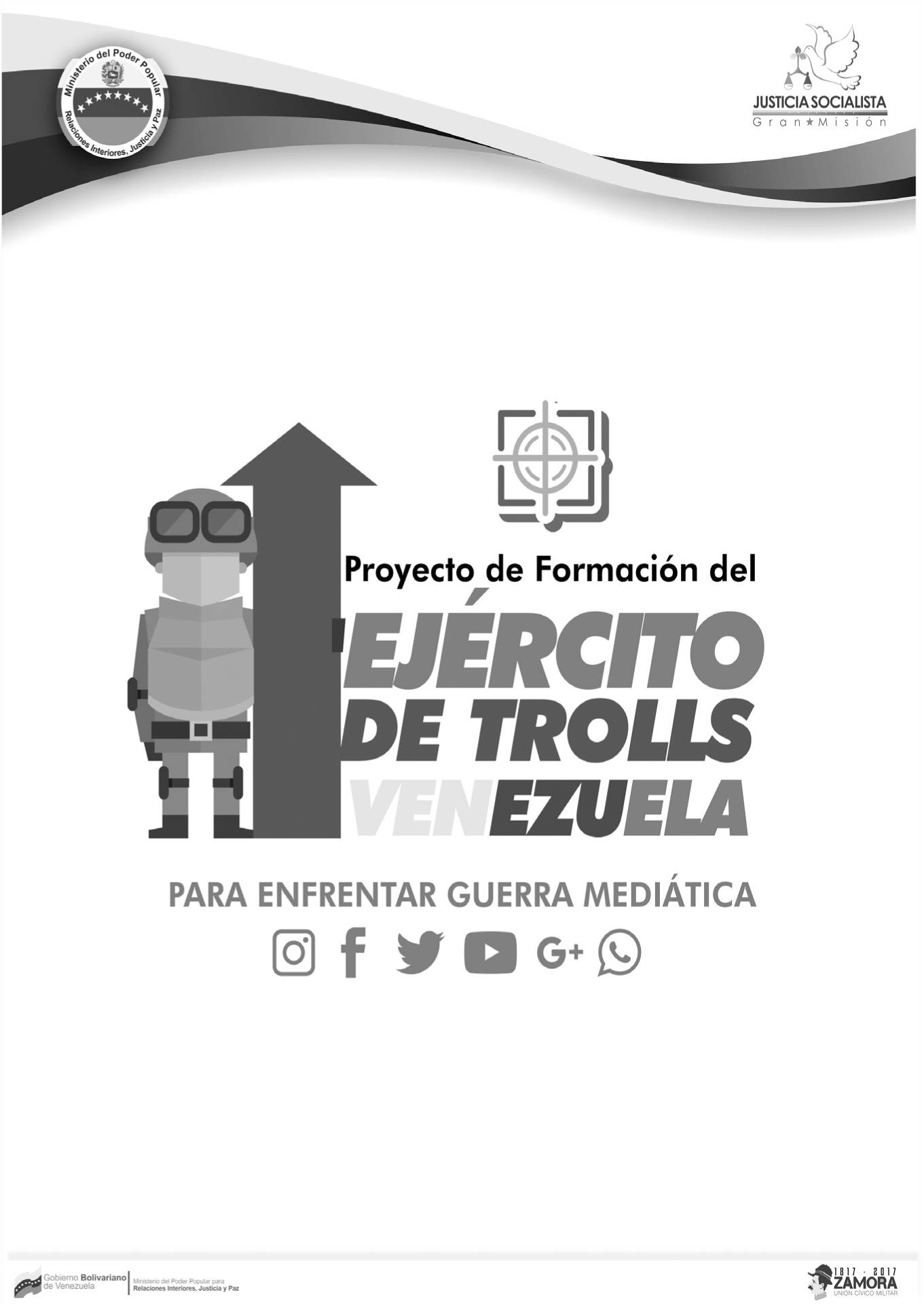
Meanwhile in poverty-stricken Venezuela, a leaked government report from 2017 revealed plans for a project to set up a troll army with a military structure. One of its recruitment tactics is to reward people, who sign up to run Twitter and Instagram accounts, with food coupons, the value of which go up according to how much people post, and where. In Mexico, one troll told internet activist and journalist Alberto Escorcia that he had been paid 50,000 pesos (around $2,500) an hour to run up to 150 accounts against Mexico’s #YaMeCansé [Enough, I’m tired] protests, which swept the country in the wake of the disappearance of 43 students in 2014; another hacker, Andrés Sepúlveda, boasted publicly that Mexico’s government paid him more than half a million US dollars to help secure Peña Nieto’s victory, using 30,000 Twitter bots.
India’s social media is also awash with information spread by trolls. Swati Chaturvedi, journalist and author of I Am a Troll: Inside the Secret World of the BJP’s Digital Army, has met several people who work in the industry. She told Index that the typical troll was motivated by money “because there is a huge unemployment crisis in India, and if you have an education there are not that many job opportunities”.
“It’s like what Hannah Arendt says in the Banality of Evil,” she added. “They were extremely ordinary people, they were like call centre workers. Only their job was to spew hate and abuse and make threats all day.”
At the same time, Chaturvedi said a lot of them were “driven by the BJP’s propaganda against minorities. They have a strange kind of persecution complex, which the [right wing Bharatiya Janata Party] is eating into”. Their motivations are “a mix of ideology, where they really don’t like minorities – they’re very anti-Islamic – and also the fact they they’re paid well”.
A leaked Venezualan government report from 2017 called A Troll Army Training Project to Confront the Media War
CREDIT: Bloomberg
A report released this summer by California’s Institute for the Future, State-sponsored Trolling: How Governments are Deploying Disinformation as Part of Broader Digital Harassment Campaigns, used a similar term – “information abundance”.
“States have shifted from seeking to curtail online activity to attempting to profit from it, motivated by a realisation that the data individuals create and disseminate online itself constitutes information translatable into power,” it said.
The report also says how state-sponsored trolling attacks in many countries “have grown out of, or been built upon, infrastructure and mechanisms established during election campaigns. Candidates and parties develop resources such as databases of supporters, committed campaign volunteers, social-media-influencing arms, and dedicated communications channels that are deployed during elections to advance a party’s platform and undermine the opposition”. They then use similar tactics and people once they’re in power.
Rodrigo Duterte, Philippines’ president, admitted to paying trolls during his election campaign. He denied using them once in office, but various media outlets have linked accounts used during his election campaign to ones which were active afterwards. The Duterte government “has even elevated bloggers and social media influencers acting as trolls to positions within the government”, said the Institute for the Future report.
The efforts are successful. Through creating huge and largely loyal armies, government-sponsored trolls have driven many journalists into exile and silenced – or drowned out – other forms of online expression.
For Evgenia Sokolovskaya, a reporter for Snob Media, Russian trolls are a part of her day-to-day job. “Basically, each time we write about a sensitive topic, like criticising [President Vladimir] Putin and other politicians who are in Putin’s favour, there are lots of trolls on social media,” she told Index.
“They’re always very angry, always trying to accuse everyone of everything.”
Sokolovskaya usually brushes off trolls herself, but says it becomes more problematic for Snob’s readers, when they are harassed. “Maybe some readers who don’t understand what is going on might believe them,” she said.
Chaturvedi says she gets, on average, about 10 to 12 death threats and rape threats a day. “But I know it’s a call centre of hate. They have a hit list of journalists they want to attack,” she said, showing a determination not to be intimidated. “In a weird kind of way there’s nothing personal about it.”
Does Chaturvedi believe the trend will get better? Indian Prime Minister Narendra Modi’s troll army has already increased threefold in the lead up to next year’s general elections, she says. “Unfortunately, the genie has been uncorked and I don’t think [it] can be put back in the bottle.”
Corrections
The sub-heading on p32 was incorrect and updated online to: Neuro-scientist Clive Coen talks to Tess Woodcraft about why some people preserve their bodies after death, and the public’s reaction to forecasting. The sub-heading for the same story on p4 was updated to: Dip into a discussion about why information works best for healthy democracies.