




Abstract

Despite years of war and destruction in Yemen, artists continue to make their marks of resistance in the damaged public squares and in private spaces.
It will be the 158th private screening of Ten Days before the Wedding, a comedy symbolising the rebirth of the city of Aden after the civil war. While hundreds still flock to the silver screen, such pleasure must remain private, as public screenings were banned in the 1990s and theatres across the country have all been shut down, damaged or destroyed.
Amr Gamal is not just the film’s director, he is also a young defender of culture in the city of Aden – a catalyst of enthusiasm and cultural activism. He said: “This film is not our creation, it is the joint work of the people of Aden. It is the first all-Yemeni film ever made because everyone – the director, the actors, the extras, the producers – comes from Yemen. No one lives abroad, no one is foreign. This film is the city’s natural reaction to war and it is the best and most peaceful response Aden could have.”
Ten Days Before the Wedding is the final link in a chain of actions and reactions that young people have made into a permanent fixture of local life – from art and photography exhibitions to the demonstrations held two years ago when militias invaded the city and four nuns from the Missionaries of Charity were murdered.
Some members of the audience cry as the story reaches its most tragic point: when a number of obstacles nearly derail the marriage between Rasha and Mamoun, whose life has been thrown into turmoil by the 2015 conflict.
Art in Yemen is the only way to express peaceful resistance to war because all militias tend to cancel, silence and persecute any form of free expression.
Gamal and his team revel in the scene that plays out night after night while also planning an international roll out – they hope at the Berlin film festival.
For many years, Sarah Abdulrashid has been working to revive and bring culture to all corners of the city. The young Yemeni woman has spearheaded so many events that she now has a role in parliament.
“I was able to take exhibitions, cultural events, and book fairs from the city’s streets to government, involving 12 national politicians in the process,” she said. “Our aim is to make it easier for young people to engage with art and for artists in civil society to engage with politics. That’s why we are trying to spotlight the oldest quarter of our city, because of its links to our traditions and shared history.”
The Crater district of Aden is a prime example. Activists have made this neighbourhood of houses in the bowl of an extinct volcano the focus of their efforts for some time now. “Crater is a distillation of the country’s past and present,” Gamal explains. “In a few square metres it has the Crater Hotel, which was occupied by Houthi militias on their arrival in the city and later became a symbol of the war when it was wracked by bombs and fire; across from the hotel is a mosque representing our indigenous tradition; while facing it is a vestige of the British Protectorate – the stadium. Along the street from this is the home of poet Arthur Rimbaud.”
Murad Subay’s street art in San’aa, Yemen
CREDITS: Murad Subay
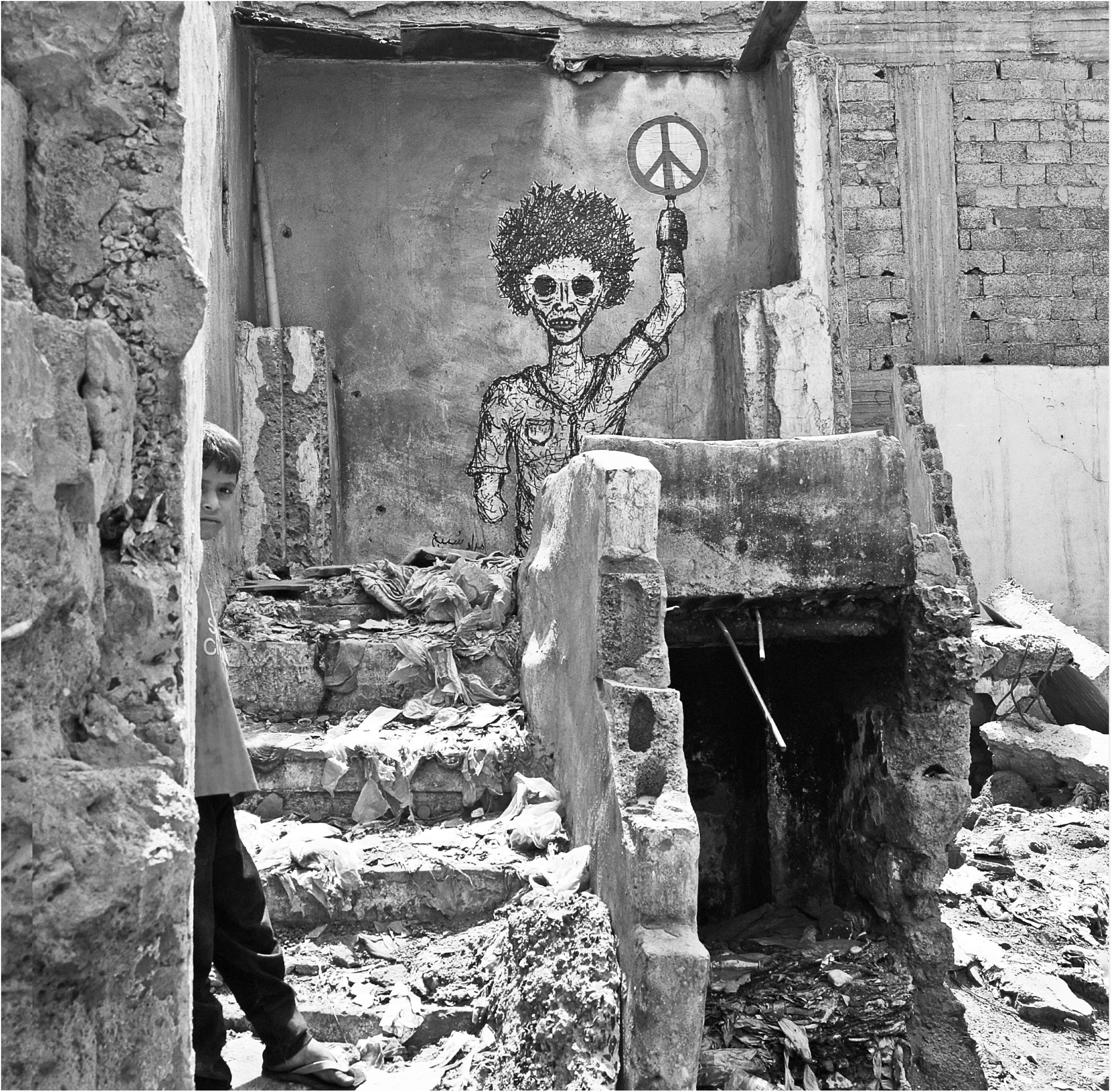
As he points to it, Gamal’s eyes shine and the corners of his mouth turn down in a mixture of emotion and anger. “Almost no one knows it’s there and no one cares about it. In a different country, this building would have been celebrated as a monument whereas here it’s a private home to families living in poverty, falling to pieces around them.”
While one city is being brought back to life, another struggles on. Sana’a, formerly the capital of Yemen and now centre of the Houthi occupation government, experienced a period of artistic ferment after the 2011 uprising.
Street artist Murad Subay still lives in Sana’a. His depictions of martyrs from the 2011 revolution fill the city’s walls, especially in the Hadda district, in an attempt to champion a future free of dictatorship. His work is overshadowed by emblems of the Ansarullah Houthi party, but he remains defiant.
“Art gives me strength and gives strength to [other] people, so I do not leave the country,” he said. “This is the way I know to fight: street art is a weapon that hits without killing and, on the contrary, gives hope to people. During the revolution in 2011 I thought I had seen the worst, but no: it was nothing compared to the war that broke out three years ago, and that continues today.”
Murad Subay’s street art in San’aa, Yemen
CREDIT: Murad Subay
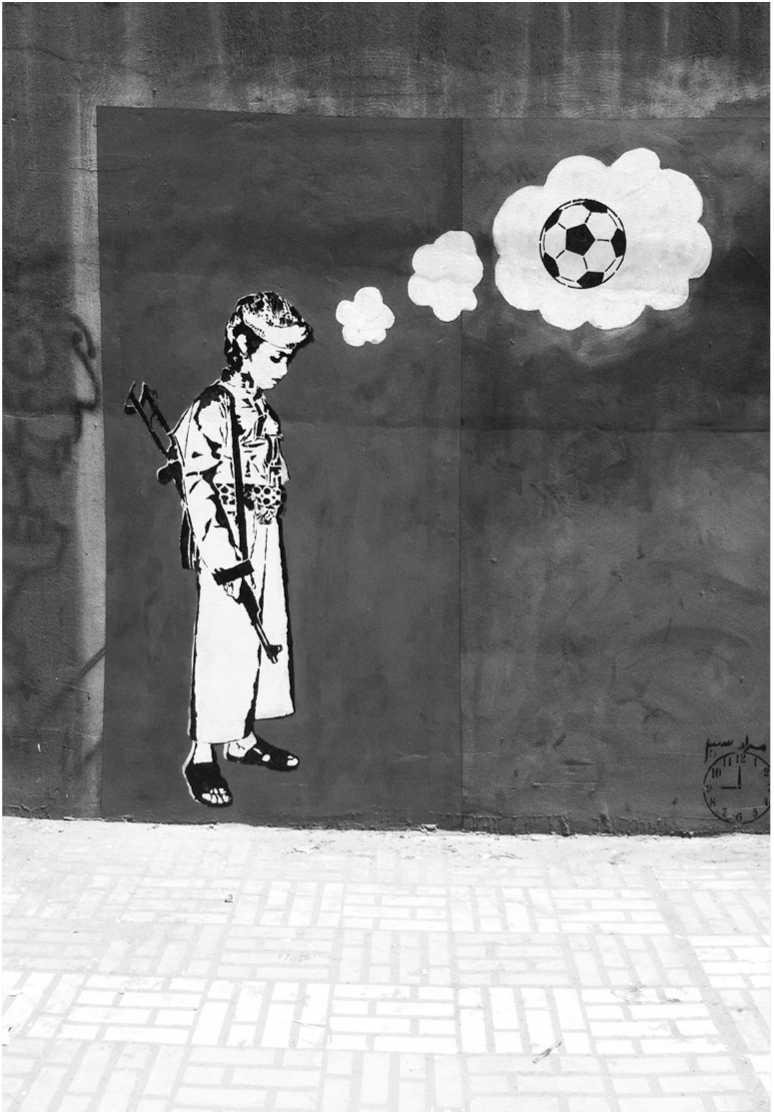
And there are others who refuse to give up. Mohammed al Shaidani is one of them, a street artist and friend of Subay. He was part of the 2014 campaign in which Subay asked citizens to join him in painting the city’s walls, an initiative which not only taught those involved how to use spray paint but also made them the voice of civil society.
Al Shaidani set up a social campaign of his own, similar to the BookCrossing initiative. “It’s called Open Book and is an ongoing means of promoting a culture of reading which doesn’t have to be about religion or education. People do not read a lot in Yemen,” he said. “We started this project in 2014 and are keeping it going. The books are not left on benches or in specific spots around the city to be passed from reader to reader, but [are] exchanged at small events held in coffee shops or private homes. Back in the beginning, we used to do it in the street.”
The main reason for this relocation was safety. The militias don’t like the activists, most of whom are young supporters of the Muslim Brotherhood-affiliated Islah party or have closer ties to the secular world.
Mohammed al Dahri is a journalist, originally from Sadah, in northern Yemen, where the Houthi rebels have their stronghold. He shares nothing of their ideology. Also a friend of Subay, he took part in the street art campaign with his daughters, one aged 10, the other aged five. Both were eager to show photos of themselves standing by a wall holding spray cans. He said: “Civil society in Sana’a has not died, it has fallen silent. In recent years, we used our voice to call for freedom and for equality between the disproportionate numbers of rich and poor, but we were silenced by the absence of law. No one in Yemen has any respect for the law and citizens have no law or constitution to appeal to. Both north and south are the realms of militias, subject to the rule of the most powerful, the kingdom of individuals.”
He says many journalists have been arrested for not having written authorisation to hold a conference rather than for something critical they might have said. He sees the current period of transition as a lesson – a hard one – in civilisation.
“Outside intervention in this war has been catastrophic as it has made everything more difficult. Nevertheless, the conflict has taught us one thing – that Yemen belongs to all 30 million Yemeni, not to a group of one million with a particular viewpoint. We have to learn to live together and we have to do it quickly, for the future.”
Footnotes
Translation by