




Abstract

In South Korea the planned film adaption of a novel about motherhood is stoking anger from men.
Kim Ji-young Born 1982 tells the story of a 34-year-old woman who has been married for two years and is the mother of a one-year-old daughter. Kim’s husband works incredibly long hours and, without her parents nearby to help, Kim gives up her job to raise the child.
At the core of the story is the main character’s struggle with the reality that after a woman gives birth she has to choose between being a full-time mother and a working mother who balances her job with childcare. The second scenario is tough in South Korea, where most childcare duties fall on women’s shoulders; the state-provided daycare is considered low quality, and too short to match the long hours the average Korean is expected to work. Meanwhile, according to data from the OECD, South Korean men do the least unpaid work (routine housework and taking care of household members) alongside men in Japan of the OECD countries.
Cho’s novel was a huge hit, selling around one million copies. Many South Korean women saw their own lives reflected in the story, and were encouraged to talk about these issues. Until this point, these conversations rarely reached wide audiences.
But many men looked at the story and saw something different: a distorted view of South Korean society told by an entitled, whinging woman who sponges off her hardworking husband and doesn’t appreciate how good she has it.
The reaction to this book is a microcosm of a loaded gender-based debate that has been bubbling for years in South Korea. In the most misogynistic corners of the Korean-language internet, full-time mothers are called “parasites” – they are accused of living lives of leisure on their husbands’ earnings and the largesse of the taxpayer-funded daycare. At the same time, working mothers lament shouldering what they see as an unfair portion of child-rearing responsibilities; this limits their advancement opportunities at companies, where late-night work is common and promotion can depend on the ability to socialise with colleagues after hours.
“This generation has to work so hard every day just to survive,” said Youjin Do, an author, lecturer and filmmaker in an interview with Index. “The fact is that some women become housewives even though they badly wanted to continue pursuing their careers, but their companies let them go. It’s not unheard of for Korean companies to punish women who get married or become pregnant.”
After the book’s release, men started to complain that the story of Kim Ji-young unfairly slandered them. They lashed out at anyone who spoke favourably of the novel, or even admitted to having read it. Photos of a member of a popular K-pop girl group were burned after she mentioned having read the novel. When Jung’s casting in the main role of the film adaptation was recently announced, her Instagram page was inundated with angry comments. One man posted a petition on the website of the presidential office asking the government to block the production. “This novel presents an overly subjective viewpoint that is contrary to the gender equality South Korea should pursue,” the petition reads. “If it is made into a movie, will only lead to more gender-based conflict.”
As the novel’s editor, Park Hye-jin feels partly responsible for the controversy. While dismayed at the contentiousness of the online debate, she says that the discourse is good for her company’s bottom line. “Many people don’t like the book, especially men, but whenever there’s controversy, our sales increase,” she told Index at the Seoul offices of Minumsa, the publishing house that released the novel. “Readers respond to the pressure by reading it more, buying copies as gifts for their friends.”
One such reader is Lee Seon-mi, who is 35 and single, and works full-time in the international cooperation department of a provincial government. She describes Kim Ji-young Born 1982 as a “100% accurate” depiction of contemporary South Korean society.
Lee isn’t surprised at the mixed response to the novel – that reactions to a work of literature could be so disparate, and so divided along gender lines. “Most Korean men don’t think that Korean society is like this,” she told Index. “Women identify with this story of a woman who has to give up her career to raise her child.”
The past several decades have seen changes that have made it harder for families to raise children, Lee said. “In my mum’s generation, families had many siblings, and social responsibility was shared within the family. Kids were raised by their aunts and uncles and neighbours, but society isn’t like that anymore. People have to leave their hometowns to find jobs in cities, and when women have kids, they don’t have networks to support them.”
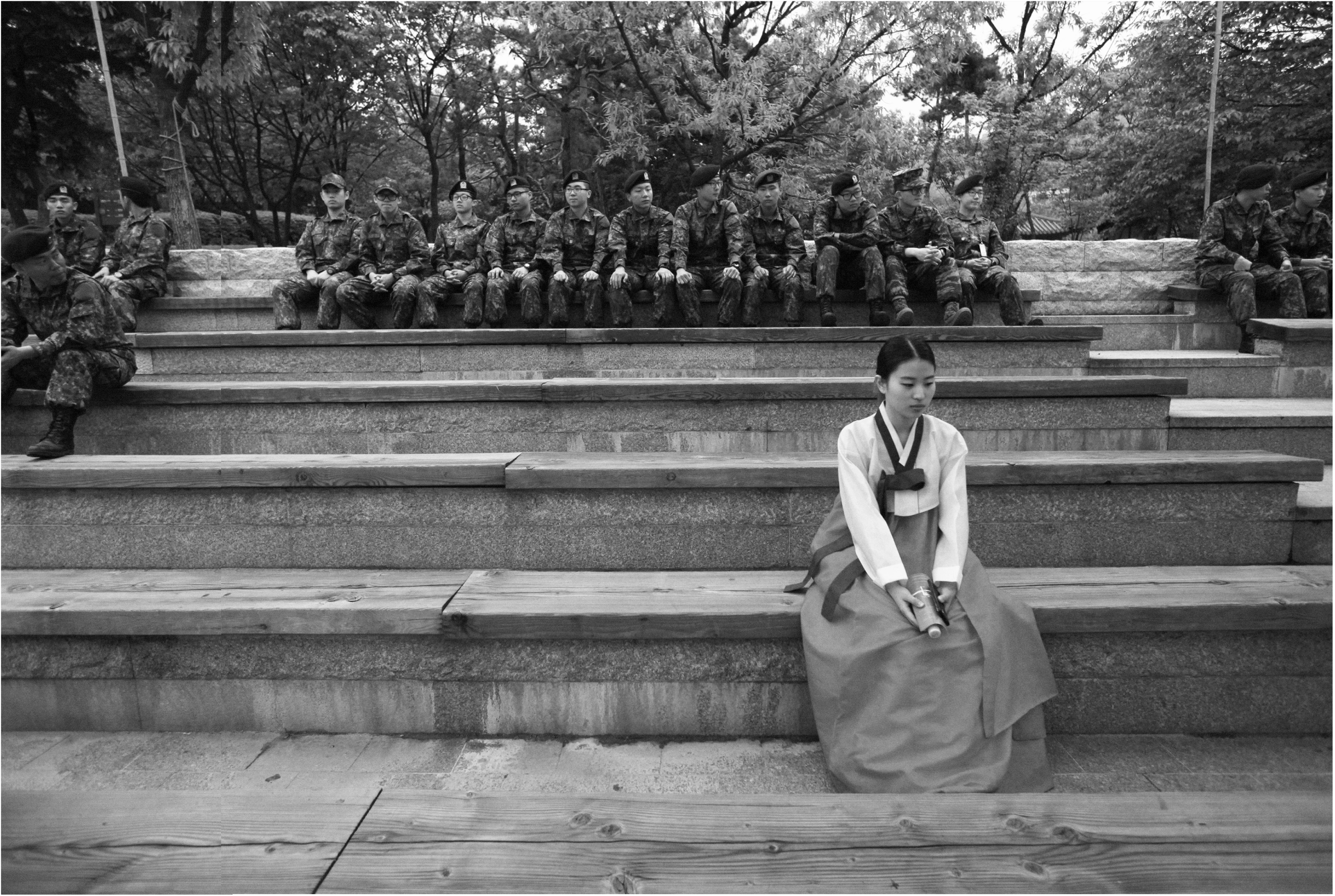
South Korean men and a woman at a traditional coming-of-age ceremony in Seoul, 2013. The ceremony reminds them of their “responsibilities” as men and women
CREDIT: Kim Hong-Ji/Reuters
Against this social backdrop, fewer South Koreans are having children: the government expects the country’s birth rate to fall to an all-time low of less than 1.0 in 2018, far below the replacement level of 2.1. Experts point to a matrix of reasons for this phenomenon, including the decline in stable jobs, rising property prices, and the high cost of educating and caring for children.
Another factor behind the low birth rate is a disagreement in many couples over who ought to shoulder childcare duties. “Men don’t value childcare as work because they don’t see it as their responsibility, they think it’s women’s work,” said Lee Sung-hee, a lecturer in sociology and social policy at the UK’s University of Derby. “And they don’t have the experience of having their careers interrupted. They aren’t expected to rush off in the afternoon to pick up their kids.”
Kim Ji-young Born 1982 is also set to become a topic of conversation in neighbouring Japan this December, when the novel is published in translation. The country has similar gender and economic issues as South Korea. Park says that Minumsa is working on an English translation, though no publication date has been fixed.
In South Korea, however, the novel has touched the rawest of nerves, and the debate looks set to continue. “Women are criticised for seeking alternative lifestyles because such decisions aren’t just personal – they amount to calls for substantial change to South Korea’s social system,” said Park. “Such calls disturb the positions of those who gain power and status from the current system. People who don’t want change are quick to criticise.”