




Abstract

As Iraq’s film industry restarts after 30 years of bans and cinema closures,
This event was once unimaginable in Karbala, a holy city where millions of Shia pilgrims from around the world still flock in commemoration of Imam Hussain, the grandson of the Prophet Mohammed, who was killed at the Battle of Karbala in 680 AD.
A short distance from the shrine, Iraq’s take on Hollywood is being revealed. Hundreds of government dignitaries and their wives mingle with Iranian leading ladies and Emirates starlets. Aspiring actors, young directors and journalists from local media and international TV stations mill around, all dressed in their best.
Streams of fascinated onlookers line up by Karbala’s auditorium, which has been turned into a cinema for the occasion.
Ali al-Siddiqi, a 40-year-old teacher from Karbala, has come with his family. In the interval between films, he can’t conceal his joy. “Unlike Baghdad or Erbil, where the cinemas have reopened, we do not have one in Karbala. I want my children to experience the same excitement their grandparents did when films were made and watched here in Iraq.”
This year’s festival, in April, was the first to include international films, judges and media coverage, screening 102 films from 30 countries and 38 films from Iraq. The “gold reel” for the best short narrative film went to Mary Mother, directed by Afghan Sadam Wahidi. Set in Kunduz, in northern Afghanistan, the story tells how a brave mother manages to trick a group of Taliban soldiers to retrieve her wounded son, who is one of the few doctors to survive an attack on a military hospital.
Iraqi submissions were equally outstanding, reflecting the recent renaissance of the local film industry – the impetus for which was given a major boost by The Journey, a psychological thriller about a conflicted suicide bomber.
Directed by Mohammed al-Daraji in 2017 and a finalist at the Toronto Film Festival, this film has come to epitomise the Iraqi revival.
Iraq stopped producing films in 2003, bringing to a halt the country’s long tradition of cinema. Prior to 1991, there were 275 cinemas in Iraq, but the international embargo imposed after the First Gulf War banned both film-making equipment and celluloid from entering the country. Local production stopped and only started several years later, aided by 3D technology, the growing use of digital methods, the development of animated film and the work of film theory professors at Baghdad’s Institute of Fine Arts and at the city’s university.
An Iraqi man sells tickets at the Atlas Cinema in Basra, May 27 2003
CREDIT: Stringer/Reuters
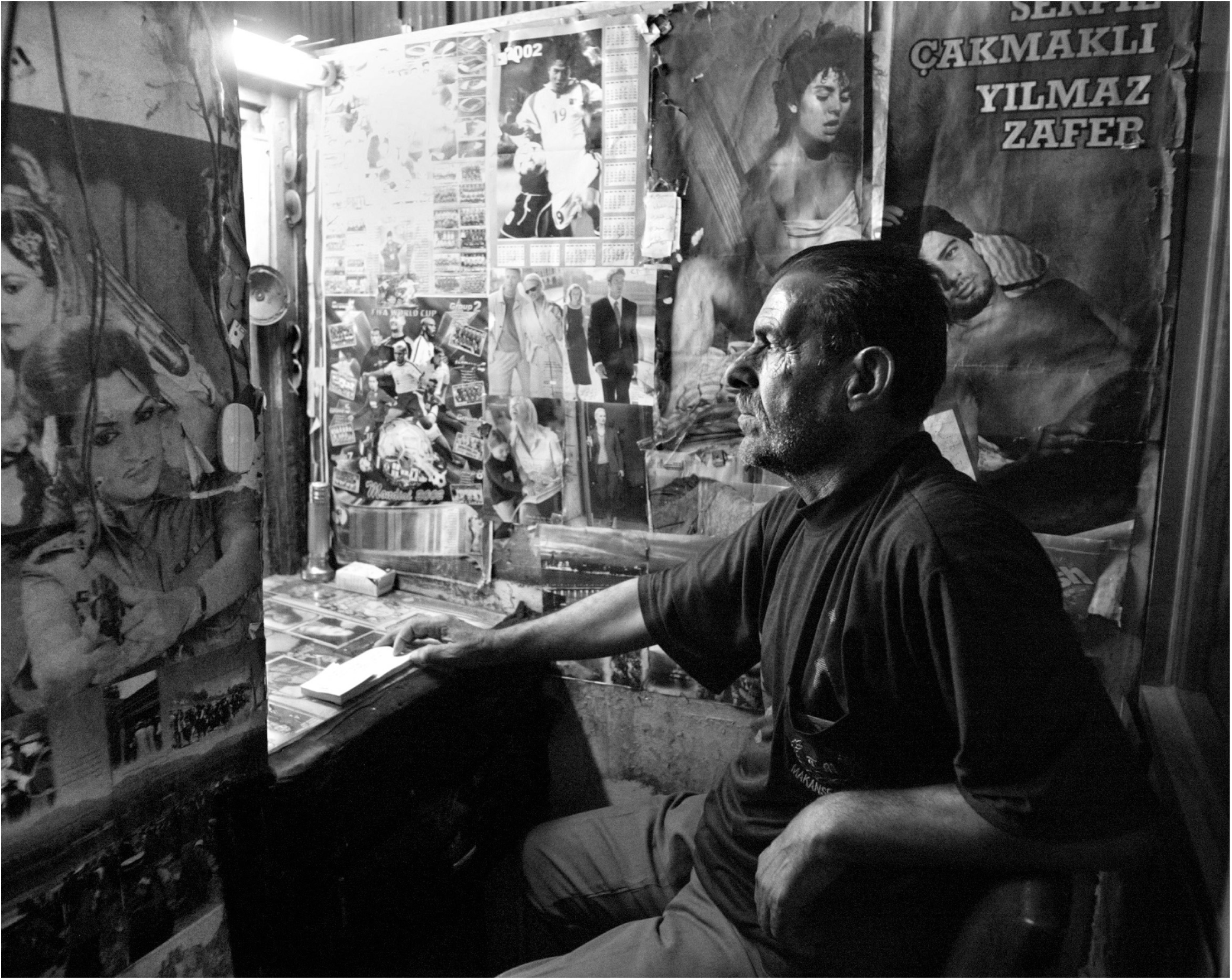
As for film-going, Iraq is now experiencing a resurgence after years of darkness – the result of the country’s many problems in the 20th century. The last light had been switched off on 1 August 2007 when the Semiramis theatre, a favourite of film lovers in Baghdad, closed its doors for the last time, along with the rest of the city’s cinemas. It was only the Kurdi Group’s investment in the Mansour Mall project in Baghdad, complete with multiplex cinema, in 2013 after US troops had withdrawn, that brought film (and also US productions) back to the Iraqi capital.
“We have made no more than 100 works of fiction since the 1940s,” explained historian Tariq Aljouboury, also a scholar who has written much on Iraq’s film scene.
Amateur directors were a large part of the industry. After the Ba’ath party came to power in 1968, the government built many film theatres but, as in all dictatorships, it used them for its own propaganda purposes. The resulting industry had limited freedom of expression in Iraq. “Today, Iraqi cinema needs investment and infrastructure if it is to be revived and develop in full.”
Iraq is at the dawn of a new cultural era – and the Al-Nahj festival, which was founded in 2014, is just the tip of the iceberg.
“Film-making in Iraq has had a 30-year sickness, but it has found a new home here. That’s why we have taken a gamble on Karbala and aim to turn it into a hub for both film-goers and makers,” said Hussein al-Hani, festival director and programme producer for Karbala TV.
Not far from the shrine, Karbala TV also has enormous recording studios in which it produces no fewer than seven short films a year. “We started screening films in 2014 but weren’t able to make it a public event that year. The Islamic State had just attacked Fallujah and spirits were low. This year, the festival is truly international. We believe Karbala can become a vital cultural centre for our country, second to none, including Baghdad.”
Al-Hani’s objective is clearly an ambitious one, but investments are flowing in as a result. The number and standard of the films in contention at the festival are proof of this, as is the quality of the judging panel, made up of film critics, directors and actors who have shaped the history of Arabic film-making over the past 40 years.
The chief judge is Mahmood Abu Abbas, an actor and director born into the Shia minority in Iraq but forced to seek refuge in Tehran during Saddam Hussein’s purge on his population. He returned to Iraq to be part of the industry’s revival.
In 2013, when Baghdad was named Arab Capital of Culture, the Iraqi Culture Ministry’s Department of Cinema and Theatre provided 12 billion Iraqi dinar ($10.3 million) to support the film industry and the production of short films, feature films and documentaries.
More investment of this type could see Iraq developing a film industry capable of competing in the international arena, on a par with Jordan, which is thriving largely because of the country’s Royal Film Commission. But opportunities are needed as well.
“It’s not just money which is lacking in Iraq... there is also a dearth of opportunities to study cinematography,” said Dirk Van Berg, a film producer who is a judge at the Baghdad Film Festival, which was revived in 2012.
“I still remember a young director I met back in 2013,” he said. “He wanted to make a short film about why he’d forgotten so much of his childhood, growing up in a war-torn country like Iraq. His script was exceptional, but young people like him don’t know how to turn their ideas into a film. This is the most difficult part of the process and there is still a lack of sensibility and the skills needed to develop a high-ranking film industry.”
This young man was Wareth Kwaish, now a refugee in Paris making independent films and working for a documentary production company.
But Kwaish says a lack of expertise is not the only problem facing film-makers. “We could make hundreds of short films in Iraq, but many important subjects are still taboo, such as political corruption, the violence perpetrated by party militias, the lack of freedom of expression young people experience, and the persecution of ethnic, religious and sexual minorities,” he said. “No one wants these films. If you make them independently, you can forget about screening them or submitting them to festivals in Iraq because they’re too uncomfortable for our country’s rulers. Winning an award for any of these subjects is absolutely out of the question because criticism of the authorities is not permitted. We’re stuck in a time warp of self-congratulation.”
The film that changed Wareth’s life in 2013 was not accepted at any Iraqi festival but was later screened in Amsterdam, then in Paris. Once They Were Here was filmed entirely on an iPhone and tells the story of four young Iraqis, three men and a woman, who join a city centre protest against the government in Baghdad.
A man armed with an AK-47 guards a cinema in Baghdad, 2003, following warnings not to play erotic movies in cinemas
CREDIT: Jamal Saidi/Reuters
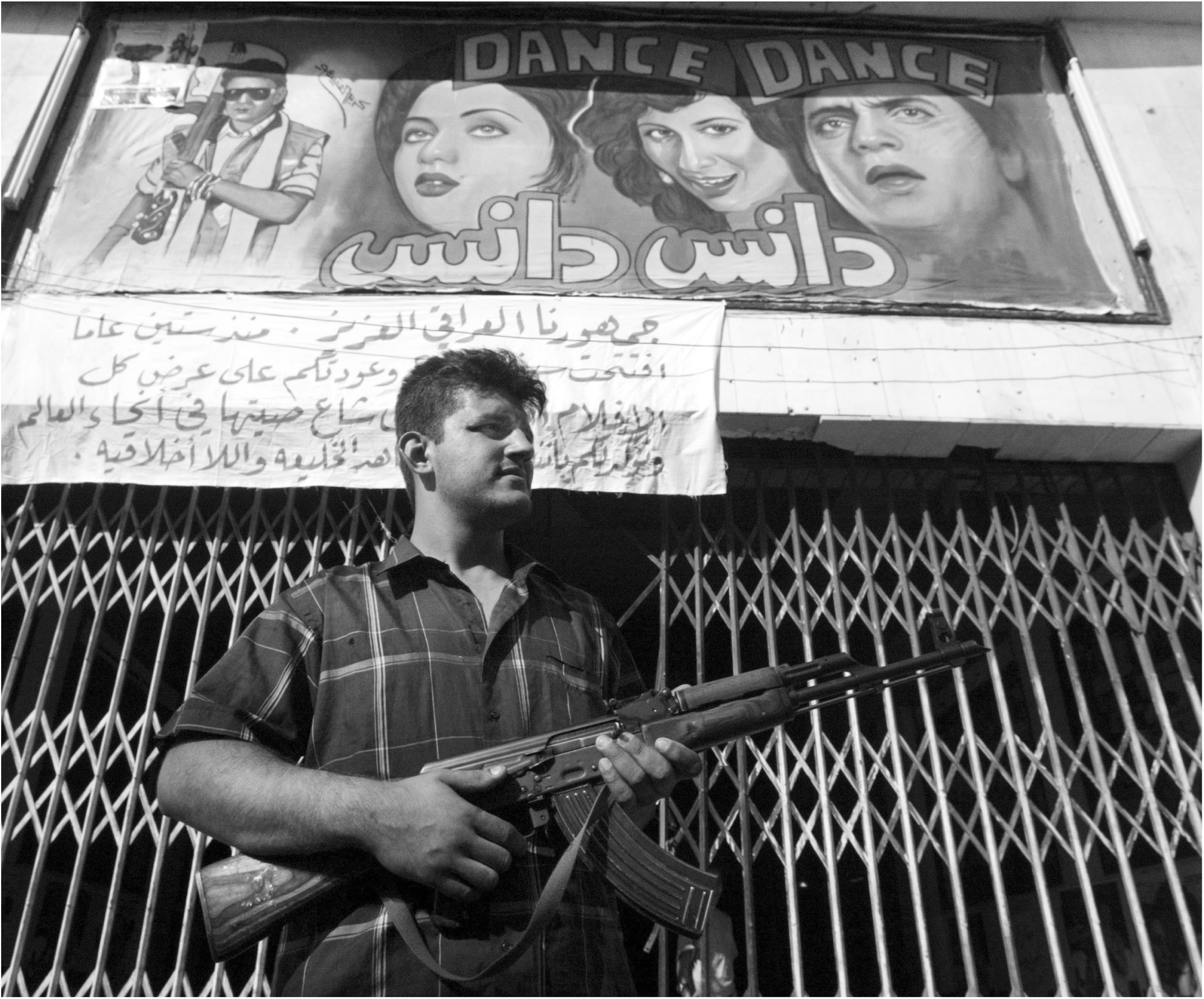
“I received death threats. That’s why I did everything I could to escape to Europe where I applied for political asylum,” he said. “Here in France, I now feel free to tell any story I like about my country.”
The independent film-making scene in Iraq is varied, offering everything from iPhone productions tackling political issues and shot by students, to costume dramas with a budget. The majority of the short narrative films are 3D animations with epic themes and reality films almost always feature Iraqi soldiers as protagonists.
They are seen as heroes and Hussein al-Hani explains that this is done to celebrate them.
On the subject of Iraq’s penchant for animated films, he added: “I am 40. I belong to the generation that grew up watching Japanese cartoons translated into Arabic. They were hugely popular. Having gone many years without a properly functioning film industry, animated films were one of the few tools we had which were also low-cost and highly imaginative, at the same time as large numbers of young people were becoming talented in using 3D programmes and inventing characters.”
Such is its influence that the symbol of the Al-Nahj festival – a genie in the lamp which also looks like a Shia Mullah – interacted with the festival presenters in a larger-than-life case of augmented reality at the service of entertainment.
Footnotes
Translated by