



Abstract

What could the pro-choice activists in Argentina learn from those who won their battle to legalise gay marriage, asks
The two had met in the 1970s in Colombia, when both of them were married to men. When they met again, Castillo was a widow and Arévalo had divorced. They fell in love and eventually moved to Argentina, Castillo’s home country.
Their fight to be married became one of the symbols of the movement in favour of same-sex marriage and mobilised the population in favour of the historic legislation.
“They were elderly and wanted to get married. They had come out of the closet, their children supported them. They started mobilising people,” said Juliana di Tullio, a former congresswoman who was president of the Commission of Women, Family and Childhood at the time. “There was no way they could be seen as offensive and they created empathy among people.”
The visibility and diffusion of stories such as Castillo and Arévalo’s was not accidental. It was part of a well-thought-out strategy to create support within the whole of society, beyond the LGBTI community.
“The important thing was to tell life stories to the general public,” Maria Rachid told Index about the same-sex marriage bill. Rachid is the founder and former president of the Argentine Federation of Lesbians, Gays, Bisexuals and Transsexuals (FALGBT), which was born in 2005 as an umbrella group for LGBTI organisations in the country. The federation’s main objectives were to obtain same-sex marriage and a gender identity law. It had a clear communication strategy, which it developed in parallel with a legal strategy and a legislative agenda.
As part of the legal fight, in 2007, Rachid filed the first same-sex couple request for marriage in Buenos Aires, at a time when there were no legislative provisions for marriage equality. This action jump-started legal proceedings that paved the way for the legislation but, more importantly, it also created repercussions socially.
“With our personal stories, we brought to light the concrete need of same-sex couples to be married, to have the same rights as other couples,” said Rachid. “We were not talking only about the right to get married – we wanted it to be called the same.”
Rachid says their campaign, Same Rights, Same Names, was inspired by the fight against apartheid in South Africa.
The Catholic church put up a fight. Pope Francis, who is Argentine, was then Cardinal Jorge Mario Bergoglio and he called the political movement to achieve same-sex marriage a “destructive attack on God’s plan”.
“It is not a mere legislative project but a ‘movement’ of the father of lies that seeks to confuse and deceive the children of God,” said the cardinal in a letter.
“The church appeals to the existential fears of people,” said Rachid. “They have no coherent arguments. It is ridiculous to say that ‘marriage’ (matrimonio in Spanish) comes from the word ‘mater’ (mother in Latin), and if there is no uterus, there is no valid marriage.”
Esteban Paulón, FALGBT vice-president and under-secretary of sexual diversity of the province of Santa Fe, in central Argentina, said: “There was a semantic battle, and we clearly won it. The opposite front spoke of perversion, paedophilia, disease. We spoke of family, life, love. We ended up with all the nice words. We gave visibility to the stories that we knew were going to create a greater impact.”
Campaigners say that a key element in gaining more ground within the whole country was to get more people involved outside of Buenos Aires. This was possible thanks to a motion from the anti-gay marriage politicians that backfired: their argument was that only middle-class people in big cities were interested in gay marriage, and called for public audiences of parliament to be held in each of the country’s provinces.
A pro-abortion campaigner holds a banner reading “Legal abortion and free now” at a recent demonstration in Argentina
CREDIT: Protoplasma K/Flickr

“At the beginning we were afraid because we knew that the Catholic church was much stronger in the provinces,” said Rachid. “But marches started popping up in response to discriminatory remarks.” Eventually these new spontaneous groups of gay rights activists joined the FALGBT. This allowed the federation to have more members everywhere, and for politicians to understand that gay marriage was widely accepted in the country. The legalise abortion campaigners made a parliamentary motion to create the same public debates throughout the country, but the motion was rejected. “Unfortunately we did not manage to consolidate our campaign so strongly in such conservative provinces,” said Augsburger.
A couple kiss outside Argentina’s congress during a rally to support the legalisation of same-sex marriage, Buenos Aires, 2010
CREDIT: Natacha Pisarenko/Rex
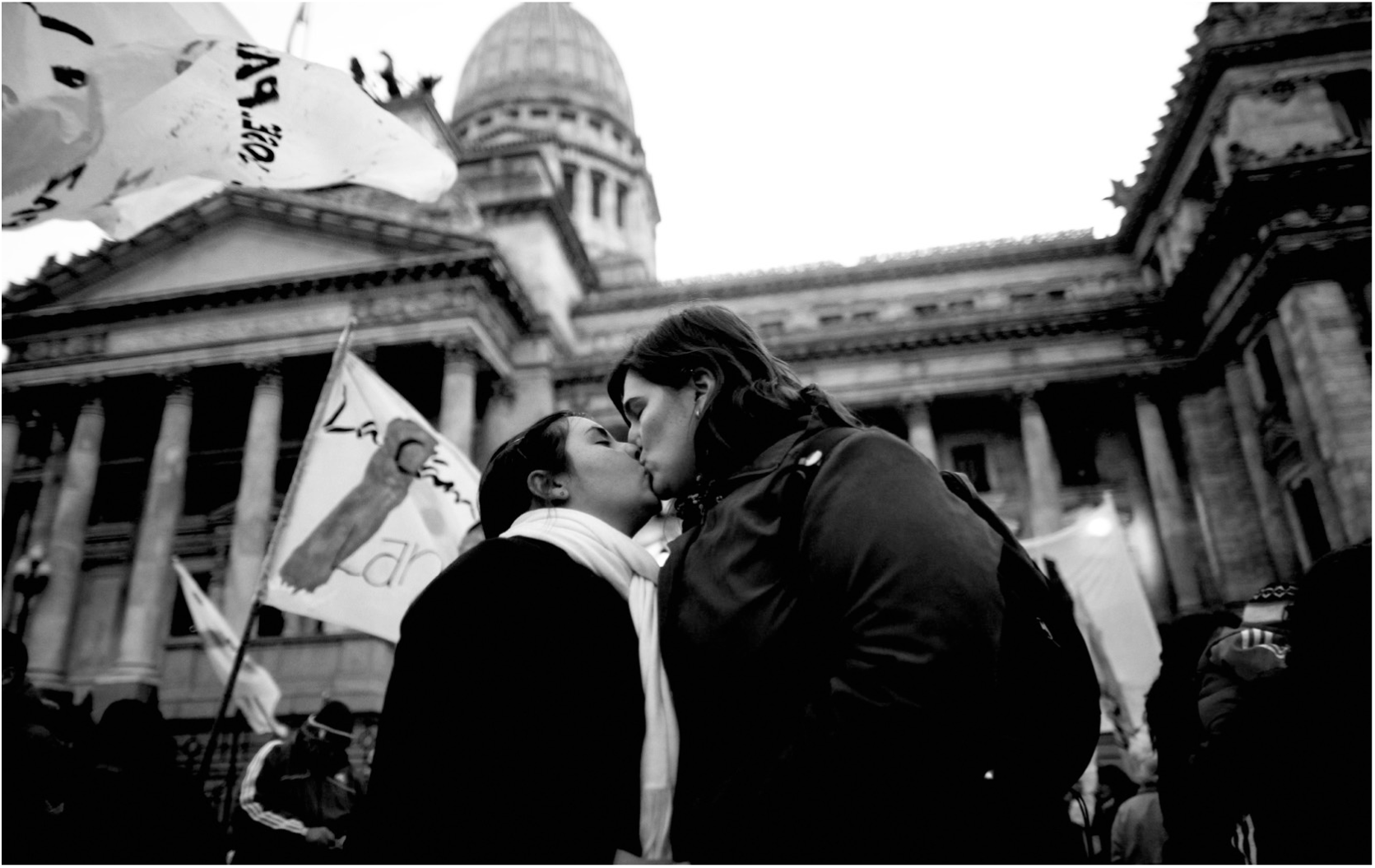
The campaign eventually succeeded, with the conservative senate backing the bill by just six votes on 22 July 2010, as thousands of people held a vigil outside congress.
Argentina became the 10th country to approve gay marriage, and the second Catholic one after Spain. It set an important precedent in the region, with Uruguay and Brazil following suit in 2013 and Colombia in 2016.
The recent fight for the legalisation of abortion in Argentina, and the opposition to the law, equally tried to appeal to the emotions of voters but failed to win legislative change.
The bill was aimed at making abortion legal up to 14 weeks but, on 8 August, the senate narrowly rejected the bill, which had been previously approved by the chamber of deputies. Pregnancies in Argentina can be ended legally only in the case of rape or if the mother’s health is at risk. If a woman or girl has an abortion for other reasons, she does so illegally and at great risk.
As in the fight to approve same-sex marriage, massive protests were organised during the run-up.
Sebastián Salinas, a 21-year-old philosophy student and LGBTI activist, remembers being in the streets in 2010 as congress was voting on the marriage law.
“It was very similar to what is happening now with the abortion legislation,” he said during a march to legalise abortion. “There was the same feeling: the same sense of solidarity among people. You can’t obtain such a law without the support in the streets, [or] if the whole of society does not mobilise.”
But the life stories that created empathy for the same-sex marriage bill were harder to find when it came to legalising abortion. The debate around abortion didn’t lend itself to the feel-good stories of those concerning marriage.
Silvia Augsburger is a former congresswoman who introduced the same-sex marriage bill in parliament and also introduced another unsuccessful bill to legalise abortion in 2008.
“Appealing to the emotions was vital,” Augsburger told Index. “Personal life experiences worked really well in supporting the cause for same-sex marriage. Many people felt they identified with those testimonies. But in the case of abortion, which is a crime, it is not so easy for people to tell their life stories.”
Augsburger also points out that many of the victims of unsafe abortion are of lower classes and come from provinces away from Buenos Aires. “Poor women are not represented in parliament and those who are involved are not affected by the issue.”
Non-governmental organisations say that 500,000 illegal abortions are performed in the country each year. Government data suggests that they are the leading cause of maternal mortality in Argentina, with 43 deaths registered in 2016 – more than 15% of the 245 recorded deaths.
“The scientific evidence in favour of legalising abortion is overwhelming,” said Paulón. “If voting happened rationally, it would be a no-brainer. But there is an issue of faith and emotion, which is where we try to put up a fight.”
The Catholic church, which led the anti-abortion legislation camp, took a clear and very emotional stance. In June, Pope Francis denounced abortion, equating it to Nazi-era eugenics programmes. Organisers used “Let’s save the two lives” as a slogan. In their marches, they carried giant plastic babies and handed out 5cm plastic images of foetuses, arguing that life starts in the uterus right at conception and abortion is a form of murder.
Arguments, masquerading as scientific, were used. During a senate hearing on the bill, for example, renowned paediatrician Abel Albino gave a presentation against abortion. Among his controversial statements, he argued that condoms didn’t offer protection against Aids. “The Aids virus goes through porcelain,” he said, adding that it can therefore pass through condoms. His remarks were quickly knocked down by the scientific community, but they showed how the debate around abortion became mired in deep ideological differences that transcended scientific reasoning and the actual issues of the debate.
“They have lied, systematically, appealing to people’s fears,” said former congresswoman Augsburger. “Albino’s statements are the tip of the iceberg, [and] lies have been told systematically. Even their slogan, which appeals to the defence of two lives, is a lie: criminalising abortion doesn’t save the mother or the foetus.”
Norma Castillo (left) and Ramona Arévalo, both 67 at the time, after their civil wedding in Buenos Aires, 2010. They became the first gay women to marry in the country
CREDIT: Leo La Valle/Rex

Ultimately, campaigners say that the support of the executive branch is crucial when it comes to making a campaign turn into legislation. In the case of gay marriage, campaigners had the staunch support of then President Cristina Fernández de Kirchner. She went as far as inviting two senators who were against the legislation to a trip to China so that they would miss the vote.
But President Mauricio Macri has declared he is against abortion. Campaigners say that the only way to turn the executive in their favour is to put more pressure on politicians with actions in the streets. “Democratic parties always feel the pressure of the street,” said former MP Di Tullio. “Any politician is afraid of massive mobilisations.”
The battle, however, is not yet over. Women’s rights activists have pledged to continue the fight and they might well use the inspiration of how the gay marriage law was changed to adapt their tactics for the future.