



Abstract

The picturesque seaside town of Ostia has escaped the mafia reputation of Sicily, but not the mafia itself.
A half-hour drive from the Colosseum in Rome, this Italian town with a population of 230,000 is where rich footballers set up homes and where Romans have gone on holiday since ancient times. But this relaxed resort is also home to dangerous criminal organisations. People struggle with poverty, they lack access to social housing and three (known) criminal gangs fight over control of the territory. In this environment, journalists are far from safe, as Angeli attests. She is currently under 24-hour police protection.
Angeli was born and raised in Ostia, where she started her career 22 years ago working for a local newspaper. For the past two decades, she has been a crime and legal reporter for La Repubblica, Italy’s secondlargest newspaper, writing on articles from clandestine dog fights to the illegal arms trade in Rome.
Her troubles started in 2013, when she began an investigation into the criminal organisations operating in Ostia. She did so at a time when the public thought the mafia only came from southern Italy, and the judiciary was only scratching the surface of Rome’s criminal activity.
“Mafia in Rome did not have a name,” said Angeli. “If you don’t name something, you cannot recognise it, you cannot identify it.”
Angeli had been witnessing an increase in criminal activity on her doorstep and decided to find out more about the contracts of beachside lidos, which were being investigated by the judiciary. In May 2013, as she was reporting, Angeli was briefly kidnapped by a member of the Spada family, Armando Spada, who threatened to kill her and her three children, now eight, 10 and 13. She reported the incident to the police and Spada was initially charged with violent threats, but on 15 May a judge pressed more serious charges against him. Spada is now being investigated for violent behaviour, and could face up to four years in jail.
Days before her investigation was due to come out in La Repubblica back in 2013, Angeli woke up in the middle of the night to a woman’s screams and the sound of gunfire. When she went to her balcony to investigate, she recognised two members of the Spada clan escaping. She filed a witness report to the police and was told that her witness account could be key in bringing charges against the clan. The trial is ongoing and a sentence is expected in November this year. As a result, since 17 July 2013 she has been living with round-the-clock police protection.
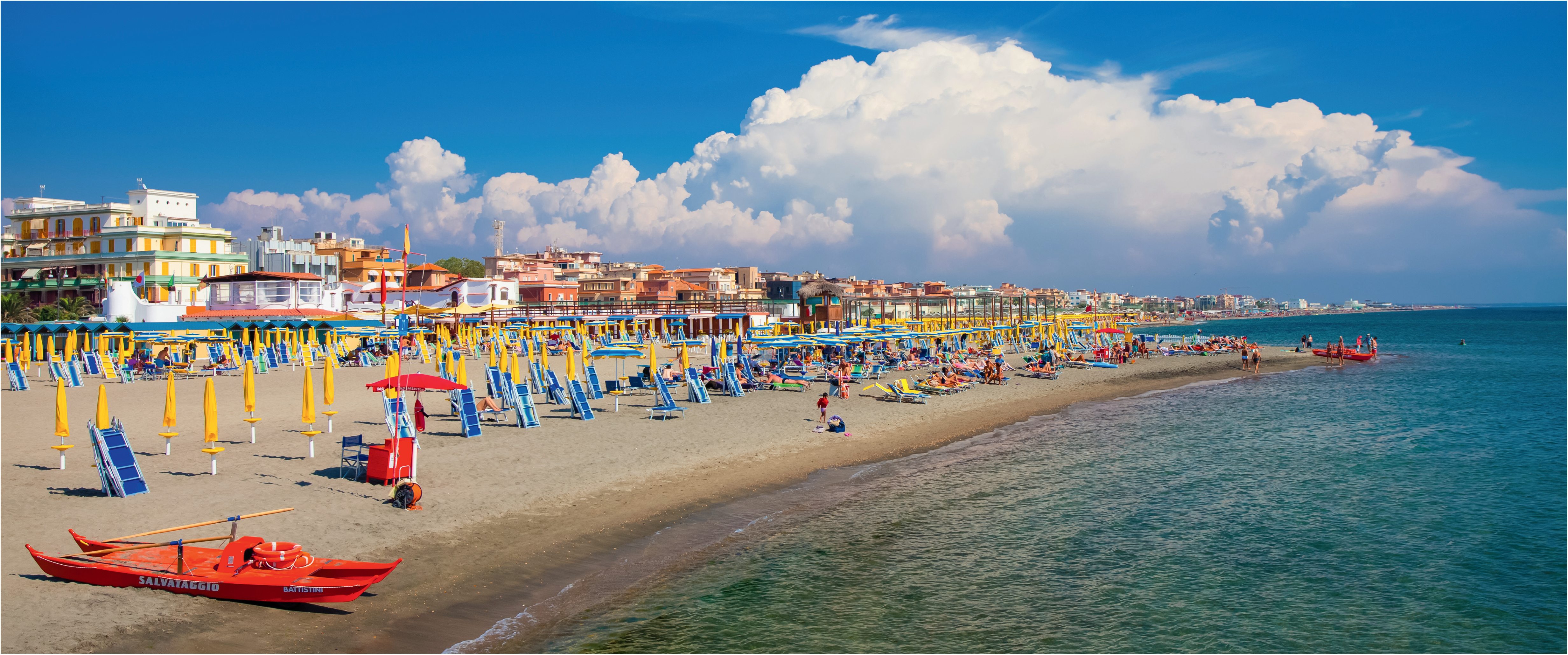
The beautiful beach of Lido di Ostia, in Ostia, near Rome
CREDIT: zazamaza/iStock
Angeli has received many threats over the years. Members of the Spada clan went around her neighbourhood saying she was an infame, the word used by the mafia to indicate those who betray them. She was also attacked on social media, being told that she should be thinking about her children.
“These are phrases that are reserved for women,” she said. “The fact that a woman was confronting the clan represented a double disgrace.”
Once, despite the police protection, inflammable liquid was thrown into her flat, but she managed to wipe it up and keep her children calm by telling them it was a game.
“I told them they could not get their feet wet and we had to catch the liquid quickly,” she said. She found inspiration from the film Life is Beautiful, where the character transforms life in a concentration camp into a game for his son’s sake.
She admits she almost gave up, but says she kept going because she felt the support and solidarity of many neighbours. People she had never talked to before started coming out little by little and telling her about how the clans were demanding protection money and threatening local businesses.
“You realise that something is not right when you see that these people are turning to you for help,” said Angeli. “It should be the state who should protect them. What can I guarantee them?”
Her work and her personal sacrifice brought attention to the story of Ostia. There was even a Netflix series released in 2017, Suburra, which shows the underbelly of the resort. In January this year, police in Rome arrested more than 30 members and affiliates of the Spada family on charges of extortion, loan-sharking and drug-trafficking.
Other journalists have been caught in the violence. In November 2017, Roberto Spada head-butted Rai TV reporter Daniele Piervincenzi, breaking his nose, then chased the film crew away with a baton. Cameraman Edoardo Anselmi was also hit in the head, but continued filming. Piervincenzi was reporting on the alleged relations between politicians and the Spada family ahead of local elections.
In May 2018, another Rai reporter, Nello Trocchia, was attacked while filming the arrests of the Casamonica family, charged with being allied with the Spada clan.
Criminals are not the town’s only demons, says Angeli. Some politicians try to discredit the work of reporters and she worries that Italy’s current political situation will leave her and other journalists isolated and exposed.
Italy has faced a reshuffle of political forces over the summer after its latest elections, held in March, ended in stalemate.
With Italy’s new prime minister Giuseppe Conte now confirmed, it is worth remembering that the Five Star Movement (M5S), a part of the government, has been vocal in its criticism of the media and has repeatedly named journalists of whose work it does not approve. Beppe Grillo, the comedian who founded the movement in 2009, set up a column known as “Journalist of the Day” on his popular blog. There, Grillo would copy and paste excerpts of articles that he thought portrayed M5S in a negative light. In 2015, Angeli became the victim of an M5S campaign after two local politicians reported her to the anti-mafia commission saying she had backed a left-wing politician who had been later arrested on charges of corruption.
Matteo Salvini, the leader of the far right League, also part of the new government, has railed against journalists. For example, he tweeted that he would remove the “useless police protection” of Roberto Saviano, the author of Gomorrah (an investigation into the Neapolitan Camorra), who has been under protection since 2006, if they got elected.
“My fear is that the threats of these political groups could lead to substantial worsening of our freedom,” Angeli told Index.
Reporters Without Borders ranks Italy at 46 in the World Press Freedom Index, a big advance over the past few years, but it warns that the level of violence against reporters is “alarming and keeps growing”. Last December, the ministry of the interior announced that more than 150 journalists received police protection in 2017, while 19 reporters were under round-the-clock police protection. The majority of them work in Rome, a clear sign of the elevated danger of criminal organisations in the Italian capital. In the same month, the ministry of the interior established a “consultation panel” on threats against journalists, with the participation of trade unions and other organisations that represent journalists – the first time a meeting of this kind has happened in Italy.
Federica Angeli speaking on a panel about journalists under threat at the International Journalism Festival 2018, Perugia
CREDIT: Diego Figone/International Journalism Festival 2018

“In Italy, people have got used to the fact that journalists need police protection,” said Angeli.
Though worried about the lack of political support, Angeli has not stopped working. On 6 May, her latest book, A Mano Disarmata (Unarmed), was released. Shortly afterwards, she did a video report for La Repubblica where she showed that villas seized by the state in Ostia from the Casamonica family are still inhabited by members of the clan.
She says it is thanks to the support she receives from her family, fellow journalists and readers that she can keep going.
“Thankfully a powerful ‘us’ was born,” she said. “Without that support, I would not go anywhere. This has helped me get through the hardest moments.”