




Abstract

Novelist and playwright
Georgian author Lasha Bugadze
CREDIT: Leli Blagonravova
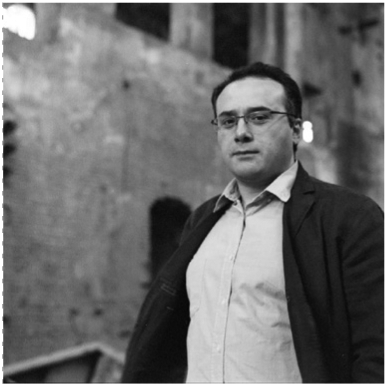
“I started writing absurd genre plays.
Sometimes absurd is very logical for Georgians,” said the author, whose play The President Has Come To See You was performed at London’s Royal Court, as well as theatres around the world. He also wrote the satirical play Putin’s Mum about the mysterious Vera Putina, a Georgian woman who, since 1999, has claimed Russian President Vladimir Putin is her lost son.
Bugadze said his first creative foray was via cartoons. He began drawing in his childhood, when Georgia was still part of the Soviet Union, to take issue with the controlling regime. From cartoons he went on to experiment with other styles of writing.
“My first play was performed in 1998, when I was 20 years old,” he said. “My first novel was published in 2005. Writing became my profession.”
As an artist, he is no stranger to controversy and knows what it is like to feel the establishment rallying against him. It did so when he published his satirical tale The First Russian, which played with a storyline about the relationship of the 12th and 13th century Queen Tamar of Georgia and her Russian husband.
“My small satirical novel became very scandalous. Some parliament members believed that I had insulted Georgian history and Queen Tamar. Orthodox members of the patriarchate (the office of the Georgian church) were outraged. Some of them called for me to be banished.”
One of the themes in his new novel, Little Country, of which we publish an excerpt below, is the power of religion.
“In the Soviet times, religion was repressed, then [after Soviet times] the church gained influence on society and [it] became a state within the state,” he said. “My novel is about this… It is about hate of love, competition for power and populism.”
Today he feels optimistic about the environment for writers in Georgia, despite the possibility of the introduction of a new blasphemy law that could lead to prosecution for offending religious feelings.
His novel, with its consideration of recent Georgian censorship, has been published by a Georgian publisher. “Georgia is a democratic country and we have freedom of speech. Fortunately, it’s a very fundamental right for Georgians,” said Bugadze.
That said, he added, “Sure, society is [more] open now than before, for example 18 years ago, but we still face lots of challenges, and the main challenge is Russia and the danger coming from Russia.”
The five-day invasion of 2008 is still in his mind and, speaking to Bugadze, while he no longer lives under the watchful eyes of
the Soviet Union, he worries that Russia still exerts its influence in the country, through politics and the media. Perhaps material for his next piece of work, whatever form it may take.
Little Country
BY LASHA BUGADZE
Georgia’s history was staring at us from a gigantic modern fresco: life-size figures, churches and monasteries and the easily recognisable Georgian glaciers.
It seemed as if a gigantic chorus, consisting of saints, kings and queens, was waiting for us, together with the Patriarch. The grim faces, depicted realistically by a modern artist, were looking fixedly at us with identical expressions so that you felt they were all twins, or pictures of the artist himself who, wittingly or unwittingly, had made everybody look like himself.
The saintly kings and queens had healthy, proud faces; some of them, those who stood a little lower with their arms crossed as tradition dictates, had their round faces and double chins lit up by thick candles stuck into tall candle holders. Above them, the golden crowns of the second rank of kings shone in the light of the chandelier. Somewhere in the middle stood David IV ‘The Builder’, holding Gelati church in his hand, while next to him was a copy of another ancient fresco – the three-metre high Queen Tamar from Vardzia, holding out her hands in imprecation to a gigantic George III.
From where I was standing I could see, behind everybody else, the shadowy angry face of one of the kings, possibly Bagrat III. In any case, I looked for a while at Bagrat staring from the murk, at his kitschy-realistic grim face, and finally at the living contrast to this fresco, the smiling Patriarch whose head was just slightly inclined to the right.
A familiar smile, which I had become used to as a child and which was now part of me.
I wondered, should I kneel down?
No sooner had I approached than I bent triple.
I had the illusion that someone was whispering to me: “Kiss his hand!”
The Patriarch’s hand quivered slightly.
Suddenly I remembered that I had been told by someone that the Patriarch, when he didn’t wish his hand to be kissed by someone bent over him, withdrew his wrist into the sleeve of his surplice: you bent down and the hand vanished. He didn’t want to be kissed, and that was the end of the matter.
I poked my face somewhere between his sleeve and his wrist.
“Aha, our troublemaker-in-chief has come,” said the Patriarch, and smiled his familiar smile again.
The fresco went dark. So did the grim, swarthy Bagrat III, and all the others looking at us from the wall. It was now that I saw three priests or monks in black surplices standing behind the Patriarch’s armchair: among them, as I found out later, was His Holiness Kristepore; on the left of the armchair was Father Tadeos, Koba, who commented on the text of two announcements from the time when I had first visited, and the secretary Khatuna, who was holding The Epoch of Freedom, which I thought I had left in the reception room but was now here.
There was a television in one corner of the hall, and you could hear a stage song coming from it: an unlit Andrea Bocelli was singing on television.
We sat down in two low armchairs.
The Patriarch watched me with a bewildered smile, his slightly open mouth and apparently out-turned thick lower lip made his face seem even more bewildered.
“How are you?” I heard him ask very quietly: in fact the sound was made by his moving lips, not his voice; and I realised that I had to be very alert if I was going to catch his words.
“We’re worried, Your Holiness,” My Father replied, even more quietly, with exaggerated humility.
The Patriarch did not respond; he adjusted his spectacles with trembling hands and turned barely perceptibly to his secretary.
“Is he here?”
“Yes indeed, Your Holiness,” she nodded to him.
“Come closer,” the Patriarch told me.
“Go up closer,” the others whispered to me: they repeated his every word like an echo. I went up as close as I could (my big armchair seemed to me to be nailed to the floor).
The secretary laid a magazine that had been opened, probably deliberately, at a specific page on the Patriarch’s lap; the old man once again adjusted his silver-framed spectacles, which were slipping down his nose, and followed the words with a trembling finger.
“Explain it to us, would you?” He gave me a sidelong glance, as if his neck hurt and he had trouble straightening his head up.
I looked at the magazine: a few sentences were underlined in red.
“What have you written here?”
The secretary bent down again, picked up the magazine cautiously and somewhat awkwardly, as if picking up a magazine demanded a certain amount of effort from her, and then called on me.
CREDIT: Alex Green
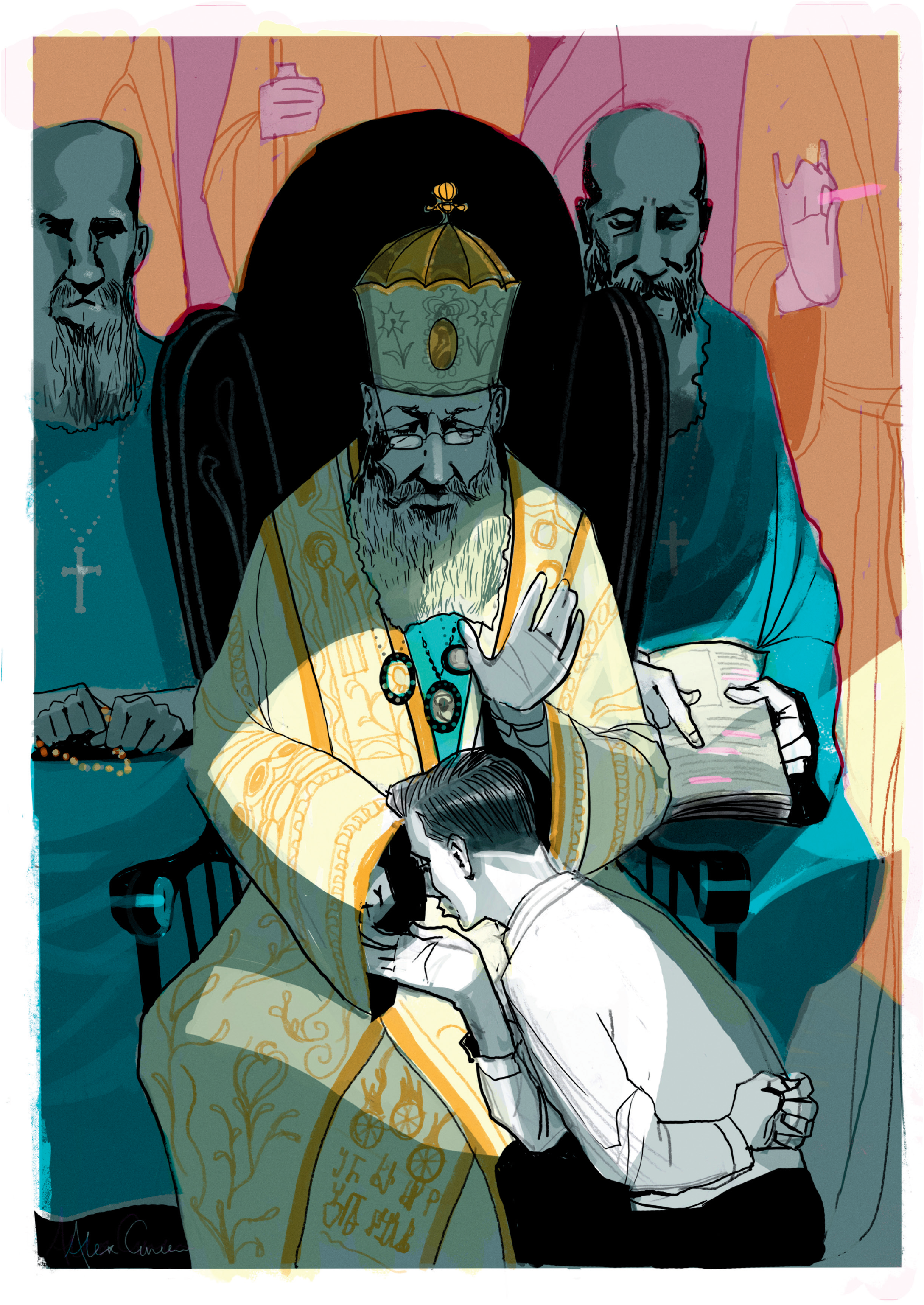
“Read it,” the others urged me. I looked up at the Patriarch. His face was bewildered, his mouth half-open, and he was looking at me as before. “Read it,” I heard behind me.
“Read it,” I heard behind me.
“Which bit? The bit underlined in red?” I tried to smile, but I managed to look up, encountered the faces of the angry Bagrat III or Bagrat IV, and looked down at the magazine again.
“Yes,” Khatuna told me.
I read: “Now let us say, Our Father…”
I didn’t know whether I should have read it again or not. Or why I should read it. I felt as if I was taking an examination.
I fell silent.
Suddenly the Patriarch spoke up again, more quietly than the silence around him:
“Why do you make fun of that prayer? We say Our Father every day, don’t we?”
He spoke with such a sense of grievance and so sadly that I was suddenly terribly worried. I felt embarrassed – not by what I had written but by him, an old and kindly man whom I had unwittingly offended.
“Why do I make fun of it?” I repeated his question like a pupil, and I looked at My Father. Perhaps it was better if he answered instead of me. No, it turned out that I was the one who had to answer all the questions (or I was induced to do so)…
“I’m not making fun of it, I myself say Our Father every day, Your Holiness.”
I said “Your Holiness” and I was amazed, because my own voice sounded alien to me.
Couldn’t someone have switched off the television sound? It occurred to me that here they did this on purpose, to block out speech. Someone told me that when the security services are listening in, you should have everything turned up loud: the radio, the television, music… This Patriarch had always been listened in on. Probably even now the Patriarch was aware of it and that was why nobody switched off the television. Maybe that was now a tradition. Complete silence was forbidden in his office.
“It’s our prayer,” he continued gravely, but sweetly, each syllable distinct. “It is a powerful prayer.”
The old man adjusted his spectacles (which had not slipped down, but which he probably thought had slipped) with the same gravity and caution, and looked at my magazine.
“What is this supposed to be?”
“Oh dear,” I thought. “If we’ve sunk to the point where Yuri the Russian has sex with a broody hen, things are going to be very awkward.”
Khatuna stood next to me and, apparently, began looking for the extract she needed. It may have been her who had been wielding the red pen.
Once again I glanced at My Father and at Dato the First. I hoped I had really convinced him and removed the irritating episodes.
Further down, a phrase where I described the Georgian monarch’s backside had been underlined in red. Why had I written that idiotic sentence! No, there was no way I could read it out now…
“You read it,” I asked Khatuna. “I’m embarrassed to do so in His Holiness’s presence.”
My Father, Dato the First and Father Tadeos laughed quietly, sympathetically, with a desire to support me.
“Then why did you write such a thing? Aren’t we a beautiful people?” the Patriarch said, looking up at me.
He knew what it was that I couldn’t read out. All the same, did I have to describe the physical attributes of Georgian women in the presence of his Holiness and His Blessedness? No, Your Holiness, everyone has the same backside – sport and a healthy diet do the job.
“Queen Tamar was beautiful,” the Patriarch continued. “Why did you write like that? Many people have been offended. Shouldn’t a writer see the beautiful in a human being? Especially in such a glorious monarch…”
He had an odd way, obscure and sugary, of pronouncing his ‘shs…
It was strange: an elderly Patriarch was defending Georgian genes from me. It was as if in his person Georgia was defending the physical and spiritual attributes of Georgians.
I didn’t know what I should do. Should I have apologised? If only someone would come to my aid. How, and on what grounds should I be debating with an elderly Patriarch talking to me about the beauty of a 13th century queen?
“Her eyebrows were joined together, as in the fresco,” the secretary read out.
“Which fresco shows they were joined together? The Gelati or the Vardzia ones?” the Patriarch asked with the same amazement. “They’re not joined on our fresco,” he smiled. “You should have looked first and then written.”
A young, energetic woman was looking out at us from the fresco: a neo-Georgian copy of the Vardzia Queen Tamar.
“She has remarkable eyebrows, remarkable,” whispered My Father, who had decided to help me. “They’re very artistic.”
“It’s your fault, Giorgi,” the Patriarch turned towards him. “You should have taught him properly.”
On television a folk ensemble had begun dancing.
I looked behind me. A bodyguard was standing by the television.
My Father instantly blushed. Because he felt insulted, not because he was embarrassed by the Patriarch, not because he was worried about me, but by a feeling of superiority; he wanted to say something with emphatic arrogance, because, in principle, he didn’t consider the Patriarch to be any sort of authority, even though, obviously, he was sitting there quietly and, his face bright red, listening to a rebuke.
“There was something else,” Khatuna said, and bent over my head like a schoolteacher. She pointed out a particular paragraph with her finger and whispered with a smile, “Here…”
The Patriarch couldn’t grasp what his secretary meant, so Khatuna reverently, with the same fixed smile, but with more precision, commented again:
“The chapters are numbered backwards, so you have to leaf through the pages backwards, and that has upset some people.”
The old man, his head leaning to one side, looked at me expectantly. I could see curiosity in his eyes.
I think they were very bored and were amusing themselves with me.
I bent my head in exactly the same way as he had, because I thought for some reason that he would understand my words better if I wasn’t sitting upright.
“It’s a literary game,” I said. “It’s a post-modern text.”
The word “post-modern” sounded in this hall as if I had belched or pronounced an obscenity out loud.
The face of the bushy-bearded Sanctity (probably Kristepore) standing behind the Patriarch expressed reproach: he looked just like the figures on the fresco.
“These -isms are terrible,” said the Patriarch.
“He means the modern trends in culture, Your Holiness,” My Father spoke up in my defence.
“That was how the communists used to persecute us,” the old man looked at him. “Our clergy and our churches and monasteries suffered very badly because of them. They swore at the priests and mocked the Christian saints. We have to talk about this, young people don’t know about it. All evil begins with mockery. First, people express contempt for things, then they get the people used to the idea that the holy and the valuable are nothing, and finally they moved to destroying the clergy and the pure at heart.”
Those standing behind him expressed agreement silently by synchronised nods of their heads. The dozens of saints on the fresco confirmed the truth of what the old man was saying.
Father Tadeos was looking at me as if these words were coming from his lips, not from the Patriarch’s.
“Yes indeed, I know, Your Holiness,” I said quietly, although I badly wanted the time to come to make my own complaints and to talk about the people, the unidentified persons and the legendary thugs from Akhaltsikhe camping outside my house in support of the Patriarch. Ever since childhood I had listened to these stories of priests tortured and shot by the Bolsheviks, and in particular about one priest who had been shot in 1983 for hijacking an aeroplane and who had, unlike my godparent, not actually been on the plane…
“Such thoughts are bad,” said the Patriarch, looking at those sitting next to me. He looked at them for a short while, as if he expected a response from them, then he turned to me. “What did you have in mind? Why did you write about Queen Tamar?”
Why had I written? What the hell, I didn’t know. Did my answer affect anything? I felt again almost as awkward as I had a long time before when my grandfather tried to find out the bad word which a football trainer had said to me. Actually, why did the queen have such an unsportsmanlike body? But what sort of body should she have had? Long legs and a narrow waist? Would that sort of joke be allowable?
“He’s a very patriotic lad, Your Holiness,” My Father suddenly joined in. “There is a sort of misunderstanding, when someone shouts out loud to us that they are to be considered patriots: actually, they are chauvinists. There’s no difference. I remember, once the school was given a day off on 26 May and it was the birthday of one of the pupils and they spent all their money on a taxi and went all round town with flags of the First Republic… It was 1988, or 1989 and they were just children, that was a different generation…”
This story made no impression on the old man. He couldn’t sense in the slightest what we had experienced or how, and he wasn’t interested in what I was frightened of or whether anyone was really threatening me. He was somewhat distant, cold in fact, and he seemed to be expecting us to say, do or become something else, so that this evening would be memorable not just because of what was on the television.
Why had I written it? I was expected to answer.
The Patriarch’s head drooped as if he was plunged in thought or had gone to sleep.
“Tomorrow there is a session of the Synod,” Father Tadeos, who was standing behind him in the darkness, said in a low, but assured and succinct voice. (It was too dark for his face to be visible, so that one had the impression that one of the kings or queens on the fresco had spoken.) “People are upset. You have to make a public apology for your story, or you will have to answer to the irate parishioners.”
For some reason I thought that this was a point when only the Patriarch should have spoken and I was almost astounded when I heard Father Tadeos’s voice.
“Yes,” the Patriarch agreed quietly, and lifted his spectacles.
And I suddenly realised, or rather it was revealed to me, that if anyone was expecting something, it wasn’t my response, my penitence or my apology, but the Patriarch’s questions and firmness.
Now they were looking at him, not at me.
Footnotes
Translated by