




Abstract
Argentina’s government still tries to gloss over the battle which wiped out the majority of its indigenous population, says
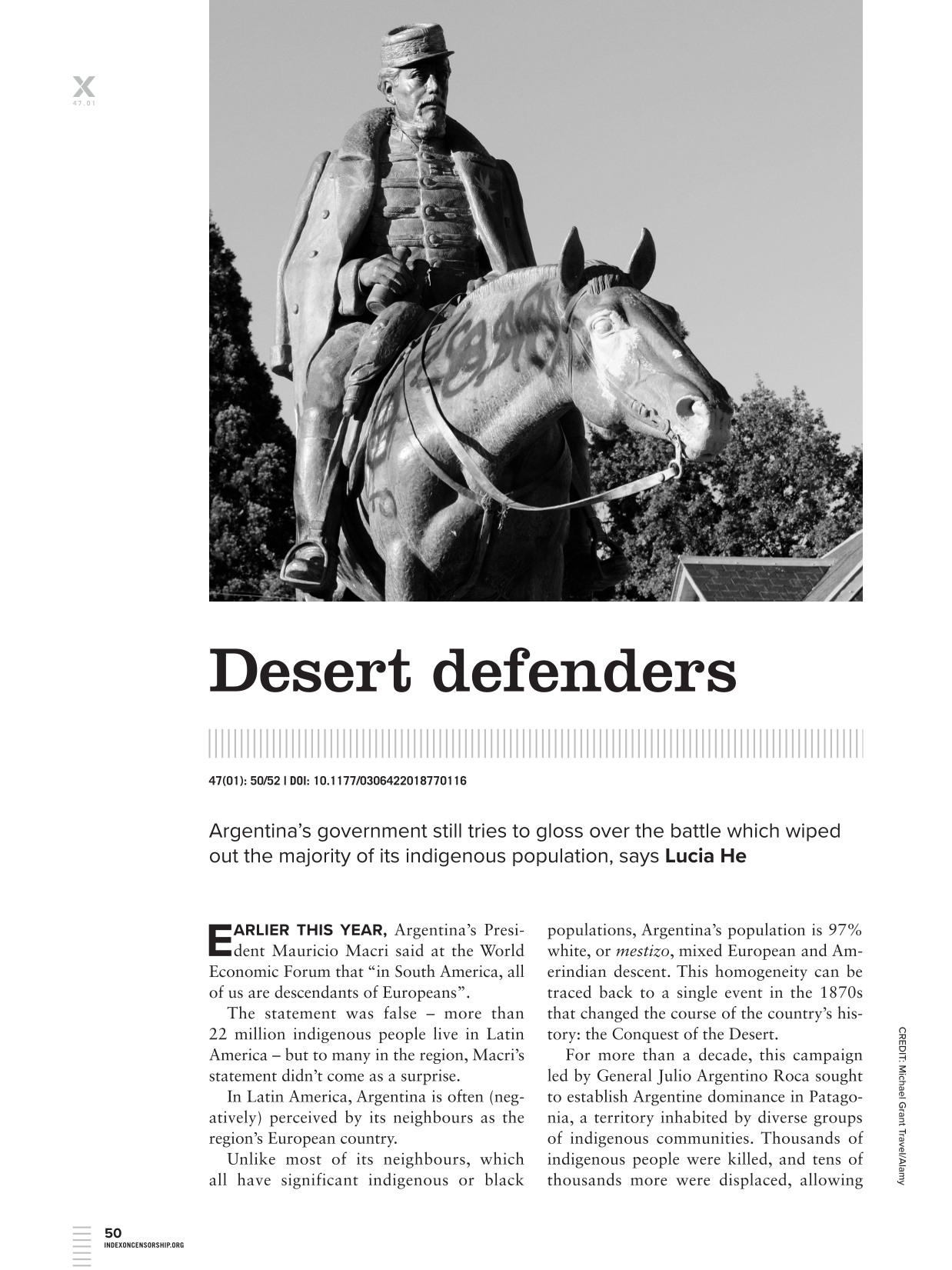
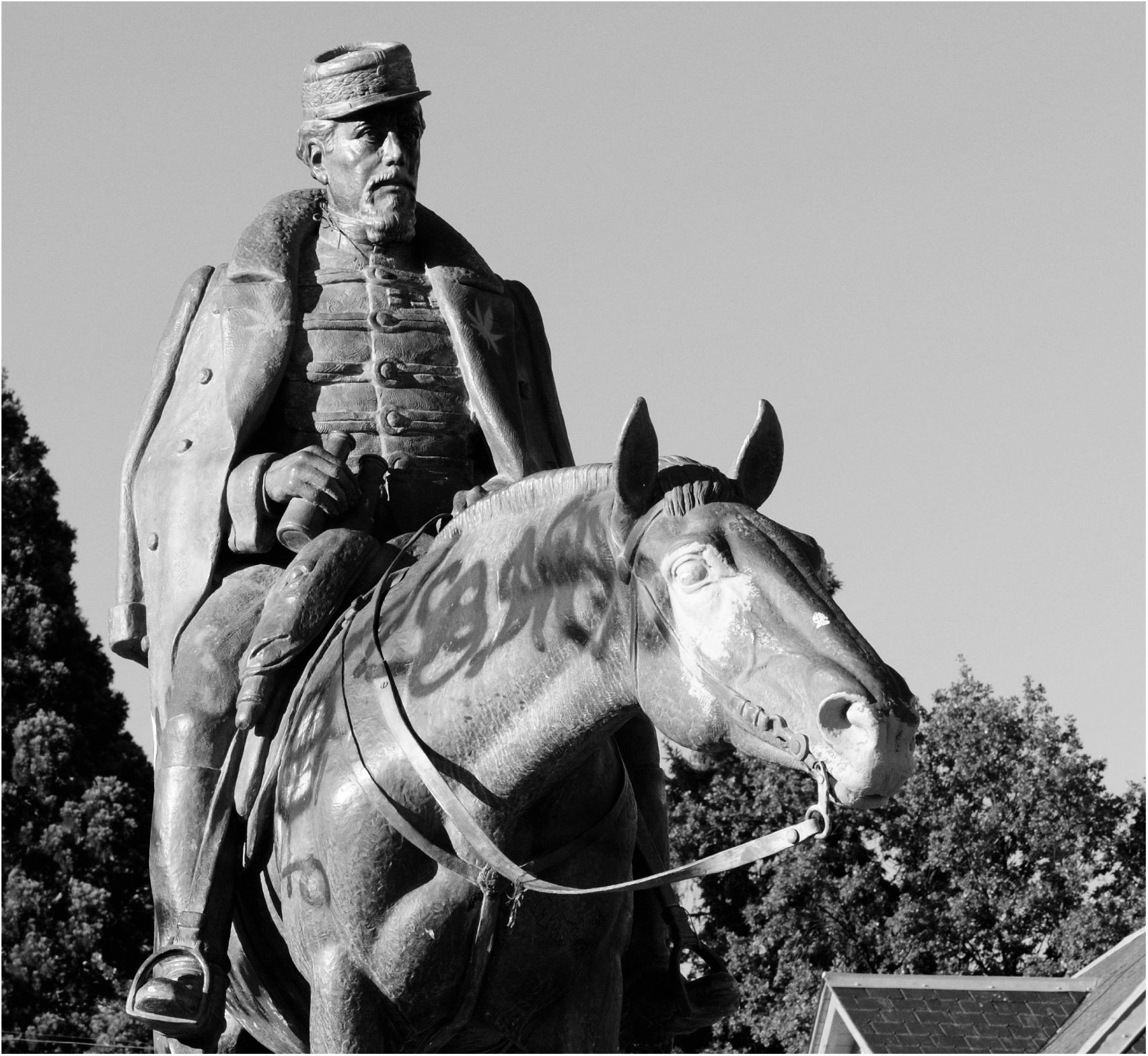
A defaced statue of Alejo Julio Argentino Roca Paz, twice president of Argentina
CREDIT: Michael Grant Travel/Alamy
The statement was false – more than 22 million indigenous people live in Latin America – but to many in the region, Macri’s statement didn’t come as a surprise.
In Latin America, Argentina is often (negatively) perceived by its neighbours as the region’s European country.
Unlike most of its neighbours, which all have significant indigenous or black populations, Argentina’s population is 97% white, or mestizo, mixed European and Amerindian descent. This homogeneity can be traced back to a single event in the 1870s that changed the course of the country’s history: the Conquest of the Desert.
For more than a decade, this campaign led by General Julio Argentino Roca sought to establish Argentine dominance in Patagonia, a territory inhabited by diverse groups of indigenous communities. Thousands of indigenous people were killed, and tens of thousands more were displaced, allowing Argentina to expand its territory to its current frontier with Chile.
Up to this day, the Argentine government still takes care to position the event as a legitimate war that sought to establish the country’s sovereignty.
A sign of how the government sees the importance of the event is illustrated by a comment by Education Minister Esteban Bullrich, in 2016, who emphasised the importance of investing in education by saying: “We can’t have independence without education.This is the new Conquest of the Desert, but with education instead of swords.”
Yet a growing number of academics and journalists see the conquest as a genocide.
According to Carlos Martínez Sarasola, an Argentine anthropologist, up to half of the indigenous people living in Patagonia were murdered during the conquest. Marcelo Valko details in his book Pedagogia de la Desmemoria (The Pedagogy of Forgetting) the process during the conquest through which a group of 3,000 indigenous people were put into concentration camps and forcefully baptised and tortured.
“We’ve been told a story that is very different from the real events that took place. It was those who benefited from the conquest who wrote this story. If you were one of the 1,845 families that received a total of 42 million hectares from Julio Roca, he’s going to be your benefactor forever. These are the same families that dominate today’s politics,” said Valko in a recent interview with the newspaper Conclusión.
Throughout the country’s history, the Argentine state has been able to keep a one-sided narrative on the events of the Conquest of the Desert and its impact, by idealising it and its leaders and suppressing and marginalising the voices of the remaining indigenous communities.
The portrayals of Roca as a hero are abundant in everyday life. In 1992, the government introduced a new design for the country’s 100 peso note commemorating him. The bills display Roca’s portrait on one side and a full picture of the army leading the military campaign on the other. A design featuring Eva Peron was introduced in 2012, but millions of the Roca notes are still in circulation.
Roca’s presence is not only inside Argentine wallets but also on the streets. There are at least 36 statues commemorating the general across the country, along with dozens of streets, avenues and public schools.
Besides commemorating Roca, another way in which the Argentine government has been able to legitimise the Conquest of the Desert has been to perpetuate the idea of indigenous communities as “others” through education and the media.
“The conquest established an official narrative: the idea that indigenous people were dangerous savages, that the conquest was a fight between civilisation and barbarism. And unfortunately, this ideology still persists until this day,” said Sarasola.
According to a study that analysed high school curriculums in Argentina from 1956 to 1980, the Conquest of the Desert was largely taught as an event that legitimised the Argentine state and allowed the country to become an agricultural superpower in the decades following the conquest. Indigenous communities were portrayed as an obstacle for the territorial consolidation of the state and the promotion of “civilisation”. Words used in textbooks and history classes to characterise them included “savages”, “barbaric”, “primitives”, “lazy” and “aggressive”.
In a study published last year, anthropologist Mariano Nagy concluded that these notions imposed in the traditional school system in Argentina continue with no major change or questioning: “Nowadays, schools display these same old premises of savagery, barbarism, the backwardness of indigenous communities and the inexorable progress achieved after the extinction of indigenous peoples.”
According to Nagy, this notion has stuck in the collective mind, and students agree with this analysis. “My personal experience on the issue of the Conquest of the Desert is dismally limited,” said Azul Cibils, a 17-year-old high school student in Buenos Aires. “We learnt about it in the first year of secondary school and, even though we talked about how many people were murdered and about how Roca was an oligarch, the discussion didn’t go much deeper. We simply talked about what the conquest meant for the Argentine republic in terms of land gain. I frankly believe the issue should be taught in much more detail and depth.”
Another study conducted in 2010 about the portrayal of indigenous communities by the media showed that, when covering territorial conflicts between indigenous Mapuche communities and the Argentine government, it often questioned the origins of Mapuches and portrayed them as land-grabbers and violent extremists. Last year, in the face of escalating conflict between security forces and Mapuche communities, the Mapuche were accused of being originally from Chile, and some characterised them as terrorists.
“Unfortunately, racism and discrimination towards indigenous communities or any other type of minorities are a part of Argentine society. This is probably a consequence of the way history has been taught to us,” said Sarasola.
“Argentina’s indigenous communities were completely left out during the democratic transition in the country,” said Diego Morales, director at the Center for Legal and Social Studies, a non-profit organisation working on indigenous issues.
In 2006, Argentina’s Congress passed a law that required the state to conduct an official survey on the lands inhabited by indigenous communities. The law introduced the survey as a first step towards the formalisation of their land rights. However, a study published this year showed that, 11 years after the sanctioning of the law, only half of the communities had been surveyed.
“Argentina hasn’t been able to establish a serious state policy that recognises indigenous communities and that goes beyond changes in government. When you don’t implement a concrete state policy, you have a policy of denial,” said Sarasola.
This has resulted in escalating conflicts between the Argentine state and indigenous communities. According to a survey conducted by Amnesty International’s local chapter, there are currently as many as 264 ongoing conflicts involving indigenous communities. Last year, a conflict between Argentine authorities and a group of Mapuches escalated into violence and culminated with the death of 28-year-old indigenous rights activist Santiago Maldonado.
Human rights activists and indigenous groups believe that in order for Argentina’s indigenous communities to be able to fully claim back their rights, the country’s historical narrative needs to be amended.
In the words of Osvaldo Bayer, a writer and journalist: “Our heroes have to be those who, in our history, fought for the right to life of all, and not the ones who, for ambition of power and property, stripped the life of the children of our land.”