




Abstract

The Soviet Union may have fallen, but some of its attitudes on controlling history live on in Ukraine and Belarus, says
Guards stand near a monument in Minsk, Belarus, commemorating the Soviet victims of the war in Afghanistan, 2014
CREDIT: Vasily Fedosenko/Reuters

Both countries share a complicated and painful history of being part of the Soviet Union. But they are both attempting to deal with understanding of, and control of, their past.
History books in Belarus have been completely republished four times since 1990, according to research by Aliaksiej Bratačkin, a historian from Minsk. Each change corresponded to a switch in political narrative to fit the objectives of those in charge.
At the beginning of the 1990s, the Soviet approaches to history were deemed “colonial and anti-Belarusian” and were changed to more nation-orientated ones. But it did not last long.
Alexander Lukašenko, the first – and so far the only – president of Belarus, came to power in 1994. All further changes in the official historical narrative have been defined by his political ambitions.
At first, Lukašenko tried to make friends with Russia, with a possible union of the two countries in mind. At that point, history books lost all national sentiment, refraining from deep analysis of previous conflicts.
But when Vladimir Putin came to power in Russia in 2000, and it became obvious the Belarus president was not going to succeed Yeltsin, the history books were rewritten to underline independence of Belarus and its differences from Russia.
“Now the authorities try to define the nation not through ethnicity but by belonging to the Belarusian state. A new model of such collective identity aims at fostering loyalty, not to the country or a nation but to the existing political regime,” Bratačkin said.
World War II plays an extremely important role in the Belarusian state’s historical narrative. It adopts the old Soviet name – the Great Patriotic War – and uses the notion of “the Great Victory” to depict the Belarusian state as an ancestor of one of the great powers that defeated fascism, thus transmitting the idea of that “greatness” to the present generation.
Lukašenko, who was born in 1954, is notorious for his emotional speech to war veterans, in which he told them his “father also died fighting in the World War II”.
Ukraine, meanwhile, has had to deal with a war within its territory, beginning in 2014. After the Euromaidan revolution ousted President Viktor Yanukovych, Crimea was invaded and annexed by Russia, and some regions in the east have also been under the control of pro-Russian military groups, with strong evidence of Russian regular troops supporting their military actions against Ukraine.
This country, too, has seen several attempts to change its official version of history. During Viktor Yanukovych’s presidency (2010–2014), history textbooks “lost” most mentions of any anti-Russian figures and events in an effort not to annoy the Kremlin.
Stepan Bandera, one of the most prominent, and controversial, leaders of the Ukrainian independence movement, is a perfect example. He was sentenced to death by the Polish authorities in 1934; held in a Nazi concentration camp; and assassinated by the Soviet KGB in 1959. The Soviet – and now Russian – propaganda depicts Bandera as a “bandit” and a “fascist”, while all his life he fought for the independence of his land.
“Ukraine is not divided now because of Bandera; it is divided because of the myth about Bandera that was invented by the Soviet propaganda,” Volodymyr Viatrovych, the head of the Ukrainian Institute of National Memory, told Apostrophe TV.
“The policy of Russia is to reinstall its empire. And it does so by reinforcing the old Soviet myths and trying to reach people who like them. Thus, any attempts to challenge Soviet myths and Soviet interpretations of history anywhere see huge protests by Russia as they challenge its current policies.”
In 2015, Ukraine adopted a series of laws that forbade propaganda of Soviet and Nazi totalitarian regimes, claiming they were equally culpable of crimes against humanity.
The country also updated its calendar of official holidays to reflect its political thinking. Some of them are simply gone, such as the anniversary of the 1917 October Revolution (a state holiday in Russia and Belarus). Others got new meanings. Ukraine now celebrates 8 May as a day of memory and reconciliation, paying tribute to victims of World War II, rather than the sabre-rattling Victory Day that Russia and Belarus celebrate on 9 May.
“Russian propaganda often uses the term ‘rewriting the history’. But this is not what is happening in Ukraine,” said Svitlana Osipchuk, a historian and lecturer at the Technical University of Ukraine.
“We are going through the process of de-communisation of history, the change of the Soviet understanding of it. I can’t say it is an easy process. But the most important thing I see is that history does not have the black-and-white narrative any more. There is now a good chance for an open public dialogue in Ukraine.”
As Alieksievič said: “Sometimes I am not sure that I’ve finished writing the history of the “Red” man.”
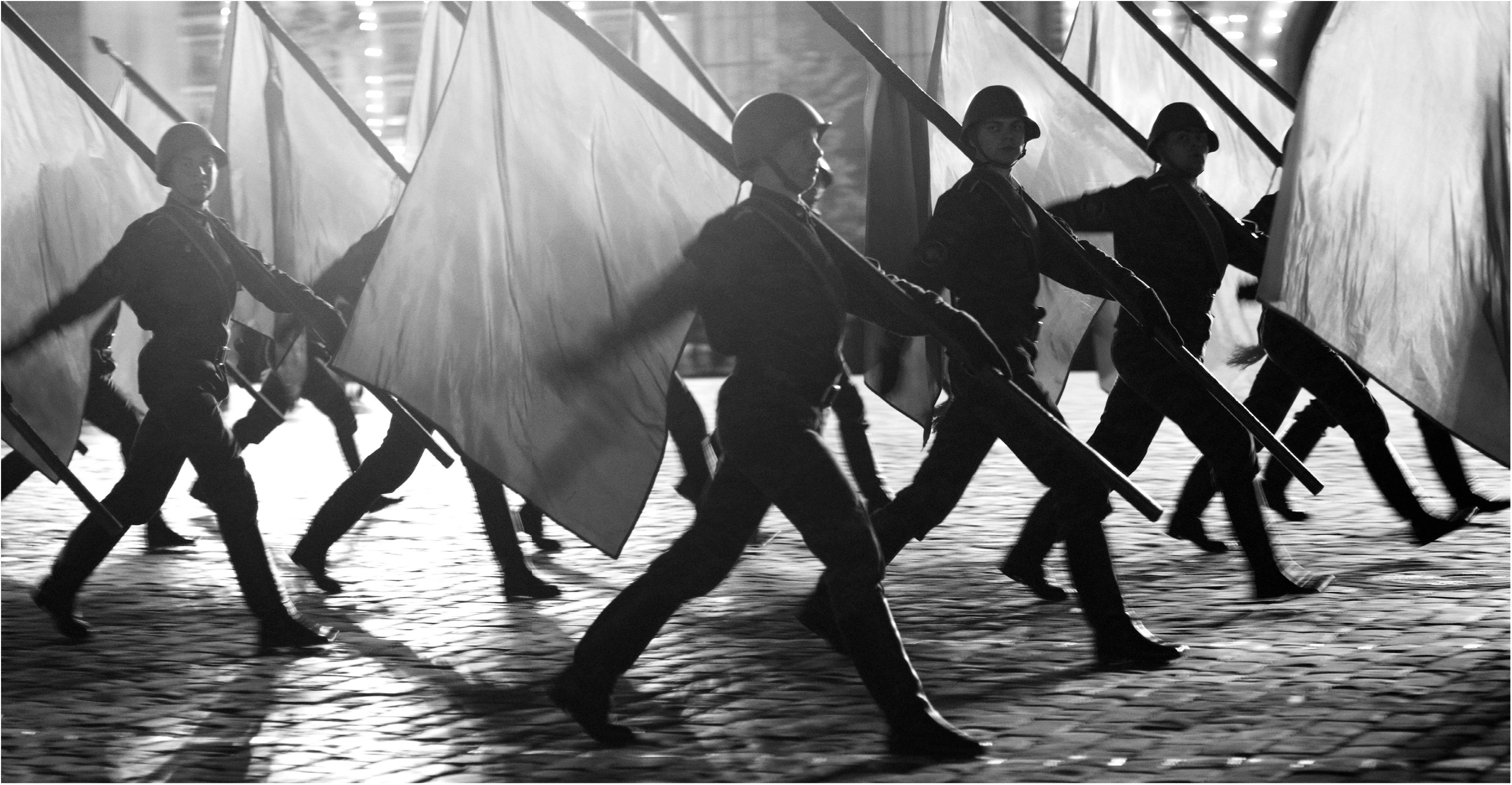
Russian soldiers carry Soviet Army flags at a rehearsal for the Victory Day parade, Red Square, Moscow, 2010
CREDIT: Alexander Zemlianichenko/Rex
The Whole Truth
Ukraine suffered greatly at the hands of the Nazis and the Soviets, leaving 13.5 million of its citizens dead. It owes a duty to the victims to tell their story. And yet that’s not what’s happening.
The latest example of how the Ukrainian government is covering up aspects of its past concerns British historian Sir Anthony Beevor. In January, the Russian translation of his bestselling book, Stalingrad, which won the 1999 Samuel Johnson prize and explores the history of the World War II battle, was banned in Ukraine. This followed the passing of a law in 2016 that banned the import of books from Russia if they contained “anti-Ukrainian” content.
Beevor’s book was prohibited on the grounds that it might incite “inter-ethnic, racial and religious hostility”.
Serhiy Oliyinyk, head of the Ukrainian Committee for State TV and Radio Broadcasting’s licensing and distribution control department, told Radio Free Europe that the ban was imposed because of a passage about how 90 Jewish children were shot by Ukrainian militia. “It’s a provocation,” he said.
Although the ban was ultimately overturned, it left the impression Ukraine was suppressing debate about its past.
There are some signs that the government is seeking to do just that. This was a directive enshrining the study of the Organisation of Ukrainian Nationalists’ contribution to the independence struggle within the education system. This promotes a history that masks the OUN’s collaboration with the Nazis.
Ukraine has been tackling awareness of its Soviet crimes, but some recent laws hamper discussion about collaboration with the Nazis and its involvement in the Holocaust. They also prohibit questioning the legitimacy of the independence struggle.
The Organisation of Ukranian Nationalists is seemingly protected from criticism. There is evidence, however, that the OUN participated in the Holocaust.
Uilleam Blacker, a lecturer in comparative culture of Russia and eastern Europe at University College London, noted that 2016 commemorations for the Babi Yar massacre, in which tens of thousands of Jews were slaughtered in 1941, “avoided the problem of local collaborators and nationalist organisations”.
Olesya Khromeychuk, a fellow in history at the University of East Anglia, said these measures are demolishing the existing eclectic memory of World War II and replacing it with a “simplistic account”. She stresses that the laws legitimise individuals such as Roman Shukhevych, the leader of the UPA, the OUN’s military wing, which worked with the Nazis.
If Ukraine doesn’t allow space for a more honest reading of its recent tragic history, we’ll see more bans in the future.
