



Abstract

Democratic transition in south-east Asia hasn’t brought the region’s journalists the freedom it once promised. Some journalists are trying to navigate censorship, while others are leaving the profession, writes
Journalists Wa Lone and Kyaw Soe Oo are escorted out of court in Yangon, Burma, after their first trial, January 2018
CREDIT: Lynn Bo Bo /Rex
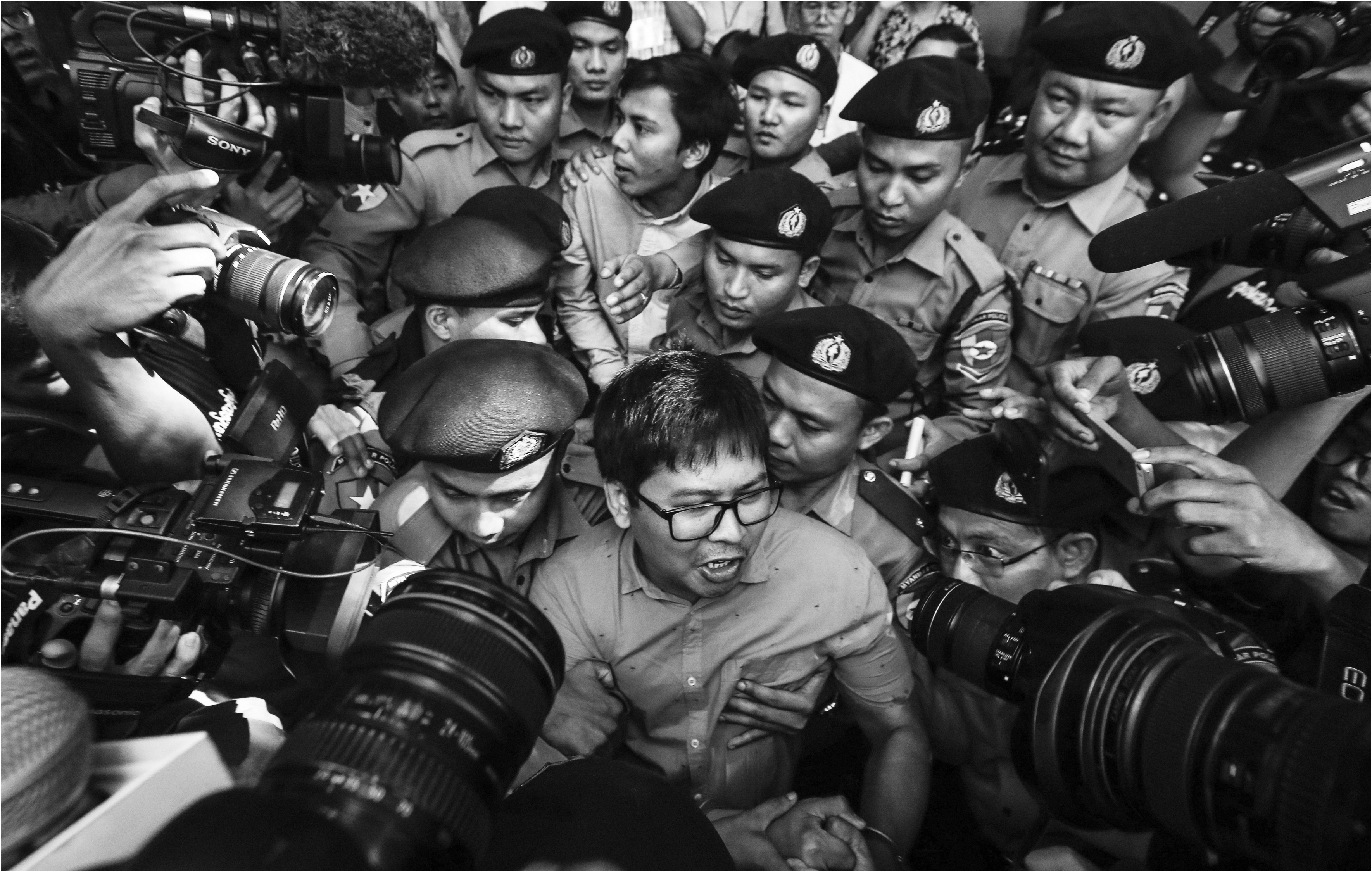
Wa Lone and Kyaw Soe Oo had been reporting on south-east Asia’s biggest humanitarian crisis: the forced exodus of more than 650,000 Muslim Rohingya from the Buddhist majority Rakhine State.
They were working on a story about the discovery of a mass grave and had been given some classified documents by police officers. They were arrested almost immediately, and later charged in court under a colonial-era Official Secrets Act. The elected government of Burma, led by Aung San Suu Kyi, was unmoved by the global outcry for their release.
Even more chilling was the impact the arrests had on local journalists, who have seen their expectations of media freedom greatly undermined since 2015’s general elections, including the use of criminal charges to curb critical reporting.
“More and more of them are choosing to look for other jobs,” said a former journalist who has been training local reporters in Burma.
Across south-east Asia, journalism is currently facing a broad range of challenges, from physical threats to life and intimidation, to prosecution, usually under arcane laws of sedition and defamation. But none is more insidious than the self-imposed censorship many working journalists adopt in order to survive.
For the many years I worked as a correspondent for international and regional publications in the region, I encountered all kinds of intimidation: there were phone calls from high officials to editors; attempts at bribery in the form of cash in envelopes; and the ever-present threat of prosecution under harsh laws that usually have their origins in the colonial era.
Malaysia, for example, uses stringent laws of sedition and an official secrets act that have roots in British colonial legislation. A Canadian colleague, Murray Hiebert, spent a month in prison in Malaysia for contempt of court. “I lost my freedom, which is a rather shocking thing to have happen, for writing about a debating team,’’ Hiebert later told The New York Times. Hiebert had written about the wife of a Malaysian judge who sued a school for dropping her son from the debating team, with a comment on how unusually quickly the case came to court.
That there are not legions of reporters in prison speaks of the practical way most working journalists deal with the problem, which is either to find ways of reporting the truth which skirt the law, or not to report the truth about sensitive issues at all.
As one young Malaysian reporter put it to me recently: “Many of us simply don’t believe we can fight the system, so we just do what we can, pocket our wages, and hope for better times.”
There are those who choose to fight. Wa Lone and Kyaw Soe Oo defiantly told the media outside the court room in January that they were being persecuted because they were reporting the truth. They face minimum jail sentences of 14 years.
But there are many who simply adapt to survive. This mostly means that sensitive topics are avoided, but they can still be broached.
For example, there is a long tradition of using oblique and indirect writing techniques to skirt draconian press laws in south-east Asia. Ambiguity and avoidance is possible in cultures and languages in which obliqueness is both acceptable and meaningful. Reporting in another language, such as English, has also helped to get things around government watchdogs.
As a correspondent for, and later as editor of, the Hong Kong-based Far Eastern Economic Review, I worked for more than two decades spanning a period of rapid economic growth and political change. The review was staffed by a collection of foreign reporters, mostly long-time Asia hands, as well as courageous local journalists who often put their freedom on the line to report on current events.
The review was hounded and punished by governments for its brave liberal stance on the politics of the region. In 1987, the Singapore government took the magazine to court after disputing the veracity of what transpired in a meeting between Prime Minister Lee Kuan Yew and the Catholic archbishop of Singapore. The review lost the case, was fined and had its circulation severely restricted in what was then one of the magazine’s largest markets.
Yet, for all the legal battles, intimidation and incarceration, we got away with a lot, although there was inevitably some self-imposed restraint driven by the need to keep reporting. I found that by deploying the tools of empathy and understanding I could say much more. This did not mean I wasn’t telling the story, but the amount of detail I was given licence to use allowed me to offer explanations and different points of view.
Also, when you had the luxury of writing at length on a weekly basis, you could play the long game and write indirectly. There were ways to articulate the shameless monopoly former President Muhammad Suharto’s children maintained in key areas of Indonesia’s economy, simply by delving in detail into the ownership structure. There were ways to comment on Malaysian Prime Minister Mahathir Mohamad’s iron grip on power and refusal to tolerate dissent, simply by offering a blow-by-blow account of how he wielded power and dealt with the victims.
The review closed as a weekly publication in 2004, due to a funding decision made by its US proprietors, Dow Jones. I still live, work and write from the region, and although I no longer work as a reporter, I still have a keen sense of the new challenges facing journalists today.
In the age of the internet and social media, it is no longer so easy to be indirect. There is little room for subtlety in 280 characters. With reporting in the English language so much more common online, laws apply just as much to what is reported in English as they do in Thai or Malay or Chinese. Before, governments could simply ban publications. Today, they cannot afford to switch off the internet.
The plight of reporters in Thailand and Malaysia is particularly acute because of the refurbishment and strengthening of laws that carry prison penalties for expression in the spoken or written word: the Official Secrets Acts 1972, the Sedition Act 1948 and – the granddaddy of them all – the Printing Presses and Publications Act 1984.
Although the Printing Presses and Publications Act has been amended so licences for press and permits for publications no longer have to be renewed annually, licences can be revoked at any time.
The expectation that democratic transition would liberate the media has proved misleading in many places. An established democratic government in the Philippines has not stopped 79 journalists being killed in the line of duty since 1992, according to the Committee to Protect Jouranlists at the start of 2018.
Democratic transition over the past two decades in Indonesia has seen a blossoming of media of all forms, which Indonesians have revelled in. But there are limits.
A law against insulting the president that was struck down in 2006 was reintroduced to parliament in 2015. With increasing levels of ethnic and religious intolerance, free expression must abide by more than just appropriate considerations of race and faith, and intimidation is common.
This leaves the working journalist with a stark reality: write or broadcast freely and face legal consequences. The preferred coping strategy is self-censorship.
In Thailand, reporters avoid all but the approved official news about the royal family. In Malaysia, only passing references can be made in the carefully couched language of allegation about one of the largest corruption cases in modern history involving the prime minister and his family.
There are scarcely any legal safeguards, and editors often have cautious proprietors to deal with. In the case of Singapore, the government continues to exert strict control over mainstream media expression, which jars with the comparative freedom of what can be posted on social media. A Straits Times reporter told me that his colleagues were flabbergasted when a feud between members of the prime minister’s family played out openly on Facebook in mid-2017, while the newspaper was discouraged from reporting the matter.
A well-developed culture of careful omission, oblique expression and respectful criticism has evolved. In part, this sits well with the deeply ingrained culture of conflict avoidance in many south-east Asian societies. But, sadly, it leaves south-east Asia with media that struggles to support the efforts of civil society or opposition politicians to highlight injustice and inequality.