




Abstract
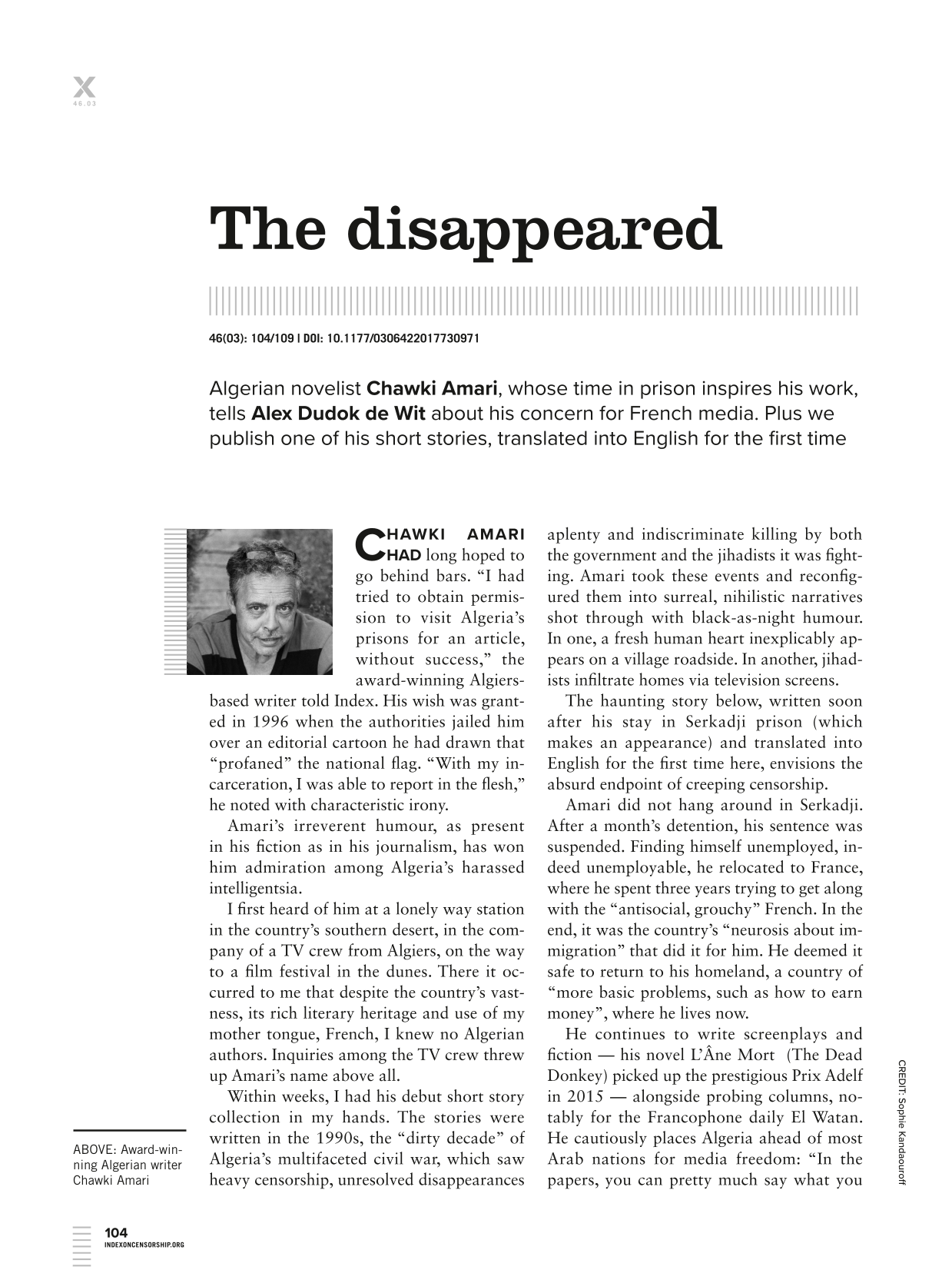
Algerian novelist
Award-winning Algerian writer Chawki Amari
CREDIT: Sophie Kandaouroff
Amari’s irreverent humour, as present in his fiction as in his journalism, has won him admiration among Algeria’s harassed intelligentsia.
I first heard of him at a lonely way station in the country’s southern desert, in the company of a TV crew from Algiers, on the way to a film festival in the dunes. There it occurred to me that despite the country’s vastness, its rich literary heritage and use of my mother tongue, French, I knew no Algerian authors. Inquiries among the TV crew threw up Amari’s name above all.
Within weeks, I had his debut short story collection in my hands. The stories were written in the 1990s, the “dirty decade” of Algeria’s multifaceted civil war, which saw heavy censorship, unresolved disappearances aplenty and indiscriminate killing by both the government and the jihadists it was fighting. Amari took these events and reconfigured them into surreal, nihilistic narratives shot through with black-as-night humour. In one, a fresh human heart inexplicably appears on a village roadside. In another, jihadists infiltrate homes via television screens.
The haunting story below, written soon after his stay in Serkadji prison (which makes an appearance) and translated into English for the first time here, envisions the absurd endpoint of creeping censorship.
Amari did not hang around in Serkadji. After a month’s detention, his sentence was suspended. Finding himself unemployed, indeed unemployable, he relocated to France, where he spent three years trying to get along with the “antisocial, grouchy” French. In the end, it was the country’s “neurosis about immigration” that did it for him. He deemed it safe to return to his homeland, a country of “more basic problems, such as how to earn money”, where he lives now.
He continues to write screenplays and fiction — his novel L’Ane Mort (The Dead Donkey) picked up the prestigious Prix Adelf in 2015 — alongside probing columns, notably for the Francophone daily El Watan. He cautiously places Algeria ahead of most Arab nations for media freedom: “In the papers, you can pretty much say what you want, within the limits of defamation, which in general is very swiftly punished, especially for opposition papers.”
Amari acknowledges that the situation has deteriorated in recent years, during which Algeria has tumbled to 134th place on the World Press Freedom Index. “The police don’t hesitate to arrest people over mere Facebook comments,” he told Index, alluding to the imprisonment of British-Algerian journalist Mohamed Tamalt over a “defamatory” poem he had posted on the social media platform. Tamalt died in December while on hunger strike.
But Amari notes approvingly that many Algerian media organs are owned by journalists, in contrast to France, where takeovers by “financial groups and businessmen” make him “rather pessimistic” about freedom of expression.
For the most part, Amari writes in French. As he once told an interviewer, however, “I laugh, I cry, I shout in Algerian.” The Algeria of his fiction is anarchic, disorienting, relentlessly harsh; yet it is his. Scathing though they are, his stories beat with a doleful affection for the country that raised him, exiled him, then drew him back. This one is no different.
It was written in the paper
Chawki Amari
Alif reads while eating, the paper on the table in front of his plate of meat. Alif likes meat. After finishing his plate, he has one last glass of lemonade, wipes his moustache with the napkin and folds his paper. He gets up and with his usual gesture summons the waiter. The latter comes over and the two men settle up. One rib steak, 37 chips and two glasses of lemonade. One hundred and fifty dinars. Alif hands him the money. He nods farewell and leaves the restaurant.
A change in temperature, a change of scene. The street is empty. A desert of grey concrete. It is around two in the afternoon. What is going on? Why is there nobody in the street at this hour? A general strike? Alif unfolds his paper and leafs through it. Nothing to suggest that this many people are off work. Alif folds his paper and walks toward the train station. Still nobody in the streets. Deserted. Alif imagines a new kind of bomb. One that would wipe out human beings without making a sound. He unfolds his paper and turns to the science page. No mention of technology on this scale. Alif folds his paper and continues to walk. At the station, he is greeted with the same sight. Nobody. Not a soul, if indeed his compatriots have a soul.
Alif walks back out of the station. Could it be a day of mourning? Is a famous dead person being commemorated? Alif unfolds his paper. No mention of a commemoration. Many deaths, but they’ve been forgotten. Commemorations don’t happen anymore. The calendar would be too full. There were people at the restaurant. He has to go back there. Perhaps they’ll give him an explanation. In any case, he’ll feel less alone. Alif hears a sound. He jumps, suddenly realising that everything has been silent this whole time. It’s a train setting off! So there’s somebody in this city after all.
Arriving at the restaurant, he sees that it has shut. The metal curtain is down. Attached to it is a piece of paper. Closed due to death. A death? Well then it must have just occurred, seeing as he was here half an hour ago. What a strange day. None of this is right. Alif unfolds his paper and checks the date. There it is: 3 November. The paper is today’s. So what’s wrong? He walks down the street in no particular direction. Suddenly, a man. Alif’s heart leaps with joy. A man, there, sat on a bench. Quickening his steps, Alif heads over to the bench. The man is an old man. Seeing Alif, he raises his head and smiles.
“Hello,” says Alif. “I’m very glad to see you.”
“Me too,” responds the old man.
Alif sits next to him. “So, what’s happened in this city? Why is there nobody around?”
The old man is astonished by the question. “Haven’t you heard? After all, it’s written in the paper.”
Alif mentally unfolds his paper and skims through it. Nothing stands out. “What happened?” he insists.
The old man lets out a sigh and explains. “There’s nothing now. It’s over. It’s written on page three.”
Alif feverishly unfolds his paper and opens it on page three. A small item in the top-right. He hadn’t noticed it. According to a statement by the Ministry of the Interior, there will be nothing as of Thursday 3 November. For security reasons and to find a definitive solution to the crisis, the authorities have decided to suspend everything.
The old man’s eyebrows sketch a small “v”, a sad “v”.
“That’s why. There’s nothing now.”
“But where did they go? Where is everyone?”
The old man pauses. Then he continues to explain.
“There’s nothing now. No more people, nothing. They’ve made their decision. You know, the problems we live with, they all come down to men. Without men there’s no crisis, no problems, no attacks, no crimes. No blood. Nothing. An empty country is a happy country.”
“But this whole thing is completely crazy! And you, why are you here if there’s nothing?”
The air seems to weigh down on the old man. His eyes go blank and his shoulders draw inward.
“I am nothing,” he responds, his voice dead. “That may be why I’m still here. I have neither home nor family. No money, no ideas. Nothing. A hypothetical present, a past without a future.” Gathering himself, he turns back to Alif. “I reckon you’re not much of anything yourself. If you’re still here.”
Alif is taken aback. He spends a few minutes considering the full significance of this fact. Then he fires back: “What do you mean, I’m nothing? I’m an intellectual! I think! I help educate people, manage the crisis! I work! I have an official position! I should also disappear!”
The old man doesn’t reply. He lets Alif pour out his incomprehension and impotence. After some minutes, he blurts out: “What have you achieved? You think you’ve achieved things. But you’re no more than a pawn made of dead wood, asleep on an abandoned chessboard.” Then he adds: “But don’t lose hope. Maybe you’ll disappear before long. They’ll see that you exist and come after you. It could be a mistake – they make so many.”
Ideas thud into each other in Alif’s devastated head. This is madness.
“Tell me, were the people taken away? Did the state take everyone away?”
“Could be. It definitely has the means to do so.”
“So they are somewhere. And those who took them away, where are they? They should be around!”
“I don’t know if that’s what happened. They simply said there would be nothing as of today. That’s all.”
The two men continue to talk, sitting on the bench. Another train goes by in the distance. Alif gets up and tells the old man he’s going to have a walk around, look into this madness. The old man watches him leave, then disappears.
Alif is back at the station. Might as well make the most of the trains, seeing as they’re running. He wants to go home; his family is surely there, waiting for him. If they haven’t disappeared, that is. He then decides to read everything, to scour the paper from A to Z. At the last page, a train arrives. Boufarik. It’s for him. Alif gets on. The train leaves, the platform recedes. Alif wants to go see if the driver is in his cab. But he doesn’t. He contents himself with watching the reflection in the window of the Mitidja Plain pass by. A zone crawling with terrorists. He scans the plain. There appears to be nobody there. Would they have taken even the terrorists away?
CREDIT: Tang Yau Hoong

After an hour and a half, the train slows down and enters Boufarik station. The road that leads to his home is deserted. The shops are all closed. He arrives home and pushes the door open. His daughter, who usually runs to hug her father when she hears him come home, doesn’t emerge. There’s nobody here either now. Alif searches his house for a clue, a word or a sign that could explain this tragedy. Nothing. Overwhelmed by impotence and incomprehension, he decides to go out anyway. There is still air. There’s a man on the doorstep. He looks nasty. Dodgy.
“Are you Alif?”
“Yes, I am,” Alif stammers hesitantly. The man smiles, revealing horrible little teeth sharp as shards of glass.
“That’s funny, I’ve come to kill you.”
Alif goes pale. Turns white. White as a flag.
“Kill me? Why kill me?”
“Because I’ve been ordered to.”
“By who?”
“Abu Yasmine.”
Abu Yasmine is the commander of one of the region’s Islamist militias. Alif knows this. He also knows that his end is near. He tries to gather his wits. This isn’t a normal day. Perhaps something can still be done. He changes the subject.
“You know there’s nobody left in the country? Everyone disappeared today.”
“I know. I’ve gone over the whole region. There’s nobody left. You’re the last one.”
“And you? How come you haven’t disappeared?”
The terrorist doesn’t look like he asks himself these sorts of questions.
“I don’t know,” he responds vaguely. “Maybe because I just escaped from prison.”
“You escaped from prison? When?”
“Two days ago. It’s even mentioned in today’s paper.”
Alif mentally leafs through his paper once again. There’s nothing there. He’s read it all. No. He hasn’t finished the last page. He takes out his paper and unfolds it on the last page. Small item in the bottom left. “Terrorist escapes from Serkadji prison, killing two guards.” There follows a detailed description of the individual. Alif turns to him.
“It’s true. It’s written here.”
The terrorist lights a cigarette and sits on the kerb. While watching the cigarette smoke lose itself to the overcast sky, he thinks. Alif says nothing; he waits. The last terrorist is before him: indivisible evil. The simplest unit there is. The last wise man and the last mutant of a mad society, face to face. It suddenly occurs to Alif that he can make history, change destiny. He has the impression that the heavens have chosen him for the final showdown. And so Alif must kill him, kill fate, strangle history, slit destiny’s throat. But Alif is an intellectual, a thinker. He doesn’t know how to kill, and above all he knows that this story can’t be divided by two. It would be too simple. There are at least three main players. To simplify the story would be to absolve power of all its crimes, society of all its archaisms. Alif looks at his adversary, his partner in fate. The man is but a pawn. Like him, in fact. But they are the last ones — the last pawns.
The terrorist breaks the silence at last.
“Listen. I have to kill you, but you’re the last man. If I kill you now, what will I do then? I’ve thought hard. I’m giving you 24 hours to flee.”
Fear overcomes Alif again. His hand rifles through his hair and nervous tics play across his face.
“Flee? Where?”
“It’s a vast country. Make the most of it. In 24 hours I’m coming to find you.”
Alif tries to speak words that never come out. He stammers, falters, wavers, sweats. Then he runs away.
The long chase began at 6.30pm on Friday 10 December. The playing field is vast: two million square kilometres.
Years later, the trains are still running. They tirelessly criss-cross the country, passing deserted towns and desolate plains. Peace has returned to the country for good.
Two trains, two solitary men. One pursuing the other. The other pursuing a solution. One is determined, the other hunted.
Footnotes
Translated by