




Abstract

Ahead of Mexico’s elections next year, in a special investigation for Index,
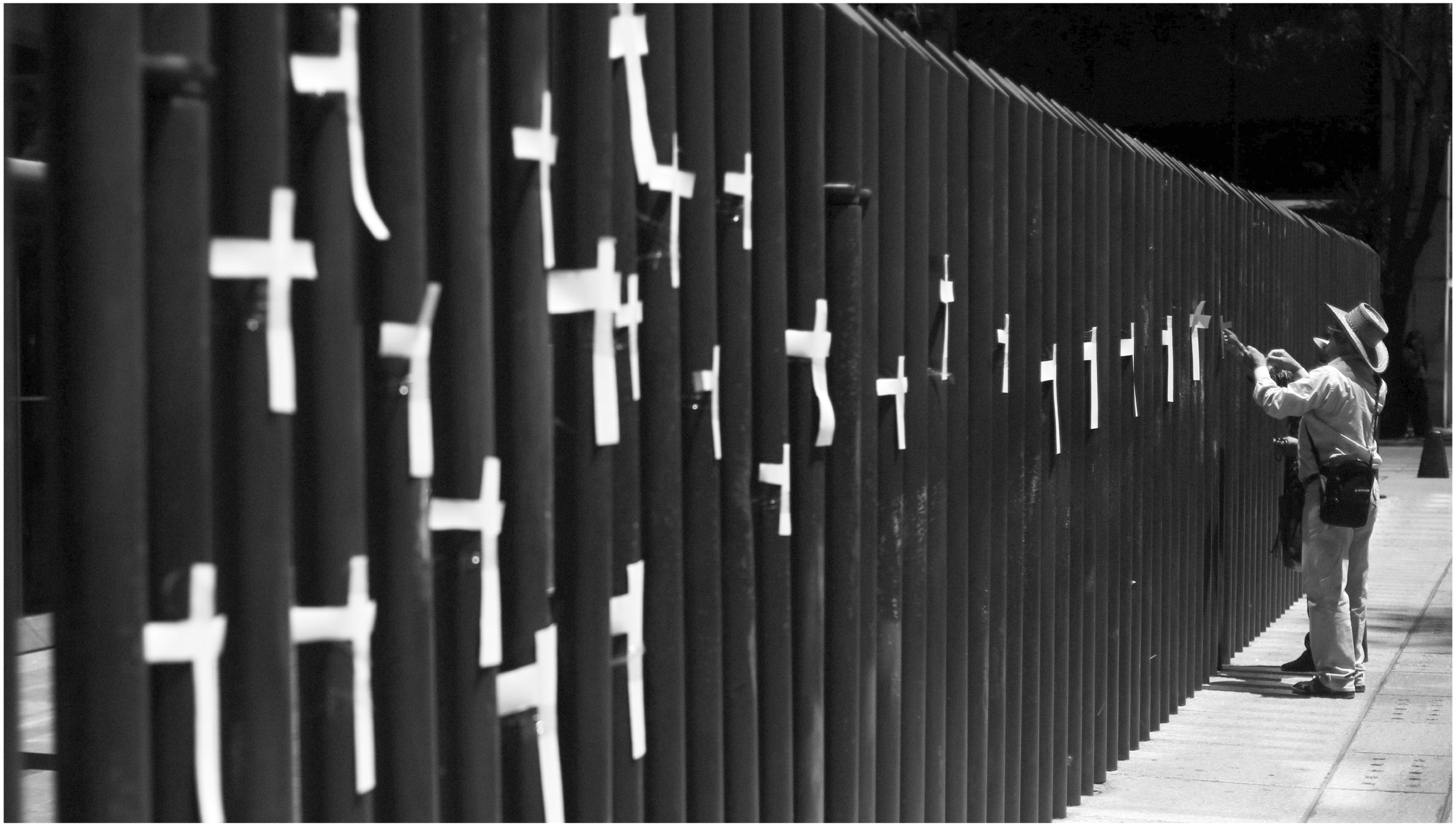
An activist puts crosses on a fence outside the attorney general’s office in Mexico City, in protest against the murder of journalists in the country, April 2017
CREDIT: Edgard Garrido/Reuters
“We’d just left the most dangerous zone and passed through an army checkpoint, which made us think we were in a safe area,” Pérez said, shortly after the incident on 13 May. “But no, just one mile down the road we were stopped by a group of 80 to 100 young men, several of them carrying guns.
“They ransacked our vehicles and stole all our equipment, money and identification. They took one of our cars and left us with the other. They told us they had informants at the checkpoint and that they’d burn us alive if we spoke to the soldiers,” he told Index.
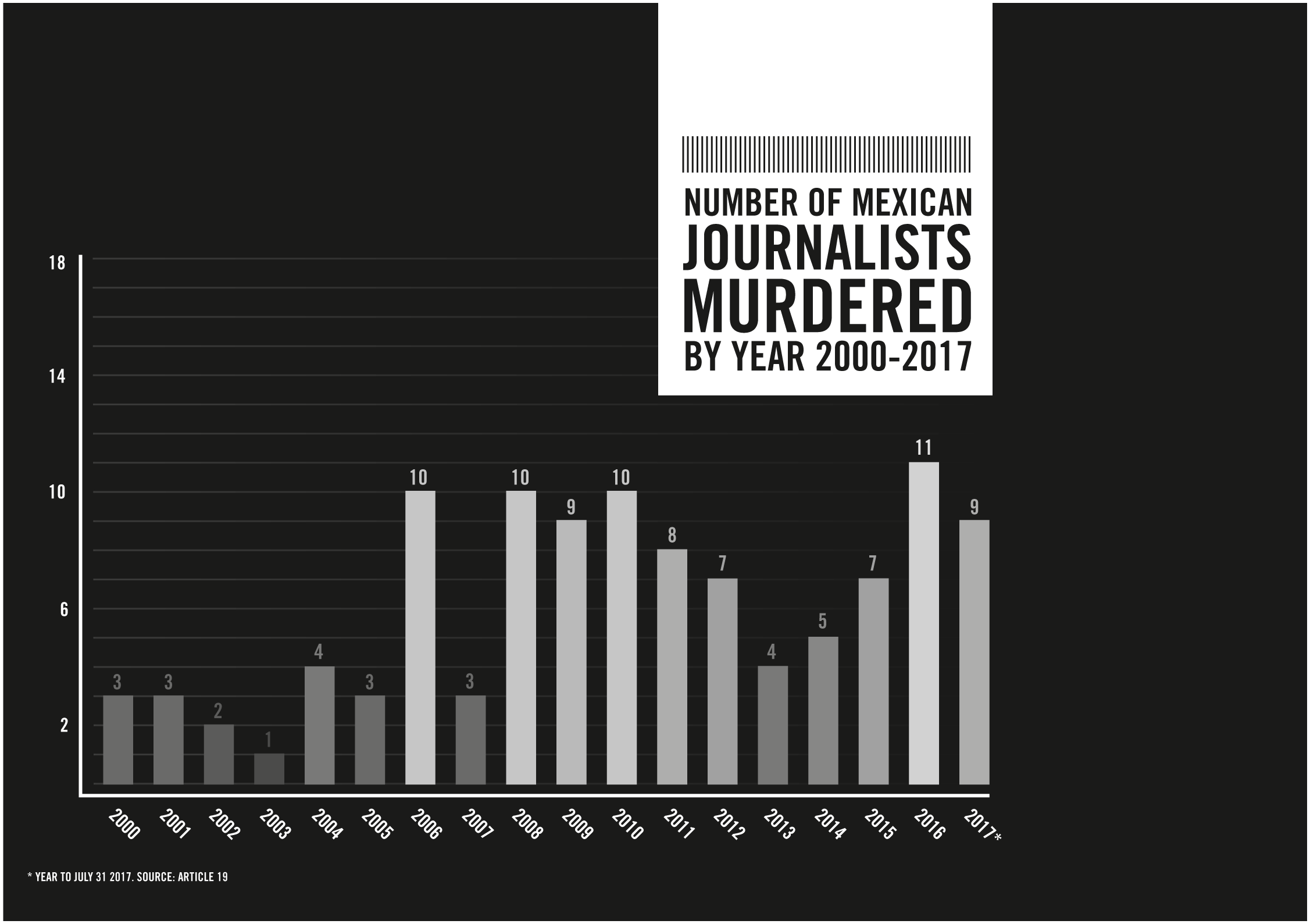
Pérez and his colleagues survived, shocked, but unharmed. Others have not been so lucky. A record 11 journalists were murdered in 2016, and 2017 is on course to surpass that grim tally.
Publications have started introducing modest security protocols in a bid to protect their staff, while the government recently announced rewards for information on those who kill journalists. Yet these measures are unlikely to have much impact in the face of unchecked violence, corruption and lack of justice. Mexico’s drug war has brought record murder rates in 2017 and with next year’s elections set to cause further instability across the country, the attacks against journalists are unlikely to subside any time soon.
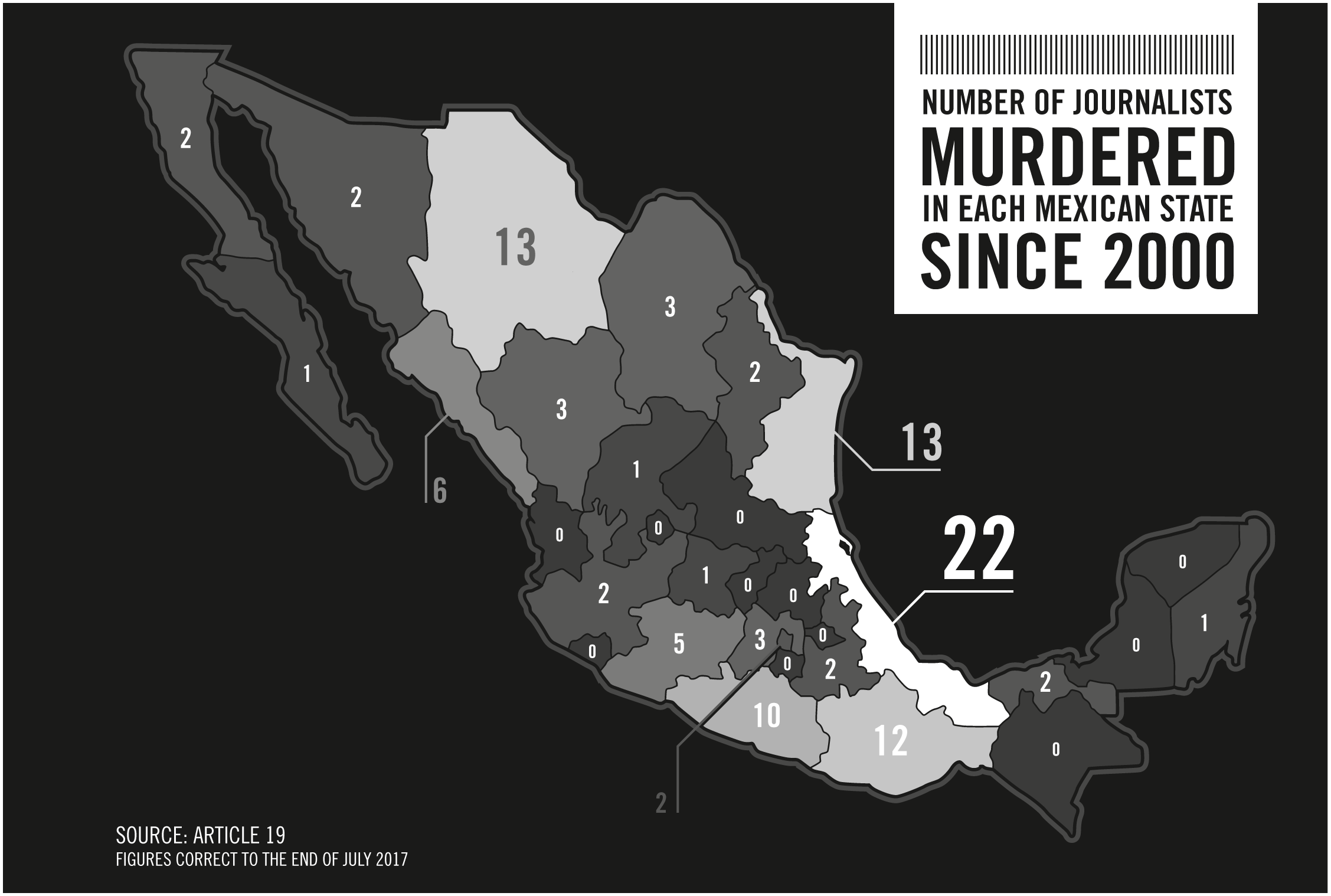
The level of risk varies considerably across Mexico. Foreign correspondents are rarely targeted, the likely reason being that this would bring unwanted international pressure. Mexicans at national or major metropolitan publications are also somewhat sheltered from the violence. It is local reporters who face the greatest risks. According to the Committee to Protect Journalists, 95% of those killed in direct retaliation for their work are reporters for publications, which are typically in remote regions where the rule of law is undermined by rampant crime and corruption. The southern states of Guerrero, Veracruz and Oaxaca currently comprise the most deadly places, accounting for at least 31 murdered journalists since 2010.
Despite the risks they face, the average Mexican journalist makes less than £500 ($650) a month and receives few benefits.
“We don’t have medical insurance or life insurance. We’re vulnerable to this violence,” Perez said. “Although those of us who live in big cities are much safer than those in places like Guerrero.”
When visiting hotspots, Perez said there’s little they can do beyond adopting basic security protocols. “Each of us tried to be in constant contact with colleagues in the city, which was difficult because we’d often lose mobile phone signal. The protocol was to keep together, stay in contact with local journalists, and be very alert to any signs of danger.”
CREDIT: Garry Milne
While journalists from the capital can retreat to relative safety after reporting in hazardous areas, local reporters are constantly exposed to the consequences of their work. This was brutally illustrated when Javier Valdez, one of Mexico’s most famed and respected journalists, was murdered in his native state of Sinaloa on 15 May. Valdez had just left the offices of Ríodoce, a news weekly he founded, when gunmen pulled him from his car and forced him to his knees. They fired 12 times at point-blank range and then fled with Valdez’s phone and laptop, leaving him face down in the road. His trademark Panama hat was stained with blood.
CREDIT: Garry Milne
Valdez was an authority on the criminal underworld in Sinaloa, the birthplace of the Mexican drug trade. And he was the highest profile journalist killed in years. Interviewed by Index a few months before his assassination, he spoke of threats against his newspaper and bemoaned the lack of government protection. He said: “The best thing would be to take my family and leave the country.”
In the weeks before his death, Valdez had become caught up in the fallout of a bloody power struggle within Mexico’s mighty Sinaloa cartel. Violence in the region has skyrocketed since the infamous kingpin Joaquin “El Chapo” Guzman was extradited to the USA last year, leaving his sons, Ivan and Alfredo, to fight his former right-hand man, Dámaso López, for control of the cartel.
When Valdez interviewed an intermediary sent by López in February 2017, Guzman’s sons called up the Riodoce newsroom and warned them not to run the article. They offered to buy up the whole printrun, but Valdez remained firm. When the newspaper went out for distribution, cartel gunmen followed the delivery trucks around Culiacan and bought up every copy. Valdez’s colleagues suspect the decision to run the interview was what cost him his life.
Adrian López, editor of Noroeste, another Sinaloa newspaper, told Index that Valdez’s death caused “a lot of indignation, anger and fear” in the local community. By targeting such a well-known figure, he said, the murderers sent a strong message to Mexican journalists, activists and society: “If we can kill Javier we can kill anybody.”
López has also experienced editorial interference by drug gangs. In 2010 gunmen fired 64 rounds into Noroeste’s offices in the coastal city of Mazatlán. The assailants had threatened their staff by telephone hours earlier, urging them to attribute recent violence to a rival cartel. “We decided not to publish what they wanted because we believe you can’t say yes to these kinds of demands,” López said. “If you say yes once then you can never say no in the future.”
López was targeted in similar circumstances to Valdez in 2014 when armed men held up his car in the state capital Culiacán. The assailants stole his vehicle, wallet, phone and laptop and shot him in the leg. Weeks earlier, Noroeste reporters had been threatened and beaten while covering Guzmán and the Sinaloa cartel.
López said his newspaper is constantly working to design better security protocols. Noroeste employs lawyers to report every threat against them to the relevant authorities and they’ve hired therapists to provide staff with psychological support. “The violence we’re covering day by day is not normal,” Lopez explained. “We need professional help to understand and talk more about these things and the trauma that the violence could cause us.”
More than 100 Mexican journalists have been murdered since 2000 and at least 23 others have disappeared. Each of the past three years has brought more killings than the last, and this year could become the most deadly yet after 10 journalists were murdered in the first eight months of 2017 (as of 23 August). Mexican authorities are often implicated in the attacks. The press freedom watchdog Article 19 documented 426 attacks against the media last year, a 7% increase from 2015. Public officials and security forces were deemed responsible for 53% of those attacks.
Security analyst Alejandro Hope told Index: “Federal authorities have failed to properly investigate and prosecute these cases. They’ve created an environment of impunity that has allowed attacks on the press to flourish.”
In July 2010, the government established the Prosecutor’s Office for Crimes Against Freedom of Expression (Feadle) to investigate crimes against the media. The agency, which did not respond to Index’s interview requests, has provided endangered journalists with panic buttons, installed security cameras at their homes and in extreme cases assigned them bodyguards. But by the end of 2016, out of a total 798 investigations, it had secured just three convictions against perpertrators of attacks against journalists.
In light of the worsening violence against the press, President Enrique Pena Nieto appointed, in May 2017, a new director to reinvigorate Feadle.The following month his government announced rewards of up to 1.5 million pesos ($83,000) for information on those responsible for killing journalists.
Hope noted that Mexico has made some progress with regard to press freedom in recent decades through the growth of critical, independent news sites and improved public access to government data. However, he said, these gains have mostly come at a national level, while journalists in certain regions operate “in a far more challenging environment”.
The biggest difficulties involve navigating the shifting relationships between local authorities and drug gangs, Hope said. He cited the case of Miroslava Breach, a respected reporter who was murdered in Chihuahua in April 2017 after investigating links between local politicians and organised crime.
There is little cause for optimism. Mexico is preparing for a general election next year, but recent contests have been marred by accusations of voter fraud and intimidation. Hope warned that elections can disrupt existing pacts between criminals and officials, making local journalists’ work even more dangerous. He expects the current wave of violence to continue throughout the election cycle “because more people will be on the ground doing reporting on regions of conflict”.
Pérez believes the situation will not improve until Mexico tackles its culture of corruption and impunity. He pointed to the case of Javier Duarte, the former Veracruz governor and friend of the president, who was arrested in Guatemala in April 2017 after six months on the run. At least 17 local journalists were murdered and three disappeared during Duarte’s six-year term, yet he did not face scrutiny until it emerged he had embezzled an estimated $3 billion in public funds.
“How many of our colleagues have been killed and the prosecutor’s office hasn’t done anything?” Pérez asked. “The most important thing to do is to imprison all our corrupt officials. If there’s no repercussions for stealing public funds then how can you expect those who impede freedom of expression to be worried about the consequences?”
A Mexican Watergate
An investigation by Citizen Lab and The New York Times this summer has revealed that messages sent to journalists and others were laced with Pegasus spyware developed by an Israeli cyberarms company, NSO Group. It has been dubbed by some papers as the “Mexican Watergate”.
Journalist Carmen Aristegui in April 2016
CREDIT: Daniel Cima/México: Libertad de expresión/Flickr
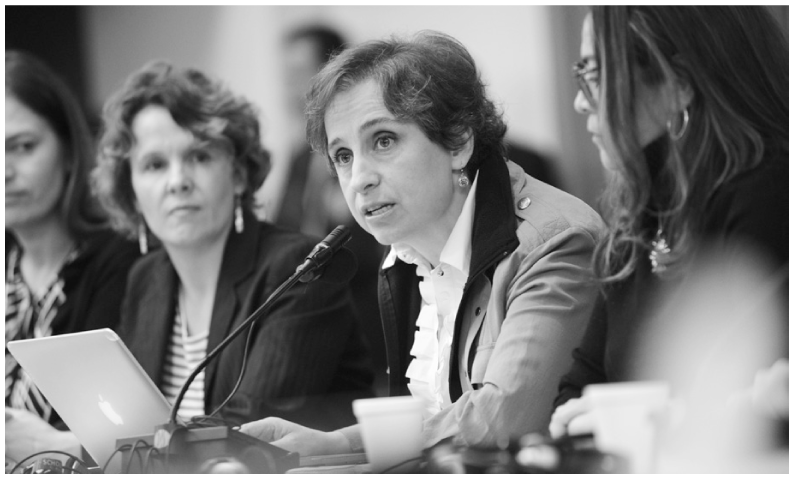
One of the spyware’s intended targets was Rafael Cabrera, a member of a team of investigative journalists led by Carmen Aristegui, who lost their jobs on a national radio network after exposing a corruption scandal involving President Enrique Pena Nieto and his wife Angelica Rivera.
Index spoke to him two years before about his coverage of the scandal (Winter 2015, 44.04, p76-80). At that time Cabrera had begun receiving mysterious text messages warning that he and his colleagues could be sued or imprisoned because of their investigation.
The messages contained links promising more information, but Cabrera was wary of opening them in case they contained a virus.
And he was right. As it turned out opening the link would have enabled the senders to access Cabrera’s data, view every keystroke on his phone and make use of his camera and microphone without being detected.
NSO Group says it sells the spyware exclusively to governments, on the condition that it only be used to investigate criminals and terrorists. But the investigation found that Aristegui and her teenage son were also targeted, along with other journalists, opposition leaders, anti-corruption activists and public health advocates.
Peña Nieto responded by saying that the law would be applied against those “making false accusations against the government”. A spokesperson later said in an interview with The New York Times: “In no way was the president attempting to threaten either The New York Times or any of these groups. The president misspoke.”
The government, though, has admitted using the spyware against criminal gangs, but denied spying on civilians. The authorities have pledged an investigation.
Cabrera told Index he had little faith the government would credibly investigate its own surveillance programmes. He also expressed alarm at Pena Nieto’s initial reaction. “It’s not cool that the president says he’ll take criminal action against you,” Cabrera said. “He went off-script and gave us a glimpse of his internal dictator.”
A Bribe or a Bullet
Mexican journalists must contend with all manner of threats and financial pressures, from drug cartels to state actors. Article 19 documented 426 attacks against the Mexican press in 2016, including 11 murders, 81 physical attacks, 79 acts of intimidation, 76 direct threats, 58 abductions and 43 acts of harassment.
Cartels have infiltrated newsrooms in crime-ridden areas, typically offering reporters a choice between plata o plomo, silver or lead, meaning a bribe or a bullet. As the acclaimed journalist Javier Valdez told Index months before he was murdered, this creates fear and mistrust within news teams and encourages self-censorship.
Many publications are also wary of criticising the state because they are heavily reliant upon government advertising. Mexico’s federal and state governments spent approximately $1.24 billion on advertising in 2015. Critics say this is a form of “soft censorship”, as publications must live with the implicit threat that the government will punish any unfavourable coverage by withdrawing funding.
The Hard Numbers
At least 107 journalists have been murdered in Mexico since 2000. Of the total, 99 are men and 8 are women.
From May 2003 to May 2017, 23 journalists have disappeared in Mexico.
Public officials were implicated in 53% of attacks against the press in 2016. Between 2010 and 2016 798 attacks against journalists were investigated by the authorities. Only the perpertrators of three attacks have ended up with a criminal conviction.
More than 200,000 people have been murdered or disappeared since Mexico’s drug war began in December 2006.
Footnotes
This investigation was carried out for Index by