




Abstract

Two years after Tanzania’s President John Magufuli came to office,
“Fear of expressing views and confronting leaders is one of the impediments towards accountable leadership in Tanzania,” Melo told Index on Censorship magazine.
That’s why in 2006, Melo co-founded JamiiForums, a website where people can blog about social, political and economic issues in the east African nation. Melo understood his market and people’s natural reticence about publicly criticising those in power, so all bloggers remain anonymous.
It’s a set-up that’s delighted JamiiForums’ users and infuriated successive governments. Finally, at the end of last year, the dam broke. Melo was arrested and detained after repeatedly refusing to betray some contributors’ real identities.
“I had no idea that I was going to be arrested,” Melo told Index. “I received a phone call from the Central Police Station in Dar es Salaam requesting that I present myself.
When I arrived, I was arrested and held for four days without any charge.”
He was eventually released on bail and has appeared in court several times.
Melo’s story is one of several that has free speech advocates deeply worried about Tanzania’s direction under President John Magufuli. Magufuli took office in 2015 and, at first, was hailed as a leader who would bring about change. His nickname is “The Bulldozer”, and his supporters view him as a tough, no-nonsense leader who’s not afraid to stamp on corrupt toes and doesn’t mind getting his hands dirty, literally.
Within weeks of being sworn in, Magufuli cancelled his country’s costly annual independence day celebrations in favour of a public clean-up. He donned latex gloves and collected litter in the streets of the capital, Dar es Salaam.
To many outside Tanzania, and especially to those elsewhere on a continent battling old-style “strong man” leaders, Magufuli is a breath of fresh air. But, as the president prepares to mark two years in office, it’s become increasingly clear that his toughness extends to issues of media freedom and free expression.
He’s not subtle about his disdain for journalists. In May 2017 he used the swearing-in of a new information minister to warn the media that press freedom comes with limits. The minister was appointed after his predecessor was sacked, allegedly for ordering an investigation into a government raid of a privately owned TV station.
“I would like to tell media owners – be careful, watch it. If you think you have that kind of freedom, [it is] not to that extent,” Magufuli said.
Melo is among those who are concerned by this kind of statement and by Magufuli’s actions.
“Under the current regime the country has fallen 12 positions down in the World Press Freedom Index from 71 in 2015 to 83 in 2017,” he said.
A newspaper was recently banned from publishing for two years; TV and radio stations have been temporarily shut down. Magufuli has accused these organisations of propagating hatred and inciting violence. In reality, most have just been critical of his administration.
“For the first time the media industry could not believe [what it’s] seeing: the government invading media houses with armed police,” said Melo. And Magufuli particularly loathes social media, including blog platforms like JamiiForums. In his campaign against Melo and other online media, the president has made use of often controversial legislation – some of which his own government brought into law, and some of which predates his administration. In some instances he’s enforced legislation which had never been implemented because it had been deemed inappropriate or unnecessarily tough. One of his most powerful weapons is the Media Services Act of 2016.
This act was condemned by free speech advocates, among them the International Press Institute, before it was even sworn into law. It did away with self-regulation of the media, made the banning of publications and organisations far simpler and carries heavy criminal penalties for, among other things, defamation and “sedition”.
A newsstand in Dar es Salaam, Tanzania
CREDIT: Thomas Cockrem/Alamy
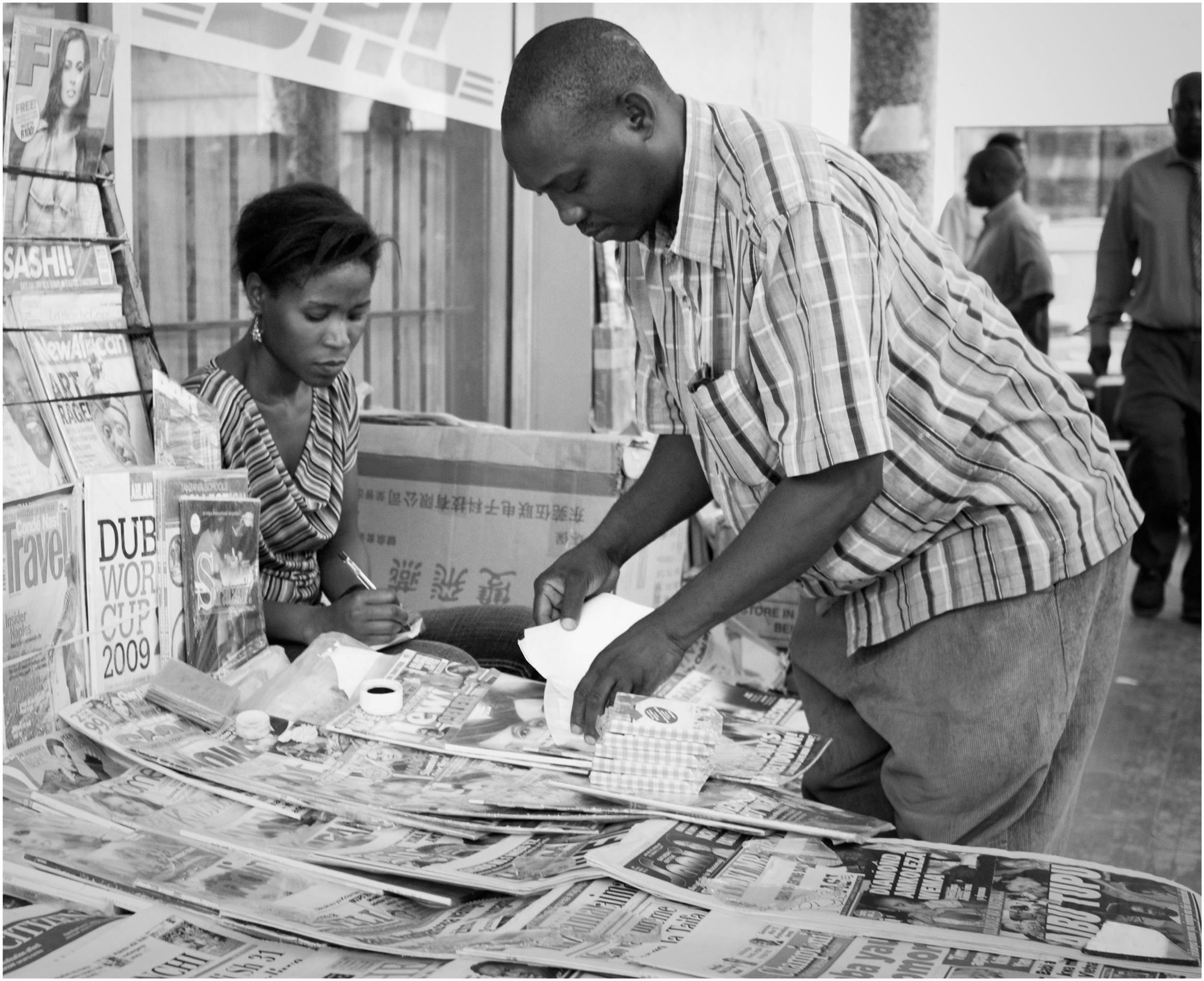
It’s not just journalists who are in the crosshairs. In early 2017 a popular rapper named Emmanuel Elibariki was arrested for allegedly insulting Magufuli in song lyrics. The “insult”? A verse asking why an unspecified but powerful person doesn’t “want criticism”.
The country’s Cybercrimes Act has also been an effective arrow in Magufuli’s quiver. In one instance, a man who posted a Whatsapp message asking friends whether the president was “a fool” was criminally charged. His case followed several others involving “insults” about the president on Whatsapp or social media.
Melo told Index that such cases amounted to “deliberate actions by the current regime to create a chilling effect through intimidating online users using state organs”.
So, is it working? Has “the bulldozer” run roughshod over Tanzanians’ freedom to speak? Melo said that his own site was going strong. “Our members are exceptional and have continued to enjoy their freedom”. Contributions are continuing to arrive and information is shared, debated and discussed every day. After all, he pointed out, “we have proved to them beyond doubt that we are ready to lose everything, including our business, in order to protect their anonymity”.
Tanzania Factfile
Mainland Tanganyika was part of German East Africa, before being designated a British Mandate after World War I. Tanganyika gained independence in 1961. Tanzania was founded by merging with the neighbouring islands of Zanzibar, which won independence from the Sultan of Oman in 1964
The country’s first president, Julius Nyerere, introduced a take on socialism called “Ujamaa” (Swahili for “brotherhood”) based on collectivised farming and a one-party political system
Nyerere was instrumental in bringing down neighbouring Uganda’s dictator Idi Amin in 1979, when he sent troops to support a domestic uprising after years of rising border tensions
A multi-party political system was introduced in 1992 and the country held its first elections under this system in 1995
At least 35 people were killed in January 2001 when security forces cracked down on protests against alleged electoral fraud in Zanzibar
Semi-autonomous Zanzibar re-ran its 2015 presidential election in 2016, after the victorious opposition party was accused of fraud by the electoral commission. The ruling party won the new poll with more than 91% of the vote