




Abstract

A strange man arrives at the White House. What does he want? Index’s contributing editor
“The president had just buzzed me,” the butler said irritably, as if talking about a wasp that had just stung him.
Inspecting the stranger’s clothes, his irritation grew and he wondered whether he could be an intruder. The middle-aged, silver-bearded stranger looked like he could be one of those radicals whom the French call “existentialiste”; he was not only suspiciously silent, but also dressed like an outsider, all in black. His face told the butler that the world was a wicked, wicked place, and no sip of Coke could alter the fact.
Once inside, the butler was surprised to see his orange-skinned boss get to his feet immediately, like a child whose schoolmaster had just entered the classroom. He had never seen the Commander-in-Chief this excited. Even when his wife, who was often away, came to visit, he would refuse to show emotion, sitting in his chair not unlike the recently reinstalled bust of Winston Churchill.
“Here comes the Underground Man!” he exclaimed, as if this could be the actual name of the visitor. “The architect of so many wonderful things. You are a brilliant, brilliant person. So good to have you here in the West Wing. So amazingly good to have you in my room. The last time I saw you, we were eating hot wings at the Moscow KFC, isn’t that right? Brilliant wings, so brilliant they were.”
There was a touch of sadness in his voice, the despair of a man for whom the Underground Man and Colonel Sanders could exist on the same plane of significance.
“You are an amazing human being. I remember so detailedly what you said about the Judeo-Christian tradition that day, and something about how important it was, it is, for us to preserve it. A philosopher – someone who lives with ideas – that is who you are. So tell me, Underground Man, would you like some Coke?”
CREDIT: Eva Bee
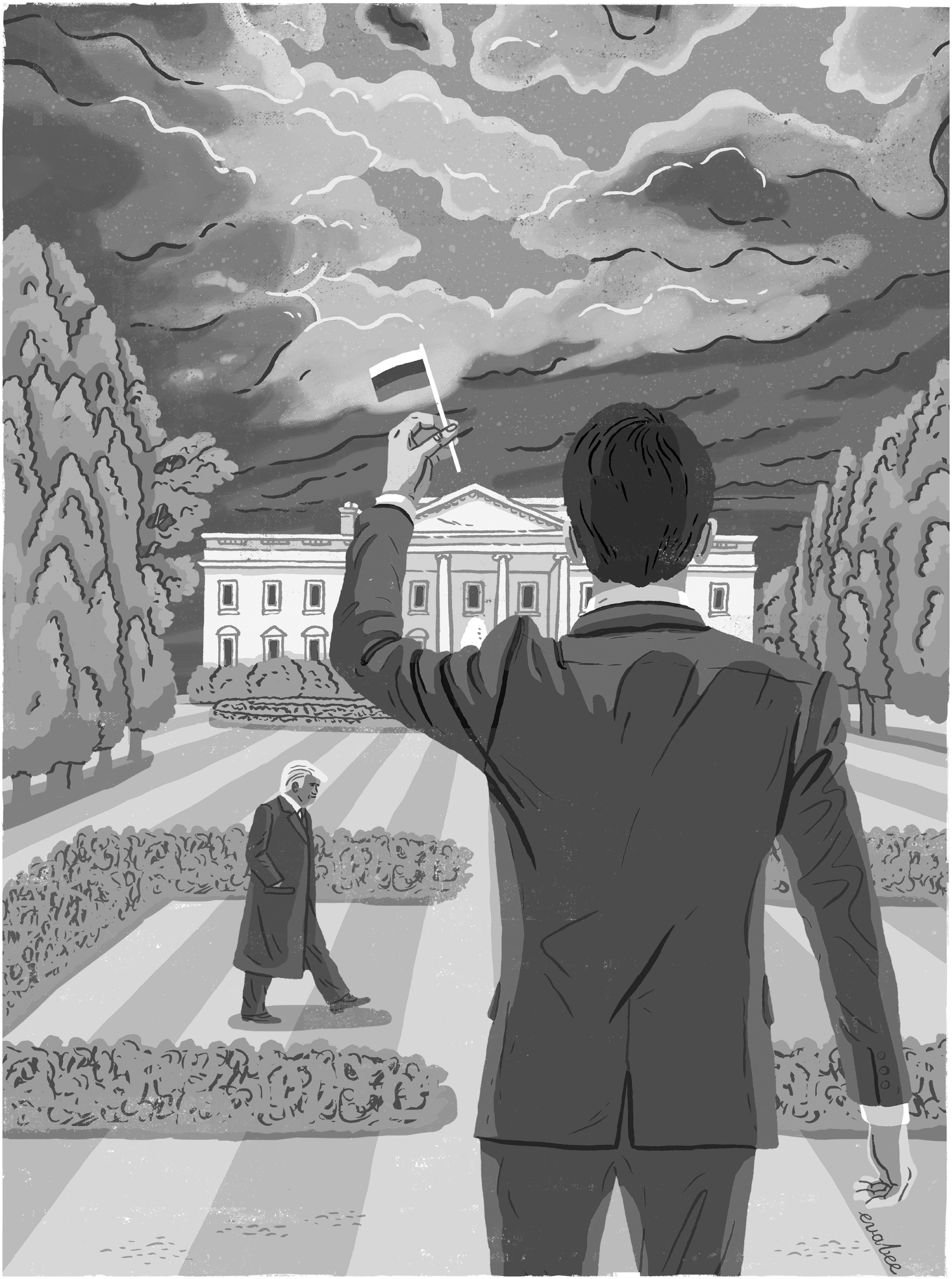
“Coke is what I came here for, Mr President,” the middle-aged man said in a thick Russian accent. His beard had turned grey, but the man’s ruffled hair retained its dark colour. “And to give some advice about the shape of things to come, too,” he added, as if his upcoming policy advice was merely an afterthought to his desire for Coke.
“I hate asking people for things, Coke or otherwise. I want to belong to this age truthfully, without any illusions. Every man for himself, right? That is the mantra of our age. Life designed only for the fittest. The pains of existence pouring on the dispossessed like acid rains. What a compassionless world we live in, and how good to be aware of it. The sad thing is no one is allowed to say it: the world is only for the fittest. But I am getting beyond myself. Can I sit down, Mr President? I have had a long day.”
“Tell me about it,” his friend replied. “I have been roasted from 6am to 11pm today by the fucking CNN, the foolish NBC, the fart-like ABC and the failing Times. They accuse me of being in bed with you, by which I mean the Russians. You can never please those furious liberals, can you? They loved Lenin and accused American folks of not understanding the great Russian revolutionaries. Now, those ex-Reds hate Russia and accuse other American folks of collaborating with Russians.”
“Call it by its name, Mr President. Call it by its true name. Call it ‘condescension’.”
“Yes, plain and simple condescension against the kind of people who…” He mumbled a word which the butler couldn’t hear. “The kind of people who drink Coke, I guess, despite the baseless accusations by liberals concerning its health implications.”
The mysterious man uttered “liberals” with such difficulty that the butler thought the word was hurting his tongue. “Don’t forget to always associate condescension with liberals. We are in the midst of a world-historical struggle between liberals and the ordinary folk. Never, ever forget that, Mr President. Read Turgenev, Fathers and Sons; read Tolstoy, What Men Live By; read Dostoyevski, Notes from Underground, to better see what I mean. Now, the shallow liberals can’t appreciate our Russian depths. They can’t see the light in Comrade Stalin’s works, either! And it is left to us, Mr President, to carry on with their ideas. You are carrying a massive Russian torch here.”
He waited for his friend to imagine the size of what he’d just described. “You and I are freedom-of-expression revolutionaries when you come to think of it,” he continued in a passionate voice, as if what he said was an indisputable fact. “Our enemies will no-platform anyone who shares our Judeo-Christian mindset. Write this down: ‘They can’t stand the messy business of tradition and religion.’ This is your ticket for the second term.”
“Let me tweet this. I couldn’t put it better. You are a true original. You are an amazing individual.”
The butler liked what he heard, except for the Stalin bit – that man had built labour camps, had he not? – and felt ashamed for having judged the Underground Man. But then, much to his chagrin, the stranger who claimed to be no different than a Russian peasant brought out a little metal stash from his jacket pocket, split some salt-like stuff on the president’s desk, and started dividing it into three lines of equal size with his earth-coloured GUEST ACCESS card. He turned to the President. “You need to do this before hearing out what I have to tell you. You need to relax, sir.”
“But that’s disgusting,” the leader of the free world said. “I have been eating all kinds of things on this table. How can you even consider putting your nostrils on it and breathing in the history of this desk, so to speak?”
“My President’s desk is much dirtier,” came the reply. “I have even seen pieces of paprika Pringles there. Just trust me with this, for it is impossible for you to comprehend what I am about to tell you without getting high. You can trust me. You did trust me. You will trust me.”
When he woke up the next day, the butler couldn’t quite remember what had happened after he was given an executive order to lock the door, sniff a line and lay down on the sofa. The conversation between his boss and the visitor featured hotels, video tapes, golden showers and cameras. In his mind, the butler pictured shiny yellow lines leading up to the sky, all the way to Almighty God, so beautiful was this feeling of transcendence… from that vantage point, everything appeared so small to him, so useless and devoid of significance: Washington DC, the Monument, the White House, his tiny Ford parked outside, the president’s hands…
***
The leader of the free world was enjoying his well-done steak that March day when the butler entered the concealed rooms of the Oval Office with a can of Coke on his tray at 12.30pm sharp. It was a Monday and the Underground Man, by now a senior advisor to the president, was reading the latest issue of Pravda on the sofa.
The Underground Man extended his arm toward the butler to ask for an ashtray. “I have told Kremlin about this mess and they agree with my solution.” He spat a wad of strawberry-flavoured gum onto the ashtray.
“I call this strategy ‘Traces for No Traces’, Mr President. The best way to get rid of an old ‘trace’ is to manufacture a new one. You know about these secret workplace lovers: she is married to her high school sweetheart and he is married with two kids. They get enormous joy from hiding their romance. Once people find out, the banality of the whole thing is revealed to both: he is attractive just because he is forbidden and vice versa. And so, what is the best way to conceal the affair? To appear as enemies, of course. They fight in front of others, raising their voices, accusing each other of doing unmentionable things. This very smoothly removes all doubts concerning their affair, without leaving any trace.”
“You are an amazing individual,” the president said, leaving his half-finished steak on the plate. He had been losing his appetite a lot lately, missing his carefree days. He then ordered the butler to bring him two cans of Coke. “You are an individual,” he said, not aware of the word he had forgotten to repeat.
***
The butler would keep the memory of the stroll that day at the Rose Garden dear for many years to come. It was the first week of April and the 30 different types of tulips crisscrossed around him with boxwood had turned the garden into a festive place. The butler looked at the diamond-shaped lavenders around the crabapple trees and felt lucky to be spending this sunny day in the garden, taking joy at the view of the West Wing colonnade behind them.
For the president, however, all this had little meaning: even that abundance of colour and fragrance were failing to lift his spirits. He seemed like a lost man, walking aimlessly along the pathways, his blue eyes raising to the sky in the pose of a tragic hero looking for an ancient god to rescue him from his sadness.
The Underground Man, who never left his sight in the previous three months, asked the butler to follow them as they moved along the lawn.
“You have your Coke and your policy advice and the support of the world’s dispossessed,” he told the president in such a sweet, serene tone that he appeared indiscernible from a high school BFF.
“The world’s citizens who are brave enough to question climate change, cosmopolitan values and the liberal mindset have put their trust in you, Mr President. I want you to imagine a young French boy who is crying in his room at this very moment. He can’t tell his school mates how wrong it is to treat homosexuality as a normal thing: he knows he is right, but he can’t voice his opinions, fearing reprisals. Now, I want you to imagine in a lavatory in Berlin this German girl, this tiny beauty, who knows Islam is a hateful religion: it is so obvious to her, but she can’t say it aloud… These people need your urgent support, Mr President. And how can you support them?”
“How,” the president mumbled with a melancholy voice, as if asked to name a poem.
“Here is how. By bombing Syria. By bombing the hell out of them.”
“But Syria is not… Why should I bomb Russia? Syria is Russia. You want me to bomb Russia?”
“This is how desire works, Mr President, this is what Russian literature has taught us for so many decades. You have to hit your lover straight in the face, you have to rape your love, you have to pull her by the hair and strangle her. Only this way she will truly love you… That is the sad truth of our existence. You should bomb Syria like crazy, Mr President. You should destroy our fighter jets, burn a field or two. Only the sight of that beautiful destruction can lead to a true regeneration.”
And with that, the butler saw the leader of the free world smile for the first time after many weeks of frustration and sadness. To the butler’s eyes, he seemed wise and strong. In the following hour, he would follow the president as he walked back to the Oval Office and gave the order to bomb, bomb, bomb. He would watch him press a red button, not dissimilar to the one he used for his Coke needs, to forget about the sadness of his existence. He would witness him saving all those innocent children, innocent babies — babies, little babies — from dying.