




Abstract

Protesters casting their feet in concrete are grabbing attention in Indonesia. Now they are inspiring other communities to challenge the government using new tactics, reports
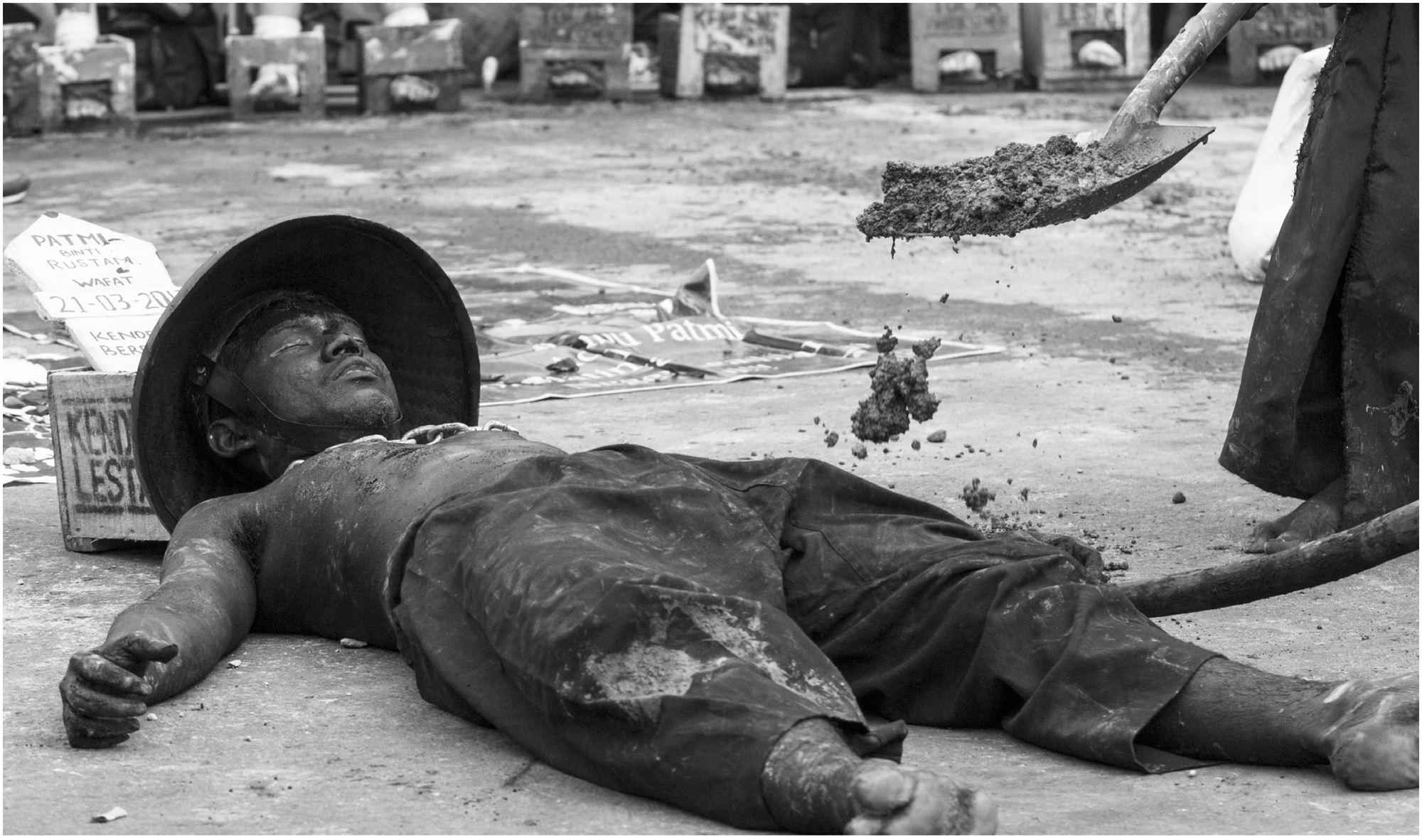
Activists hold a mock burial to commemorate Patmi, who died during the March 2017 protest
CREDIT: Afriadi Hikmal/Barcoft Images/Getty Images
They couldn’t move around and needed to be lifted to go to the toilet. At the end of each day, the women were ferried to the nearby Legal Aid Foundation office in Jakarta, where they would sleep with their feet still embedded in concrete blocks. They would then repeat the protest. The protesters sat in the sun and rain, singing songs, saying prayers. Soon some 60 people had joined them, all encasing their feet in cement. All refused to break the concrete until they could meet with the president. Six days into this unusual protest their wish was granted. The protest is part of a series of demonstrations organised by communities around the Kendeng ridge, which spans 250 kilometres in northern Java. The ridge is abundant in limestone and clay, essential for making cement, and has been eyed up by large corporations. But the area is also home to many farmers who own, cultivate and depend on its fertile lands.
Villagers from the March 2017 protest
CREDIT: Beawiharta/Reuters
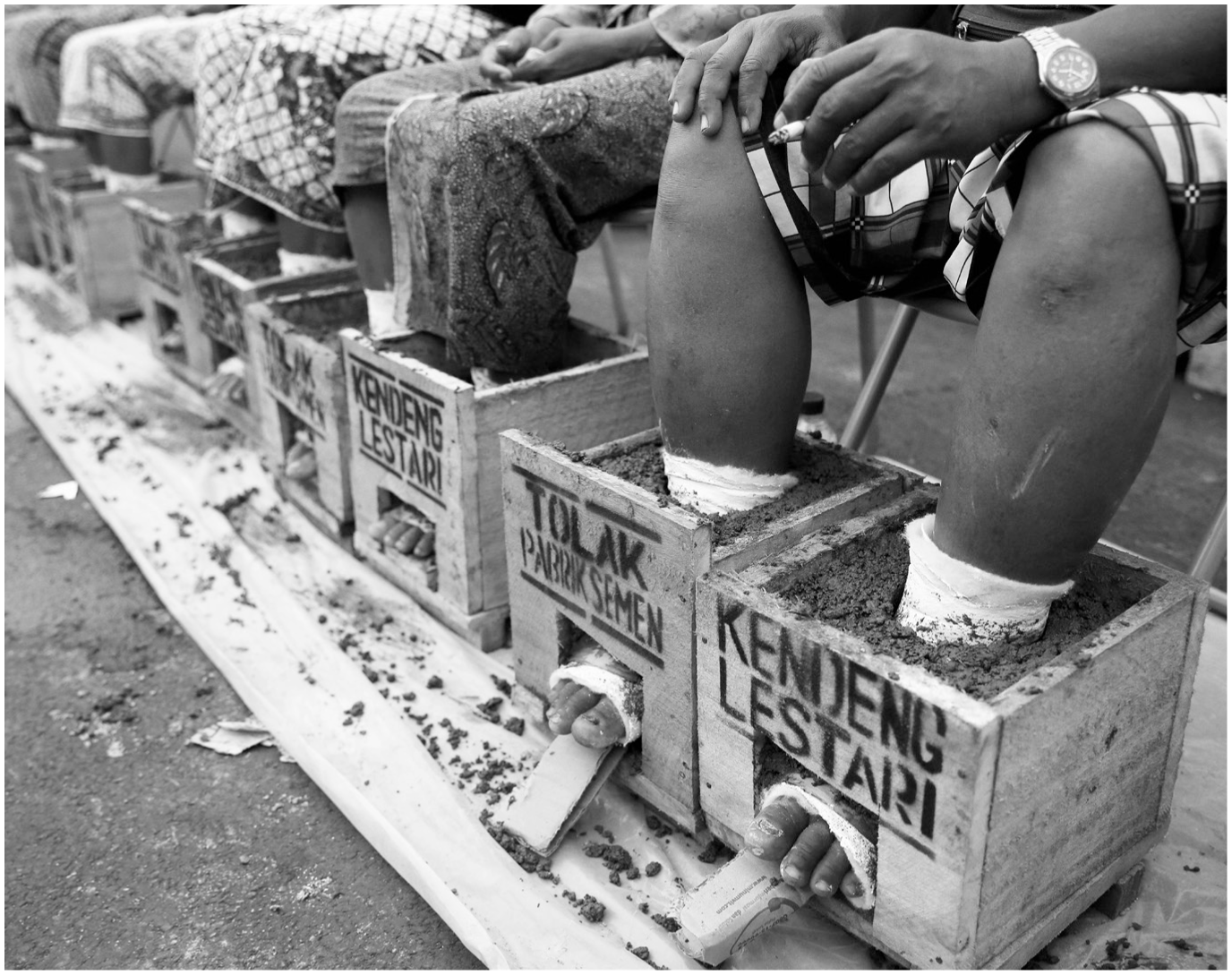
“We want to show the president and the nation that our livelihood and our lives are being threatened by cement companies,” said Sukinah, one of the protesters, in an interview with Index.
Following the protests, an environmental study on Kendeng has been ordered by the government. It is due out in June.
The inventiveness of these protests has inspired others. Many communities have recently visited the Kendeng villages to study their methods, including Aleta Baun, who staged her own protest in 2013 in Timor where villagers occupied local marble mining sites and weaved. Baun visited in April to learn more about the Kendeng people and to swap tips on successful activism.
Ibrahim Massindereng, a lawyer for the Association of the Defenders of Traditional Communities, has been involved with the people of Seko, on the island of Sulawesi, since 2015. He told Index that one person from Seko, Andri Karyo, had visited Kendeng and that people from Seko had gathered locally to watch the protests on tapes. Massindereng said: “Women stepped forward; around 400 women set up and manned tents for 2 months at the planned hydroelectric dam site. Before Andri’s visit to Kendeng, Seko’s women were rarely involved.” With a theatrical background, Massindereng is preparing a dramatic protest, “a harvest party,” which he said he was coordinating with artists in the area.
And there have already been protests inspired by Kendeng. For example, at the end of March a protest was mounted by Forum Satu Bumi (One Earth Forum) in the city of Samarinda, East Kalimantan, to voice their concerns on how this province in Borneo has been destroyed by the mining of oil, gas and coal. They also put their feet in concrete.
“We meet often, in different villages, sometimes a few times a week,” said Giyem talking about how the Kendeng protesters organise. She is a farmer and leader in her Pati village. “There are always representatives from the different villages.”
“We usually don’t plan far ahead of time,” said Sukinah. “We decided to cement our feet a few days before we left for Jakarta.”
Dhyta Caturani, a Jakarta activist involved in the Kendeng struggle, confirmed this. “One morning they told us they were going to Jakarta and we scrambled to find them a place to stay,” she told Index. To fund campaigns each village has set up a reserve. “Each time we want to do something, everyone contributes,” said Sukinah.
Dewi Candraningrum paints portraits of the farmers, to increase their profile. She has painted Kendeng leaders such as Joko Prianto and Paini; those criminalised for protesting, like Murtini; and those who died during the Kendeng people’s 10-year struggle so far like Atma Khikmi Azmy, who was killed in an accident; and Sarmi, who was killed by a sickle to the neck by a pro-cement thug.
“It’s as if the dead are still fighting beside us, which is in line with Samin belief that when people die they simply take a different form,” said Candraningrum.
Many artists have created works and donated the proceeds to support the Kendeng cause, including well-known band Marjinal, graphic artists, tattoo artists, T-shirt makers and batik artists. The documentary Samin vs Semen was shown in Germany this year by Dandhy Laksono, the director, and Gunarti, a Pati farmer who was instrumental in bringing women into the struggle.
Kendeng farmers have been politically active for 10 years since a traditional Samin community in Pati resisted plans to set up a mining operation in their village. They rallied support and founded a network of allies. Over the years they have pursued legal means, as well as frequently holding events with strong messages and creative methods rooted in local culture and spirituality. The women who encased their feet in concrete had campaigned before. In April 2015, they had beaten lesung – a wooden vessel and pestles, used to grind rice – in front of the presidential palace.
“We wished to wake the Indonesian government to our plight and beat back environmental destruction caused by cement companies,” said Sukinah.
Significantly, nine of them already had encased their feet in concrete last year. This protest ended after they met the president’s staff and were promised a meeting. The meeting never materialised, but they realised it was an effective means of getting their message out. They camped outside the president’s palace again later and finally met him.
The meeting and the ensuing study did briefly halt some plans. But when a cement company’s licence was reissued this February in Rembang, the women returned to Jakarta.
They were joined by dozens more people from their villages, as well as sympathisers from Jakarta and Papua. The women’s persistence in demonstrating had captured much public attention. Expressions of solidarity poured in from Sumatra, Kalimantan, Sulawesi and abroad.
Not everyone supports the protests though. Some accused the Kendeng farmers of abusing women by forcing them to encase their feet in cement. “We put women forward because we want to avoid tendencies towards violence,” said Sukinah. “No one was obligated to take on any roles, everyone volunteered,” Giyem added. This included Patmi, a protester who died of a heart attack the night after she removed her feet. Her widower Rosat told Index: “The struggle to preserve mother earth was very important to her. She participated in all kinds of protests.”
Many accused the women of being bad mothers who abandoned their children. “We’re doing this for our children too, so we can keep our lands to bequeath to them,” said Sukinah.
Intimidation by thugs and officials, criminalisation of protesters and media bias have all happened. There are demonstrators and social media campaigners paid by pro-cement interests. Children are bullied at school by pro-cement teachers. There have been sexual assaults on women activists.
“Historically Samin people have resisted exploitation. If anyone says we’re violating Samin philosophy, then they haven’t understood it completely,” said Gunretno, a prominent Kendeng leader, in an interview with Index.
Siti, a Samin farmer, added, “I don’t think I’m violating our customs. Our purpose in protesting is clear: to protect the land. Samin people are allowed to work only as farmers. If our lands are lost, if our water runs dry, it hurts us and everyone in the region.”