




Abstract
Moscow-based writer
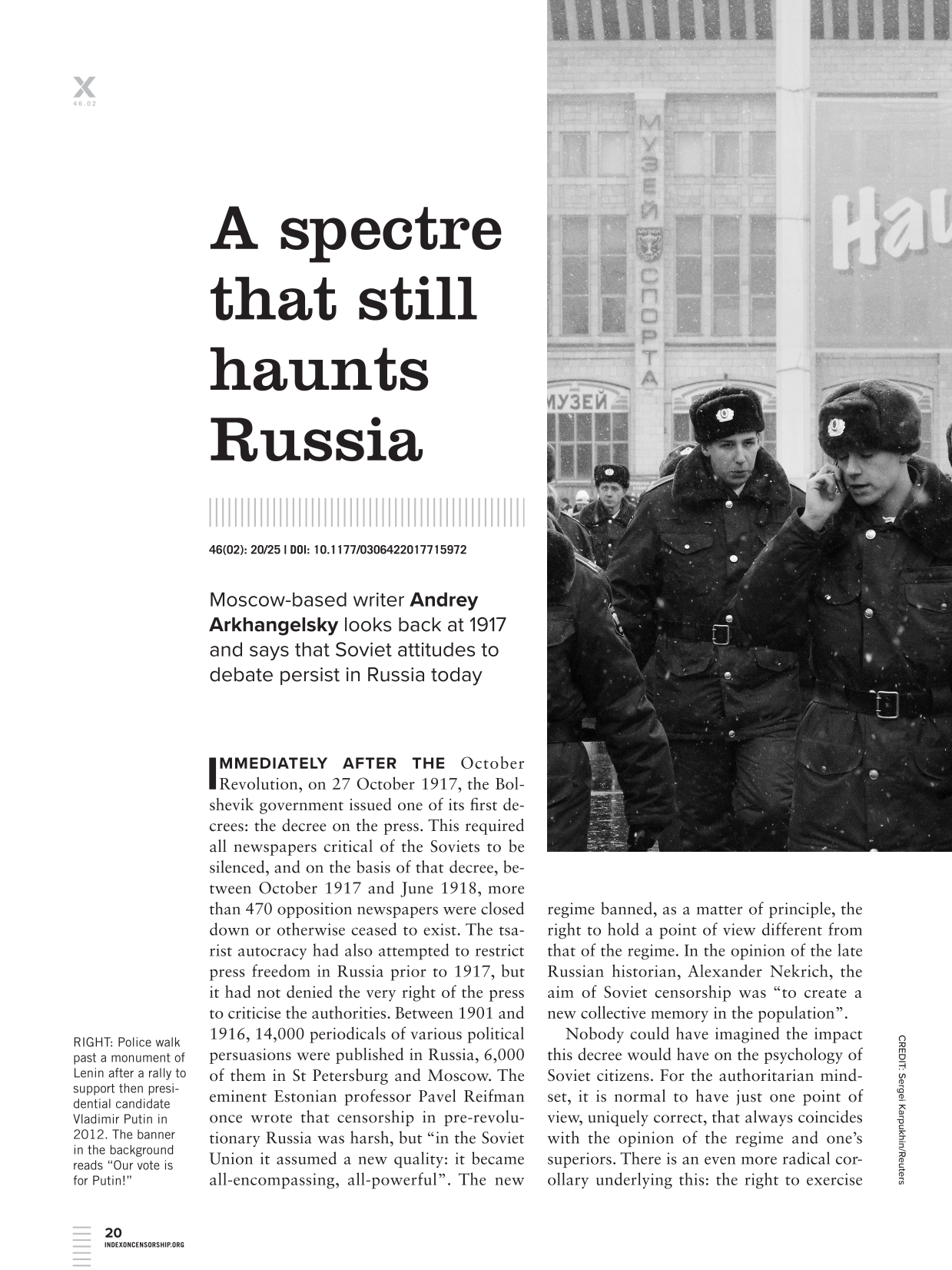
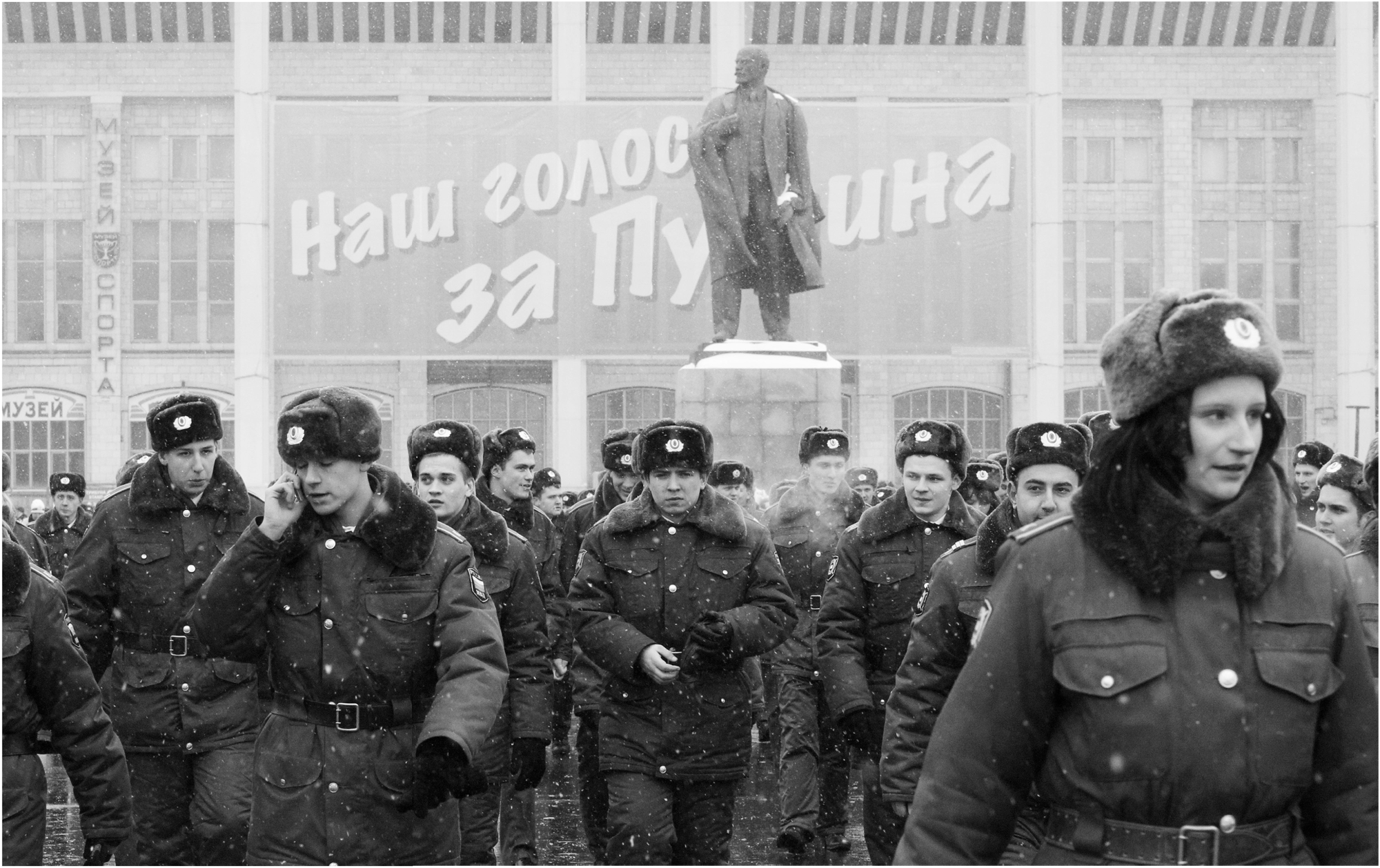
Police walk past a monument of Lenin after a rally to support then presidential candidate Vladimir Putin in 2012. The banner in the background reads “Our vote is for Putin!”
CREDIT: Sergei Karpukhin/Reuters
Nobody could have imagined the impact this decree would have on the psychology of Soviet citizens. For the authoritarian mind-set, it is normal to have just one point of view, uniquely correct, that always coincides with the opinion of the regime and one’s superiors. There is an even more radical corollary underlying this: the right to exercise physical and symbolic force against the individual. For the Soviet regime this axiom became not just a tool but an outlook, a fundamental principle. The ban was not just on writing or speaking out of turn, it was a prohibition on being different, of not being identical to everybody else.
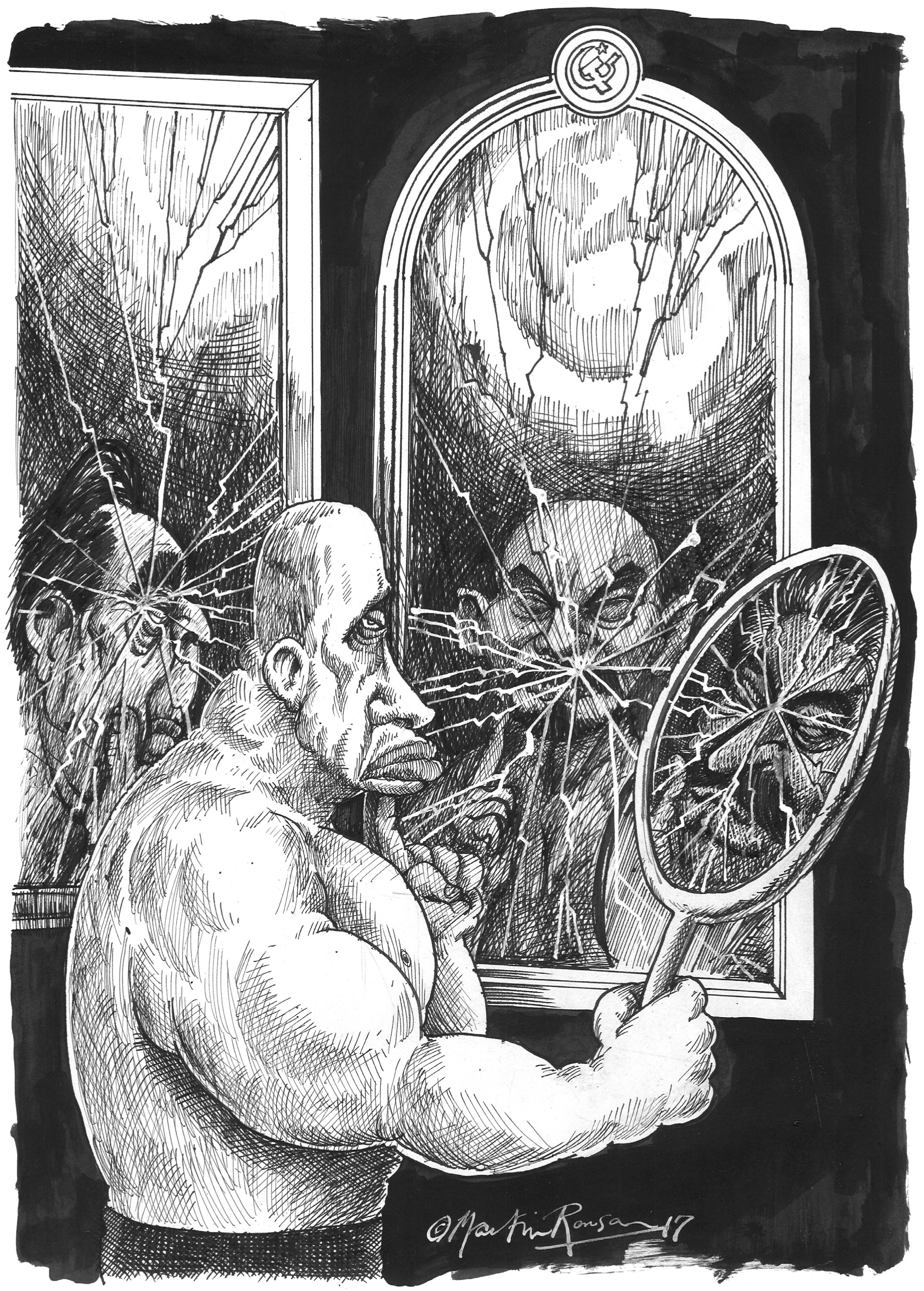
For all the might of its suppressive apparatus, the Soviet regime continued to be terrified of the slightest freedom of expression, and it put a great deal of energy into crushing it. Indeed, as subsequently became evident, the Soviet ideal could exist only in a hermetically sealed, self-contained space. The situation was like that in the fairytale about an evil princess who ordered all mirrors to be removed from her palace in order not to see her pimple. You can get by without a mirror for years, decades even, but when one accidentally finds its way into the palace, the impact is devastating. That is what happened to the Soviet regime: as soon as the gates of perestroika were opened, even slightly, between 1986 and 1991. As soon as there was scope for differences of opinion, the Soviet project found itself unable to survive for even another six years. The foundations of a massive building labelled ‘“socialism” were undermined by a puny trickle of free discussion, the very thing banned in 1917.
The USSR ceased to exist, but homo sovieticus was still around. The paradox was registered between 1994 and 1999 by the Yury Levada Analytical Centre (now the Levada Centre) that the Soviet mentality persisted.
Soviet Man finds the very possibility of having a choice disturbing. Russian Federation propaganda, describing elections in Europe where there is no knowing right up until the last minute which of the candidates will win, successfully persuades him that this is a shortcoming, not the whole point of the system and that it is dangerous.
For most of the Russian population, press freedom is of little interest: they think it is something of concern only to journalists. President Vladimir Putin tapped into this mood and from the early 2000s he rearranged the media in Russia along Soviet lines, concentrating particularly on television: all the main television channels now reflect only the point of view of the regime. Putin has, admittedly, learned some lessons from the experience of the USSR, and leaves just a chink of freedom for a number of print publications, a couple of radio stations (Echo of Moscow and Radio Liberty) and a single television channel (Rain) which, for the time being at least, are able to express views not in harmony with those of the authorities.
Restricting free speech is typical of an authoritarian regime, but by doing so, the present regime struck a body blow at a society that was only just beginning to acquire the skills of dialogue and communication. The authorities in Russia simply do not understand what those are and see no value in them. They see dialogue only as a means of manipulation, but it involves a lot more than merely opening and closing your mouth; it has to involve a readiness to “wait for the other”, as the philosopher Paul Ricoeur put it. Dialogue involves a readiness to “accept the world”, to take account of it. That is what meaningful communication is and it is the only way to smooth out, at least to some extent, the unavoidable cultural gap between different people.
In Russia, “dialogue” is understood as a synonym for fighting and you are justified in using all necessary means to defeat your adversary. We can illustrate this with the example of any political talk show on the Russian federal channel, where the regime’s apologists gang up to attack lone opponents, not allowing them to get a word in edgewise; or with the kind of language recently used by Vladimir Safrokov, Russia’s representative in the United Nations, when he told the British ambassador:”Look at me when I am talking to you,” in a row over Russia’s support for the Syrian regime of Bashar al-Assad.
CREDIT: Martin Rowson
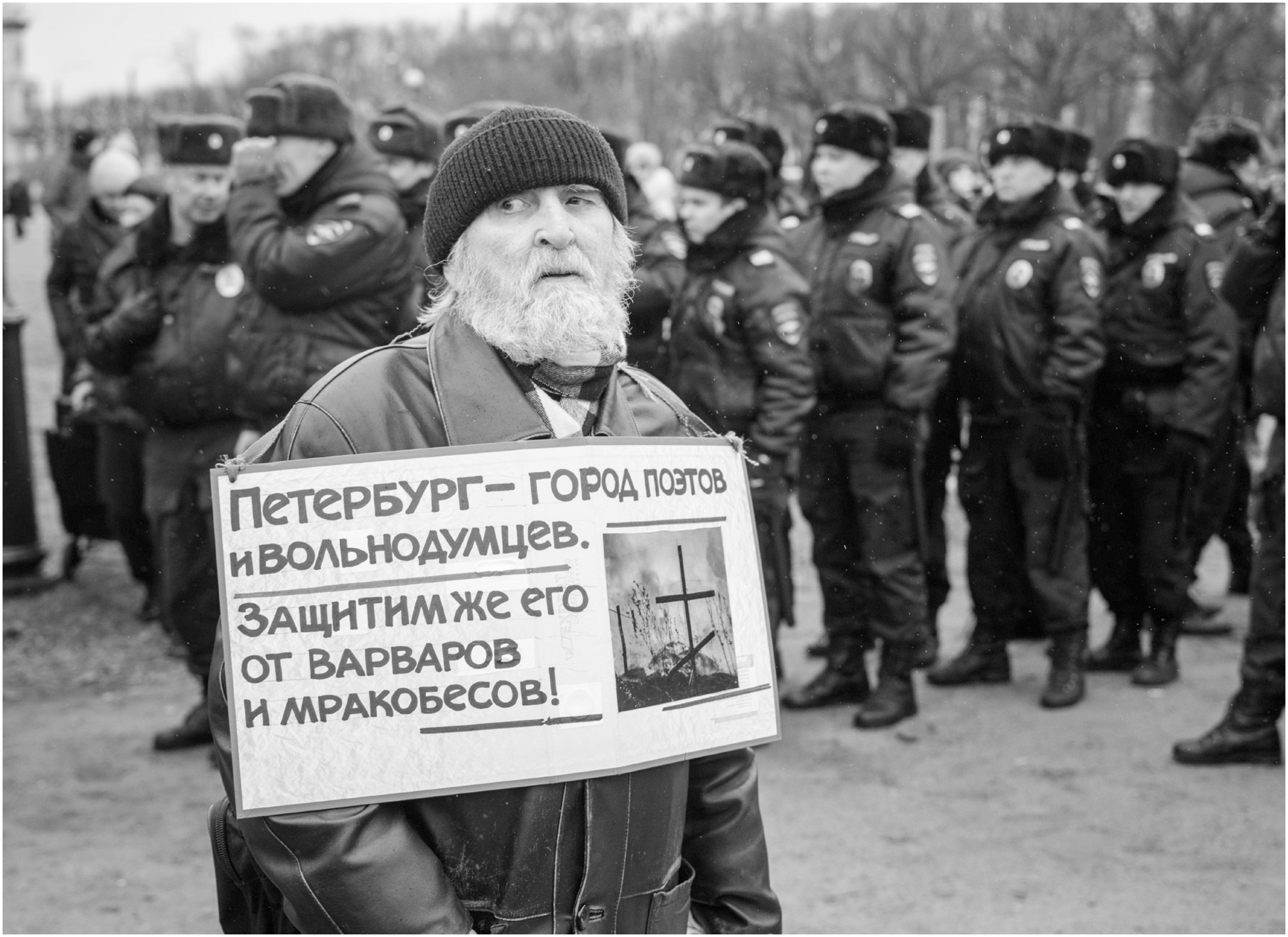
A man protests government corruption in St Petersburg in March 2017. His sign reads: “St Petersburg is a city of poets and free thinkers, we should protect it from barbarians and witch hunters”
CREDIT: Farhad Sadykov/Flickr
Contempt for dialogue, for meaningful communication, is the main psychological consequence of the censorship introduced in 1917, because censorship not only prohibits the expressing of a different opinion, it actively trains us not to discuss, not to listen to an opponent, not to respect his rights, not to take account of him as a person. The present regime in Russia replicates this principal feature of Bolshevism: it despises the other person’s opinion; it prefers the use of force (in the case of Safrokov, only psychological). However, this atrophying of elementary communication skills is coming back to haunt the regime, as is evident, for example, in the clumsy attempt to demolish dilapidated, Khrushchev-era residential blocks in Moscow and replace them with new buildings. One might imagine this would be cause for celebration, but the authorities communicated with the people affected in the tones of a camp commandant haranguing his subordinates, a lack of respect that caused predictable resentment. Why not just enter into dialogue with the residents involved? Why not give them a say? The Russian regime would, however, feel it was lowering itself if it were to seek agreement with other people. It is accustomed to issuing orders, to dictating terms, and this rejection of dialogue becomes the norm. We see the same thing in the failed dialogue between teachers and their pupils, which appeared on the internet on the eve of, and in the aftermath of, the anti-corruption protests on 26 March this year.
A new generation of pupils and students, born when Putin was already in power, ask their teachers questions about corruption, which the teachers are incapable of answering. They can only accuse the pupils of treason and mouth clichés from the Soviet era. The pupils are familiar with social networks and accustomed to dialogue and alternative sources of information, while their teachers, who only watch TV and consider the internet “trash”, fail to find a common language with them. Moreover, they have no wish to do so. The two generations seem to speak entirely different languages and this results from the deficit of meaningful communication within society. It is just the way things became in the Soviet Union of the 1980s, when the gap between Soviet reality and Soviet propaganda became enormous.
Life without a mirror generates a hermetic, self-contained mentality in which Russia is always right, while the rest of the world is stupid and ridiculous. The world is incapable of judging Russia fairly, of appreciating how beautiful and intelligent we Russians are. The world is jealous of us and wants to destroy us. The lack of a mirror generates a perverse morality that ignores universal values, believing that only what we say is true; only our understanding of good and evil is correct. This too is a legacy of 1917, when truth, good and moral values had to come with the prefix “Soviet”. This is a morality with no faith in individuals, in their ability to accomplish anything of their own free will. It is a morality that claims the various “colour revolutions” happened “at the behest of the West”, and that any human passion can be explained in terms of nothing more exalted than personal gain.
Finally, the lack of a culture of pluralism has once more made possible manipulation of the population through television, on a massive scale. A monstrous propaganda experiment was conducted after the protests of 2014, which seems beyond belief in the 21st century: how, given that there is an internet with thousands of alternative sources of information, can people believe only what they are told on television? Alas, we have to recognise this as a feature of authoritarian thinking, which finds it unacceptable for there to be an alternative point of view. People with this mindset are used to living in a world where decisions about what is good and what is evil are taken on their behalf by the state, to which they entrust their consciences. No one today is prohibiting them from seeking an alternative point of view, but that is not something they want. For such a person, there is no problem if the regime completely changes its mind from one day to the next, as in George Orwell’s novel 1984. Yesterday Turkey was an enemy and today it is a friend, because that is what Big Brother has decided.
The regime has, however, come up against a paradox. This kind of psychology is incompatible with Russia’s economic model which, so far at least, is still capitalist and founded on private property. There is no understanding that a modern economy is not based on oil and gas alone but, more importantly, on communication, on respect for others, on tolerance. A modern economy can be built only with people who know how to compromise, with the daily input of the individual decisions of millions, as economist Friedrich von Hayek argued. Only a culture of pluralism, only freedom of speech can educate people to be capable of taking such decisions. We have run up against a brick wall. It is impossible to build an efficient economy with unfree people. Free people, however, are just what the Putin regime most fears. It will permit no changes; it is a dead end and, like the Soviet regime before it, is gradually pushing itself into a corner, trapping itself, by underestimating human psychology.
The roots of this impasse are to be found right there, in 1917. That is when it all began, with the prohibition of free speech, the prohibition of free thought. The shadow of 1917 hangs over Russia to this day and it seems, alas, that the country has failed to learn the lesson given by the USSR. Today that ban on free speech is again leading Russia up the same path, to the same dead end, with no sign of a way out.
Footnotes
Translated by