




Abstract

With a new film about Trotsky’s killing just released,
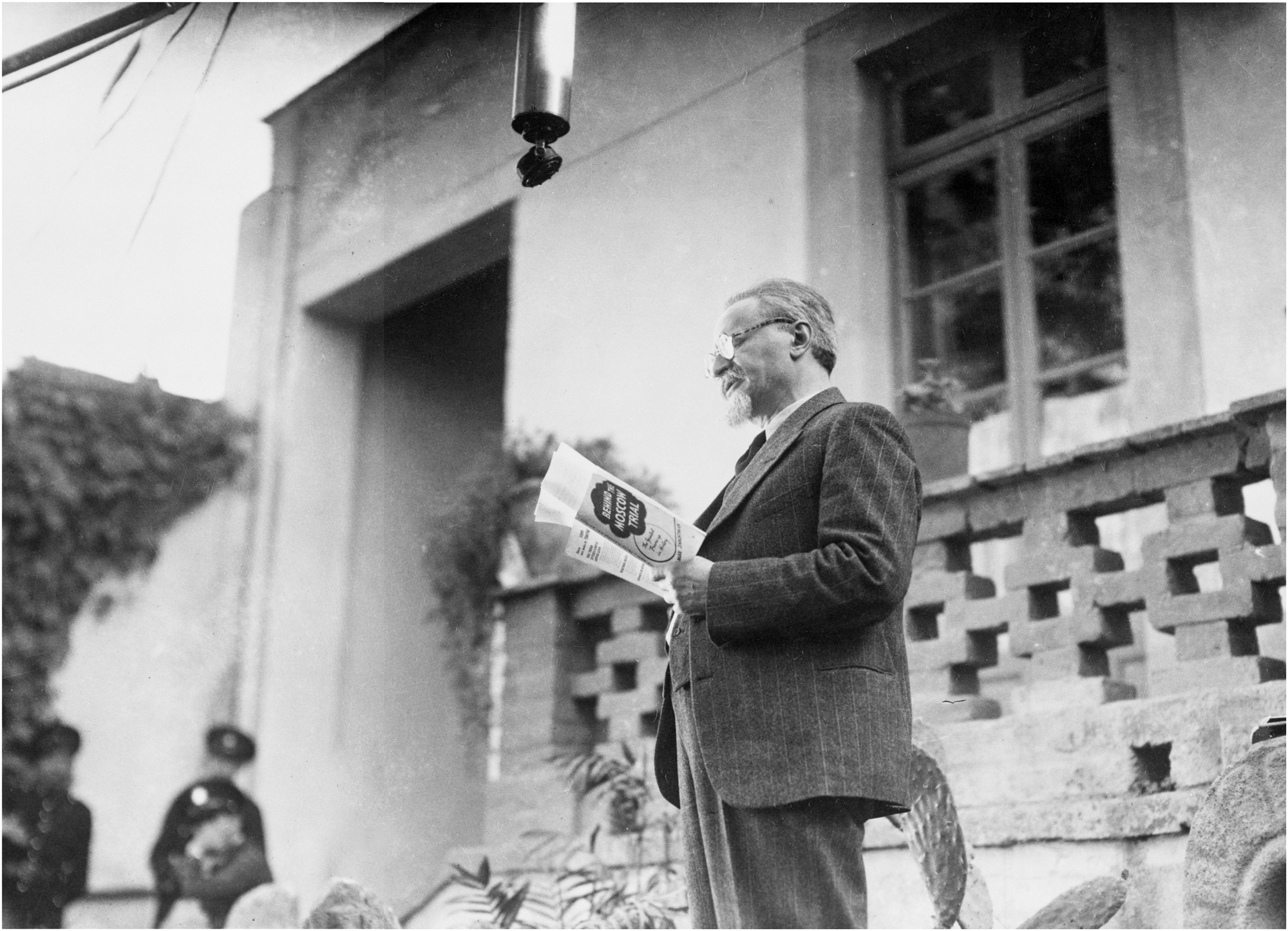
Trotsky reads from Behind the Moscow Trial, a book examining Stalin’s trials of Trotsky supporters, at his home in Mexico City in 1939
CREDIT: akg-images
Responsible for the repression and murder of thousands of political opponents during Russia’s Red Terror, Trotsky was an unlikely advocate for free speech. Yet, having been exiled by Joseph Stalin and airbrushed from Soviet history after losing out in a power struggle with his former comrade, he was no stranger to censorship himself.
Embraced by a small community of artists and intellectuals, Trotsky stayed active in Mexico, founding a local Marxist magazine and launching an international initiative for revolutionary art. Then he was murdered by a Stalinist agent.
A century on from the Russian Revolution and 80 years since Trotsky arrived in Mexico, his time there continues to pique public interest. His former home, now a museum, draws some 17,000 foreign visitors and 50,000 Mexican students a year, while The Chosen, a new film based on his assassination, was bought by Netflix and released in 190 countries in April.
Trotsky’s presence in Mexico, a nation that had only emerged from its own decade-long revolution in 1920, proved divisive from the outset. The socialist-leaning president Lázaro Cárdenas had offered him asylum after Trotsky had difficult spells in Turkey, France and Norway, but the decision did not go down well with Mexico’s Kremlin-backed communist party nor left-wing newspapers.
“Mexico’s communist press attacked Trot-sky systematically. They tried to have him expelled from Mexico and rejected by the labour movement,” Dr Olivia Gall, author of the book Trotsky in Mexico, told Index. “They even tried to prepare public opinion so that if Trotsky were assassinated it wouldn’t cause too much drama in Mexico.”
Trotsky stayed for two years with the iconic Mexican artists Diego Rivera and Frida Kahlo. He then moved a few blocks down the street after a political disagreement with the former and a rumoured affair with the latter. The first attempt on his life came in May 1940, when Stalinist agents sprayed his house with machine-gun fire.
“Awakened by the rattle of gunfire but feeling very hazy, I first imagined that a national holiday was being celebrated with fireworks outside our walls. But the explosions were too close, right here within the room, next to me and overhead,” Trotsky wrote afterwards. “The odour of gunpowder became more acrid, more penetrating. Clearly, what we had always expected was now happening: we were under attack.”
Trotsky and his wife survived by hiding beneath the bed while their bodyguards managed to repel the attackers. Yet his luck ran out just three months later, when another Soviet assassin stabbed him in the head with an ice pick while he was reading at his desk. Trotsky died the next day at the age of 60.
Covered with dusty books, ink pots and a metal lamp, Trotsky’s wooden desk remains in his house, just as it was that day. His ashes lie in a stone tomb marked with a hammer and sickle in the leafy courtyard.
Known by those close to him as “the Old Man”, Trotsky spent his last years looking after his pet rabbits and trekking into the mountains to pick rare flowers and cacti for his collection. He also still wrote prolifically.
In 1938 Trotsky founded Clave, a magazine that would circulate among small groups of Mexican Marxists. “Only the greatest freedom of expression can create favourable conditions for the advance of the revolutionary movement in the working class,” Trotsky wrote in his first editorial. “The Mexican proletariat needs an honest press to express its needs, defend its interests, broaden its horizon and pave the way for the socialist revolution in Mexico. This is what Clave intends to do.”
Debate over freedom of expression among Marxists in the turbulent 1930s was very different to what it is in many Western democracies today. “Trotsky argued that any attack on freedom of press was an attack on the worker’s movement and socialist revolution. But he didn’t see it as an attack on democracy, as we would today,” Gall observed. “The central issue for the left was moving forward with the proletarian revolution, not whether socialist or communist projects should be democratic.”
That year Trotsky also launched the International Federation of Independent Revolutionary Art alongside Rivera and the French surrealist writer, poet and anti-fascist, André Breton. He and Breton co-wrote its manifesto, affirming that “in the realm of artistic creation, the imagination must escape from all constraint and must, under no pretext, allow itself to be placed under bonds.”
Citing censorship in Nazi Germany and Soviet Russia, the authors warned of “the ever more widespread destruction of those conditions under which intellectual creation is possible.” They emphasised the need for “complete freedom for art” and lamented that “thousands on thousands of isolated thinkers and artists are today scattered throughout the world, their voices drowned out by the loud choruses of well-disciplined liars.”
Neither Clave nor the federation had the impact Trotsky desired. Breton helped the latter to gain ground in Europe, but momentum was lost after Rivera fell out with Trotsky and World War II broke out. Both initiatives came to an end shortly after Trotsky’s death in 1940.
One of Trotsky’s primary concerns was that censorship would leave the proletariat vulnerable to abuses of power. “Today the government may seem well disposed towards workers’ organisations. Tomorrow it may fall, and it inevitably will, into the hands of the most reactionary elements of the bourgeoisie,” he wrote in Clave. “In this case, the existing repressive laws will be used against the workers. Only adventurists who think of nothing but the moment’s needs can fail to guard themselves against such a danger.”
This proved to be the case in Mexico. Andrew Paxman, a historian at Mexico’s Centre for Research and Teaching in Economics, told Index that Trotsky’s vision for the Mexican press went unfulfilled as many worker-led newspapers closed down in the 1940s. Press freedom suffered as Mexico’s ruling Institutional Revolutionary Party took a “right turn” and began clamping down on labour rights and co-opting the media through subsidies that encouraged self-censorship.
Throughout his time in Mexico Trotsky also had to confront what is now known as “fake news”. The term may only have been popularised in the last year, but the way segments of the Mexican press covered Trotsky illustrated that there is nothing new about reporting falsehoods. Now-defunct newspapers such as El Popular and El Nacional portrayed Trotsky as a Nazi or US agent intent on stirring up trouble in Mexico, and even accused him of staging the shooting at his home, which left his grandson injured, in an attempt to provoke a war between the USA and Mexico. Trotsky identified his main aggressor as Vicente Lombardo Toledano, an influential labour leader who owned El Popular and had close links to the Kremlin.
It was not, and still isn’t, unusual for the powerful to use Mexico’s press as a tool to attack or discredit rivals. “There’s a tradition in Mexican journalism that goes back to the 19th century of newspapers and magazines being set up not as businesses but as means of trafficking influence,” Paxman noted. On top of sales, subscriptions and advertising revenue, he explained that they “have traditionally had two other revenue streams: the main one being government subsidies and the other being covert funding by a range of businessmen or politicians looking to boast about their deeds or defame rivals.”
Trotsky did not have to wait long to demonstrate that the attacks and threats against him were genuine. Within just months of the botched shooting he was silenced forever.