




Abstract

To deliver satirical jibes effectively, it helps to be around at the right time. Spitting Image set up shop when the country was deeply divided. Riots on the streets were the order of the day – the police versus the miners, protests against the poll tax and more. Feelings were running very high. Personally I would have killed my mother to make Spitting Image. I was angry and I really wanted to do that kind of television satire. Spitting Image had British Prime Minister Margaret Thatcher and US President Ronald Reagan and a robust couple of decades obsessed with war, money and celebrity. Gillray had British Prime Minister William Pitt and French Emperor Napoleon Bonaparte and a robust couple of decades also obsessed with war, money and celebrity.
Peter Fluck, my partner in crime, and I had been making caricatures for print for 20 years before we struck out with the satirical puppet show Spitting Image. With hindsight, possibly our only achievement was to take political cartooning from print to television. Although it was not easy to convince television programme controllers to back the idea, the time was right. Charles Denton of Central Television decided to sprinkle the holy water on the project and backed us to the hilt.
Good satire comes out of conflict. In the present climate of division, fueled by Brexit in the UK and President Donald Trump in the White House, the long established British satirical magazine, Private Eye, is enjoying the highest circulation in the publication’s history. (Ian Hislop, the current editor of Private Eye, cut his teeth writing for the first series of Spitting Image.) NBC’s Saturday Night Live has been running in the USA for as long as I can remember. With the dissent Trump is causing, their ratings are up by 60% from a year ago.
Although an extremely cumbersome way to make television, the Spitting Image puppets had a huge advantage over actors. Viewers will accept the rudeness, violence and disorder on screen because the protagonists are puppets. Mr Punch of Punch and Judy is an alcoholic wife beater and serial murderer who repeatedly whacks his baby for crying, yet young children adore him. Spitting Image puppets likewise moved from one sketch to another with mayhem and violence accepted by 15 million viewers on a Sunday evening. It is hard for actors to be relentlessly rude and unpleasant whilst nurturing a career, and perhaps playing tennis with their victims. Puppets have no agents or careers and, after the show, can be hung up in a cupboard.
Then Prime Minister Margaret Thatcher lampooned in the Spitting Image television show
CREDIT: Spitting Image Workshop
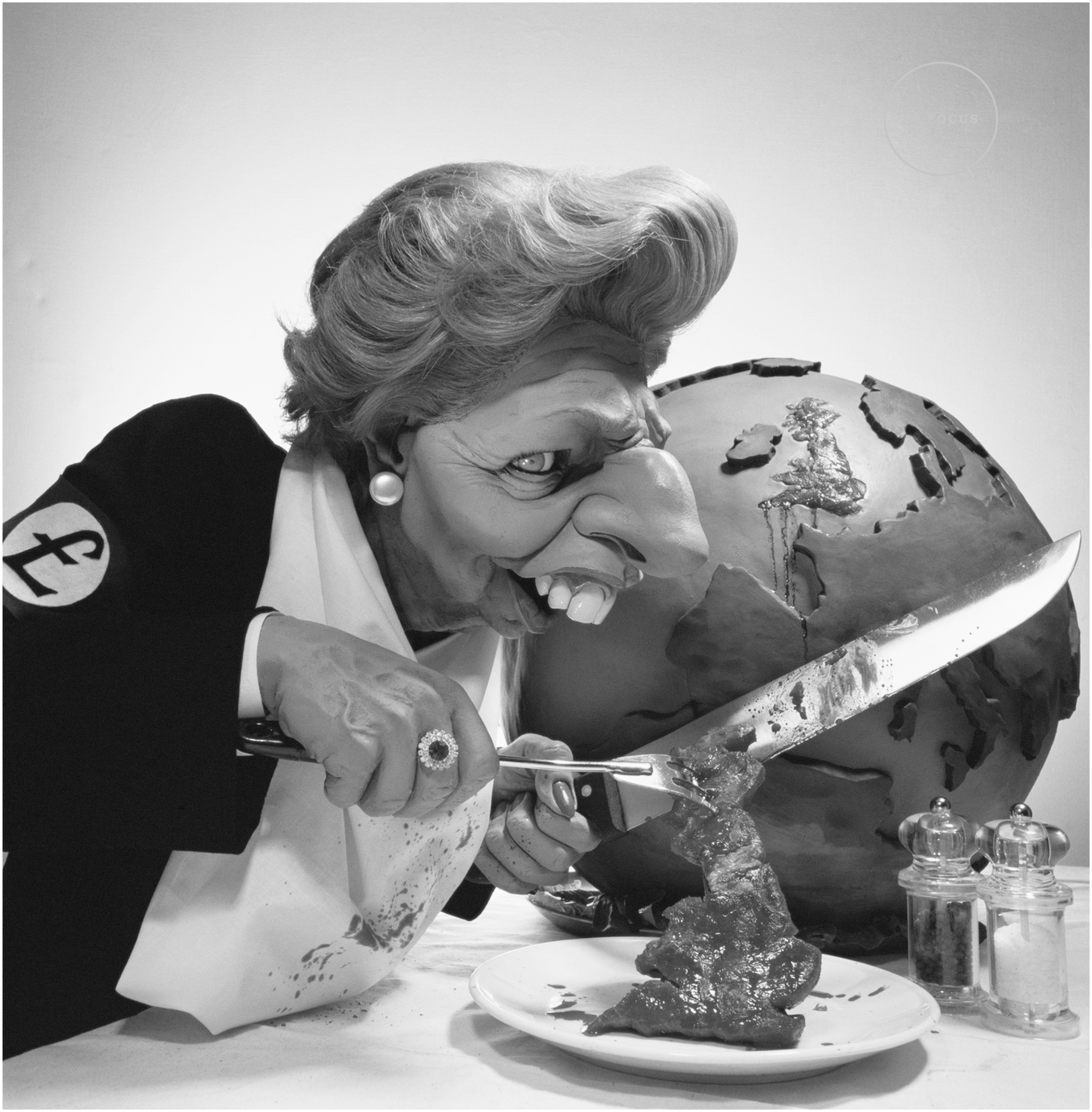
The long tradition of satire in England might explain why caricature and satire is tolerated. Spitting Image on television astonishingly had less censorship than Fluck and I had experienced when working for print. Years of editorial control had conditioned us to what it was possible to get away with when working for publications such as The Sunday Times, The New York Times and European magazines. But our workshop rule was not to censor ourselves as there were plenty of people who would do just that.
We put out some raunchy royal sketches on Spitting Image. But it was the image published in The Appallingly Disrespectful Spitting Image Book of the young Duke of York (Prince Andrew) reclining nude in silk sheets with two pounds of Cumberland sausages nestling between his hairy thighs that caused the royals to reach for the Director of Public Prosecutions. “This time they have gone too far!” To which a wise DPP advised: “Don’t do it Ma’am. These people will turn up in court with the effigy and the sausages.” And we would have done.
I still find the difference in freedom between print and television puzzling. My theory is that the English only take gardening and literature seriously. Television is visual and ephemeral; after all, “It’s only TV.”
Does satire change anything? Not really from my experience. However whilst Spitting Image was on air its audience knew what was going on and who the perpetrators were. Unfortunately it cut both ways. Spitting Image became such essential viewing for members of parliament that on Monday morning Central Television would deliver a video tape to Westminster for those who had missed the show the night before.
Good satire, like a good joke, can be a superior way to tell the truth. Max Beerbohm, the dapper British Edwardian caricaturist, said he could never look at a hot water bottle without thinking of King Henry VIII.
Consequently, neither can I. And Francis Bacon said that “a good portrait has to do some damage”, which I think our caricatures did. Such is the power of visual satire that Spitting Image did change the viewer’s perception of public figures. For example the slug-like Education Secretary Kenneth Baker or the leader of the Social Democratic Party David Owen with the whining, bed-wetting Liberal leader David Steel in his pocket. This visual subversion even played tricks with me.
After Thatcher’s election triumph in 1987 I asked my wife if she’d seen photographs of the new cabinet on the front page of The Sunday Times. “Those are your Spitting Image puppets, you dope, not photos of the real people!” she said. I began to realise, with delight, that other people had acquired the same ability to confuse the puppet and their behaviour with that of the person; no mean feat considering the great lengths and amount of money the powerful in public life spend on public relations. David Cameron (the most ineffectual prime minister in decades) was in public relations before he came to power and “it will never happen again” became his mantra.
If only for this reason I think satire is important. At the time of writing President Trump is trying to bypass the news media with relentless insults and censorship, using his tweets and rallies to publicise the “truth” as he sees it with the cry “the enemy of the people” levelled at the BBC, CNN and The New York Times.
Satire is only able to lance the boil from time to time. But it is worth doing. ITV seem not to have the vision or budgets for another Spitting Image and I doubt very much that the BBC, with their remit for balance, would ever commission such a show. The dark side of the Scottish comedian Frankie Boyle is getting a hearing, but are there any angry young satirists out there to help him? The rise of nationalism in Europe and the boil that is President Trump are in urgent need of lancing. The grave danger is that censorship and alternative truths will win out as they did before, in the 1930s.