




Abstract

Gay men and women in China are keeping their sexuality secret because of family and state attitudes, says
“I didn’t go home for Chinese New Year,” says 31-year old Wen Yuxiao. Born and raised in a small town in the province of Hubei in central China, Wen now lives in the USA, pursuing a master’s degree. Instead of returning to China, Wen opted for a short holiday with his partner. While going home would have been feasible, the impending family pressure ultimately swayed him against making the trip.
“I’m not out to my parents and I don’t think I’ll ever be. I’m an only child and, as the only son, the burden is really all on me. Since graduating, it’s been the same rotation of questions. It used to be why I wasn’t dating and now it’s jumped straight to why I’m not married. I can’t tell them that I am in a relationship, because it’s not with a woman,” he said.
China’s Lunar New Year is a week-long national holiday full of family reunions, traditions and plenty of food. It is also a fraught and highly pressurised time for anyone single over the age of 25, as questions of marriage and children inevitably surface. Many in the LGBT community, for whom a conventional union isn’t an option, feel pressure to keep quiet about their identity when at home over the holiday. An industry of renting a partner has even developed in response.
Homosexuality was illegal in China until 1997 and, despite official legalisation, societal acceptance – and even recognition – has been slow, especially in smaller provinces. This has led many to negotiate their sexuality alongside familial expectations. For the older generation, nothing is more important than the nuclear family, a foundation around Confucianist values and filial duty. But the pressure is further compounded by the one-child policy, introduced in 1979: millennials from the single generation household bear the weight of carrying on the family name.
Ju Huang, a 34-year-old gay man from southern Guangxi province living in Hong Kong, is another who cannot anticipate coming out to his mother, especially as his father died four years ago. As an only child, he feels pressure to appease her.
CREDIT: Rebel Pepper
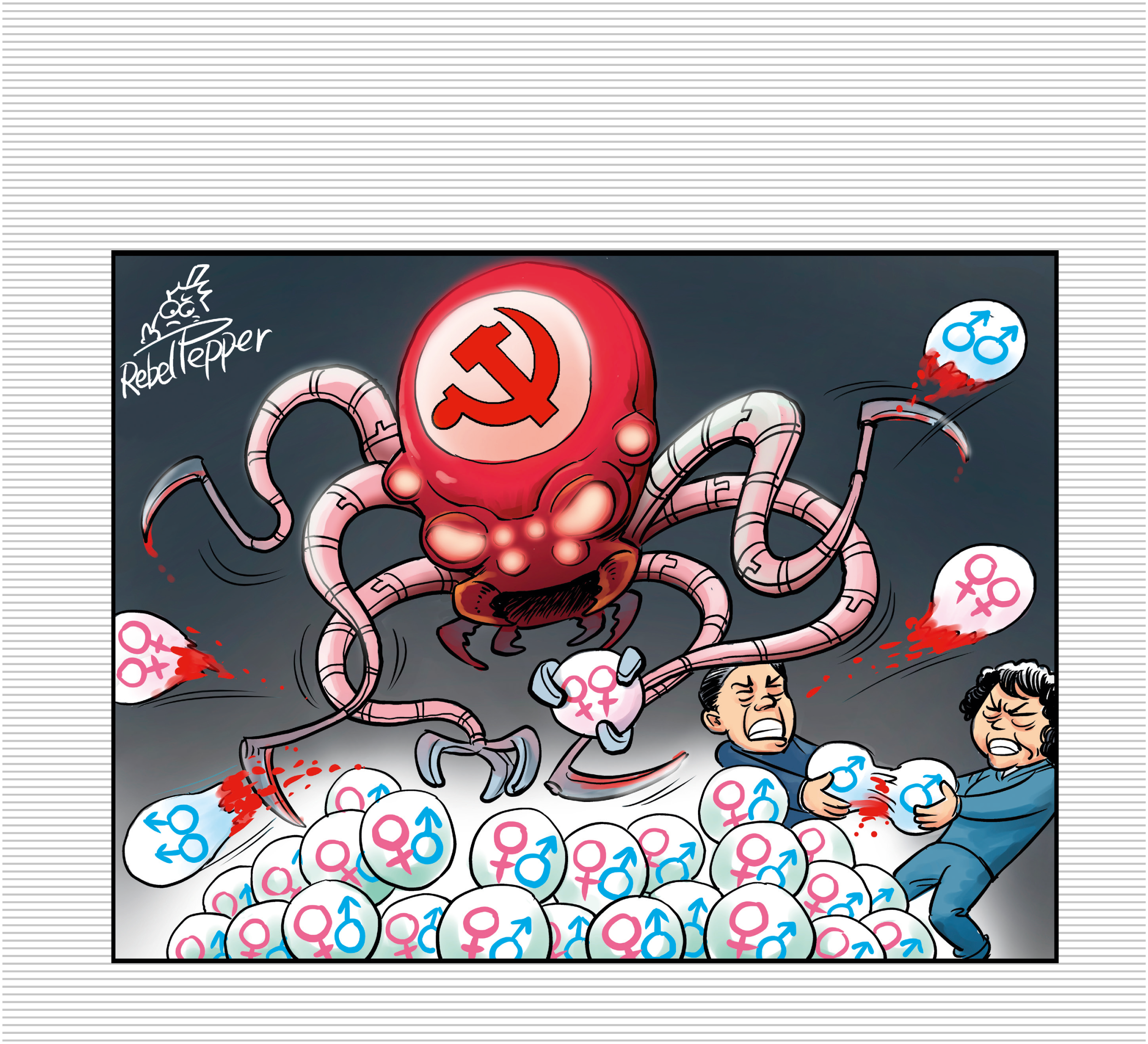
“I would never come out to my mum. Where I come from, the societal norm is to land a stable job, get married and have kids. These are your sole responsibilities,” he said.
He spent this year’s Lunar New Year dodging questions from relatives about his dating life. While he has considered telling his classmates – some of whom are more open-minded – he hesitates out of fear that word will get back to his mother.
“I don’t care about my own reputation, but if it goes back to my family, they will worry and face scrutiny from others. I don’t want this to circulate,” he said.
Ju has hatched a plan he hopes will appease both sides: “I won’t marry a woman, but I plan on getting a surrogate. I haven’t worked out the details of how I will explain why to my mum, but I think she will be happy if I just had a child. This is something I’m planning on doing within the next four to five years,” he said.
Cover marriages and surrogacy are common within the LGBT community. Damien Lu, founder and president of Clearinghouse for Chinese Gays and Lesbians, a non-profit, said he had seen a rise in these arrangements over the last two years.
“Many gays are looking for ways to have children, simply to give to their parents, without understanding the implications and responsibility beyond. While some parents may accept that their sons or daughters have same-sex attraction, they still expect them to follow the traditions of marriage and reproduction,” he said.
He added that this often resulted in dire consequences, and he has seen cases of children caught in legal battles when couples break up, and children raised primarily by grandparents and distant parents.
There are positive developments, with players trying to shift such expectations for the LGBT community. In 2015, the group Parents, Family and Friends of Lesbians and Gays made a popular short video telling the story of a man struggling to come out to his family over the New Year holiday. The man is immediately rejected by his parents, only for them to relent later and ask him to come home. The footage contains commentary from parents who have accepted their LGBT children and who are urging others to do the same. Despite the optimistic ending the short film provides, societal and structural acceptance still have a long way to go.
In March last year, the government banned the popular gay-themed online drama Addiction from being streamed on domestic platforms, three episodes short of completion. The show, which followed teenage boys in their coming-of-age sexualities, ended up airing the remaining episodes on YouTube, which is blocked in China, as are sites such as Facebook, Instagram and Twitter. The ban was imposed by the State Administration of Press, Publication, Radio, Film and Television under the premise that it was not adhering to new regulations.
“From an art and culture perspective, there was no reason why this show should have been cancelled, as it was not profane. It was simply because the government didn’t want to be seen as promoting gay values. And this comes at the expense of limiting the amount of gay-produced or gay-created art,” said Lu, citing the case of filmmaker Fan Popo, whose documentary Mama Rainbow was taken off websites without a reason being given.
This tightening grip has been under way since current President Xi Jinping came into power. Xi’s “anti-corruption” campaign has come at the expense of marginalised civil rights groups. Under his rule, netizens who congregated over Sina Weibo (a service similar to Twitter) have migrated to the more closed platform WeChat, where messages are visible only to an immediate circle of followers, and thus exempt from potential public ire. Ironically, the success of Blued can be attributed in part to the ban in China of another gay dating app, Grindr, alongside a slew of social media platforms with the ability to gather an international – and largely unmonitored – crowd. This is reflective of a shifting governmental stance on LGBT issues in China, being complicit and then suddenly restrictive, forcing communities to find ways to adapt in unstable environments.
For Wen, the ability to be fully himself can be done only overseas, a future he had planned since high school.
“I plan on staying in the USA for as long as possible. It might seem like a form of escapism, but at least this way my parents have less pressure from their friends about why I’ve made no plans for marriage. I can use the excuse of being overseas,” he said.