




Abstract

Social media likes, fun photos and a drive for instant reaction are all part of the pressures on accurate reporting, writes
The internet has undermined authority and trust in journalism, siphoning off audiences and advertising and diverting attention with sensation, trivia and – of course – “fake news”. Trusted information is the currency of healthy democracies, but today that currency is debased, and we are all paying the price.
Look at the United States. Since the lifting of the “fairness doctrine” under Ronald Reagan in 1987 – which obliged broadcasters to be fair and balanced in their news coverage – partisanship in talk radio and the TV news networks has contributed to a polarised political environment and the election of a populist president. Ratings drive advertising and sensation drives ratings. The drama of Donald Trump’s election campaign pushed viewing figures ever higher and ad revenues followed. As CBS chief executive Leslie Moonves stated: “[Trump’s candidacy] may not be good for America, but it’s damn good for CBS.”
The wall between journalism’s commercial and editorial operations is dissolving. Native advertising – PR disguised as journalism – is expected to be the new commercial saviour, from Buzzfeed to the New York Times. If the readers don’t notice or care, does it matter if what we used to call advertising looks like news? Not always, but as PR, advertising, political activism and entertainment all blend together with journalism, it opens the door to exploitation and the “fake-news” panic we have had for the last few months. Too many members of the public can no longer tell the difference between those categories of information, largely because media companies are complicit in confusing them. A study at Stanford University found 82% of students couldn’t tell the difference between sponsored content and independent news. In the UK, a YouGov survey for Channel 4 found only 4% of respondents could reliably tell real news from fake.
Social media and the technology giants bear a major part of the responsibility. Jonah Peretti, co-founder of Buzzfeed and the Huffington Post, recently said that social behaviour had changed media forever. For him, sharing is the key metric indicating user value, and his company is based on measuring and encouraging content that is shared.
That has clearly been very successful for many social media platforms. The problem is that sharing is a good indication of consumer value but not of citizen value. Sharing rewards sensation over authority, and encourages the clickbait online economy where it doesn’t matter if something is true or not, just as long as you click on it and advertisers can ride on the back of your curiosity.
Members of the audience hold up their phones as Donald Trump speaks during an election campaign event in Tucson, Arizona
CREDIT: Sam Mircovich/Reuters
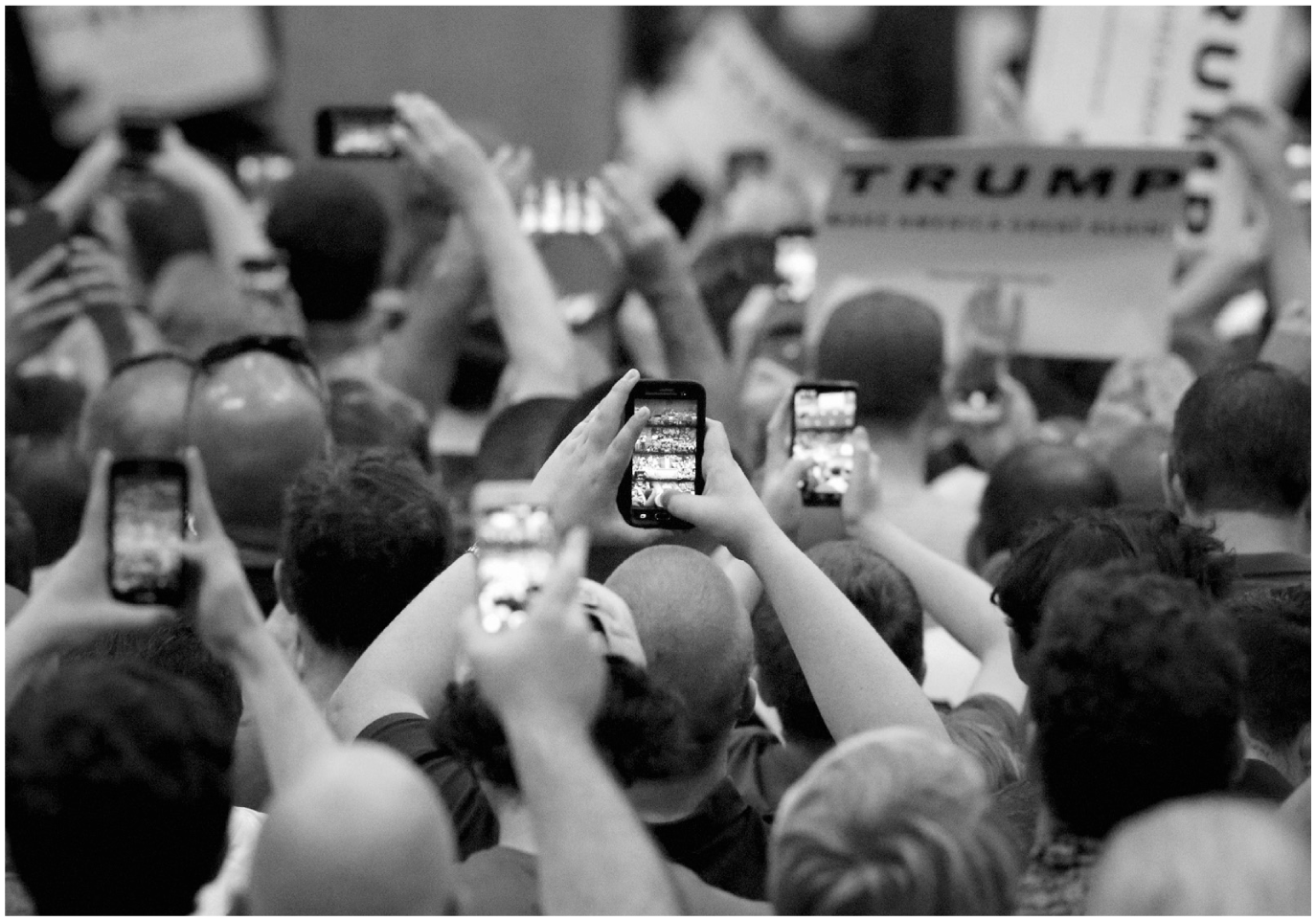
So a colourful lie will amass a million hits before the prosaic truth gets noticed. It used to be said in journalism, “if you are first and wrong, you are not first”. Today, if you are one of the Macedonian teenagers manufacturing fake news to reap the ad revenue, you don’t care.
The new economics of information and the weighting of sensation and immediacy over authority or accuracy has polluted public debate and left many citizens deeply confused about how the world works.
So what is to be done? The problem is that the two internet giants – Facebook and Google – that now dominate how we find out about the world are global, and largely unaccountable beyond their shareholders. And their boards are, of course, focused on the huge profits they generate rather than any wider social responsibility. However, there are signs that both are responding to perceived brand damage, rooting out fake news, tweaking algorithms, supporting media literacy programmes and helping search for a new economic model for journalism. These actions may ease part of the big squeeze on serious news, but there is a long way to go.
Some propose more foundation-funded public media. But such initiatives are usually small-scale, and not sustainable in the long term or replicable in countries that don’t enjoy a large scale of philanthropy.
There are new initiatives from big media including more fact-checking services and, from the BBC, a commitment to “slow journalism”, a deliberate turning away from the instant demands of Twitter to a longer and more considered approach to news. A welcome move, but one only a large public-funded organisation could afford to take.
There is a recognition that digital media has moved far ahead of most people’s ability to understand it, so a renewed commitment to media literacy – understanding and dissecting the media more widely – is important. Helping people think critically and recognise the qualitative difference between a tweet and a well-researched article from an accountable news organisation is crucial, but it is a long-term process.
In the meantime, we get the journalism we deserve. So think twice before you click “like” on a sensational headline from a source you don’t know – every time you do, you help fashion the media environment. Take out a subscription to a serious news organisation of your choice, because good journalism has to be paid for. And slow down – when it comes to understanding the world, speed is a dubious virtue.