Abstract
Protests, media monitoring and panel appearances were all part of Index’s work over the past few months.
So why organise a protest? “It reminds the people who are behind bars that somebody outside is still rooting for them,” said Index CEO Jodie Ginsberg. “It gives them a sense of hope, it gives them a sense that the fight is not lost, and it’s important also to show the authorities that these individuals haven’t been forgotten, because detention is a way to try and hide individuals away. Governments don’t want their crimes and human rights violations known about. Making a noise, at least in some small symbolic way, helps remind governments that the people they’ve imprisoned and ideas they are seeking to suppress haven’t been.”
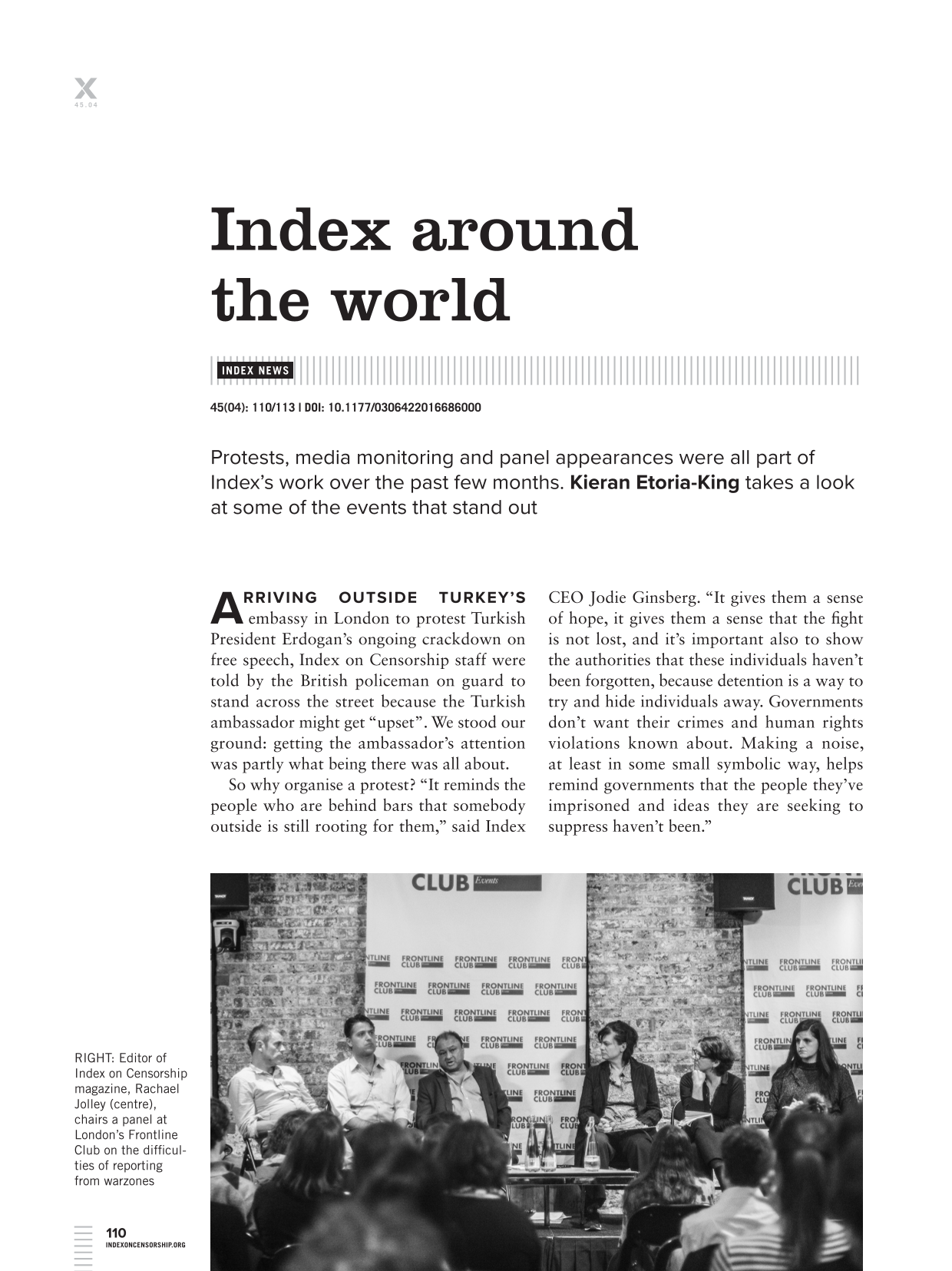
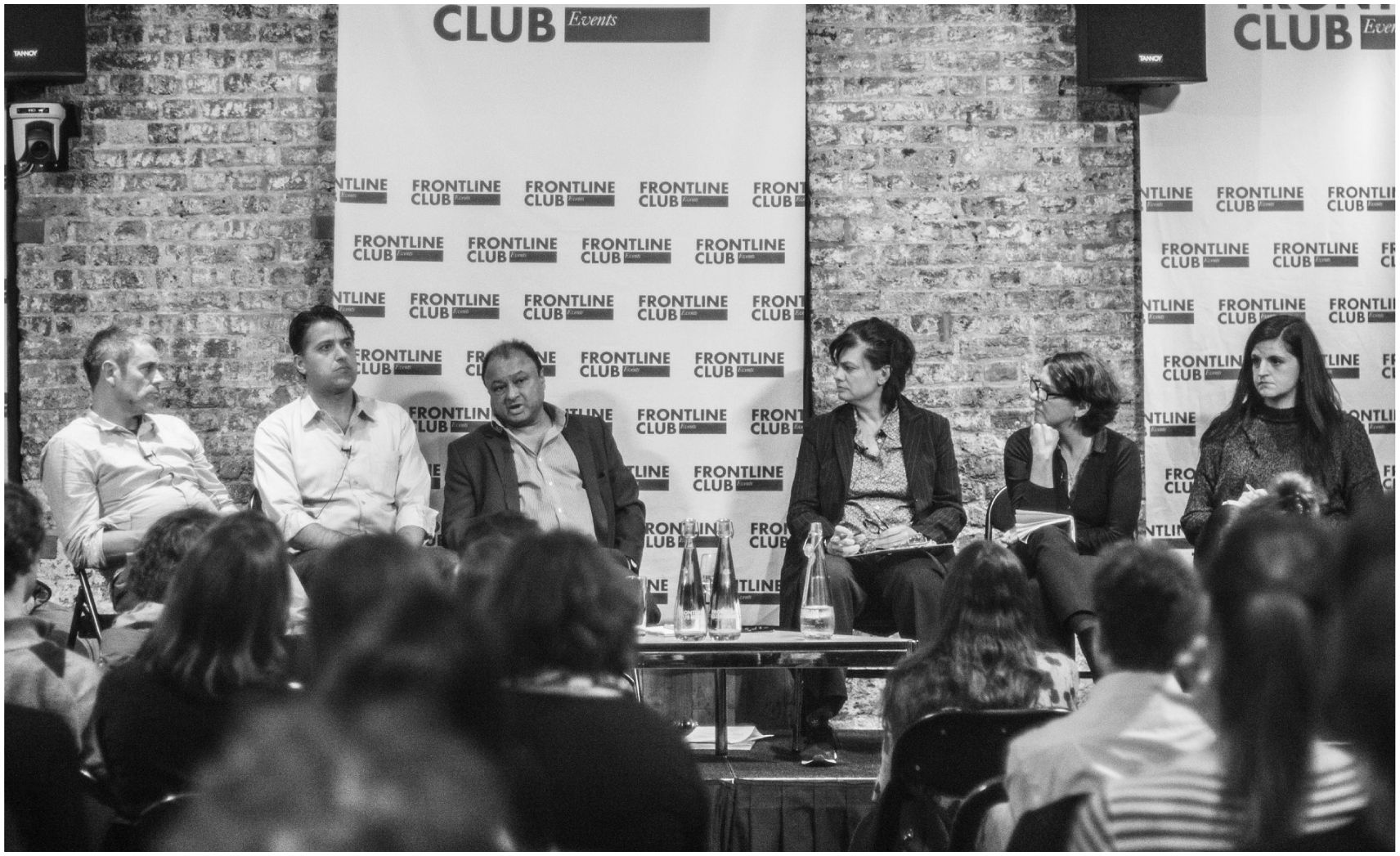
Editor of Index on Censorship magazine, Rachael Jolley (centre), chairs a panel at London’s Frontline Club on the difficulties of reporting from warzones
CREDIT: Tolly Robinson/Frontline Club
It was with the intention of drawing attention to those behind bars that Ginsberg wrote to Prince Charles ahead of his official visit to Bahrain in November. As a significant trading partner with Bahrain, she believes that Britain has a responsibility to condemn the nation’s treatment of people such as Nabeel Rajab, the activist and Index Freedom of Expression award winner who has seen his sentencing repeatedly delayed after being imprisoned for comments on Twitter. At the time of going to print, Rajab’s trial was set for 15 December.
“If he [Prince Charles] is going to go there, then he needs to go with as much information as possible,” Ginsberg said of her offer to brief the prince on Bahrain’s human rights situation.
As part of its other advocacy and media monitoring work, Mapping Media Freedom project officer Hannah Machlin flew to Moscow in September. She spoke at the On The Tightrope conference, debating the future of journalism in a fragmenting Europe. Machlin met with representatives from most of the independent national media outlets in Russia.
“It was incredibly inspiring to meet with people doing great journalism despite the fact that they are operating in a near-complete climate of fear,” she said.
“I spoke to a journalist who told me that after pieces are published she is always looking over her shoulder because she feels paranoid. Another said that he just assumes he is under more or less constant surveillance from the state. Unfortunately, it’s just part of being an independent journalist in Russia.”
In the past few months, the MMF team, who oversee crowdsourced reports of media harassment from around Europe, have been inundated by reports from Turkey, as the post-coup crackdown on journalists and government critics continued. MMF received 124 reports on Turkey from 1 July to 1 November, including reporting on the closure of 15 pro-Kurdish media organisations and 13 journalists from Cumhuriyet newspaper being detained on terror charges. Machlin said: “Violations to press freedom in Turkey have consistently risen and press freedom has severely deteriorated in 2016.”
What a Liberty!, Index’s youth project, launched to reimagine the Magna Carta for the 21st Century, has grown into a movement of its own. The group’s members have now taken over management of the project, with a year-long campaign plan to encourage young people to take part in further discussions and film showings. In late September, three of the group – Darshan Leslie, Ché Applewhaite and Mohamed Adan – attended the British Film Institute’s Flip the Script, a day where young filmmakers and artists were urged to talk about how they wanted to see their generation portrayed in the media. The three What a Liberty! members hosted a panel discussion, alongside Index head of advocacy Melody Patry, where they talked about the importance of open debate, and examined the merit of limits meant to protect people from offensive speech. “It’s really exciting to see how What a Liberty! has expanded,” Leslie said. “This will inform how we go forward because we’ll be able to draw from those messages about speaking up and making sure you have a voice and using it properly.” To find out more about What a Liberty! visit www.whataliberty.co.uk.
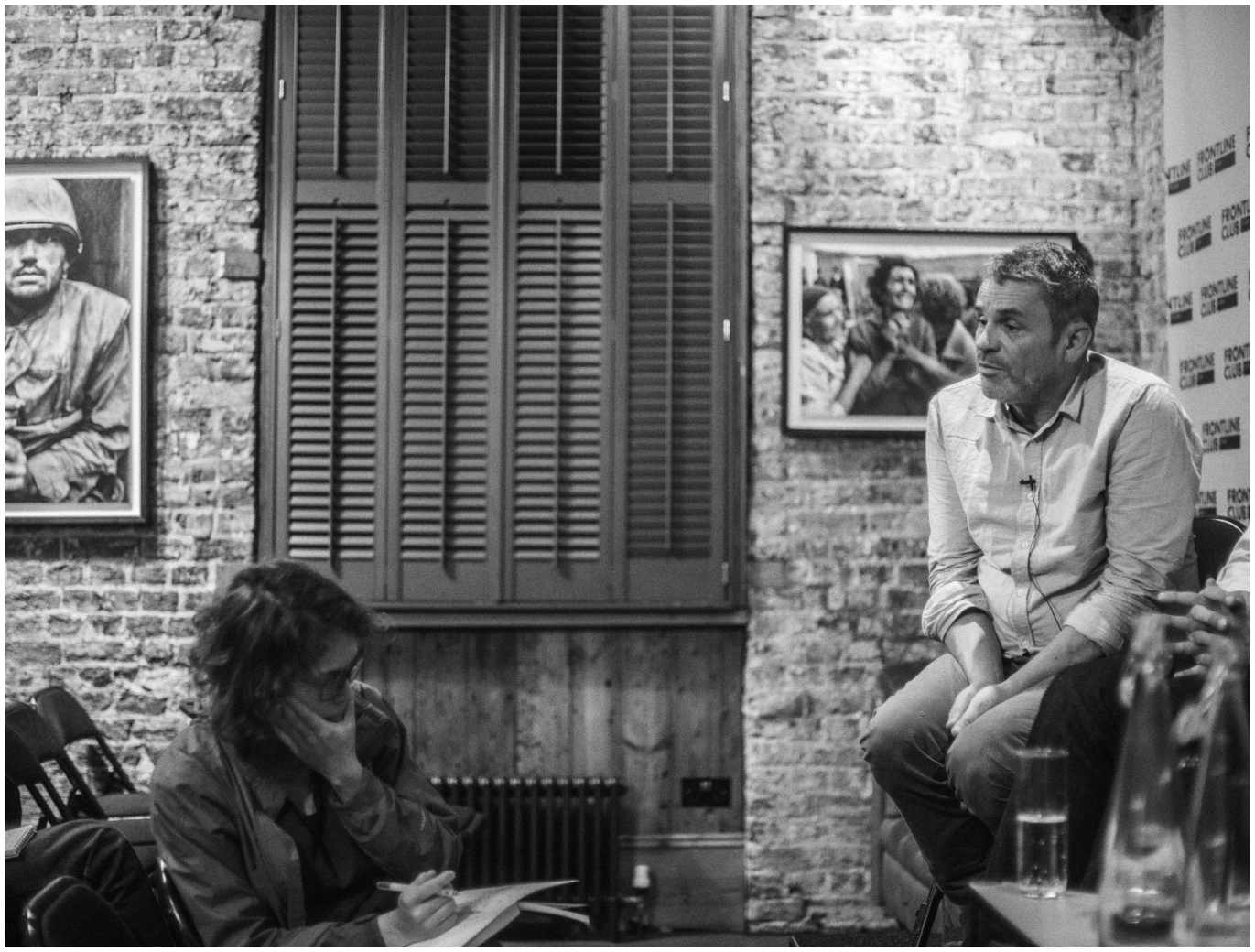
Photographer Paul Conroy talks about the future role of foreign correspondents at the Frontline Club
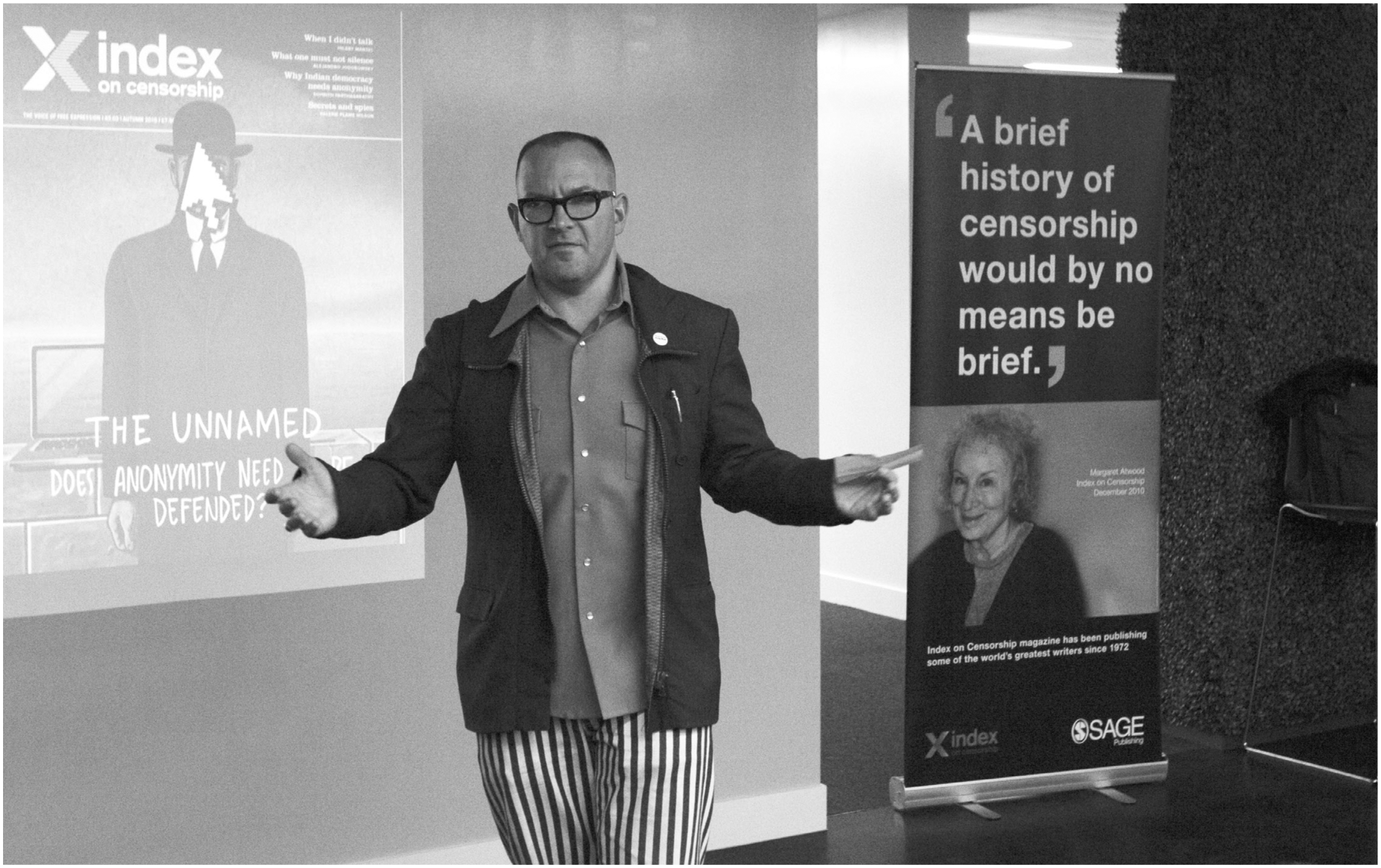
Technology writer Cory Doctorow explains the challenges of anonymity at the launch of the autumn edition of Index on Censorship magazine
CREDIT: (left) Sean Gallagher; (right) Sean Gallagher
Index’s youth advisory board, a selected group of young people from around the world who advise and inform Index’s work, continued to meet every month via Google Hangout to discuss freedom of expression.
The board shot and published videos drawing attention to murdered media workers around the world, in support of International Day to End Impunity for Crimes Against Journalists. The day, part of IFEX’s No Impunity campaign, was held to demand action against the alarming rate of attacks on journalists that go unsolved, or are not even investigated, all over the world – according to IFEX research, nine out of 10 cases since 2006 remain unpunished.
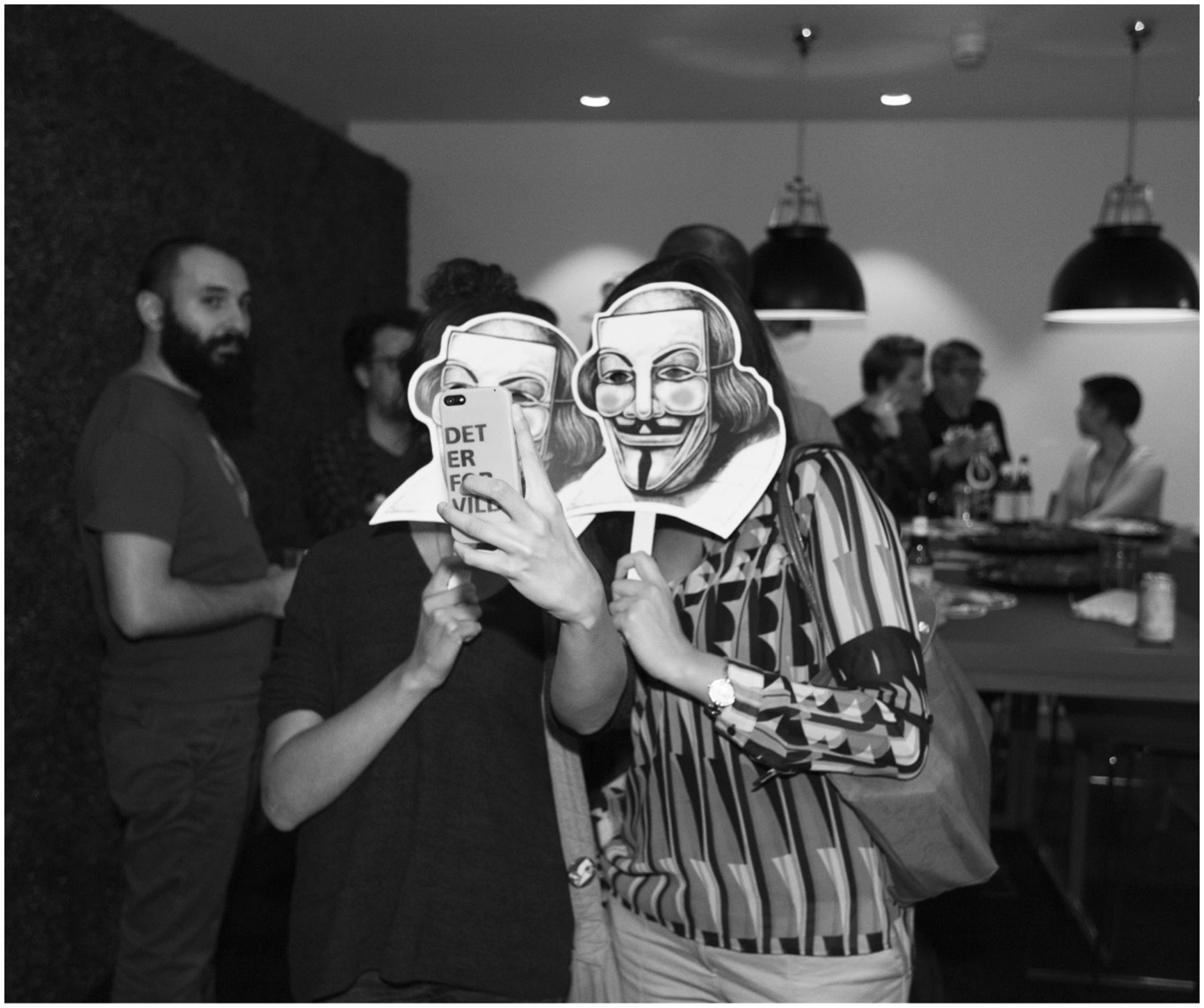
The autumn issue of the magazine was launched with an event held at the office of the VPN software company Hide My Ass, to discuss the value of anonymity. Technology journalist Geoff White mined data from every smartphone in the room to demonstrate how simple actions such as searching for a wi-fi connection can expose users to invasions of privacy and endanger journalists in the field. He told Index: “What troubles me is that, talking to journalists, there’s this idea of, ‘I’ve survived Baghdad, I’ve survived here, I’ve survived there, what have I got to fear from my phone?’ But it can give away such valuable information – location data and who you’re meeting.” In the second half of the session Canadian writer Cory Doctorow discussed the long struggle to make people care about protecting their personal information online.
Index has also started the initial stages of the judging process for the 2017 Freedom of Expression Awards. The short list will be announced on 17 January 2017. Last year’s award winner Smockey, the rapper who led a revolution in Burkina Faso, is raising funds to rebuild his music studio after it was burned down for the second time in a year. He played a concert at Ouagadougou’s Revolution Square on 15 October to mark the two-year anniversary of the country’s successful uprising against former president Blaise Compaoré. He called on those implicated in crimes by the previous government to face trial, telling Index: “Burkina Faso literally means ‘the land of men with integrity’, so we would like to trust the justice of our country.”
Staff have taken part in many events around the world over the past few months. Index on Censorship magazine editor Rachael Jolley chaired a panel at London’s Frontline Club on the future challenges for foreign correspondents and difficulties of reporting from warzones. Ginsberg was a panellist at a debate at October’s Battle of Ideas festival at London’s Barbican, called Comedy and Censorship: Are You Kidding Me?, where she argued for comedians’ right to be offensive. Citing Scottish stand-up Frankie Boyle and Australian Jim Jefferies as her favourite examples of comedians who sometimes cause outrage, she said: “Jefferies’ stuff on gun law in the United States is just brilliant, and shocking, and I think sometimes in order to have the truth stuck in our faces, you do sometimes need to shock, because otherwise how do we get shaken out of complacencies?”
Two audience members check out the anonymity masks at the launch of the autumn issue of Index on Censorship magazine