





Abstract
Imprisoned journalists make headlines, but the Turkish government has a more insidious method for controlling the media, argue researchers
The large advertising budgets of state-controlled Turkish industries like banks, telecoms companies and Turkish Airlines are being used by the government to develop a financial grip over newspapers and control what they report.
Patterns of advertising during 2015 suggest that newspapers which do not toe the government line, or are hostile, are being starved of those revenues.
For instance, Sabah, a newspaper particularly sympathetic to the government, received more than 20% of the advertising budget of the state-controlled bank Halk Bank, while the independent Hürriyet received only 2.9%, despite both having similiar circulation.
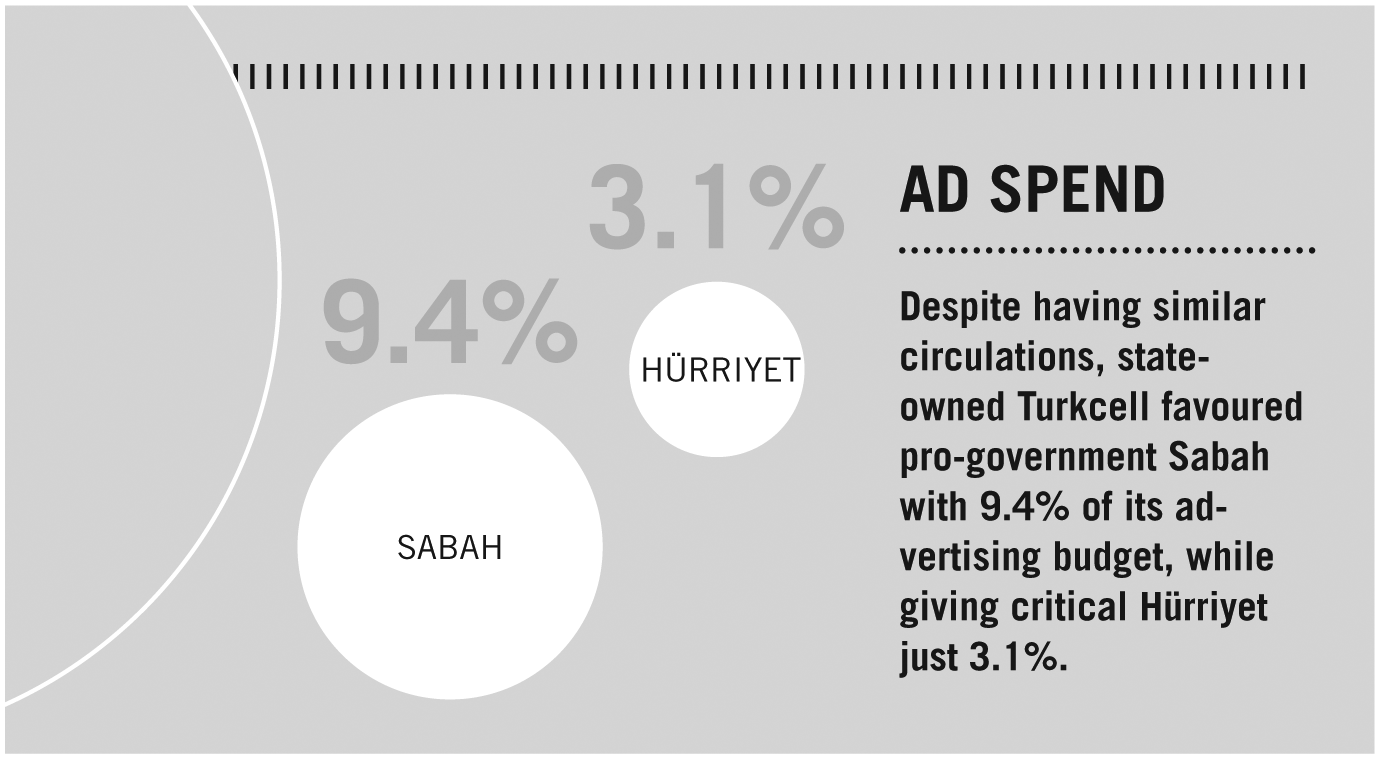
Government-controlled telecoms company Turkcell also favoured Sabah by giving it 9.4% of its advertising, while Hürriyet took just 3.1%.
The situation was similar for another state-controlled telecoms company, Turk Telekom: Sabah received more than twice Hürriyet’s share of their total advertising.
New research found that any paper critical of the government – those associated with the social democratic movement, liberalism, Kemalism, nationalism, Islamism – was either discriminated against, or excluded entirely, when it came to crucial advertising revenue.
There was a clear inconsistency between the market share of the newspapers, as evidenced by their circulation, and their share of advertising coming directly from the state, or indirectly through state-controlled companies.
Research discovered that state-controlled companies’ advertising policy was not in line with market forces: in other words, they did not choose to put advertising in newspapers according to those newspapers’ circulation. Instead they chose the outlets according to how they reported on the government.
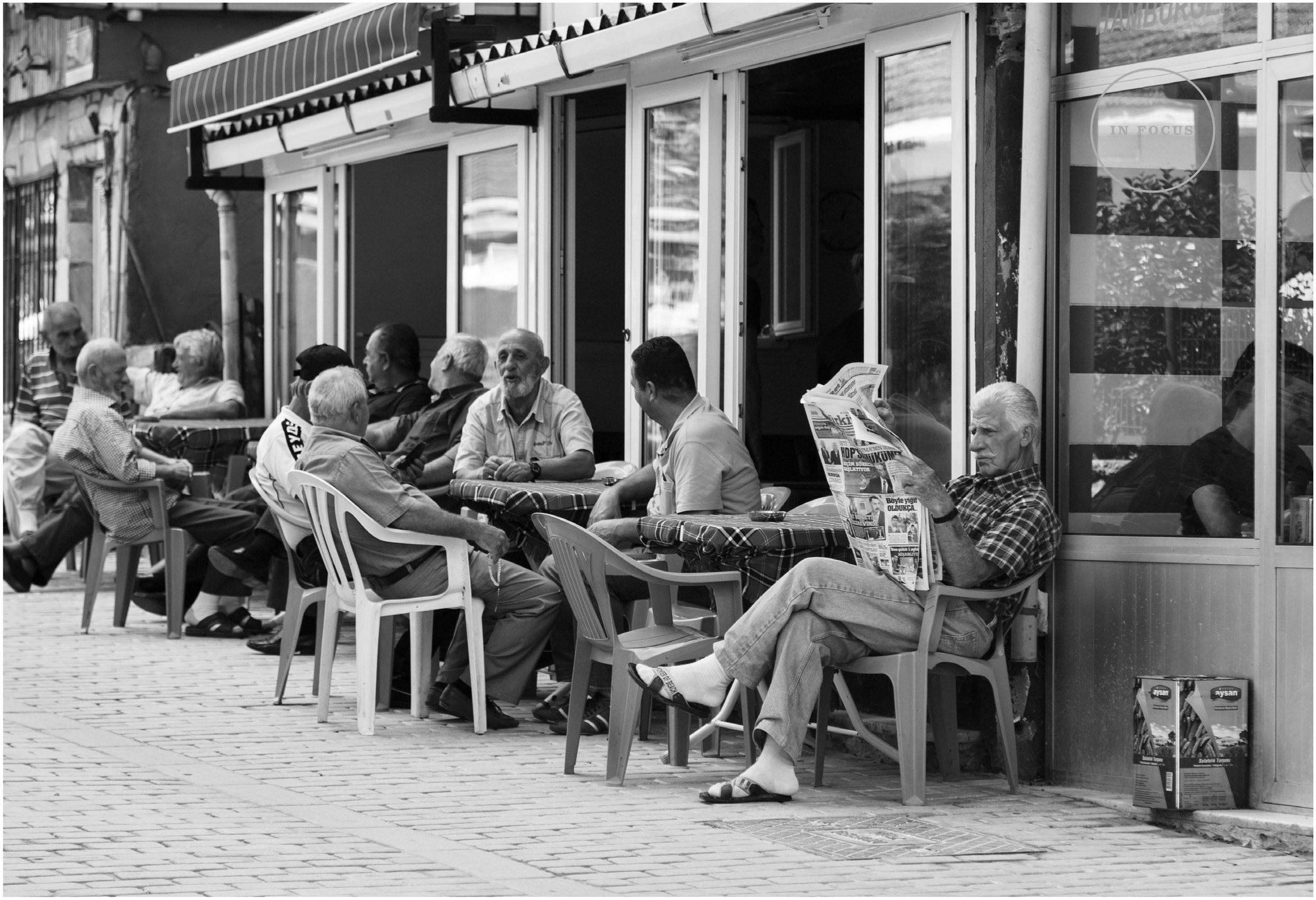
A man reads a newspaper outside a café in Istanbul
Credit: Egyptian Studio/Shutterstock.com
And this means that the newspapers’ customers have become the state and state-controlled companies, not their readers. As a consequence some newspapers have started reporting for the state’s benefit and only publishing content of which the government approves.
Economic dependency of this kind has caused individual journalists and media organisations to give up their freedoms voluntarily. It has also imposed major financial penalties on those who want to continue exercising these freedoms.
The state and its companies have ensured positive coverage and increased public approval ratings.
The research was carried out by analysing the advertising spend of some of the leading state-controlled players including public banks such as Ziraat Bank, Vakif Bank and Halk Bank; telecommunications companies such as Turk Telekom, TTNET and Turkcell; and Turkish Airlines. The companies are fully or partially owned by the state and their management boards are predominantly appointed by the government, although they act as private entities aiming to maximise profits.
Although the exact amount of money spent by these companies is not transparent, information provided by the USA-based Nielsen Company, which monitors advertising worldwide, was used to approximate the total spend by measuring the number of ads (and their sizes in column inches) published in newspapers by Turkish state-controlled companies in 2015.
Using content analysis, the research then divided newspapers into three categories: pro-government, critical of government, and neutral.
The findings were very clear – and the researchers believe that this deeply entrenched asymmetrical economic dependence on the state by some Turkish media outlets is playing an important role in the decline of press freedom.
Few can argue that Turkish media was ever fully free, but balanced coverage and critical reporting have traditionally been considered important editorial norms by most journalists in the country.
But, as the ruling Justice and Development Party (AKP) has gradually consolidated its power, winning consecutive elections since 2002, press freedom has been in sharp decline.
Although those with an interest in free speech have been increasingly concerned by this, it was the reluctance of the mainstream media in 2013 to cover the extraordinary and unprecedented Gezi Park protests which made us, as media researchers, ask the question: “Why was the media so reluctant to report on what was happening?”
Of course one of the answers is coercion -but from this research we see the less overt, but equally effective way of limiting free speech has been the control of advertising. These mechanisms incentivise pro-government reporting and punish criticism.
Recent developments in Turkish politics, namely the failed coup in July 2016 and the state of emergency declared in its aftermath, have created an even more highly policed environment. By increasing the risks of critical reporting, these events have further accentuated the dependency structure.
As a result, there is little reason to expect the AKP government to relinquish its pressure on the media, unless major transparency and oversight mechanisms are set in place to regulate these kinds of state interventions.
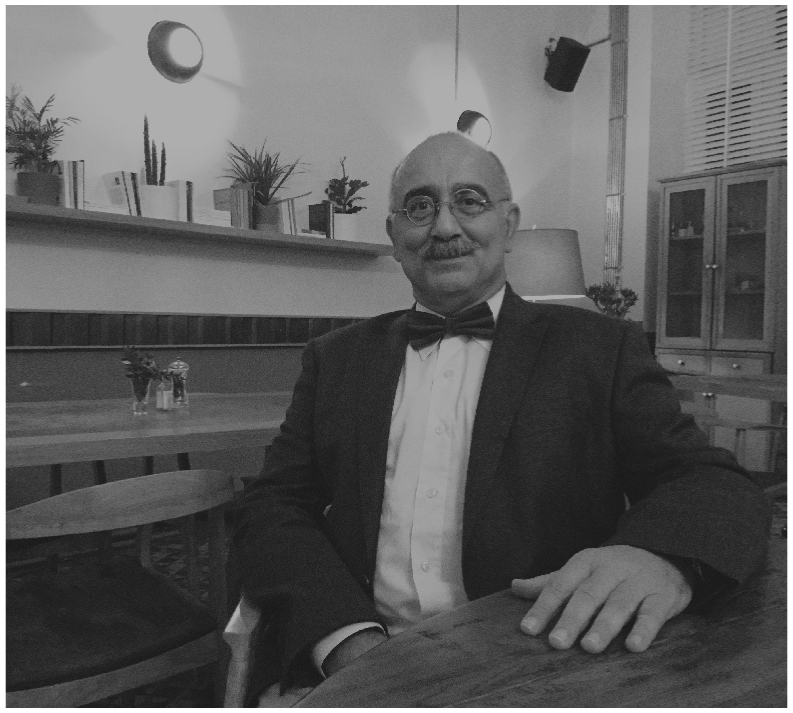
Linguist and newspaper columnist SEVAN NIŞANYAN has found himself locked up for 16 years after being subjected to a torrent of lawsuits relating to a mathematics village he was building. Researcher JOHN BUTLER managed to interview him
Well-known linguist Sevan Nişanyan will not be eligible for parole in Turkey until 2024. Locked up in the overcrowded Turkish prison system, he has found his initial relatively short jail sentence for blasphemy getting ever longer as he has been subjected to a torrent of lawsuits on minor building infringements related to a mathematics village he founded.
Nişanyan, who is 60, spoke exclusively to Index on Censorship. He said he was being kept in appalling conditions. Moved from prison to prison since being jailed in January 2014, he is now being held in Menemen Prison, a “massively overcrowded and braindead institution”.
He added: “About two thirds of our inmates were recently moved elsewhere and the remainder pushed ever more tightly into overpopulated wards to make room for the thousands arrested in the aftermath of the coup attempt.”
Nişanyan’s ordeal started in 2012 when he wrote a blog post about free speech arguing for the right to criticise the Prophet Mohammed. Through notes passed out of his high security prison via his lawyer, Nişanyan told Index what he believes happened next:
“Mr Erdoğan, the then-prime minister, believes in micromanaging the country. He was evidently incensed.
“I received a call from his office inquiring whether I stood by my, erm, ‘bold views’ and letting me know that there was much commotion ‘up here’ about the essay. The director of religious affairs, the top Islamic official of the land, emerged from a meeting with Erdogan to denounce me as a ‘madman’ and ‘mentally deranged’ for insulting ‘our dearly beloved prophet’.
“A top dog of the governing party, who later became justice minister, went on air to assure us that throughout history, no ‘filthy attempt to besmirch the name of our holy prophet’ has ever been left unpunished. Groups of so-called ‘concerned citizens’ brought complaints of blasphemy against me in almost every one of our 81 provinces. Several indictments were made, and eventually I was convicted for a year and three months for ‘injuring the religious sensibilities of the public’.”
But what happened afterwards was even more sinister. He found himself, while in prison, facing eleven lawsuits relating to a village he was building with the mathematician and philanthropist Ali Nesin. Nişanyan has been involved for many years in a project to reconstruct in traditional style the village of şirince, near Ephesus, on Turkey’s Western seaboard. It is now a heritage site and popular tourist destination. And nearby, he and Nesin have built a mathematics village which offers courses to mathematicians from all over Turkey and operates as a retreat for maths departments in other countries. They hope it will be the beginnings of a “free” university.
It was this project the Turkish authorities decided to focus on. Nişanyan was given two years for building a one-room cottage in his garden without the correct licence, then two additional years for the same cottage. Nine more convictions for infringements of the building code followed, taking his total term up to 16 years and 7 months.
He, and many others, are convinced that this is a political case, because jail time for building code infringements is almost unheard of in Turkey. He believes the authorities have prosecuted him for these crimes because they do not want his case to cause an international stir.
“Jailing a non-Muslim, an Armenian at that, for speaking rather mildly against Islamic sensibilities… would be a first in the history of the Republic,” he told Index. “It might raise eyebrows both here and abroad.”
Despite everything, Nişanyan is adamant that his time has not been wasted. He has been working on the third edition of his Etymological Dictionary of the Turkish Language, which presently stands at over 1500 pages.
On entering prison, he signed away most of his property, including the copyright to his books, to the Nesin Foundation which runs the mathematics village he is so passionate about. Today the village has added a school of theatre. A philosophy village is the next project in the works.
“The idea is, of course, to develop all this into a sort of free and independent university,” he said. “I am sure the young people who have come together in şirince for this quirky little utopia will have the energy and determination to go on in my absence.”
