




Abstract

As “modest fashion” becomes increasingly popular in Turkey, representations of veiled women in magazines are provoking a major public debate, finds
In a country where the dividing cultural and political lines between secularists and conservatives seem increasingly dramatic, the growth in the visibility of garments for conservative women has turned into a key talking point both in Turkey and abroad. “Modest fashion” refers to garments considered to be in line with Islam’s principles and understanding of modesty. The term applies also to fashion targeting Orthodox Jewish, conservative Protestant and Mormon women; some even consider Kate, Duchess of Cambridge as a modest fashion icon. But this broad definition is debated vigorously in Turkey, and in conservative circles, the question of who draws the line between “modesty” and sexiness has become increasingly more pronounced.
Berin Tuncel is a psychologist who writes columns for Aysha, currently the leading name in the field of “modest” fashion magazines. She told Index on Censorship: “As Muslims, we are experiencing an era where the spiritual is being deconstructed.” Tuncel said. “This is a test for us.” For Tuncel it is crucial that conservative women express themselves via their garments, but this freedom of self-expression carries with it responsibilities.
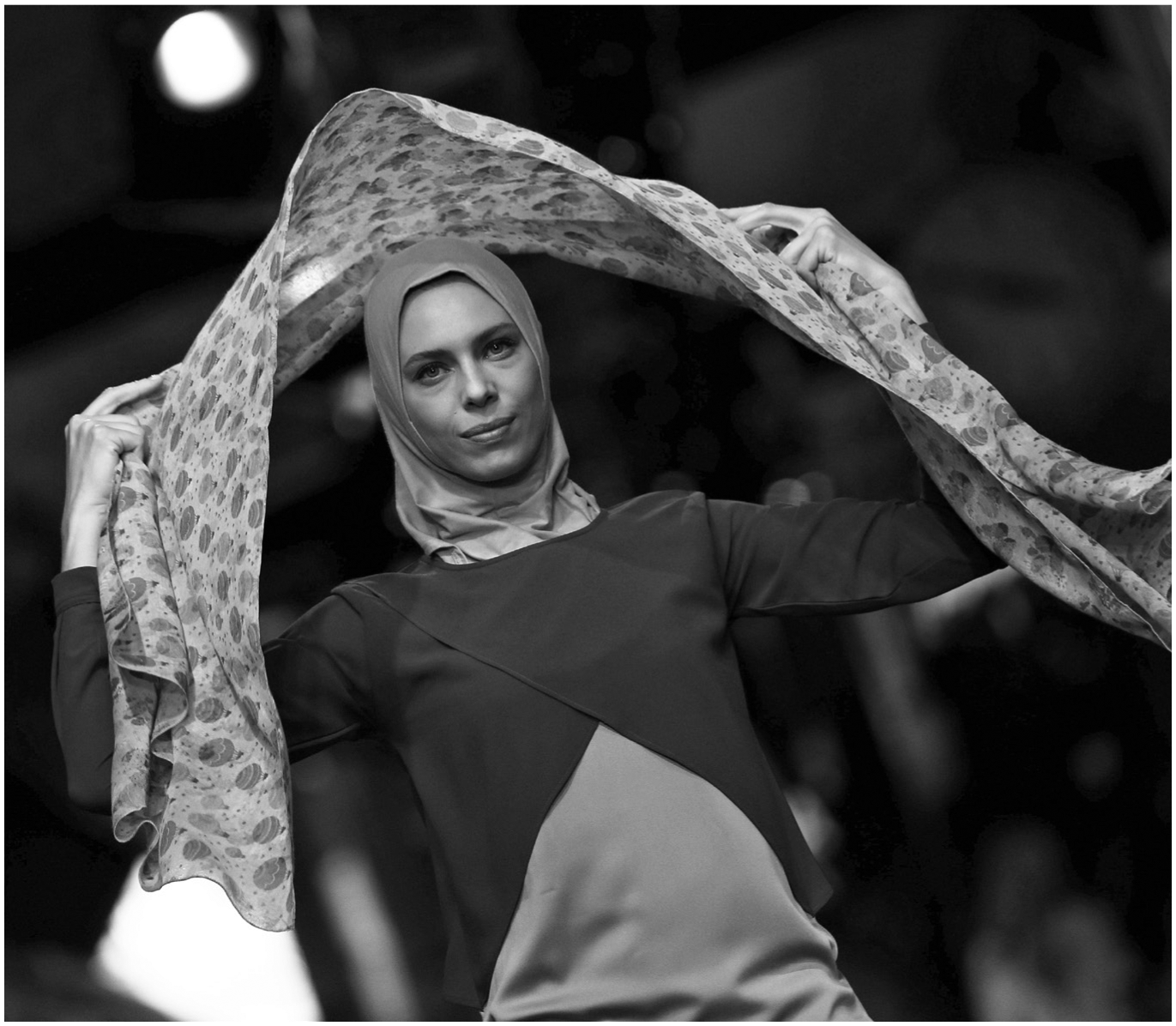
Aysha straddles both conservative Muslim society and liberal Western culture. In May, the Istanbul Modest Fashion Week took place at Haydarpasa, a railway station from Ottoman times. Featuring products by more than 75 fashion designers and a line-up of top models in the modest fashion industry, the event was attended by Spanish beauty queen Natalia Ferrer Fernández and prominently backed by the magazine. The September 2014 issue of Aysha featured a cover interview with Emine Erdoğan, the wife of Turkey’s conservative President Recep Tayyip Erdoğan, and contained a portrait of Tanju Babacan, the gay fashion designer who has recently begun working for Turkey’s first lady.
While the week was a success, other such events have excited considerable controversy. Modest fashion magazine Ala (the name means “beautiful” in Ottoman Turkish) had already been severely criticised for its glossy, somewhat suggestive images of veilwearing women when its editors announced the Ala Fashion Party in 2014. Here, things came to a boiling point. The party was scheduled to take place at Istanbul’s Sheraton Hotel with the participation of DJs and a famous Turkish star. Ticket prices were reaching £1,000.
Islam, a religion of moderation, did not allow such excesses, a columnist from the Yeni Şafak newspaper argued, and then the party was abruptly cancelled. When three months later the magazine came up with a cover featuring a Swedish model, the criticisms were even harsher. “This is one of the magazines that ‘sells happiness in exchange for money’ to the secular women of the world,” a columnist complained. “It is about time some said ‘stop’ to this lack of etiquette. Tomorrow can be too late.”
The rise in modest fashion has both political and economical reasons. According to a Global Islamic Economy report, in 2020 the spending on modest clothing will grow to $327 billion, so the market is ever growing, and the entrepreneurially minded conservatives support this type of Islamic consumerism.
Clothes have been an intensely political subject in Turkey since at least 1829, when Sultan Mahmud II came up with a law concerning how statesmen should dress in the Ottoman Empire. The Sultan ordered his subjects to replace turbans with fezzes, and gave specific instructions on the colour of veils women were allowed to wear.
Almost exactly a century afterwards, Mustafa Kemal Atatürk, the founder of the modern Turkish state, enacted the first of his dress codes in 1925. Atatürk famously gave a sermon in Anatolia where he asked his people to wear Oxford shoes, remove their fezzes and put on fedoras. Women were asked to dress like European ladies.
Such “modernising” measures continued throughout the 20th century. Following the military coup in 1980, for example, the new governing junta ordered that, with regards to “the clothing and appearances of personnel working at public institutions… female civil servants’ head must be uncovered”.
“As a result of this history, conservative women in Turkey were focused on being invisible instead of translating their identity into an image,” Tuncel told Index. In her opinion, Turkish modernisation has been built on a process of de-veiling Turkish women and stigmatising conservative dress. “In television series and films, veiled women only played the roles of cleaning ladies or apartment attendants. This way a subconscious association was forged between veiled women and being lower class,” she continued.
The tensions within the modern fashion movement have long fascinated Magdalena Craciun, an anthropologist from University College London. In her new book Islam, Faith and Fashion: The Islamic Fashion Industry in Turkey, Craciun explores the subject, building her arguments on the 15 months of fieldwork she conducted in Istanbul. There, she focused on what Islamic fashion means to different people: money, an opportunity for self-expression, or an ethical issue to be debated.
On several occasions, Craciun has attended fashion shoots for Islamic fashion magazines in Turkey. “I attended a fashion shoot. At this magazine, garments that did not reveal the flesh, except the face and hands, were considered modest.” In addition, attention was paid to the make-up. “This is one way to materialise the boundaries of modesty… And one way to handle the issue of morality. From the editors’ perspective, as long as they respected this boundary, then their work was within the limits of morality or the religiously acceptable.”
However, even this working definition does not necessarily please everyone. “The final product, the fashion image, is a multi-authored creation,” Craciun added. “It [involves] different agents; eastern European models, who knew nothing about Islamic modesty and employed their well-rehearsed repertoire of postures; the photographer, who had little or no experience of working with and for headscarf-wearing women…”
Modest fashion images have also taken over social media. “I would say there is a desire to dress fashionably, but also a concern over the public exposure through social media, Facebook, Instagram and Twitter,” Craciun said.
“These young, fashionably dressed veiled women often express this concern. They might use different means to limit the public access to their personal posts.
She added: “There is a difference between the reaction that critics have to fashionable dress and the concern over over-exposure via social media.”
Kübra Karakaş, a veiled fashion designer with more than a hundred thousand Insta-gram followers, feels the burden of the kinds of criticisms Craciun talks about. Karakaş, whose interest in fashion began in high school and turned into a career during university, told Index about “the unprecedented happiness that comes with realising one’s dreams in life”. But with this also comes a pressing sense of responsibility. “The pressure is sweet and perhaps even a good thing,” Karakaş told Index. “Thanks to Allah, I have never received any rebuke from Islamic intellectual circles because of my Instagram posts. And there is a reason for that: my dresses are quite loose and I have my boundaries.”
Karakaş success is mostly due to the way she designs, wears and sells clothes using social media. She sees herself as part of this new entrepreneurial identity that combines stylishness and commerce in the field of modest fashion. “My visibility excites and scares me in equal measure,” she said. “But for me this is not a bad thing at all. One has to think about her every step, and feel the excitement and fear together so as to avoid mistakes.”
A model wearing a style by Malaysian designer Aidijuma during Istanbul Modest Fashion Week
Credit: Murad Sezer/Reuters
If modest fashion is a test for Muslim conservatives, as Tuncel said, not all have passed it successfully so far. But there is a growing sense among those who define their careers through these clothes that the responsibility falling on their shoulders is worth carrying so as to be able to find the right balance between how they look and how they feel.