




Abstract
In the Soviet era, censorship forced authors to resort to metaphors and parables. This allusive language has become so entrenched in Russian literature that it is holding writers back from tackling today’s problems, argues Uzbek author
Russian writers love metaphor. It’s easy to see why. During the Soviet era, Leonid Brezhnev’s clique found itself failing to change the world, and began to change the words instead – renaming places, recreating history, creating new simulacra, and all to make people believe that they were living in a perfect socialist world. Writers opposing the regime responded by creating a coded literature, full of hints, allusions and metaphors, leaving perceptive readers to find the real meaning between the lines.
Today, even though the break-up of the Soviet Union and the short period of reigning liberalism in Russia has led to many changes, literature has stayed the same. Editors of literary magazines, publishers, critics and, consequently, the writers themselves have become so accustomed to this type of overly coded literature that it has never gone away.
The “best” of the living Russian novelists, the ones who win awards and literary acclaim, are still obsessed with intellectual jigsaws, enigmatic parables and high-brow exercises. Their way of reflecting the current reality of Russia is expressed through Buddhist philosophy (Victor Pelevin’s Omon Ra or Chapayev and Void), historical parallels with medieval Russia (Vladimir Sorokin’s Day of the Oprichnik, Eugene Vodolazkin’s Laurus) or utopian or dystopian narratives (Mikhail Shishkin’s Letter Book or Dmitry Bykov’s Jewhad).
This leaves straightforward prose to journalists, from the late Anna Politkovskaya [see page 69] to Arkady Babchenko, a soldier-turned-war correspondent who wrote a book about war in Chechnya. Or to non-fiction writers, such as the winner of the latest Nobel prize for literature, Svetlana Alexievich from Belarus.
Though political art exists, it tends to come in other forms, from pop-punk group Pussy Riot and their protest performance in an Orthodox cathedral, to artist Pyotr Pavlensky, who sewed his mouth shut and nailed himself to the Red Square. (In June, Pavlensky was charged with vandalism and fined for setting fire to the door of Russia’s security service headquarters in protest.)
Switching to writing manifestos, social pamphlets or “realist” literature isn’t the answer. But in Russia and many post-Soviet countries, the oblique, jigsaw-like canon of fiction writing has gained undue prominence at the expense of other, more direct styles of writing. This has become a new form of restriction. It is not state-imposed censorship, nor self-censorship, but a sort of control that comes from your literary peers, critics, publishers and some readers – one that is dictated by the expectations of the whole industry.
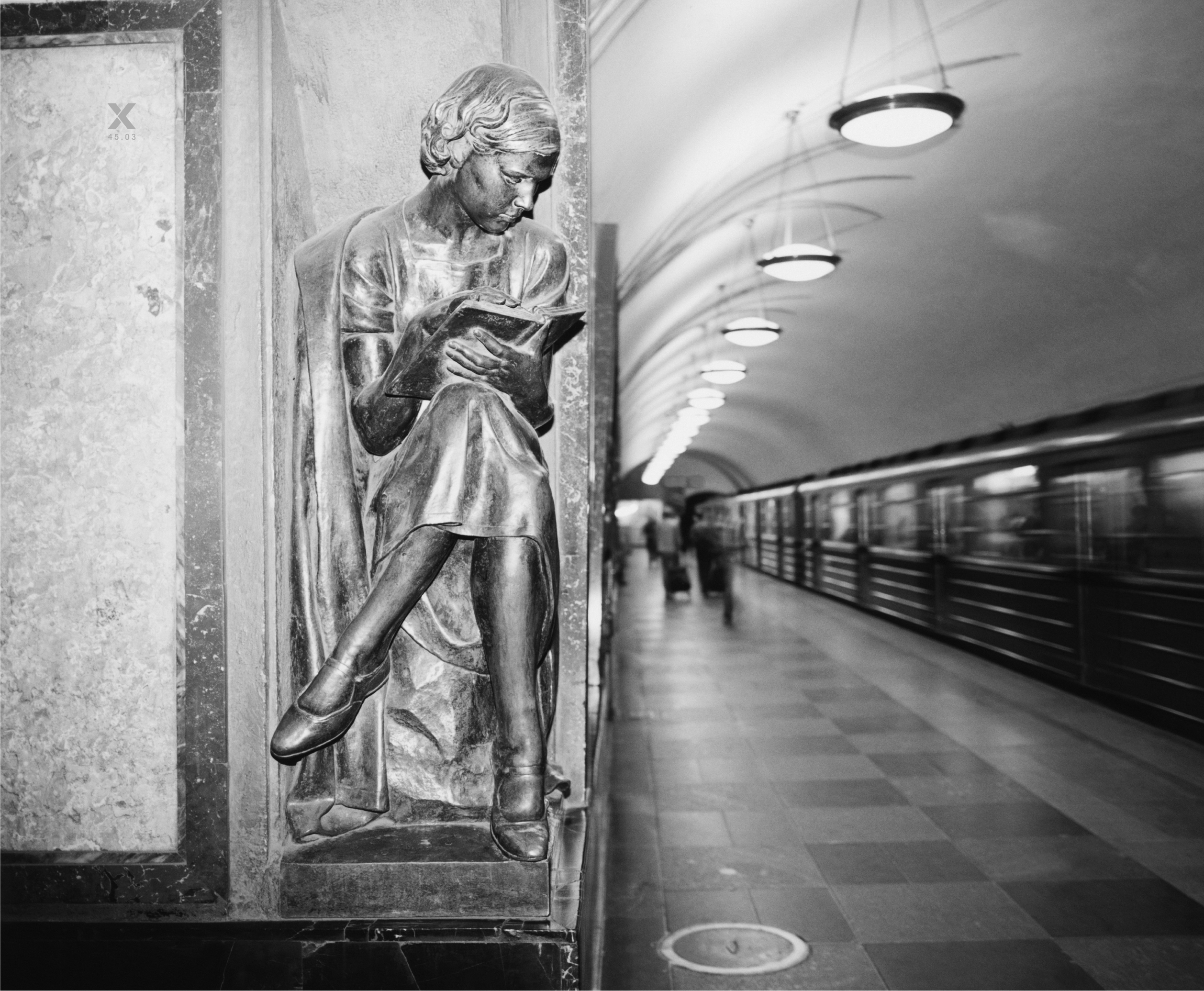
Statue of a girl reading in the Moscow Metro
Credit: Silvia Otte / Getty
As we approach the 100th anniversary of the 1917 revolution, I find the old Russian classics are more relevant to our times. On recently re-reading Notes of a Stranger by Nikolai Leskov, written nearly 150 years ago, I was surprised to find it related to current realities much more than any recent prizewinner. Leskov dares to tackle corruption in society and even in the Orthodox church – an issue that is extremely acute in today’s Russia. Modern writers who do the same risk rejection from the establishment.
But does this mean the great Russian literature is becoming a kind of “glass bead game”, an elitist priesthood? Should we expect a backlash from younger writers and readers? Russian poetry, for instance, has moved on. The coded “meta-metaphoric” poetry of the late Soviet period has already been replaced by a fresh, more direct new wave.
Take one of the leading literary figures of Russia, Dmitry Bykov, whose project Citizen Poet was extremely topical and very successful. It saw actors reciting Bykov’s satirical verses about Russian politics and society. First broadcast online in 2011, via the Dozhd (Rain) channel, it later moved to Echo of Moscow radio station. Bykov’s journalism is similarly direct in style. Yet his novels remain rather enigmatic and symbolic.
For the rest of Russian literature to move forward, it needs to expand beyond Moscow and St Petersburg. It needs an influx of “other” voices, from the provinces – especially from the ethnically diverse ones. It could benefit from the same expansion as, say, postcolonial Britain, where literature was enriched by the likes of VS Naipaul, Derek Walcott, Salman Rushdie, Chinua Achebe and Ngũgĩ wa Thiong’o.
This is happening in Russian literature, but slowly. Different perspectives are coming from Alisa Ganieva from Dagestan, Guzel Yakhina from Tatarstan, Suhbat Aflatuni from Uzbekistan, and Russian writers with experience of living on the fringes of Russia, such as Alexey Slapovsky, Roman Senchin and Alexander Terekhov. Contemporary Russia’s great narrative is the search for its identity, a new place in the world after the collapse of the Soviet Union, and those writers are better placed to address that.
Much of my criticism of modern Russian literature is true of the Uzbek contemporary literature as well. Authors considered the “best” of modern Uzbek writers by the country’s literary critics are those who are writing pseudo-Sufi parables. These are oblique tales, the sort that use a fable about a goldfish in a tank in order to criticise the social passivity of people.
Those who dare to write about the horrid conditions of life in modern-day Uzbekistan, about the millions who are migrating to Russia and other places to make a living, about the thousands upon thousands being arrested and tortured for their beliefs, about the prostitute girls and destitute boys leaving schools uneducated: they end up either in prison or in a mental institution. And this is not a metaphor, but the grim reality, which people like Mamadali Makhmudov, Yusuf Juma, Muhammad Bekjan, Dilmurad Sayid, Diloram Iskhakova, Mutabar Tadjibayeva, Salomat Vafo and many others have faced.
When I was young, there was a game that children used to play. You would walk from a distance of 10 steps away towards a small box of matches and try to flick it with a finger, but delibrately miss it, nine times in a row. The 10th time you would ask another person to try to flick the box, but against all odds he or she would usually miss it too. This innocent game comes to my mind as I think about the future of Uzbek literature. As the experience of Russia demonstrates, even when given the liberty to write, many people carry on with their myths and parables.
I can’t resist a parable myself. This one is about an old folk hero, Hodja Nasreddin, who was sometimes simple, sometimes wise.
“Hodja, last night I was passing by your house and I heard a lot of commotion. What was that all racket?”
“Nothing serious. My wife threw my coat down the stairs.”
“Hodja, how could a coat falling down the stairs make that much noise?”
“At the time, I happened to be in it!”
Unless you fill the empty coat of metaphors and parables with something substantial, it seems that there’s no noise …